Skip to content
DevMeme
4938 of 7435
Rockstar Games Ships a Cracked Version of Their Own Game on Steam
GameDev Post #5405, on Sep 7, 2023 in TG

Rockstar Games Ships a Cracked Version of Their Own Game on Steam

Why is this GameDev meme funny?

Level 1: Hidden Pirate Flag

Imagine you bought a fancy toy from a big store, and when you open it up, you find a little pirate flag hidden inside. That’d be pretty surprising, right? It’s like the toy makers ran out of parts and secretly borrowed from crafty pirates to complete your toy. In this meme’s story, a big game company sold a game that secretly had a pirate’s mark left inside its code – kind of like a teacher accidentally handing out homework answers that a known cheater wrote (with the cheater’s name still on it!). It’s funny and a bit shocking because the people who are supposed to play by the rules ended up using the pirates’ shortcut, and they didn’t even erase the pirates’ signature. It’s a moment of “Oops, caught red-handed!” that anyone can laugh at, because even the “good guys” accidentally left the bad guy’s sticker on their product.

Level 2: Hidden in Plain Bytes

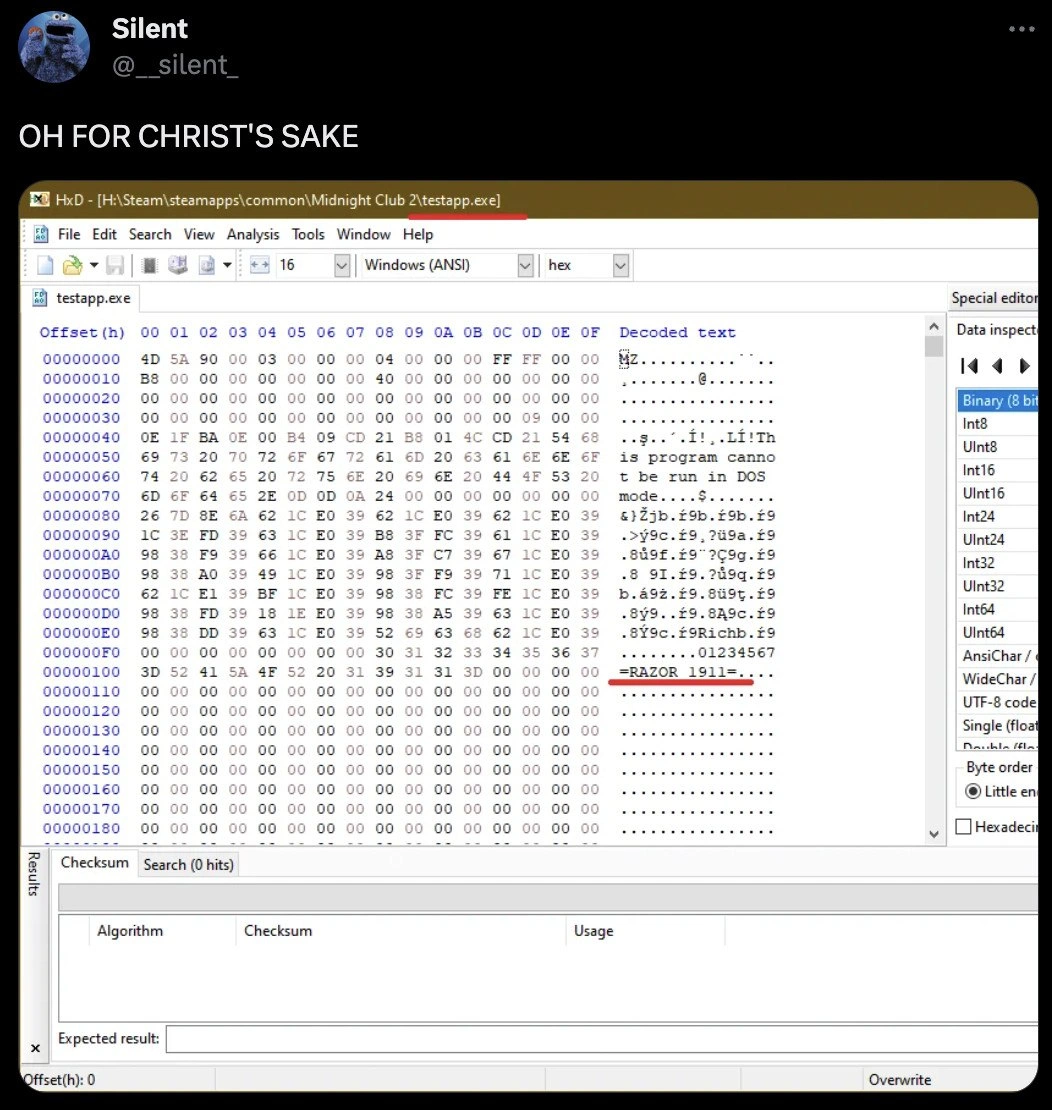
Let’s break down what’s going on here in simpler terms. The image shows a tool called a hex editor (HxD) opened on the game’s executable file (testapp.exe). A hex editor lets you see the raw bytes that make up a file. Normally when you run a program, you never see this garble of numbers – but underneath, everything is stored as bytes (numbers 0-255). In a hex editor, those bytes are shown in hexadecimal (base-16) form, which is a convenient way to represent binary data. The left column in the screenshot is an offset (memory address within the file), the middle is the actual byte values (in hex), and the right column is those bytes interpreted as text (ASCII characters) if they correspond to printable characters. Most of the time, an executable’s bytes look like nonsense (random letters, symbols, or just dots for unprintable codes), because it’s machine code – instructions for the computer, not humans. But occasionally, you’ll spot actual readable words.

In this meme, the person scrolling through the file noticed two big things in the text column: one is the phrase “This program cannot be run in DOS mode.” and the other is the string “–RAZOR 1911–”. The first phrase is a normal part of every Windows program file. It’s a decades-old legacy message from the DOS era that’s kept in the file for compatibility. Think of it like a note saying “hey, you’re not supposed to run this on really old computers.” Every .exe has it, so seeing that in the hex dump was expected.

The “RAZOR 1911” part, on the other hand, is definitely not standard – it’s basically a name tag left by a group of software crackers. Razor 1911 is the name of a famous group in the “warez” or game cracking scene. These are folks who specialize in removing copy protection from games and software (often so they can be pirated). They sometimes embed their group’s name as a signature inside the cracked program, kind of like a graffiti tag or a watermark, to take credit for their work. It’s usually innocuous text tucked away where normal users won’t see it (you’d have to open the file in a tool like this to notice). So when the developer in the meme saw “Razor 1911” in the Midnight Club 2 executable, alarm bells rang – it meant the game’s EXE wasn’t the original file from Rockstar at all, but one that had been modified by this piracy group.

Why would that happen? Well, Midnight Club 2 is an old game that likely had a CD-check or some form of DRM (Digital Rights Management) that requires the original disc or a valid license to play. When re-releasing it on Steam, the publishers might have had trouble getting that old DRM to work on modern systems (or maybe they lost the source code to easily disable it). So instead of patching the game themselves, someone took a shortcut by using a cracked executable – basically the version that Razor 1911 had already altered years ago to remove the CD requirement. It’s a bit like if you lost the key to a door and instead of changing the lock properly, you just use the copy of the key that a burglar made. Sure, it opens the door, but it’s not the “official” way.

For a junior developer or just a tech-savvy gamer, this is wild to discover. It’s one thing to hear about game cracks in shady corners of the internet, and another to find evidence of one inside a game you bought legitimately on Steam. The tweet’s author exclaiming “OH FOR CHRIST’S SAKE” is basically saying, “I can’t believe a reputable company actually shipped something this unprofessional.” It’s a mix of amusement and disbelief. In the world of software development, this is quite embarrassing for the publisher. They essentially got caught using a debugging/cracking shortcut that we’d warn any newbie programmer against. It’s also a little funny because it shows even big companies sometimes fudge things in a very ad-hoc way.

Let’s decode a few terms here:

  • ReverseEngineering – this is the practice of taking finished software and figuring out how it works (or how it was made) by disassembling or inspecting it, often down to the binary level. In the meme, the person is reverse-engineering in a light way by peeking at the file’s contents for clues.
  • Cracked executable – a program that has been modified to remove protections or limitations. In gaming, a “crack” often lets you play without paying or without the original CD. Here it means the game’s EXE was altered by Razor 1911 to bypass the original copy protection.
  • Warez (pirated software) – slang for illegally distributed software. Groups like Razor 1911 are part of the “warez scene” that release these cracked versions.
  • HxD – the specific hex editor being used. It’s a tool that anyone (even you as a curious junior dev) can download to inspect files at the byte level. It’s often used for low-level debugging, manual file corruption repair, or yes, reverse engineering.

So in summary: The developer opened the game’s file in HxD and found the literal text “Razor 1911” inside. This implies Rockstar’s Steam release of the game wasn’t using a clean original file, but one that had been tampered with by a known cracking group. It’s like finding an unexpected Easter egg, except it reveals a possibly shady development shortcut. For those of us in development, it’s equal parts hilarious and mortifying to see a big company do this. For gamers, it’s a “lol wow” moment – the company that doesn’t want you pirating games ended up shipping a pirated component themselves!

Level 3: Officially Unauthorized

It’s not every day you catch a AAA game studio accidentally shipping a pirated crack as part of their official product – but here we are. The meme highlights a cringe-inducing irony well known among veteran developers: sometimes even big companies take questionable shortcuts. Midnight Club 2 is an older game (circa 2003), originally protected by disc-based DRM. Fast-forward to the Steam era – nobody wants to deal with old CD checks or defunct DRM servers. So what’s a quick and dirty solution? Grab the community’s already-cracked EXE that removes those checks. Voilà – no need to write new code or negotiate with the DRM vendor. Rockstar Games (or whoever they outsourced the re-release to) basically said, “If you can’t beat ’em, join ’em (and ship ’em on Steam).” They likely assumed no one would ever notice. But developers are a curious bunch – especially those into reverse engineering and game modding. One such dev (Twitter user Silent who posted “OH FOR CHRIST’S SAKE”) peeked into the game’s files with HxD and immediately recognized the hallmark of a warez release. The result: a mix of horror and laughter across the industry.

Why is this so funny (and slightly horrifying) to us in tech? Because it’s a classic case of the pirates beating the creators at their own game, and the creators secretly waving the white flag. Imagine the meetings that might have led to this: “We lost the source code signing keys… The old SecuROM driver won’t work on Windows 10… Just download a no-CD crack from the internet, nobody will know.” It’s an open secret that for some abandoned games, publishers have “borrowed” fan-made patches or cracks to make them work on modern platforms. But to actually leave the infamous Razor 1911 name inside the code is next-level sloppy (or brazen). It’s the kind of thing a cynical old engineer chuckles at while muttering “typical.”

There’s also a shared nostalgia here. Razor 1911 is a legendary name in the game cracking scene – around since the ’90s, synonymous with PC gaming piracy. Seeing their tag pop up in an official Steam install is surreal, like finding a notorious hacker’s graffiti on the wall inside a Microsoft office. It triggers that senior-dev memory bank: “Hey, I remember swapping warez on 3.5″ floppies with that group’s cracks!” The humor partly comes from gaming culture too. We’ve witnessed decades of cat-and-mouse between game studios implementing DRM and groups like Razor 1911 tearing it down. To find out Rockstar (makers of GTA, no less) essentially shipped a Razor-cracked copy of Midnight Club 2 is the ultimate “if you can’t fix it, just copy the guy who did” moment.

From a troubleshooting perspective, this scenario also underscores an unspoken truth: many “legacy” problems in software (like outdated copy-protection) get solved with less-than-elegant hacks behind the scenes. Seasoned developers have all inherited some unexpected release artifacts or weird bandaids in production code – though usually not as spicy as literally including a pirate release. It’s funny because it validates a cynical view: under the polished surface of software, there might be all sorts of duct tape… even tape borrowed from pirates. This meme’s punchline, Rockstar shipped a cracked game copy on Steam, perfectly captures that dark humor. It’s a facepalm for the publisher, and a hearty laugh for every dev who’s been around the block, thinking “I’ve seen it all now.”

Let’s not forget the security eyebrow-raise here: using a crack from the internet in an official product is like a bank using a lock picked by a burglar because the janitor lost the keys. 😅 It’s both absurd and oddly practical. The #GameDev folks on Twitter ate it up because it highlights how even large studios sometimes cut corners we’d only joke about. Remember the unwritten rule “never deploy unvetted code to production”? Well, this is that rule being dunked on. The lack of due diligence – not even scrubbing out the RAZOR 1911 text – gave the game away (pun intended). In short, the meme resonates on multiple levels: the technical WTF, the industry in-joke, and the schadenfreude of seeing a big company caught red-handed using the very hack they’d publicly condemn.

Level 4: Scene in the Machine

At the binary level, a Windows Portable Executable (PE) file is full of hidden stories. The HxD hex editor screenshot reveals the very start of the game’s testapp.exe in raw bytes. Notice the file begins with 4D 5A (MZ in text) – that’s the ancient DOS MZ header from the days of MS-DOS. Every modern Windows EXE still carries this legacy baggage: a tiny DOS stub program. Its job? If you somehow run the EXE in DOS, it prints the message “This program cannot be run in DOS mode.” You can actually see that entire ASCII string embedded in the middle column of the hex view. Here, it’s a telltale landmark in the sea of bytes: a human-readable sentence amid chaos. Immediately after that stub, the real Windows PE header begins (you’d find the bytes 50 45 00 00 or "PE\0\0" marking its start, not shown in the cropped image). But the real shocker lies just a bit further down: the ASCII text –RAZOR 1911– underlined in red. In a normal game executable, that warez signature has no legitimate reason to be there. It’s as out of place as graffiti on a bank vault – clearly added by someone reverse-engineering the binary.

From a low-level perspective, seeing --RAZOR 1911-- in the bytes is like finding a hacker’s fingerprint inside the code. The crackers from Razor 1911 likely injected their tag into an unused portion of the file – possibly right in that DOS stub or padding space where it wouldn’t affect the game’s functionality. The red underline in HxD indicates the user probably searched for the string "RAZOR" and the editor highlighted the match. Hex editors allow such direct pattern searches, which reverse engineers use to hunt for known markers (just like anti-virus scanners search for virus signature bytes). Here it paid off spectacularly. The presence of the Razor 1911 tag means the executable wasn’t compiled fresh from Rockstar’s source code – it was byte-for-byte identical with a cracked release that the Razor 1911 group distributed. In other words, the official game EXE on Steam is literally the one that pirates modified years ago.

Technically, this implies that the game’s copy-protection was stripped out by Razor 1911’s patch. These cracking groups often alter a few bytes or instructions in the binary to bypass DRM checks. For example, a common crack for a CD-based game might change a conditional jump in assembly into a couple of NOP instructions (0x90 bytes) to skip the “please insert CD” error. In assembly, it could look like this:

; Original DRM check (simplified example)
MOV EAX, [licenseValid]   ; load license flag
CMP EAX, 1                ; compare to 1 (valid license?)
JNZ  no_license           ; if not valid, jump to failure routine
... 
; (game continues normally if jump not taken)
no_license:
    CALL ShowInsertCDDialog
    JMP ExitGame

; Cracked version patch
CMP EAX, 1
NOP                       ; remove the jump by replacing JNZ with NOPs
NOP                       ; second NOP for the two-byte JNZ instruction
; Now even if licenseValid is 0, it falls through as if check passed

In the hex view, these kinds of edits show up as runs of 90 90 90 ... (the opcode for NOP), effectively neutering the original DRM code. In fact, looking at the screenshot’s hex bytes around the DOS stub, you can spot sequences of 90 (highlighted as .. dots in the ASCII panel) which is a strong hint of padding or patched-over code. It’s likely the crack replaced a chunk of the copy-protection routine with do-nothing instructions, and left their calling card in the file as a flex. Razor 1911, being one of the oldest groups in the cracking scene (their name even harkens back to the demoscene/BBS era), often include such textual watermarks. It’s their way of saying “we were here” in the code. The irony is delicious: the only reason that tag is present is because the scene group deliberately inserted it when creating a cracked executable – never expecting it to one day ship on a legitimate platform!

From a binary inspection standpoint, this discovery is equal parts hilarious and technically intriguing. It means whoever packaged Midnight Club 2 for Steam possibly grabbed the first readily available “No-CD” patched EXE (likely Razor 1911’s crack) to avoid dealing with the game’s old SecuROM/SafeDisc protection. The underlined RAZOR 1911 text is definitive proof – a bit like finding a specific byte pattern or hash that matches a known warez release. Indeed, tools like strings (which extracts all printable strings from binary data) would quickly reveal this Easter egg too. We basically have a warez group’s tag cohabiting with Rockstar’s code. For seasoned reversers, this is a wild find: official software containing the literal mark of a scene crack, hiding in plain sight at the file’s lowest levels.

Description

A screenshot from a tweet by the user 'Silent' (@__silent_) exclaiming, 'OH FOR CHRIST'S SAKE'. The image displays a hex editor program, HxD, showing the binary content of an executable file named 'testapp.exe'. The file path, visible at the top, indicates it's from the Steam directory for the game 'Midnight Club 2'. The hex editor shows rows of hexadecimal values on the left and their decoded text representation on the right. A specific string in the decoded text, '-=RAZOR 1911=-', is highlighted with a red underline. This meme documents a real-world blunder where a game developer, Rockstar, accidentally shipped a version of their game on the official Steam platform that had been cracked by the famous warez group Razor 1911. The humor lies in the profound irony and the failure of the internal build and release processes that allowed a pirated copy to become the official distributed version
Comments

21
Anonymous ★ Top Pick I guess their CI/CD pipeline has a secret step: 'if build fails, download a working copy from The Pirate Bay and ship it'
  1. Anonymous ★ Top Pick

    I guess their CI/CD pipeline has a secret step: 'if build fails, download a working copy from The Pirate Bay and ship it'

  2. Anonymous

    Their SBOM now lists DirectX, OpenAL, and Razor 1911 - because nothing says “enterprise-grade CI/CD” like cargo-culting the warez scene straight into prod

  3. Anonymous

    Finding Razor 1911 in production code is like discovering your senior architect still has their Napster playlist backed up on a RAID array - technically impressive, legally questionable, and a nostalgic reminder that some developers peaked when compiling meant watching ASCII art scroll by

  4. Anonymous

    When your game's executable contains a RAZOR 1911 signature and you realize your 'legitimate Steam purchase' has more history than your git repository. Nothing says 'production-ready' quite like finding warez scene group artifacts in your binary - at least the DOS stub is honest about its inability to run in DOS mode, unlike your sprint estimates

  5. Anonymous

    The commit message that bypassed review - immortalized in strings.exe for every postmortem debugger

  6. Anonymous

    If your Steam build’s PE still contains “RAZOR 1911”, your SBOM is basically a confession and Legal just joined your on‑call rotation

  7. Anonymous

    SBOM said “no third‑party binaries”; the hex dump replied “ - RAZOR 1911 - ”. SLSA level: YOLO

  8. @tiny_coin 2y

    Not the first time. It's easier that way than delete securom themself

  9. @anarchist47 2y

    Same was with manhunt and max payne

  10. @Vanilla_Danette 2y

    Oh ma gawd

  11. @AlexAparnev 2y

    I hope they paid royalties to the author of the crack😂

    1. @ZgGPuo8dZef58K6hxxGVj3Z2 2y

      💀😂

  12. Deleted Account 2y

    What’s razor 1911?

    1. Deleted Account 2y

      Joe

      1. Deleted Account 2y

        The one in the ma accident?

      2. @BenKillsYouu 2y

        Jews*

    2. @ZgGPuo8dZef58K6hxxGVj3Z2 2y

      Cracking teams tend to leave their signature (not digital signature just their name) in files they have cracked

      1. Deleted Account 2y

        Oh, thanks!

    3. dev_meme 2y

      Like one of or most famous cracking team in the world? 😄

      1. Deleted Account 2y

        Different interests different worlds, I’m not a part of hacking community

  13. @doodguy1991 2y

    When I pirate a Rockstar game I get a letter sent to my ISP. But when THEY pirate a Rockstar game it's ok?!?!

Use J and K for navigation