The Five Stages of Debugging a COBOL Application
Why is this Bugs meme funny?
Level 1: When Your Toy Won’t Work
Imagine you have a favorite toy that suddenly stops working. Maybe it’s a cool robotic toy that isn’t lighting up anymore. At first, you might think, “No, it’s fine, I must be doing something wrong.” So you keep pressing the on-switch again and again, convinced that eventually it will just start (that’s denial, not accepting that the toy is broken). When nothing changes, you get angry. You might yell at the toy, call it a silly or mean name, or even hit it lightly, like “Bad toy! Work now!” You know the toy isn’t alive or listening, but you’re just so frustrated that you take it out on the toy. After anger, you try to make a bargain: you plead with the toy, even though it can’t hear you. You might say, “Please, please work just this once! If you do, I promise I’ll take super good care of you – I’ll clean you up and give you fresh batteries every day!” You’re basically offering a deal to the toy, hoping somehow that will make it start working. Of course, it doesn’t, because it’s just a toy. When that fails too, you feel sad and defeated. You might even cry a little because it’s so frustrating and you really wanted your toy to work (that’s the depression stage – feeling very down). Finally, after you’ve gone through all those feelings, you accept what happened: you say, “Okay, maybe this toy is just broken for real, or maybe it was a mistake to try to use this old toy.” You come to terms with the reality that the toy isn’t working, and you start thinking of what to do next (maybe ask an adult for help or consider playing with something else).
This is just like what the developer in the meme went through with their computer program. They treated the broken program kind of like you treated the broken toy – first refusing to believe it’s broken, then getting mad at it, then begging it, feeling sad, and finally accepting the truth. It’s funny because we don’t usually think of grown-ups having temper tantrums, but when something important to them (like their work or project) isn’t going right, they can feel a lot of the same emotions. The meme is showing that even big programmers can act a little like upset kids when their computer code doesn’t work! The important part is, in the end, they calm down and figure out what the real problem is (in the meme, the programmer realized maybe using such an old computer language wasn’t a good idea). It teaches a tiny lesson wrapped in a joke: everyone gets frustrated when things don’t work, but eventually we have to accept reality and try a better way.
Level 2: Compile, Crash, Cry
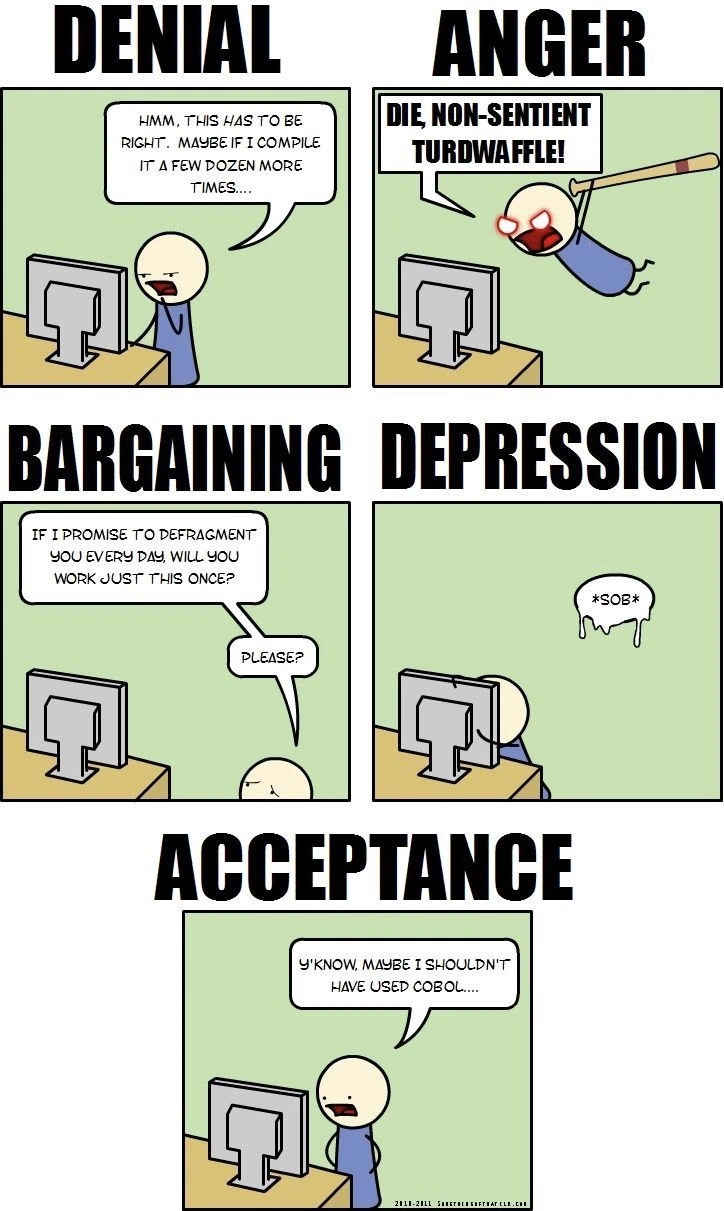
This meme uses the idea of the “five stages of grief” and applies it to a programmer trying to fix a broken program. The five stages – Denial, Anger, Bargaining, Depression, Acceptance – are originally a model to describe how people deal with grief or bad news. Here, it’s a funny coding twist: the “bad news” is a program that just won’t compile (meaning the code has errors and can’t turn into a runnable app). Each panel shows a different emotional stage that a developer might go through when debugging a stubborn error. It’s a very relatable scenario for anyone who has written code and hit a wall of errors. Let’s break down what’s happening in simpler terms:
Denial: In the first panel (labeled “DENIAL”), the developer insists, “Hmm, this has to be right. Maybe if I compile it a few dozen more times....” Here “compile” means running the code through a compiler, which is a tool that translates the programmer’s code into a form the computer can execute. A compiler error is when this translation fails because there’s something wrong in the code (like a syntax error or a missing symbol). In denial, the programmer can’t believe they made a mistake. They’re thinking “No, my code is correct, it must be something else.” So they just hit “compile” over and over without changing anything, hoping the error magically disappears. It’s like pressing the elevator button repeatedly thinking it will make it come faster. 😅 Of course, if nothing in the code changes, the same error will show up every time. This is a debugging mistake beginners often make – refusing to accept the error is real. The meme humorously exaggerates it (compiling “a few dozen more times”) to show how stubborn a person can be when they really don’t want to believe their code is wrong. It captures that initial debugging frustration where you’re almost in shock that your program isn’t working when “it should”.
Anger: In the second panel (“ANGER”), frustration boils over. The developer’s eyes turn red and they literally jump at the computer with a baseball bat, yelling “DIE, NON-SENTIENT TURDWAFFLE!”. This is obviously a comic exaggeration – in real life, programmers (usually) don’t physically attack their computers. But it symbolizes the very real anger and irritation one feels when a bug is just not making sense. Let’s unpack the phrase: “non-sentient” means not capable of feeling or thinking – essentially, not alive. A computer is a machine, so indeed it doesn’t think or feel. “Turdwaffle” is a made-up silly insult (combining “turd,” a rude word for feces, with “waffle,” a kind of breakfast food). It’s not a standard term; it’s used for humor, to show the developer is angrily calling the computer a ridiculous name. The combination is intentionally over-the-top and nonsensical, which makes it funny. So in this anger stage, the programmer is basically screaming gibberish insults at an inanimate object out of sheer rage. This represents how a lot of developers feel internally when debugging: you want to yell at the code or the machine because it’s so frustrating, even though you know it’s not the computer’s fault. The term “non-sentient” even acknowledges “I know you’re just a dumb machine, but I’m still furious!” It’s a rage meltdown. This part of the meme highlights a common developer pain point: sometimes coding problems make you unreasonably angry, and you might vent by swearing at your screen (hopefully without really smashing it!). It’s relatable and funny because most coders have felt that urge to rage at a computer when nothing seems to fix the error.
Bargaining: The third panel is labeled “BARGAINING.” Now our developer has calmed down from anger and is trying a different tactic: pleading with the computer. He says, “If I promise to defragment you every day will you work just this once? Please?” This is the bargaining stage, where the programmer is basically saying, “Okay, I couldn’t force you to work by yelling, so maybe I can negotiate.” It’s treating the computer like a living thing that might respond to promises or bribes. Let’s explain defragment: On older computers, especially with traditional hard drives, defragmentation is a process that reorganizes how files are stored on the disk. Over time, files can get scattered in pieces across the disk (fragmented), which slows things down. Defragmenting puts pieces of files back together, which can make the computer run faster. Back in the day, people might defragment their PCs periodically as routine maintenance. By saying “I’ll defragment you every day,” the developer is basically offering to take extra good care of the computer’s disk health if only the program would run this one time. It’s a pretty absurd bargain – defragging daily is usually unnecessary (even once a week or month was plenty), and it has nothing to do with fixing a compile error. That’s the joke: the programmer is so desperate that they’ll try anything, even something unrelated, as if the computer will say “Deal!” and let the code run. This is anthropomorphizing the computer (treating it like a person who can be persuaded). In real life, during debugging, bargaining might look like: “Computer, I promise I’ll never write bad code again if you just let this compile,” or “I’ll update all my libraries and clean install everything if you just work now.” Of course, the computer can’t be negotiated with – it’s just going to do what it’s told by the code – but this stage reflects the desperate mindset of a programmer who’s run out of ideas. It’s humorous and relatable humor because many of us have felt like we’re begging our code to work at 3 AM, saying silly things out loud like, “Come on, please work, I’ll be so good if you do.” The meme amplifies it by using the ridiculously formal daily defragmentation promise to show how irrational debugging fever can get.
Depression: The fourth panel, “DEPRESSION,” shows the poor developer slumped in defeat, with a big tear and a dripping “SOB”. At this point, all the anger and bargaining failed, and they’re feeling hopeless and sad. This represents the point in troubleshooting where you’re just exhausted and think, “I can’t do this, it’s never going to work.” Debugging can be really emotionally draining, especially when you’ve tried many fixes and nothing works. You start feeling depressed or extremely discouraged. In the meme, the cartoon actually crying is an exaggerated way to show that feeling. While most of us might not literally cry over a bug (though some might if it’s a really bad day!), we do feel that heavy “I give up” sensation. A new developer might start doubting their abilities: “Why can’t I solve this? What’s wrong with me?” A more experienced developer might be thinking: “This is a disaster; maybe this whole approach is doomed.” The humor here is in the exaggeration – seeing a stick figure programmer with a teardrop is a funny image – but it’s funny because it’s true to the feeling. The term “tearful debugging” in the context tags directly points to this kind of moment, where debugging literally brings someone to tears (at least figuratively). It’s a kind of collective programmer joke that something as logical as code can push us to an emotional low point. So, the depression stage is simply showing the sadness and despair that comes when nothing you do fixes the problem and you feel completely stuck.
Acceptance: Finally, the fifth panel is “ACCEPTANCE.” The developer has recomposed themselves (no more tears) and says, “Y’know, maybe I shouldn’t have used COBOL....” This is the moment of acceptance – not necessarily that the program is working (it’s still not), but accepting the reality of the situation. In this case, the programmer realizes the root of the problem might be the choice of programming language or technology. Let’s clarify COBOL: it stands for Common Business-Oriented Language. COBOL is a very old programming language (first developed in the late 1950s and used heavily in the 60s-80s). It’s typically found in legacy systems, like old banking or government software, and is known for being quite verbose and outdated compared to modern languages. Most new developers today never learn COBOL, and it has a reputation for being cumbersome to work with unless you’re an old-school expert. So when the character says “Maybe I shouldn’t have used COBOL,” it implies that using such an old, perhaps ill-suited language for whatever they were trying to do was a mistake from the start. This is a funny twist: instead of finally fixing the bug, the programmer’s acceptance is basically “I chose the wrong tool, and I have to live with that now.” It resonates because sometimes the real lesson in debugging a nightmare issue is “Let’s not do it this way again.” For example, if someone tried to write a modern web app in COBOL (which is extremely uncommon and impractical), they would likely have a horrible time with it. So the meme is poking fun at legacy code and tech decisions. The acceptance stage in a real debugging scenario might be something like, “Okay, this bug is real and I’ll have to log it and fix it properly tomorrow,” or “Maybe this whole module needs rewriting, I accept that quick hacks won’t solve it.” In the meme’s comedic example, it’s accepting blame in a humorous way: the programming language choice was wrong. It also subtly jabs at COBOL as a language – many developers joke about how outdated or difficult COBOL is (even if they haven’t used it, it’s kind of infamous). So ending with “COBOL” ties back into the LegacySystems theme – the cartoon developer essentially admits defeat and acknowledges that using a crusty old language might be the reason they’re in such pain.
Overall, this comic-strip meme is developer humor that’s very relatable to programmers. It shows how troubleshooting a bug isn’t just a straightforward task – it can be an emotional roller coaster, especially when you’re dealing with tricky CompilerErrors or messy LegacyCode. Each stage (denial, anger, bargaining, depression, acceptance) is exaggerated for comedic effect, but each contains a kernel of truth about coding frustration:
- At first, you don’t believe the error (because you thought your code was perfect).
- Then you get mad at the computer or the code.
- Then you start doing irrational things or making wild promises to somehow “trick” it into working.
- Then you feel awful and defeated when it still doesn’t work.
- Finally, you either find the real solution or at least accept what the problem is (even if that means acknowledging a bigger issue like “I shouldn’t have done it this way”).
For a junior developer or someone new to coding, the meme is a playful way to learn that these emotional phases are normal – everyone goes through them, even experienced devs. It also indirectly highlights some technical concepts: the idea of compiling code, what a compiler error is, what defragmenting a disk means, and even a bit about COBOL and legacy systems. And crucially, it’s saying: “Don’t worry, you’re not the only one who has felt like screaming at your code or bargaining with your computer. It’s a shared experience and we can all laugh about it.” This relatable humor turns a painful experience (being stuck on a bug) into something we can smile at, which is why it’s popular in developer circles.
Level 3: Legacy Code Lament
When a developer hits a stubborn bug or endless compiler errors, it can feel like a full-blown grief cycle. This meme perfectly captures the five stages of debugging grief in a legacy codebase. It’s a tongue-in-cheek parallel to the Kübler-Ross five stages of grief, but for coding: from confident compile denial all the way to bitter COBOL acceptance. Seasoned engineers know these stages all too well:
Denial: The coder refuses to believe their logic is wrong. In the first panel, our intrepid dev squints at the monitor insisting, “This has to be right. Maybe if I compile it a few dozen more times...” We’ve all been there, rerunning the build hoping for a miraculous pass. It’s basically a compile-retry loop driven by pure stubborn hope. Deep down, a veteran knows that recompiling unchanged code is futile – the error isn’t just going to evaporate on the 37th attempt. But in the denial stage, logic takes a backseat. Maybe the compiler misread my code? (Spoiler: it didn’t.) Perhaps the 12th compile will magically succeed? It’s the classic first reaction: my code is fine, the tools must be wrong. This is debugging frustration at its purest – a refusal to accept that the bug is real. In a darkly comic way, it mocks that newbie instinct to treat compilers like flaky slot machines: if I pull the lever enough times, I’ll hit jackpot and the code will compile. Experienced devs chuckle because they remember those days (or those 3 AM deployments) when denial had them chasing a non-existent fluke instead of reading the actual error message.
Anger: Eventually reality breaks denial, and frustration flares into rage. Our stick-figure hero literally goes ballistic: eyes glowing red, swinging a baseball bat at the unyielding monitor. He’s screaming, “DIE, NON-SENTIENT TURDWAFFLE!” in a glorious outburst of programmer profanity. This panel is hilarious and painfully relatable – it exaggerates the developer pain points we usually internalize. In real life, you (hopefully) don’t beat your PC with a bat, but you do feel the urge. Seasoned coders have uttered far worse than “turdwaffle” at a screen of uncompileable code. The term “non-sentient turdwaffle” is a comedic gem: part insult, part acknowledgment that the computer isn’t even alive to blame. The dev knows the machine isn’t conscious (non-sentient), yet he’s personifying it as a malicious entity, a “turdwaffle,” to vent his fury. This kind of creative cursing and anthropomorphizing of hardware is a rite of passage during late-night debugging sessions. The anger stage often includes slamming the keyboard, shouting at the IDE, or sacrilegiously muttering “Stupid compiler, your mother was a vacuum tube!”. It’s an emotional segfault moment – the code’s not broken, you are. Every senior engineer recognizes this fiery phase of the debugging grief cycle: when you’ve tried everything sensible and now you’re rage-flailing. The humor here is how truth-based it is: after too many failed compiles, even the calmest programmer can turn into a monitor-smashing Hulk, at least in their fantasies. Anger is raw, unfiltered developer frustration – and this meme isn’t afraid to show it with cartoon violence and a very colorful insult for the ages.
Bargaining: After blowing off steam, desperation sets in. The developer, now slumped with only eyes peeking over the desk, tries to bargain with the computer. “If I promise to defragment you every day, will you work just this once? Please?” he pleads. This is where the meme’s dark humor really shines. In real debugging, bargaining might mean running some legacy system cleanup, rolling back a change, or pleading, “Just pass the tests this time, and I swear I’ll refactor later.” Here it’s exaggerated to performing daily disk defragmentation as an offering. The absurdity is gold: defragmenting is an old-school maintenance chore (reorganizing disk data for efficiency) that has zero to do with fixing a code bug. It’s basically a techie sacrifice to appease the computer gods. 😂 This developer is so desperate, he’s offering the machine a daily ritual of disk tidying in exchange for one successful run. Seasoned devs recognize the satire: we’ve all attempted some ritualistic workaround or clung to hope that an unrelated action might coax the code into working. It’s like trying to appease a printer by patting it – totally illogical, yet in the debugging grief cycle, logic left the building back at denial. At this stage, the meme exposes a truth about human nature in IT: when faced with a baffling bug, even logical professionals get superstitious. We’ll clear caches, reboot the system again, run a clean build, whisper a prayer to Linus Torvalds – anything for a bit of mercy. The bargaining stage often involves making promises to ourselves too (“I’ll never write sloppy code again if this just works now!”). It’s funny because it’s true. By lampooning a developer offering daily defrags (a hilarious outdated chore, invoking LegacySystems vibes), the meme highlights how troubleshooting can devolve into bedazzled desperation. A senior dev chuckles because they recall times they’ve bargained with a build system or CI/CD pipeline: “please deploy without errors and I swear I’ll automate tests next sprint.” Of course, the computer doesn’t strike deals – but in the throes of debugging despair, we momentarily act like it might.
Depression: The fourth panel shows pure dejection. The developer is slumped in defeat, a big cartoon tear blob labeled “SOB” hanging in the air. This is the depression stage of debugging grief – when it feels like you’ll never fix this bug and you start questioning all your life choices. In the meme it’s a literal crying-over-keyboard moment. While played for laughs here, it hits a nerve: every programmer has experienced that heavy, hopeless sigh after hours of fruitless troubleshooting. Maybe you’ve stared at a legacy codebase so convoluted it defies logic, or a compiler error message so cryptic you’re ready to cry. This panel says: yep, been there, done that. Seasoned devs know the late-night blues of debugging, when coding frustration turns into self-doubt. “Maybe I’m just not cut out for this,” “Why is this code so cursed?” – those thoughts creep in. The meme exaggerates it to actual tears, which is darkly comedic, but not entirely off-base (I’ve seen developers come perilously close to a tearful debugging meltdown when prod was down at 4 AM). The humor here is equal parts relatability and absurdity: it’s funny to imagine a stick-figure dev literally sobbing, but it’s also uncomfortably real how a stupid bug can ruin your day and morale. In a shared office, this might be when someone finds you with your head on the desk in despair, or calls you out for looking like you need a hug and a coffee. The depression stage in the debugging context underscores that coding isn’t just technical – it’s emotional. And the meme draws that out to an extreme in a way experienced folks immediately get. It’s essentially the “I give up” moment before final relief or breakdown. No solution in sight, confidence shattered, just the bleak acceptance looming... which leads to the final stage.
Acceptance: The last panel delivers the punchline: the developer calmly, almost cheerfully, admits, “Y’know, maybe I shouldn’t have used COBOL...” This is the resolution: acceptance of reality. After all the turmoil, the dev finally identifies a fundamental truth – perhaps the real problem is the choice of language or platform. This is hysterical to seasoned engineers on multiple levels. First, the idea that after all that grief, the takeaway is regret of choosing a legacy language like COBOL. COBOL is an ancient programming language (dating back to 1959) notoriously used in old banking and mainframe systems. Modern devs rarely touch it unless they’re maintaining LegacySystems that nobody dared to rewrite. By saying “I shouldn’t have used COBOL,” the meme taps into a common industry joke: using COBOL (or any outdated tech) can come back to bite you, big time. It’s the final stage of debugging grief – not just accepting the bug, but accepting that your tools or decisions were flawed from the start. Essentially, the dev concedes defeat and is humorously implying, “The code might not be broken; maybe it’s me for picking this cursed language.” For veteran developers, this hits home. How many times have we concluded a disastrous bug hunt by deciding “We should rewrite this in a better language” or “Let’s never use that library again”? Acceptance often means learning a lesson: in this case, acknowledging COBOL was a misguided choice. The joke’s on COBOL, too – a language synonymous with legacy code and tech debt. (COBOL’s not evil, but it’s decades old and can be incredibly verbose and finicky, especially if you’re used to modern languages. It’s an easy scapegoat for programmer pain.) The acceptance phase in the meme brings catharsis: after all those emotional swings, the developer isn’t screaming or crying anymore. They’ve reached a sort of Zen: the bug won, and I’ll just live with the consequences. That resigned humor resonates with weary IT veterans – sometimes you just have to laugh and say “welp, lesson learned.”
In the end, this comic nails developer humor by showing that debugging a tough problem can make you crazy enough to treat your computer like a living being and go through all the emotional stages. It’s funny because it’s true – from the compile-retry loop of denial, through the rage and ridiculous bargains, to the final facepalm realization that maybe the entire approach (or language choice) was wrong. The relatable humor lies in exaggerating what every coder has felt at some point. We normally don’t say it out loud, but this meme lays it bare: coding can be an emotional rollercoaster. For anyone who’s wrestled with legacy code or a maddening bug, the “Five Stages of Debugging Grief” is both hilarious and comfortingly familiar. It’s a reminder that you’re not alone in feeling like your sanity is slipping after the 50th failed compile – and that sometimes the only path to peace is accepting the ugly reality (maybe next time, don’t use a 60-year-old language for a new project!).
Description
A five-panel comic strip illustrating the five stages of grief (Denial, Anger, Bargaining, Depression, Acceptance) as experienced by a software developer. The developer first tries recompiling repeatedly ('HMM, THIS HAS TO BE RIGHT. MAYBE IF I COMPILE IT A FEW DOZEN MORE TIMES...'), then gets violently angry at the computer ('DIE, NON-SENTIENT TURDWAFFLE!'), tries to bargain with the inanimate machine ('IF I PROMISE TO DEFRAGMENT YOU EVERY DAY, WILL YOU WORK JUST THIS ONCE? PLEASE?'), despairs ('*SOB*'), and finally comes to the resigned conclusion that the problem was choosing to use the COBOL programming language ('Y'KNOW, MAYBE I SHOULDN'T HAVE USED COBOL....'). This meme captures the emotional rollercoaster of debugging, especially when working with legacy systems. For senior developers, it's a relatable take on the pain of maintaining old, difficult codebases and the dawning realization that a poor architectural or language choice from the past is the source of present-day suffering
Comments
9Comment deleted
They say the five stages of grief are denial, anger, bargaining, depression, and acceptance. For a legacy COBOL dev, it's denial, anger, bargaining, depression, and finally accepting that the system will outlive you and you are merely its caretaker
Stage six of debugging grief: convincing the CFO that the 12-million-line COBOL monolith is not a “fully depreciated asset,” it’s a high-interest loan from 1974
The real sixth stage of legacy code grief is 'Promotion' - when you become senior enough that maintaining that COBOL system becomes someone else's problem, but you still wake up at 3am remembering that one PERFORM VARYING loop that never quite worked right
The five stages of debugging perfectly mirror the Kübler-Ross grief model because, let's face it, watching your code fail IS a form of loss - specifically, the loss of your sanity, your weekend, and your naive belief that 'it worked on my machine' would be sufficient. The progression from denial ('just one more compile!') to acceptance ('maybe COBOL wasn't the answer') is a rite of passage every senior engineer has experienced, usually around 3 AM when you realize the bug was a single misplaced semicolon... or that your architectural decision from six months ago has finally come home to roost
Turd Waffle: the dependency that turns 'proven in production' into 'proven to cause production issues'
The real sixth stage is “strangler-fig adapter,” where you ship a JSON gateway that spawns JCL to a VSAM-backed COBOL job - and then you own it for the next 12 years
After the tenth recompile and one nostalgic defrag, Acceptance hits: it’s not a bug, it’s COBOL - and the only unit test is tomorrow’s bank statement
Ehmm, ough, yeah, I missed dot here! Success! Comment deleted
y'know, maybe I shouldn't have started coding... Comment deleted