The Escalating War of Bad Code Confessions
Why is this CodeQuality meme funny?
Level 1: The Backwards Bragging Contest
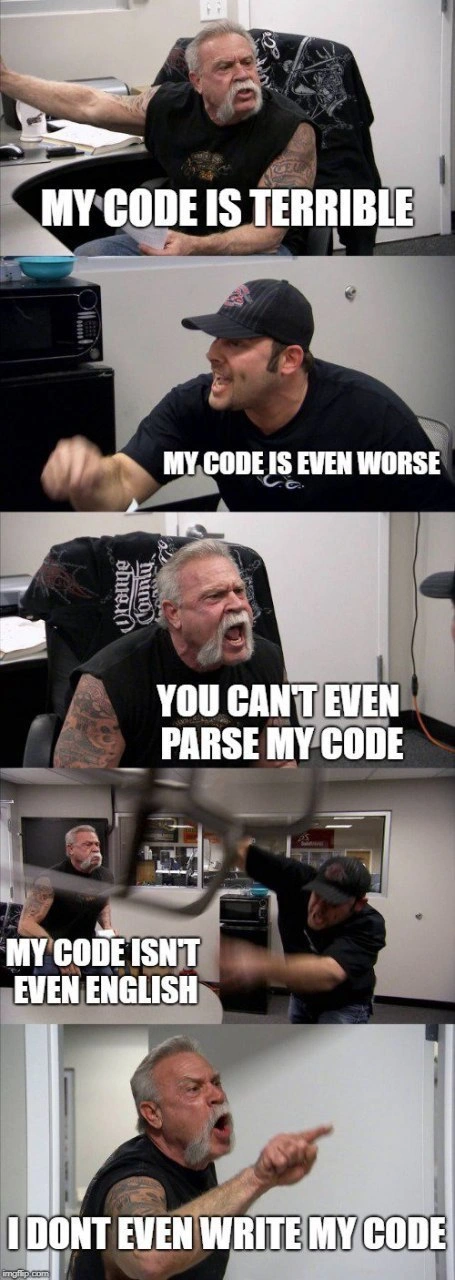
Two grown-ups are having the silliest argument ever: instead of fighting about who's the best at something, they're screaming about who's the worst — like two kids yelling "my room is messier!" "oh yeah? my room is SO messy you can't even find the floor!" "well MY room isn't even a room anymore!" It gets so heated that someone throws a chair. The punchline is the last guy winning the messy-room contest by announcing he doesn't even have a room. You can't lose a contest you never entered — and somehow that's the most impressive move of all.
Level 2: Decoding the Escalation Ladder
A few terms make the panels click. To parse code is what a compiler or interpreter does first: read your text and check it follows the language's grammar, like checking a sentence has a verb. A syntax error means parsing failed — so "you can't even parse my code" claims code so broken the computer rejects it before even trying to run it. Spaghetti code is the classic insult the first two panels imply: tangled logic where everything depends on everything, usually the product of technical debt — shortcuts taken under deadline that compound interest forever.
The last panel describes practices you'll meet early: copy-paste programming (assembling solutions from Stack Overflow answers you don't fully understand) and code generation (tools that write boilerplate for you). Neither is inherently shameful — every working developer does both — which is exactly why the line is funny rather than damning. Your first months in the industry will teach you the cultural rule on display here: when seniors gather and trash their own code, it's not despair, it's hazing-free bonding. Join in, but know that the person laughing loudest about their terrible code is usually the one whose code reviews you want.
Level 3: The Race to the Bottom of the Stack Trace
The American Chopper argument template — Paul Sr. and Paul Jr. screaming across an office, complete with the panel-four chair throw — is the internet's designated format for arguments that escalate while going nowhere. Here it hosts one of developer culture's strangest rituals: competitive self-deprecation. The captions chain a reverse brag: "MY CODE IS TERRIBLE" → "MY CODE IS EVEN WORSE" → "YOU CAN'T EVEN PARSE MY CODE" → "MY CODE ISN'T EVEN ENGLISH" → "I DONT EVEN WRITE MY CODE." Each line one-ups the last in a contest where the prize is owning the most cursed codebase.
What's sociologically sharp is why this contest exists at all. Claiming your code is terrible is a status move with armor built in: it signals you've seen enough good code to judge your own harshly (taste), it preempts criticism (nobody can roast you harder than you roast yourself), and it bonds the room through shared shame — the engineering equivalent of soldiers comparing scars. Imposter syndrome gets laundered into comedy. The inverse is also true and everyone knows it: the developer who says their code is excellent is the one you should audit first.
The escalation itself is technically literate. "You can't even parse my code" is a precise flex — bad code still compiles; unparseable code defeats the parser itself, the compiler stage that turns text into a syntax tree. That's not poor craftsmanship, that's anti-craftsmanship. "My code isn't even English" nods both to identifiers in other human languages (a genuine archaeology problem in inherited codebases — try debugging variables named in transliterated Hungarian) and to esoteric languages like Brainfuck where the source resembles line noise. And the final panel is the kicker that aged into prophecy: "I DONT EVEN WRITE MY CODE." In March 2019 it meant Stack Overflow copy-paste, code generators, and npm install-driven development — shipping a product that is 2% your code and 98% dependencies. Read today, it's the entire AI-assisted era in one shouted sentence. The ultimate victory in the worst-code contest is vacuous truth: zero authored lines, zero authored bugs. The blame lives in the supply chain now.
Description
A five-panel meme using the popular 'American Chopper Argument' format to humorously depict a one-upmanship battle between two developers over who writes worse code. The argument escalates with each panel. It starts with the older man (Paul Teutul Sr.) stating, 'MY CODE IS TERRIBLE.' The younger man (Paul Teutul Jr.) retorts, 'MY CODE IS EVEN WORSE.' The argument intensifies with the father shouting, 'YOU CAN'T EVEN PARSE MY CODE,' followed by the son throwing a chair and yelling, 'MY CODE ISN'T EVEN ENGLISH.' The final punchline comes from the father, pointing aggressively, 'I DONT EVEN WRITE MY CODE.' This meme satirizes developer imposter syndrome, the shared experience of dealing with 'terrible' code, and the modern reality where developers might rely heavily on frameworks, libraries, Stack Overflow, or even AI code generation tools to the point of feeling detached from the code they produce
Comments
8Comment deleted
That last panel is just every senior developer after configuring a webpack plugin and writing three lines of YAML to glue a dozen microservices together
In our last architecture review, the real fight wasn’t over whose code was worse - it was whether the 2,000-line Helm chart that shells out to bash to generate Terraform which writes CloudFormation to spin up a Lambda running eval’d JavaScript should be classified as “code” or modern performance art
The evolution from "I wrote bad code" to "I orchestrate YAML files that generate Terraform that provisions Kubernetes that deploys containers running code written by Copilot" - and somehow we call this progress
The senior move in any 'my code is worse' contest: you can't have bugs in code you never wrote - just dependencies
This perfectly captures the senior engineer's journey: first you admit your code is terrible, then you realize it's so abstracted through metaprogramming and code generation pipelines that even the parser gives up, and finally you achieve enlightenment - your 'code' is just a YAML configuration that generates Terraform that provisions infrastructure that deploys containers running code generated by an LLM. You're not writing code anymore; you're just orchestrating the orchestrators
When a review jumps from bad style to not-a-context-free-language and ends with I don't even write my code, it explains why the AST looks like lorem ipsum with side effects
The four stages of legacy grief: terrible, worse, unparsable, 'git blame: not me'
You know you’re senior when the flex is: my service is 85% YAML, 10% codegen, 5% Bash written by cron - and the only English in the stack is the postmortem