The Unrequested Multi-Lens Smartphone Apocalypse
Why is this IndustryTrends Hype meme funny?
Level 1: The Backpack With Fifteen Zippers
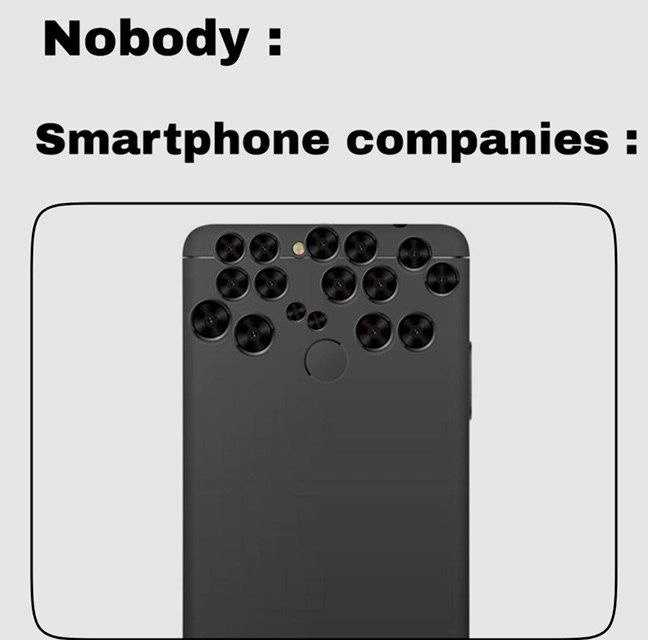
Nobody asked for anything — that's the joke's whole first line, just silence. And then the phone companies burst into the room shouting "WE PUT FIFTEEN CAMERAS ON IT!" It's like a kid asking for a backpack that doesn't rip, and the store proudly unveiling one covered in fifteen zippers instead. More zippers doesn't mean it carries books better; it just looks impressive on the shelf next to the fourteen-zipper backpack. The phone in the picture, with its back full of little camera eyes like a spider's face, is what happens when companies keep answering a question that nobody ever asked.
Level 2: Why Phones Grew Extra Eyes
The real engineering rationale, before satire inflated it: a phone is too thin for a zoom lens that physically moves, so manufacturers add separate fixed cameras for separate jobs — a wide main camera, an ultrawide for landscapes, a telephoto for zoom, maybe a macro or a depth sensor for portrait-mode background blur. Software then blends their outputs, a practice called computational photography: when you pinch-zoom, the phone hands off between lenses and merges data so the transition looks seamless. Two to four cameras genuinely earn their place. The meme's fifteen is the logical conclusion of "if three is marketable, more is more marketable."
A product render like the one in the frame is the polished 3D mock-up companies (and pranksters) circulate before launch — which is why this image was plausible enough to sting. And spec-sheet marketing is the pattern worth internalizing early in your career, because software does it too: dashboards bragging about microservice counts, frameworks bragging about features, resumes bragging about technologies. Whenever a number is easier to grow than the quality it's supposed to represent, someone will grow the number.
Level 3: When the Roadmap Optimizes for Lens Count
The format does half the satire: "Nobody :" — a deliberately empty line representing the complete absence of any request — followed by "Smartphone companies :" and a product render of a dark grey phone whose back is carpeted with roughly fifteen lenses, clustered around the fingerprint sensor and flash like barnacles on a hull. The "Nobody:" template is the internet's cleanest tool for mocking unsolicited behavior, and there are few better targets than the late-2010s camera arms race, when phone marketing collapsed into a single integer that could be incremented each fiscal year.
The render is a parody, but barely. This posted within weeks of the Nokia 9 PureView shipping with five rear cameras arranged in a hexagonal array, and the Light L16 — a real $1,950 camera with sixteen lenses — had already proven someone would actually build this. That's what gives the image its uncanny power: it's satire racing the spec sheet and only narrowly winning. The underlying dynamic is one engineers recognize from every domain, not just hardware. When a product matures and genuine differentiation gets hard (every flagship phone is a glass slab with a good screen), competition migrates to legible metrics — numbers a shelf tag can carry. Megapixels in the 2000s, GHz in the CPU wars, blades on razors, and now lens count. Goodhart's law does the rest: once "number of cameras" becomes the measure of photographic ambition, it ceases to measure photography and starts measuring marketing budget.
The cruel joke understood by anyone near imaging engineering: more lenses past a point delivers diminishing returns while multiplying real costs — calibration between modules, computational photography pipelines that must fuse mismatched sensors, BOM cost, and internal volume stolen from the battery everyone actually begged for. "Nobody:" is literally accurate. The user-research column for "fifteenth camera" was empty; the tickets users did file — headphone jacks, battery life, repairability — were closed as wontfix. It's feature creep as corporate strategy: shipping the askable instead of the asked-for, because a keynote slide can't show you a phone that simply lasts two days.
Description
A meme using the 'Nobody:' format to satirize the smartphone industry. The top text reads 'Nobody:' followed by 'Smartphone companies:'. Below this, enclosed in a rounded rectangle, is an image of the back of a dark grey smartphone. The phone's surface is absurdly covered with at least 15 camera lenses, a flash, and a fingerprint sensor, creating a trypophobia-inducing pattern. The humor critiques the perceived trend of mobile phone manufacturers relentlessly adding more camera lenses as a primary selling point, implying that this is a form of feature creep that consumers are not actually demanding. For senior engineers, this resonates with the concept of over-engineering or adding complex features for marketing purposes rather than genuine user need, a common frustration in software and hardware development

Comments
8Comment deleted
This is the hardware equivalent of a product manager asking for 'just one more tracking script' on the front end. Eventually, the entire thing is just lenses and analytics
That camera bump is basically our production architecture: 18 loosely-coupled lenses, no shared focus plane, yet marketing calls it “microservices for photons.”
Remember when we optimized code for memory constraints? Now we're shipping phones with more cameras than a Hollywood production studio, each running its own ML pipeline, because apparently computational photography means solving P=NP by throwing tensor cores at bokeh effects until the battery thermally throttles
Fifteen cameras, one roadmap: when the OKR is 'lenses shipped', nobody files the ticket for 'photos improved'
This perfectly captures the smartphone industry's approach to innovation: when you can't fundamentally improve the architecture, just add more sensors and call it 'computational photography.' It's the hardware equivalent of microservices - if one camera is good, surely 20 cameras with overlapping responsibilities and complex orchestration logic will solve all our problems. Meanwhile, the actual bottleneck remains the ISP pipeline and the fact that physics still exists, but hey, at least the marketing deck looks impressive
Smartphone companies: we scaled the camera like microservices - 18 lenses, RAFT for focus; CAP still applies, you can have zoom or stability, pick two
We proposed tuning the ISP; PM opted for horizontal scaling - now photons are sharded across 16 sensors and QA’s test matrix looks like a Cartesian product from hell
Hardware's microservices moment: decompose one camera into 25 pods, celebrate the 'scalability,' ignore the observability nightmare