Skip to content
DevMeme
4516 of 7435
Developer claims Meta stock surge as his strongest resume bullet point
Career HR Post #4956, on Oct 27, 2022 in TG

Developer claims Meta stock surge as his strongest resume bullet point

Why is this Career HR meme funny?

Level 1: All Because of Me

Imagine you join a school basketball team, and that year the team wins the championship. Later, you move to a new town, and the very next season your old team starts losing games. You laugh and tell your friends, “See? They only won because of me!” – even though deep down you know the team won thanks to everyone, not just you. It’s a silly, boastful claim, right? That’s exactly what’s going on in this joke. A worker is joking that a huge company became super successful just because he was there, and then it started struggling when he left. Of course, in reality one person isn’t responsible for something so big. But it’s funny when someone pretends it was all because of me, because it’s such an over-the-top way to take credit. It’s like a playful way of bragging and we all laugh because we know they’re just kidding around.

Level 2: Resume vs Reality

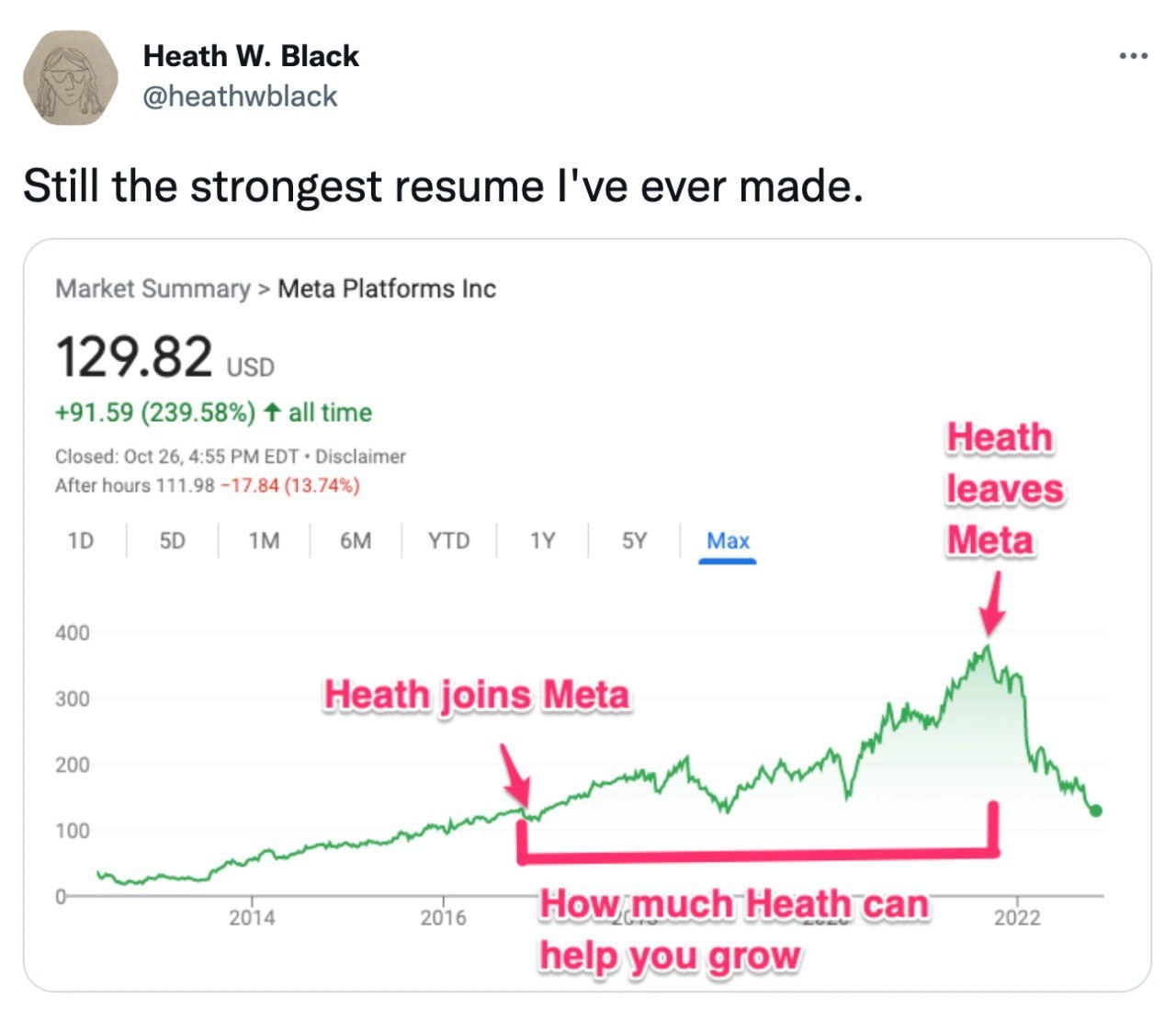
Let’s break down the meme for a less jaded crowd. We have a screenshot of a tweet by Heath W. Black, where he says, "Still the strongest resume I've ever made." The image attached is a stock price chart for Meta Platforms Inc (Meta is the company formerly known as Facebook). This chart shows Meta’s stock price over time (the “Max” range, meaning from its start around 2012 up to 2022). The green line starts near $0 (back when Facebook was young and its stock wasn’t worth much yet), then climbs steadily over the years as the company grew. It peaks sometime after 2021 (the line goes up to its highest point – over $300), and then the line drops sharply by 2022 (meaning Meta’s stock price fell significantly from that peak). The numbers at the top say 129.82 USD which is the current price per share at the time, and +91.59 (239.58%) all time which means the stock increased by $91.59 from its start, a 239.58% rise since the beginning – that’s where the “+239.58%” comes from. After-hours it shows a drop of -13.74%, likely indicating that right after some earnings report or news, the stock was trading lower (this detail sets the scene that the stock had a big fall that day).

Now, the funny part: Heath has added bright pink labels onto this stock chart. There’s an arrow pointing at a point somewhere in the middle of the rising curve labeled "Heath joins Meta", and another arrow at the very peak labeled "Heath leaves Meta." Then along the rising section of the graph, a pink bracket spans from his join point to the peak, labeled "How much Heath can help you grow." Essentially, he’s marked the time he was employed at Meta and is highlighting that the stock went up during that exact period. The tweet caption calls it the strongest résumé he’s ever made – implying that his biggest professional achievement on paper is this graph, which seems to show Meta’s huge market growth while he was there.

This is a form of self-attribution humor: he’s jokingly taking credit for Meta’s success. On a résumé, people often list bullet points that showcase their accomplishments at each job. For example, someone might write, “Improved website performance by 30% leading to increased user engagement,” or “Managed a project that added $5M in annual revenue.” These bullets try to quantify how much impact you had. It’s common in Career HR and tech hiring to focus on outcomes and numbers – it shows you didn’t just sit around; you got results. However, it’s also common to embellish achievements on a resume a bit, meaning you make them sound as impressive as possible. Maybe the whole team or company achieved something, but you word it like you were a driving force.

Heath’s meme is a playful exaggeration of that. Meta’s stock price going up so much was due to many big things: more users joining Facebook/Instagram, growth in online advertising, new products, and sometimes just general market conditions or hype about tech stocks. It wasn’t literally because Heath (an individual developer or manager) joined the company. Likewise, the stock dropping after 2021 was due to factors like market saturation, competition (like TikTok), economic downturn, or Meta’s costly investments in new areas (the Metaverse projects) spooking investors. But Heath is jokingly framing it as “I left the company, and look, the stock tanked – must’ve been because I left!”

For someone newer to the industry, the meme is highlighting how ridiculous it would be to claim personal credit for a company’s stock performance. It’s poking fun at a bit of corporate humor: sometimes people do try to indirectly take credit for big successes in which their role was actually small. There’s even a phrase “resume-padding” – adding extra fluff to your resume to impress recruiters. Here, rather than say a normal line like “During my tenure, company revenue grew 3x,” he literally shows the stock price graph as if that’s his direct accomplishment. It’s a joke, of course – no serious resume has a stock chart with “I joined here” arrows! But it riffs on a truth that being part of a famously successful company looks good on a resume. If you worked at a place during the boom times, you might casually claim, “I was at Meta when it grew to billions in profit,” implying you know how to ride a rocketship.

The categories Career_HR and CorporateCulture are relevant because this meme is about how people present themselves in job-hunting, and the sometimes silly culture of personal branding in tech. IndustryTrends_Hype also fits: big tech stock surges and crashes (hype cycles) were a huge trend, and many folks enjoy dark humor about how those wild swings happen. The context tags like resume_boasting and self_attribution_humor perfectly describe the joke: it’s making fun of bragging on resumes, by absurdly attributing a whole stock price surge to oneself. In short, the meme is a lighthearted way of saying, “I know it’s silly, but I’m going to claim I made Meta’s value explode, just to have the most epic resume bullet ever.” Anyone who’s had to polish up a CV or LinkedIn profile can chuckle at that.

Level 3: Resume-Driven Growth

When a developer jokes that they singlehandedly made Meta’s stock price skyrocket, experienced engineers recognize a classic case of correlation being spun as causation. This meme layers a personal narrative onto a Meta stock chart to parody how tech professionals sometimes inflate their resume achievements. The humor stems from the absurd implication that one engineer joining caused a +239% all-time surge in market value – and that their departure triggered the subsequent plunge. It’s a tongue-in-cheek exaggeration of resume boasting, where team accomplishments or even macroeconomic trends get packaged as personal feats.

In the corporate culture of big tech, there's an ongoing joke about the “10x engineer” – the mythical developer who is ten times more productive. Here we have a 239% engineer, which is even more preposterous. The chart annotations – “Heath joins Meta” at the start of the rally and “Heath leaves Meta” at the peak – frame Heath as the single point of success (and failure) for a trillion-dollar company. Seasoned devs smirk because we’ve all seen colleagues or LinkedIn influencers implicitly claim “I was the secret sauce”. In reality, if a company’s fortunes truly hinged on one coder, that’s a giant single point of failure (or a bus factor of 1, as grim jokers call it). Meta Platforms Inc has tens of thousands of employees, massive product lines, and external market forces at play – obviously, one person’s pull requests didn’t drive user growth to billions or ad revenue to the moon. But on a resume or in a humblebrag tweet, why not attribute the entire hype cycle to yourself? Sure, and I’ll also claim I control the NASDAQ with my commit messages.

This meme hits home because it satirizes a real industry pattern. During performance reviews or job hunts, developers often frame their work in terms of business outcomes. You’ll see bullets like “Optimized recommendation engine, contributing to 5% increase in quarterly revenue” or “Led projects that grew user base from 10M to 100M.” It’s usually phrased to imply direct causation, even if the truth is “I was one member of a team, during a period when a lot of things went right.” Here Heath takes it to comedic extreme: claiming his mere presence at Meta coincided with a multi-year stock rally. It’s a playful jab at how we all polish our narratives. The unspoken shared experience is that tech folks know companies love big numbers – and ambitious candidates oblige by owning those numbers on their CV. This creates a collective chuckle: we recognize the exaggeration because we’ve written or read similar inflated claims (though usually not as egregious as “I more than tripled the market cap”).

Why is this so relatable? Because behind closed doors, engineers joke about how little one person often matters to a giant corporation’s fate. The code you pushed likely didn’t make Meta dominate social media – that was years of strategy, network effects, maybe some luck… and occasionally industry hype beyond anyone’s control. Yet, corporate culture encourages us to be impact-driven: promotions and new jobs often demand concrete metrics of success. So people get creative, taking a slice of a huge pie and styling it as their personal recipe. Heath’s tweet just cranks that practice up to 11 and slaps it on a Google Finance graph for comedic effect. It lampoons both the ego it takes to claim outsized impact and the hiring system that half-expects such grandiose bullet points. After all, if a recruiter saw “Increased Meta stock by 239%” on a résumé, they might do a double-take – it’s an obviously facetious claim, but it sure is an attention-grabber! In a way, the meme is also a subtle commentary on how Industry Hype works: sometimes individuals get excessive credit or blame for outcomes that were really driven by larger trends (remember how every exec wanted to hire *“ex-Google” folks assuming their mere presence would recreate Google’s success?). The seasoned engineer in all of us snorts at that oversimplification. Correlation != causation, but it sure makes for a strong résumé bullet, doesn’t it?

Description

Screenshot of a tweet by Heath W. Black (@heathwblack) that reads, "Still the strongest resume I've ever made." The attached image is a Google-Finance style chart titled "Market Summary > Meta Platforms Inc" with the current price shown as 129.82 USD, +91.59 (239.58%) all time, and an after-hours figure of 111.98 USD (-17.84 / 13.74%). The green MAX-range line starts near zero around 2012, rises steadily, spikes to a peak just after 2021, then drops sharply. Over the chart, bright pink call-outs have been added: an arrow about midway up the curve labeled "Heath joins Meta," a bracket under the entire upswing labeled "How much Heath can help you grow," and an arrow at the peak labeled "Heath leaves Meta." The meme humorously suggests that the engineer’s personal impact drove Meta’s market value, parodying how tech professionals embellish achievements on a resume

Comments

9
Anonymous ★ Top Pick Forget DORA metrics - just screenshot the market-cap curve between your onboarding and your exit interview. It scales until the Fed starts load-testing the economy
  1. Anonymous ★ Top Pick

    Forget DORA metrics - just screenshot the market-cap curve between your onboarding and your exit interview. It scales until the Fed starts load-testing the economy

  2. Anonymous

    The best engineers know correlation doesn't imply causation, but when you're negotiating comp at your next startup, that stock chart correlation becomes your most compelling architectural diagram - complete with clear performance metrics and a dramatic production incident at the end

  3. Anonymous

    Ah yes, the classic 'post hoc ergo propter hoc' resume entry - where correlation meets causation in a beautiful O(1) lookup of self-importance. This is the engineering equivalent of claiming you 'scaled the infrastructure' when really you just happened to be there during the growth phase. The real kicker? The chart perfectly captures what every senior engineer knows: individual impact is inversely proportional to company size, yet directly proportional to how much credit we'll take at the next all-hands. Pro tip: if you're going to claim responsibility for a 239% stock increase, maybe leave before the 50% correction - that's just good exit strategy and even better narrative control

  4. Anonymous

    Resume bullet: “Shipped correlation-as-a-feature; Me=ON during ZIRP ⇒ market cap 3x, Me=OFF when rates rose ⇒ rollback.”

  5. Anonymous

    Resume tip for staff+ engineers: Plot your tenure over stock price - perfect correlation, zero causation needed for that dream offer

  6. Anonymous

    Measuring your impact by share price is like proving p99 latency with the NASDAQ - impressive during QE, still zero causality

  7. @LionElJonson 3y

    this guy must have created really solid bus factor

  8. @tokimonatakanimekat 3y

    I see no impact on existing trend dynamics

  9. @gizlu 3y

    mp4 version

Use J and K for navigation