Skip to content
DevMeme
3228 of 7435
From Humble Text Editor to 'Software Engineer'
Career HR Post #3549, on Aug 18, 2021 in TG

From Humble Text Editor to 'Software Engineer'

Why is this Career HR meme funny?

Level 1: Fancy Words, Same Job

Imagine your friend spends the day drawing with crayons and then says, “I’m a professional artist.” That sounds big and important, right? But if they said, “I just scribble on paper all day,” it suddenly sounds super simple. Yet they might be talking about the exact same day of drawing! This meme is doing the same thing with programming.

In the first part, the bear says in plain words, “I edit text files for a living,” which is like saying “I just type on a computer all day.” In the second part, the bear uses a fancy title: “I’m a software engineer,” which sounds much more impressive, like a big important job. It’s funny because both sentences are true about the same job. Writing code is basically typing instructions (text) into the computer. But calling yourself a “software engineer” is a grand way to describe it.

So the joke is like if you have a really fancy name for something that’s actually pretty ordinary when you zoom in. It makes us laugh because we realize, hey, we’re not that different from someone just writing notes, except our notes tell the computer what to do. It’s a way for programmers to poke fun at themselves – we know we do something cool, but we also know at the end of the day, we’re basically just writing in a glorified notepad!

Level 2: Editing vs Engineering

Let’s break down the joke in simpler terms. In programming, code is typically stored in plain text files. A text file is just a file containing human-readable characters (letters, numbers, symbols) — nothing fancy, no secret sauce beyond the text itself. So when a developer says “I edit text files for a living,” they’re describing coding in the simplest, bluntest way possible. It’s like saying a painter “puts colored goo on canvases for money.” It’s true, but it leaves out all the creativity and skill involved!

Now, the second line, “I’m a software engineer,” is how we usually present ourselves professionally. A software engineer (or software developer, programmer, etc.) is someone who designs and builds computer programs or systems. It’s a real job title that suggests expertise in creating software — which indeed involves much more than just typing. But on a literal level, what do we see when we watch a programmer at work? Typically, someone sitting at a computer, typing into a window that looks like a digital notepad. Those windows are often IDEs (Integrated Development Environments) or code editors – basically specialized applications for writing and editing code (text). For example, Visual Studio Code, IntelliJ, Vim, or Emacs are popular editors. They come with features to help programmers, but fundamentally you’re still writing lines of text. So the meme is highlighting that funny mismatch between how simple the action looks (just typing text) and how important the title sounds (engineer!).

This is a bit of classic developer humor and self-deprecation. Developers often joke about their work in humble terms. Why? Partly because it’s funny to downplay something complex as if it were trivial, and partly because it keeps us humble. We know programming can be difficult and requires problem-solving, but when you zoom out, a lot of time is spent doing seemingly basic things like typing code, saving files, and running those files to see if they work. There’s even a saying: “Programming is 10% writing code and 90% debugging code,” which again is mostly staring at text trying to find mistakes. It certainly feels less glamorous than the title “engineer” implies!

Also, consider the text editor wars mentioned by the community. That refers to light-hearted (sometimes heated) debates over which text editor or IDE is the best. One developer might brag about mastering vim (a powerful keyboard-driven editor), while another swears by the user-friendly interface of VS Code. At the end of the day, it’s a funny contradiction: we have strong opinions about how to edit text, acknowledging that editing text is a huge part of our day. These debates are part of developer culture. They show that we identify with our tools and workflows — even though to an outsider, it might all look like “just typing into a box on the screen.”

The category DeveloperExperience_DX and DeveloperProductivity tie in here. Those terms refer to making a programmer’s life easier and more efficient. Many tools, practices, and even job roles (like Developer Experience engineers) exist to streamline the process of writing and managing code. Features like auto-complete suggestions, error highlighting, and version control are all about improving the experience of editing these text files so that software gets built faster and with fewer bugs. We emphasize these things because we spend a lot of time editing text. If a builder spends most of their day with a hammer, they care about having a good hammer. Similarly, since a developer spends most of the day in a code editor, having a great editor is extremely valuable. So yes, we jokingly admit “we edit text files for a living,” but we invest an awful lot in making that text-editing as pleasant and powerful as possible!

In summary, the meme is funny because it’s true: a huge part of being a programmer is writing and changing text in files. Describing it that way sounds incredibly basic, especially contrasted with the proud statement of being a “software engineer.” It’s like two perspectives on the same job – one modest and literal, one formal and a bit puffed-up. For a newcomer to programming, it’s a reminder that at its heart, coding isn’t magic – it’s writing instructions in a text form. But those plain text instructions can do amazingly complex things when run by a computer! The humor comes from realizing that something that appears simple (just typing text) is actually the gateway to creating big, complex software systems… and yet, we love giving ourselves a pat on the back with an impressive title while doing this seemingly simple activity.

Level 3: Nobility of Notepad

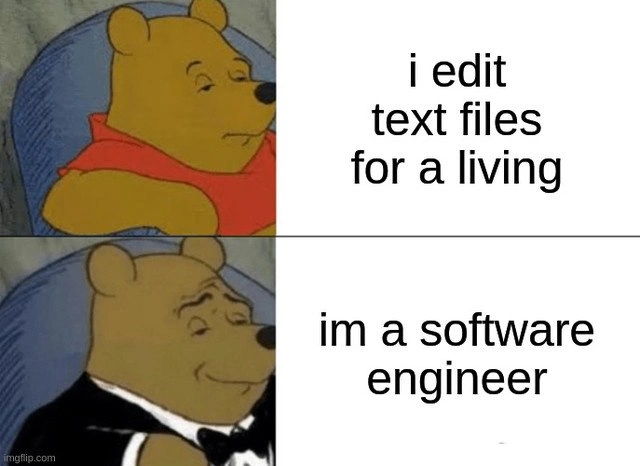
At first glance, this meme lays bare a comical truth of software development: our grand job titles often mask the mundane reality of our daily work. In the top panel, Winnie-the-Pooh, casual and half-asleep, deadpans: “i edit text files for a living.” In the bottom panel, the same Pooh now dons a tuxedo and monocle, proudly proclaiming: “im a software engineer.” The contrast is hilarious because both statements describe the exact same job — writing code — but with wildly different levels of self-importance. This tongue-in-cheek humor pokes fun at developer culture and a bit of our collective ego.

On a technical level, it’s true: most of us literally manipulate plain text all day. We write code in files that are essentially plaintext documents. Whether you’re coding in Python, JavaScript, or C, your brilliant algorithm initially exists as nothing more than lines of text in a file. All those high-falutin’ systems architectures and cutting-edge applications boil down to editing and organizing text. It’s a humbling thought hidden behind the fancy job title of Software Engineer. And oh, do we love that fancy title! The term “engineer” suggests we’re like architects or rocket designers, but some days it feels like we’re glorified typists tweaking characters and symbols. The meme hits on that self-deprecating humor many developers share: calling ourselves out for how grand we make our work sound compared to what we literally do hour by hour.

There’s also a nod to the great Editor Wars of programming. Developers famously debate their choice of text editor or IDE with almost fanatical passion — Vim vs Emacs, or these days VS Code vs JetBrains vs insert your editor. This rivalry underscores the point: we care a lot about how we edit text files. Entire communities and plugins and keyboard shortcut philosophies exist just to optimize editing code. That’s because efficient text editing is the core of our craft. The joke’s subtext is, “If all we do is edit text, we might as well be really fancy about it!” Indeed, modern IDEs (Integrated Development Environments) provide luxurious features like code completion, syntax highlighting, and refactoring tools that make the text-editing experience feel high-end. It’s like putting a tuxedo on plain editing – much like Pooh did. We developers love to feel productive with powerful tools, which can make the simple act of editing text feel like a sophisticated engineering ritual.

The DeveloperExperience_DX angle here is strong: a huge part of improving developer productivity comes from making that text-editing process more convenient and less error-prone. Think about it, entire fields like DevOps or front-end development ultimately involve editing configuration files (.yaml configs, HTML/CSS) or scripts — again, text files — to shape complex systems. We joke about spending all day in Stack Overflow or Google, only to copy-paste code (text) from the internet into our projects. Beneath the humor is a shared experience: no matter how advanced our software engineering projects get, we still end up neck-deep in text editors, tweaking punctuation and indentation.

From an industry perspective, this meme also hints at an identity quirk among programmers. We sometimes suffer from imposter syndrome, secretly feeling like “All I do is fiddle with text, am I really an engineer?” Other times, we relish the elegant title on our LinkedIn profiles and resumes. Historically, the term “software engineer” was adopted to convey that building software is a disciplined, design-oriented process akin to classical engineering. Yet day-to-day coding feels more art and trial-and-error than building a bridge. This duality — lofty title vs. gritty reality — resonates with senior devs who have seen that flashy titles don’t spare you from merging <div> tags or chasing a missing semicolon at 2 AM. The humor lands because it’s a gentle roast of our own developer self-importance: we know our work creates immense value and can be intellectually challenging, but at a low level, we’re pushing letters around in a file and hoping the computer does what we mean. We’re essentially text editors with delusions of grandeur, and we can laugh at ourselves for it.

Description

A two-panel meme using the 'Tuxedo Winnie the Pooh' format to contrast perceptions of a programmer's job. In the top panel, a standard, unimpressed-looking Winnie the Pooh is paired with the text, 'i edit text files for a living.' This represents a simplistic, unglamorous view of the profession. In the bottom panel, a sophisticated Winnie the Pooh, dressed in a tuxedo, is paired with the text, 'im a software engineer.' This represents the formal, high-status job title. The joke lies in the humorous gap between the mundane reality of daily tasks (editing text files) and the grand, professional title used to describe the career. It's a self-deprecating nod to how software engineers might view their own work or explain it to non-technical people
Comments

10
Anonymous ★ Top Pick The transition from 'editing text files' to 'Software Engineer' happens when you spend more time arguing about YAML indentation than writing actual code
  1. Anonymous ★ Top Pick

    The transition from 'editing text files' to 'Software Engineer' happens when you spend more time arguing about YAML indentation than writing actual code

  2. Anonymous

    My LinkedIn says “Distinguished Engineer driving cloud-native strategy”; my git log says “fix-indentation-in-values.yaml” forty-seven times before lunch

  3. Anonymous

    After 20 years, I've realized the only difference between junior and senior engineers is that seniors edit YAML files that edit other text files

  4. Anonymous

    At its core, we're all just glorified text file manipulators with imposter syndrome and a Stack Overflow subscription - but 'Software Engineer' sounds better on LinkedIn and definitely helps justify that TC package to non-technical relatives at Thanksgiving

  5. Anonymous

    After two decades, the craft is just persuading four dialects of text - .go, .sql, .tf, and .yaml - to agree long enough for CI to turn green; the tux is for the title ladder

  6. Anonymous

    I don't edit text files; I run distributed consensus on them, apply human merge strategies, and let a CI bot decide if I'm allowed to ship

  7. Anonymous

    Senior perk: editing text files that route petabyte queries, tuxedo not included in the merge conflict resolution

  8. @tercio133 4y

    I tell computer what to do

  9. Deleted Account 4y

    notepad.exe ./ansible.yaml

  10. @feskow 4y

    btw powershell accepts forward slash delimiter

Use J and K for navigation