Skip to content
DevMeme
3229 of 7435
The Salary Hype Mismatch
Career HR Post #3550, on Aug 18, 2021 in TG

The Salary Hype Mismatch

Why is this Career HR meme funny?

Level 1: The Fancy Job Story

This is like watching videos where every kid who plays a sport gets a giant trophy and then joining a team expecting the same thing. The funny part is realizing that the internet made the software job sound richer and easier than it usually feels, so the disappointment becomes a joke everyone recognizes.

Level 2: Highlight Reel Salaries

In developer communities, career expectations are the beliefs people form about what their work life will be like: salary, free time, respect, remote work, growth, and stability. The tweet jokes that the internet made one expectation feel especially natural: getting "heavily paid."

That connects to developer expectations versus reality. A junior developer may see posts about huge offers, dramatic promotions, or people leaving jobs after a few months for more money. Those stories can be true, but they are not the whole market. Many software developers have normal salaries, normal managers, normal deadlines, and normal frustration. The job can be good without matching the online fantasy version.

The image uses a tweet because this kind of expectation is often created socially. People compare themselves to short posts, not to full career histories. A salary screenshot does not show years of practice, location, taxes, cost of living, rejection emails, layoffs, burnout, or the quiet fact that not every programming job is at a giant tech company.

Level 3: Total Compensation Theater

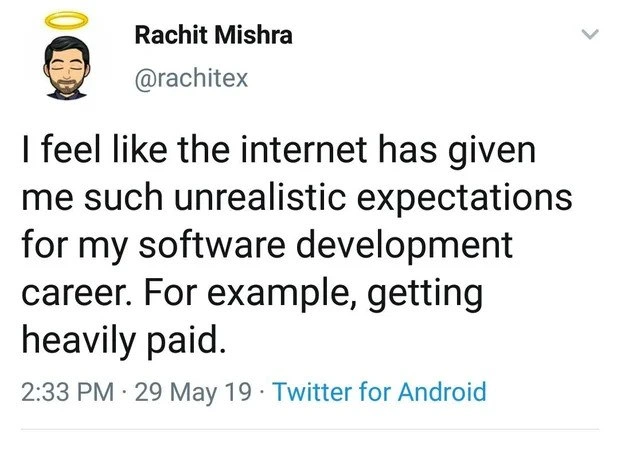
The tweet says:

I feel like the internet has given me such unrealistic expectations for my software development career. For example, getting heavily paid.

The humor is dry because it punctures one of software culture's favorite myths: that becoming a developer automatically means joining the ranks of the extravagantly compensated. The image is just a plain tweet, but that plainness is part of the joke. There is no elaborate setup, no reaction panel, no chart. Just the weary realization that Tech Twitter, bootcamp ads, salary threads, and "day in the life" videos can make a normal software job feel like a personal financial bug.

Senior developers recognize the sampling problem immediately. The internet over-represents people with unusually good outcomes: high-paying companies, equity windfalls, remote roles in expensive markets, viral career jumps, and highly optimized negotiation stories. It under-represents the much larger middle: developers at local companies, agencies, universities, internal IT teams, startups with "equity upside," consulting shops, and organizations where the compensation philosophy was apparently written on a napkin during a hiring freeze.

This is not just about money. It is about career expectations being shaped by the loudest examples instead of the broadest reality. Compensation depends on geography, company business model, seniority, specialization, negotiation leverage, immigration constraints, market cycles, interview performance, and whether the company actually treats software as a profit center. The meme's post text about wanting spare time fits the same pattern: online developer culture often sells autonomy, high pay, remote flexibility, side projects, and hobbies as a bundle. Real jobs frequently hand you sprint planning, legacy incidents, meetings, and a laptop sticker.

The sting is that the expectation is not completely irrational. Some developers really do get paid extremely well. That is what makes the mismatch painful instead of obviously absurd. The industry contains both life-changing compensation and perfectly ordinary employment, and the internet mostly hands beginners a highlight reel with the boring distribution quietly cropped out.

Description

The image is a screenshot of a tweet by Rachit Mishra, @rachitex, with a profile avatar that has a small halo drawn above it. The tweet reads: "I feel like the internet has given me such unrealistic expectations for my software development career. For example, getting heavily paid." The timestamp line says "2:33 PM · 29 May 19 · Twitter for Android". The joke targets the gap between online narratives about software developers making huge money and the more uneven reality of actual developer compensation, job markets, geography, and career stage.

Comments

4
Anonymous ★ Top Pick The internet benchmarked compensation on FAANG TC and forgot to publish the confidence interval.
  1. Anonymous ★ Top Pick

    The internet benchmarked compensation on FAANG TC and forgot to publish the confidence interval.

  2. @declonter 4y

    You will not need any hobby if your hobby coincides with your work 😭

  3. @NiKryukov 4y

    Wait.. you get paid?

    1. @Whitexwine 4y

      No. Getting paid is a joke

Use J and K for navigation