The Four Stages of Vim Enlightenment
Why is this IDEs Editors meme funny?
Level 1: Joining the Club for the Inside Jokes
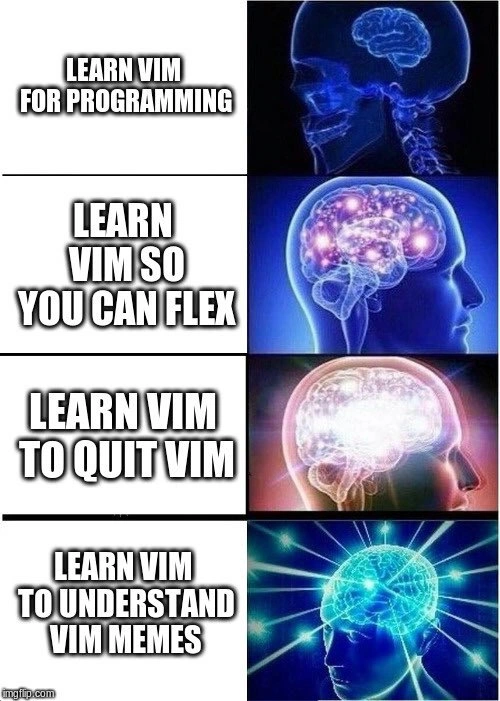
Imagine a famously tricky old car with controls so strange that some people climb in and genuinely can't figure out how to open the door again. This picture lists the reasons people learn to drive it, from boring to brilliant: to actually go places (boring), to show off to friends (better), to be able to get out of the car (very practical!), and — the glowing, galaxy-brain winner — to finally understand all the jokes other drivers tell about it. It's funny because it's true of so many things: sometimes we learn a complicated skill not to use it, but just so we can laugh along when everyone else jokes about how complicated it is.
Level 2: Why Quitting Is the Hard Part
Vim is a text editor that runs in the terminal, descended from the 1970s editor vi, and it works unlike anything else you've used: it's modal. In normal mode, keys are commands (j moves down, dd deletes a line); you must press i to enter insert mode before typing adds text. This makes experts astonishingly fast and beginners completely paralyzed — especially at exit time:
:q " quit
:q! " quit, discard changes — the panic button
:wq " save and quit
ZZ " save and quit, for the flex
Type those without pressing Esc first and they just appear in your document, which is why the trapped-in-Vim experience is universal. You'll likely meet it via git: commands like git commit (without -m) open Vim by default, and suddenly you're inside the puzzle. The "flex" panel refers to developer showing-off — Vim mastery reads as a badge of hardcore terminal credibility. And the expanding brain format itself is a four-panel meme where each row pairs a statement with an increasingly glowing brain, ironically ranking ideas from "sensible" to "enlightened." The career tip hiding here: learn the four lines above even if you never adopt Vim. Five minutes of memorization buys you a lifetime of not panicking.
Level 3: The Editor as a Social Object
The expanding-brain format ranks motivations from mundane to transcendent, and this one weaponizes it against the Vim subculture with anthropological precision. The progression:
LEARN VIM FOR PROGRAMMING → LEARN VIM SO YOU CAN FLEX → LEARN VIM TO QUIT VIM → LEARN VIM TO UNDERSTAND VIM MEMES
Panel one — the shriveled small brain — is the official reason, the one in every "10 tools every developer should master" listicle: modal editing, composable commands, keyboard efficiency. The meme assigns this the lowest consciousness, which is the first joke: the editor's actual utility is the least interesting thing about it.
Panel two names what everyone suspects: Vim proficiency is a status display. Watching someone slice through a file with ci" and d} at a shared screen is the developer equivalent of doing card tricks — and a measurable fraction of Vim adoption is driven by wanting to be the person doing that in front of the team. Editor choice has always been tribal signaling first and ergonomics second; the vi-versus-Emacs holy war predates most of its current combatants' careers.
Panel three is the canonized in-joke: people get trapped in Vim. Launch it, and your keystrokes don't insert text — they're commands in normal mode, and the exit incantation (:q!, after pressing Esc) is undiscoverable by experiment. Stack Overflow's question "How do I exit the Vim editor?" became a milestone in its own right when the site announced it had helped millions of stranded developers. So "learn Vim to quit Vim" is literal: a real, defensible reason to study the editor is to escape it when git unexpectedly drops you into it for a merge-commit message — which is, statistically, how most modern developers meet Vim against their will.
The cosmic final panel delivers the thesis: the highest purpose of learning Vim is meme literacy. This is sharper sociology than it looks. Vim's joke ecosystem — exit jokes, "my coworker's been in Vim for three years," keyboard-only smugness — has become self-sustaining and arguably more culturally load-bearing than the editor. The tool became a fandom; fluency in the fandom now outranks fluency in the tool. Plenty of real-world technology choices follow the same gradient — adopted less for the engineering and more for membership in the conversation — and the meme quietly indicts all of them.
Description
This is a four-panel 'Expanding Brain' or 'Galaxy Brain' meme illustrating the evolving motivations for learning the Vim text editor. Each panel pairs a statement with an image of a brain showing increasing levels of enlightenment. The first panel shows a simple brain scan next to the text 'LEARN VIM FOR PROGRAMMING,' representing the most basic, practical motivation. The second panel shows a more illuminated brain with 'LEARN VIM SO YOU CAN FLEX,' suggesting the desire for social status within the dev community. The third panel features a brightly glowing brain for 'LEARN VIM TO QUIT VIM,' a classic, self-referential joke about the editor's notoriously non-intuitive exit command. The final panel displays a transcendent, god-like brain emitting cosmic energy, paired with the ultimate reason: 'LEARN VIM TO UNDERSTAND VIM MEMES.' The meme humorously captures the journey of a developer with Vim, from practical application to the meta-realization that understanding the tool's culture and surrounding humor is the highest form of mastery. It resonates with experienced developers who understand that tool proficiency is as much about community and culture as it is about functionality
Comments
8Comment deleted
The Vim learning curve is a circle. You start by not knowing how to exit, and you end by understanding memes about not knowing how to exit
I mastered Vim for “efficiency,” but ten years later my .vimrc is a miniature microservice architecture - and quitting Vim is still the only part of my stack that exits in constant time
The real enlightenment is realizing you've spent 20 years perfecting your .vimrc only to watch your junior developers ship faster with VSCode and Copilot
Vim meme literacy is the only certification with a practical exam you can't leave until you pass it
The true measure of Vim mastery isn't configuring your .vimrc with 500 lines of custom keybindings or achieving sub-millisecond navigation through modal editing - it's finally understanding why ':wq' jokes get 10k upvotes on r/ProgrammerHumor while your carefully crafted pull request gets three emoji reactions
Learn Vim so when kubectl exec strands you in a BusyBox at 3 a.m., ':q!' saves prod - and the only thing you can’t exit is the Slack thread of Vim memes
The real payoff of learning Vim isn’t hjkl speed - it’s that when kubectl exec drops you into a busybox shell with only vi, your incident timeline doesn’t include “googled how to quit.”
Vim at 20 YoE: Less about editing code, more about modal-editing your way out of legacy YAML hell at 3AM