Skip to content
DevMeme
116 of 7435
LISP Parentheses vs. JavaScript Bracket Hell
Languages Post #149, on Feb 18, 2019 in TG

LISP Parentheses vs. JavaScript Bracket Hell

Why is this Languages meme funny?

Level 1: Complaining About the Neighbor's Fence

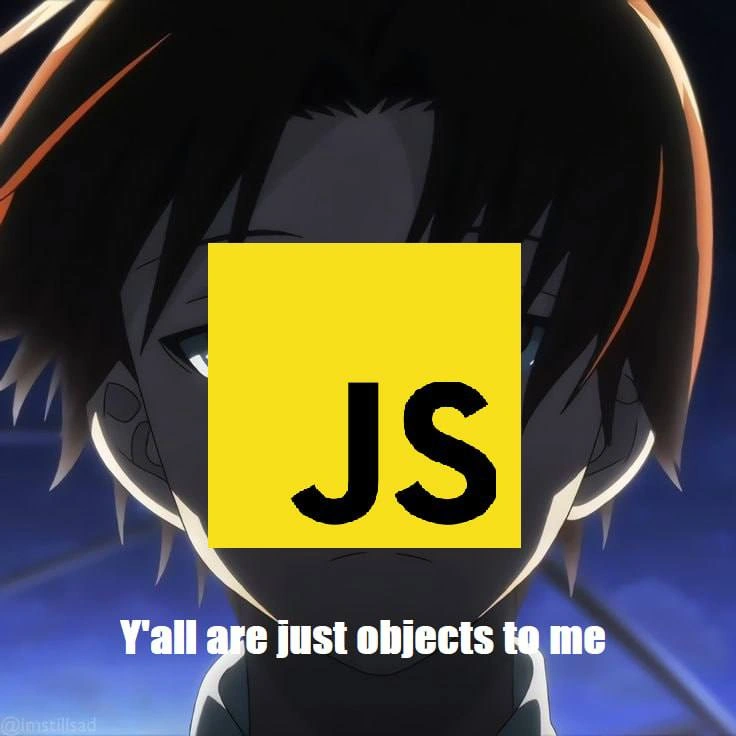
Two builders stand around on break, making fun of another crew's house for having "way too many fence posts." Then they walk back to their own job site — which turns out to be a wobbly tower of fence posts stacked taller than a mountain, and they have to climb it just to get to work. The joke is the oldest one there is: it's easy to laugh at someone else's mess while standing knee-deep in your own. They don't even notice theirs anymore, because when you see a mess every single day, it stops looking like a mess and starts looking like Tuesday.

Level 2: Brackets, Braces, and Why They Pile Up

Some terms doing the heavy lifting:

  • Lisp — a language family from 1958 where all code is written as parenthesized lists: (+ 1 2) instead of 1 + 2. More parentheses, but only one rule to learn.
  • Callback hell — in JavaScript especially, when each asynchronous operation takes a function to run "when done," and those functions nest inside each other:
getUser(id, function(user) {
  getOrders(user, function(orders) {
    getDetails(orders[0], function(details) {
      render(details, function() {
        // you are now four mountains deep
      });
    });
  });
});

That });-staircase at the bottom is exactly the avalanche drawn in panel three.

  • Pyramid of doom — the triangular shape this nesting makes when indented; the code's right edge drifts further and further from the margin.

Early in your career you'll likely have both experiences in quick succession: hearing (or repeating) that Lisp looks like "a punch card of confetti," and then opening a legacy JavaScript file where finding which } closes which { requires your editor's bracket-highlighting, a prayer, and twenty minutes. Modern fixes exist — async/await, promises, early returns, extracting named functions — but legacy mountains don't refactor themselves, which is why the figures are climbing rather than demolishing.

Level 3: The Pyramid Builders' Smoke Break

The comic, in classic rakhim.org stick-figure deadpan, lands its punch entirely through camera work. Panel one gives us the eternal water-cooler take — "LISP is ugly and confusing with those endless parentheses!" — met with the lazy consensus of "Yeah, totally...". Panel two: "Well, let's get back to work." Panel three zooms out, and "work" turns out to be a sheer cliff of dense code terminating in a cascading avalanche of }); lines, with our two critics dangling off it like alpinists who forgot their ropes.

This is the callback hell / pyramid of doom indictment, and it has real teeth. Lisp's parentheses are uniform: every form is (operator args...), fully regular, trivially balanced by any editor since the 1980s. The mainstream alternative didn't eliminate nesting — it diversified the punctuation. A pre-async/await Node.js codebase, a deeply nested jQuery success handler, or an Angular 1.x promise chain produces closing-delimiter staircases of }), }];, and }); that are strictly worse than Lisp's, because now you're matching three delimiter species across inconsistent indentation instead of one.

The deeper irony the comic skewers is aesthetic critique as social signaling. The workers aren't evaluating syntax; they're reciting a tribal shibboleth. "Lisp has too many parentheses" is one of the longest-running received opinions in software — repeated mostly by people who've never internalized that Lisp code, by virtue of that very uniformity, is homoiconic: programs are data structures, which is what makes Lisp macros possible and why the language family keeps getting rediscovered (Clojure being the most successful recent excavation). Meanwhile, the critics return to maintaining a structure whose nesting depth nobody chose — it accreted, one "just wrap it in another callback" decision at a time. That's the sharpest observation here: nobody designs a bracket mountain. It's pure technical debt geology, deposited in layers, and by the time you notice you're a mountaineer, refactoring it costs more than the smoke break where you complained about someone else's syntax.

There's also a workplace truth in the construction-helmet metaphor: developers critique languages the way builders critique architecture — from the scaffolding of something objectively uglier, because it's their ugly, and it ships.

Description

A three-panel comic strip featuring two stick figures in orange hard hats. In the first panel, one figure complains, "LISP is ugly and confusing with those endless parentheses!", and the other reluctantly agrees, "Yeah, totally...". In the second panel, they decide, "Well, let's get back to work". The final, large panel reveals their "work": pushing against a massive, diagonally-nested wall of code, likely JavaScript, which culminates in a long, staggering cascade of closing curly braces `}`. This visual structure ironically mimics the very nesting complexity they criticized in LISP. The comic is signed with "rakhim.org" in the bottom right. The meme humorously points out the hypocrisy of developers who criticize LISP's parenthetical syntax (S-expressions) while being blind to the similar, or even worse, syntactic complexity in their own preferred languages, like JavaScript, Java, or C#. The pyramid of closing curly braces, often called "callback hell" or simply a result of deep nesting, is a common pain point for developers. The joke resonates with senior engineers who have seen language fads come and go and recognize that syntactic complexity is a widespread issue, not unique to older languages like LISP

Comments

8
Anonymous ★ Top Pick Complaining about LISP's parentheses is a rite of passage. Realizing your own language's callback hell is just parentheses with extra steps is a sign of seniority
  1. Anonymous ★ Top Pick

    Complaining about LISP's parentheses is a rite of passage. Realizing your own language's callback hell is just parentheses with extra steps is a sign of seniority

  2. Anonymous

    “Lisp’s seven layers of parentheses are ‘unreadable,’ but the same people will happily navigate a React template whose <div> depth requires tail-call optimization.”

  3. Anonymous

    After 20 years in the industry, I've realized LISP developers are just Stockholm syndrome victims who've been held hostage by parentheses so long they've started defending their captors

  4. Anonymous

    Lisp's parentheses at least balance; their bracket cliff needs a sherpa, a linter, and an archaeology grant to find which '});' closes the promise from 2014

  5. Anonymous

    The beautiful irony here is that after decades of language evolution - from LISP's parentheses to C's braces to Python's whitespace - we've come full circle with modern frontend development. Today's senior engineers complain about LISP's syntax while casually writing deeply nested React components, Redux selectors wrapped in reselect, RxJS pipe chains, and functional composition that would make a Scheme programmer blush. The parentheses never left; they just got rebranded as 'functional composition' and 'declarative programming.' At least LISP was honest about it from the start

  6. Anonymous

    We dunk on Lisp’s parens, then ship a microfrontend where one missing </div> breaks four teams - Paredit would’ve caught it

  7. Anonymous

    We mock Lisp’s parentheses, then go maintain an AST encoded in C++ templates - turns out S-expressions with angle brackets are still S-expressions

  8. Anonymous

    Lisp: Proof that true power means voluntarily forging your own paren-shaped shackles

Use J and K for navigation