Skip to content
DevMeme
114 of 7435
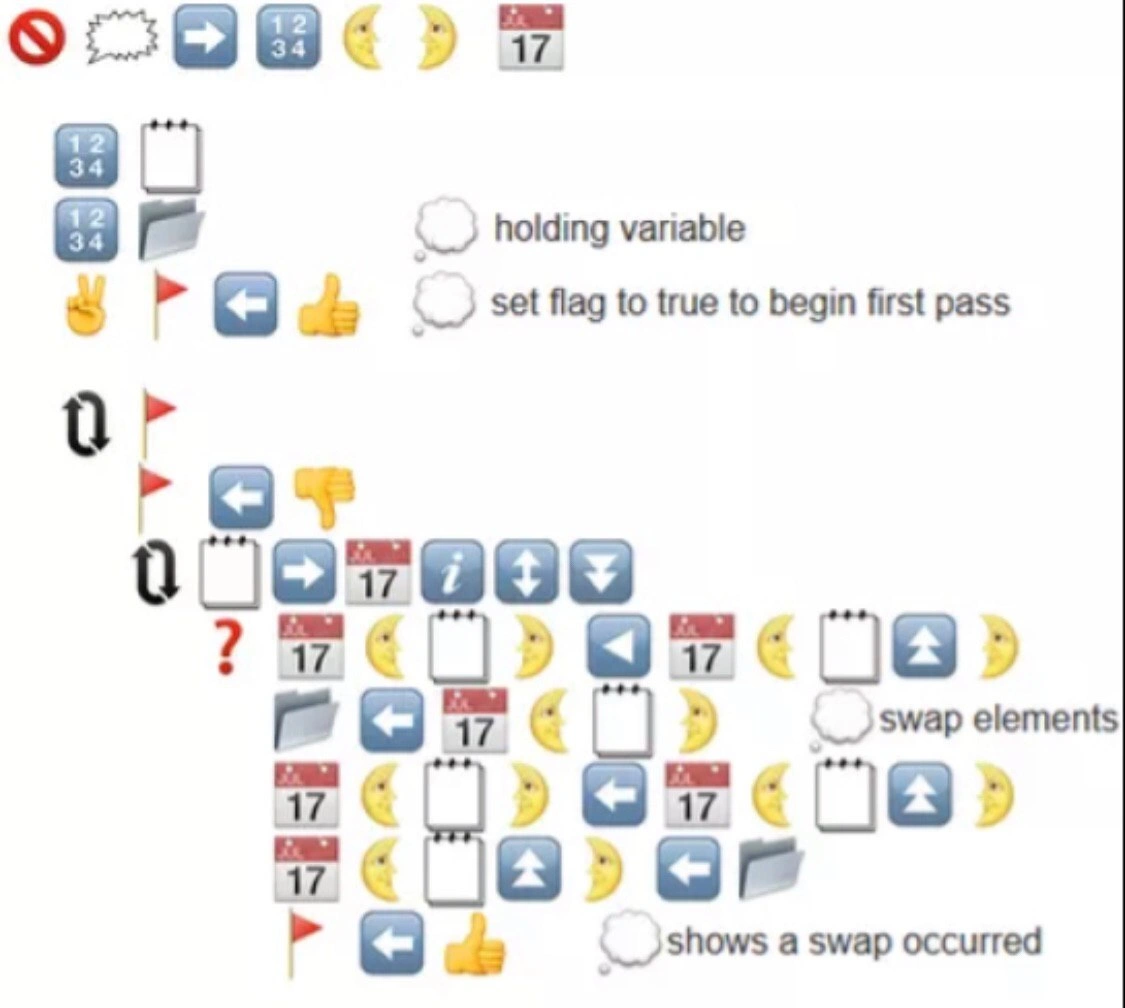
The Bubble Sort Algorithm in Emoji
CS Fundamentals Post #147, on Feb 18, 2019 in TG

The Bubble Sort Algorithm in Emoji

Why is this CS Fundamentals meme funny?

Level 1: Instructions Written in Stickers

Imagine writing a recipe for baking cookies, but instead of words you may only use stickers — a flag sticker means "keep going," a thumbs-up means "yes," two moons hug each step like parentheses, and a little notepad sticker is the bowl where you set things aside. Amazingly, the recipe works: a computer can follow these stickers and correctly sort a list of numbers from smallest to biggest. The joke is that someone did all this hard work on purpose, just to prove it could be done — like building a real, drivable car entirely out of toy blocks. You laugh, you applaud, and you quietly hope you never have to fix it.

Level 2: The Pieces on the Board

Emojicode is a real, working programming language where every keyword and bracket is an emoji — you can download its compiler and run programs like this one. Bubble sort is the beginner sorting algorithm: walk through a list, compare neighbors, swap any pair that's out of order, and repeat passes until a full pass needs no swaps. In a conventional language, the logic in this image looks like:

swapped = True                 # the red flag + thumbs up
while swapped:                 # the loop arrows + red flag
    swapped = False            # red flag + thumbs down
    for i in range(len(a) - 1):
        if a[i] > a[i + 1]:    # the '?' conditional row
            temp = a[i]        # "holding variable" (the folder)
            a[i] = a[i + 1]    # "swap elements"
            a[i + 1] = temp
            swapped = True     # "shows a swap occurred"

The key vocabulary: a variable is a named box for a value (the notepad and folder emoji); a boolean flag is a variable that's only ever true/false, used here to remember whether the pass changed anything (thumbs up = true, thumbs down = false); the moons act as parentheses, grouping expressions; and the thought bubbles are comments — notes for humans that the compiler ignores. The takeaway for early-career devs is the comments themselves: even in the least readable language imaginable, four short comments make the algorithm followable. Comment the intent, and even emoji soup becomes maintainable. Almost.

Level 3: A Ransom Note That Compiles

What experienced developers find delightful here is that this is not gibberish — it's a syntactically coherent bubble sort in Emojicode, annotated with thought-bubble comments that translate the crime scene: "holding variable", "set flag to true to begin first pass", "swap elements", "shows a swap occurred". Read it like a senior reviewing a junior's PR and the structure snaps into focus. The victory-hand line declares the red-flag variable and assigns it a thumbs up — the classic swapped = true priming of the outer loop. The black loop arrows open while loops; the inner sequence of calendar-17 and moon-bracket clusters is the array indexing and three-step swap through the temporary notepad variable; the final red flag gets a thumbs up because, indeed, a swap occurred. It's the textbook flagged bubble sort — the optimization where a pass with zero swaps terminates early — implemented in a writing system normally reserved for reacting to vacation photos.

The layered irony is what gives it staying power. First: a red flag emoji used as the swapped boolean is accidental poetry — in code review culture, "red flag" means run, and here it's a declared, mutable local. Second: the code has comments, and the comments are in English, which inverts the usual readability hierarchy — normally the code is precise and comments rot; here the comments are the only load-bearing documentation, because the code itself has the legibility of a ransom note assembled from a phone keyboard. Third, and most cutting: every veteran has maintained production code that was less readable than this. At least the emoji sort is honest about being a puzzle. The enterprise codebase with AbstractFlagManagerFactoryImpl pretends to be self-documenting while communicating just as little. Bubble sort itself completes the gag — the algorithm every developer learns first and is told never to use, here lovingly hand-implemented in the language no one should ever use. A monument to effort, fully decoupled from utility.

Level 4: Syntax Is a Costume

The reason this program can exist at all is one of the quietly profound results of computer science: syntax is arbitrary; semantics is everything. A compiler's front end is a pipeline — lexer, parser, abstract syntax tree — and the lexer genuinely does not care whether a token is spelled while, begin, or a pair of black loop arrows. Tokens are just byte sequences mapped to grammar symbols. Emojicode simply chose its terminal symbols from the Unicode emoji blocks: moons for expression grouping, a notepad glyph where another language would put {, thumbs up and thumbs down as the boolean literals true and false. Once tokenized, the parse tree of this bubble sort is isomorphic to the same algorithm in Java.

This is the serious idea hiding inside the joke, and it's the same idea behind the whole esoteric language tradition: languages built from whitespace alone, from eight punctuation characters, from Shakespeare-style plays. Each is a constructive proof that Turing completeness — the capacity to compute anything computable — requires shockingly little: conditional branching, some form of unbounded iteration or recursion, and mutable state. The Church–Turing thesis doesn't mention readability. Every esolang is a small experiment in how far you can push the surface of a language while the underlying automaton stays exactly as powerful. Emojicode's answer: all the way to the phone keyboard.

Description

This image presents a creative and complex visualization of a sorting algorithm, likely an optimized bubble sort, constructed almost entirely from emojis. The flow of logic is depicted using various emoji symbols for loops (repeat symbol), variables (blank page, folder), conditions (question mark), and state (red flag, thumbs up/down). Text annotations in thought bubbles clarify key operations: 'holding variable', 'set flag to true to begin first pass', 'swap elements', and 'shows a swap occurred'. The structure suggests a do-while loop that continues as long as swaps are being made, which is a common implementation of bubble sort. This is a form of visual code or a logic puzzle, representing a fundamental computer science concept in a highly unconventional medium. The humor and appeal for senior developers come from the novelty and the mental exercise of deciphering a familiar algorithm presented in a completely new, symbolic 'language'. It's a testament to the abstract nature of programming and the creative ways developers find to express logical concepts
Comments

8
Anonymous ★ Top Pick Finally, a universal programming language. The only problem is that code reviews are just arguments over which emoji best represents a boolean
  1. Anonymous ★ Top Pick

    Finally, a universal programming language. The only problem is that code reviews are just arguments over which emoji best represents a boolean

  2. Anonymous

    Turns out the real cost of emoji bubble-sort isn’t O(n²) runtime - it’s O(senior²) reviewers per PR just to decode why “🌙 ➡️📅17” means swap

  3. Anonymous

    When you spend three days optimizing a sort that runs once at startup on 50 items, but the emoji documentation gets more praise in the architecture review than your O(n log n) implementation

  4. Anonymous

    Finally, a language where the code review feedback and the code are written in the same alphabet - and the red flag is a declared variable instead of the entire architecture

  5. Anonymous

    When your algorithm explanation gets so abstract that you resort to emoji-driven pseudocode, you know you've either achieved peak pedagogical innovation or you're one PR away from your team staging an intervention. But hey, at least the calendar emoji accurately represents how long it takes junior devs to grok two-pointer techniques - roughly 17 iterations of 'wait, which pointer moves when?'

  6. Anonymous

    Emoji bubble sort: still O(n²) and in-place - now with literal red flags and code reviews that scale at O(eyes²)

  7. Anonymous

    Bubble sort's swapped flag: the boolean that optimistically dreams of early exit, yet dooms you to quadratic purgatory anyway

  8. Anonymous

    Bubble sort in emoji: the swap flag is 👍 - which is also how it passed code review; runtime O(n^2), comprehension O(n^2) meetings

Use J and K for navigation