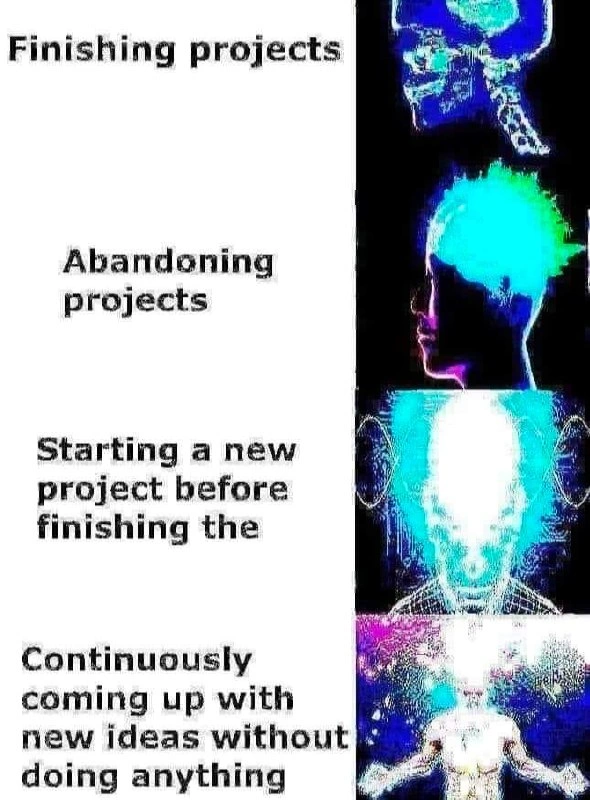
The Developer's Path to Inaction Enlightenment
Why is this DeveloperProductivity meme funny?
Level 1: The Unfinished Puzzle
Imagine you’re doing a jigsaw puzzle. In the beginning, you focus and actually finish the whole puzzle – you see the complete picture, and you feel proud. That’s like finishing a project. Now think of another time: you start a puzzle, but halfway through you get bored and wander off, leaving it undone on the table. That’s like abandoning a project. Next, picture that you’re halfway through one puzzle, but then you suddenly grab a new puzzle box and start that one before you even complete the first. Now you have two half-finished puzzles lying around. This is like starting a new project before finishing another. Finally, imagine you keep buying cool new puzzles or thinking of fun puzzle ideas, but you never actually open the boxes or put any pieces together. You’re just daydreaming about how awesome each puzzle could be. That’s like constantly coming up with new ideas without ever doing anything.
The meme jokes that as you go from the first scenario to the last, you’re somehow getting smarter or wiser (that’s why the brain picture in the meme glows brighter and bigger each time). Of course, in real life, doing no puzzles at all (just imagining them) isn’t smarter – it’s just a funny way to show how our mind prefers the exciting part (new ideas) over the boring part (finishing what we started). The reason it’s funny is because many of us recognize a bit of ourselves in this: it’s so easy to get excited about a new idea and forget about the old one. The meme is like a friend teasing us, saying, “Look, you’ve reached galaxy brain level – you have tons of ideas and zero finished projects!” It makes us laugh because we know it’s a little true, and it reminds us that even though new ideas are fun, actually completing something is important (and maybe we shouldn’t always listen to that “Oooh, shiny new thing!” voice in our heads).
Level 2: Shiny Object Syndrome
Let’s break down the meme in simpler terms. It’s showing four stages of a developer’s habit, from actually finishing work to just daydreaming, and joking that as you go down the list, the developer’s brain power is going up! This is an example of developer humor and DeveloperProductivity satire – it’s not serious advice, it’s a joke that many programmers can relate to (RelatableDevExperience).
The left side text lists:
“Finishing projects” – This means completing a software project from start to finish. For example, you had an idea for a small app, you wrote all the code, fixed the bugs, added documentation, and finally delivered a working product. In real life, this is what we aim to do. A finished project might be a website that’s deployed and live, or a mobile app that’s published and can be used. Finishing a project usually requires persistence, because after the fun initial coding, there are usually boring tasks like writing tests or fixing subtle bugs. In the meme, this sensible behavior is humorously shown as the lowest enlightenment level (the small dim brain), implying it’s just the starting point for our “expanding brain” joke.
“Abandoning projects” – To abandon a project is to stop working on it before it’s done. Imagine you started making a game or a website, got partway through, and then just… gave up. Maybe you got distracted, or the project became difficult, or you lost interest. Many new developers have folders full of these unfinished apps or half-written code. It’s like starting to read a book and never finishing it. In the meme, abandoning a project is depicted as a bigger, brighter brain state than finishing one, which is funny because abandoning is usually a bad thing productivity-wise. The meme is being sarcastic: it’s something a lot of us do, even though we know we shouldn’t. When developers see that, they likely chuckle and think, “Yup, been there, done that – so many side projects left hanging!”
“Starting a new project before finishing the [previous one]” – This text is slightly cut off, but it implies starting another project before the current one is done. This is a step beyond just abandoning one project; it means you leap to a fresh idea while your earlier project is still incomplete. For instance, say you’re building a personal todo list app, and halfway through, you get a great idea to make a weather app. Instead of completing the todo app, you jump immediately into coding the weather app. Now you have two unfinished projects. This is a pretty common scenario, especially for enthusiastic programmers who constantly get new ideas. It’s also a mild form of procrastination – you procrastinate on finishing Project A by occupying yourself with Project B (which feels productive because you’re coding, but you’re still avoiding the original task!). In the meme’s right side, the brain image here is extremely radiant, suggesting this behavior is being facetiously treated as third-level genius. In reality, starting too many things at once is usually an issue in project management: it means you’re spreading your effort thin and might not finish any of them soon. Teams and developers often have to learn to focus on one thing at a time for this reason.
“Continuously coming up with new ideas without doing anything” – This is the final stage on the list. It describes someone who just keeps imagining or talking about new project ideas but never actually starts them, let alone finishes them. It’s like you have an infinite list of cool app concepts (“What if I make a robot that does my laundry? Or a game that teaches math? Or a social network for pets?”) and you always come up with another one, but you don’t write any code or take any action on these ideas. You’re basically just dreaming endlessly. The meme shows this as the ultimate enlightenment (a cosmic, rainbow-glowing brain figure). Of course, in real life, that’s not really wise – it’s the ultimate form of not getting anything done. But the joke is that the meme treats it as if the developer has ascended to a higher plane of existence, doing so much “brain work” that they don’t even need to code. This is pure satire. Developers find it funny because it’s a truth wrapped in exaggeration: we’ve all had brainstorming sessions where we thought of tons of projects but then ended up watching TV or browsing the internet, doing nothing. Seeing “doing nothing (but ideating)” joked about as the top level of brain power is an absurd twist that makes us laugh at our own tendencies.
So, the meme is basically a comedic chart of idea vs execution in a developer’s life. At first you have execution (finishing a project), and as you go down, execution drops and ideas (or distractions) increase. It’s mocking the way our brains sometimes trick us: new ideas feel good, so we chase them, and the meme pretends that the more you chase ideas without finishing, the more galaxy-brained you are. The DeveloperProductivity joke here is that writing code and finishing things is portrayed as a lower state, whereas usually that’s what productivity is! This irony is what makes it funny and relatable. Any programmer who’s started a hobby project and then started another one (without finishing the first) will see themselves in this meme. It’s basically calling us out, but in a lighthearted way.
To visualize the progression, here’s a summary of each stage and what it means for a developer:
| Meme Stage | What it means in real life |
|---|---|
| Finishing projects (small brain) | Completing a project as planned (the ideal, but shown as basic in the meme). |
| Abandoning projects (glowing brain) | Stopping halfway through a project (common when interest fades or something harder comes up). |
| Starting a new project before finishing one (brighter brain) | Jumping to a new idea mid-stream (multi-tasking instead of closing out the first project). |
| Continuous ideas, no action (cosmic brain) | Only brainstorming constantly (zero coding, zero completion – just daydreaming about projects). |
Notice how the “brain power” column increases as the actual productivity decreases – that contrast is the core humor. Terms like “Shiny Object Syndrome” often describe this habit: always chasing the next shiny new idea. It’s something many developers have to learn to manage. Early-career developers might do this because there’s so much new technology to explore – today they want to try Python, tomorrow it’s Rust, then some new JavaScript framework, each time starting a “Hello World” project and moving on. It’s great to experiment, but if you never follow through, you end up with a lot of half-baked apps. Even in a professional setting, constantly pivoting to new projects or features without completing the current ones can lead to a pile of unfinished work and lots of unhappy users or managers. That’s why experienced developers chuckle at this meme – it’s a funhouse mirror of a real pitfall in productivity. The meme encapsulates a piece of wisdom in a joking way: ideas are easy, execution is hard (and sometimes we unconsciously avoid the hard part by endlessly hopping to a new “easy” beginning).
In summary, this meme is relatable to anyone who’s dabbled in side projects or struggled to focus. It’s highlighting procrastination in a creative format. Each stage on the list is basically a level of procrastination disguised as progress: finishing (no procrastination) -> abandoning (some procrastination) -> starting something new (procrastinating on finishing by doing something else “productive”) -> only ideating (ultimate procrastination, no actual productivity). Developers find it amusing because it’s a pattern we have to fight in ourselves. Seeing it laid out with an expanding brain graphic is a humorous reminder of how ridiculous it can get if we let it.
Level 3: Cosmic Procrastination
The meme uses the classic expanding_brain_meme format to lampoon a developer’s project_completion_hierarchy. Each panel on the left lists a stage in a developer’s productivity (or lack thereof), while the right shows an ever-glowing brain silhouette to imply a higher state of “enlightenment.” Ironically, the galaxy brain (highest enlightenment) is reached when the developer does the least actual work. This tongue-in-cheek progression resonates deeply in software circles because it exaggerates a real productivity trap: chasing novelty over finishing tasks.
In the first stage, Finishing projects, the developer actually completes what they start – arguably the sensible goal in ProjectManagement and DeveloperProductivity. Yet the meme humorously portrays this as the lowest brain state (dim blue X-ray skull). Why? It’s setting up a sarcastic contrast: normally we praise finishing a project as success, but the meme pretends it’s pedestrian and “small-brained.” Many experienced engineers chuckle here because finishing can indeed feel mundane compared to the initial excitement of a new idea. Every senior dev knows that polishing the last 10% of a project often takes 90% of the effort (debugging edge cases, writing tests, documentation, deployment scripts – the unsexy but critical stuff). It’s important, but it’s not glamorous.
The second stage, Abandoning projects, shows a brain lit up in cyan. This suggests a “higher” form of thinking, poking fun at how frequently developers drop projects mid-way. It’s a rite of passage in DeveloperHumor: you get a brilliant idea, start strong, then hit a snag or lose interest and quietly let the repo gather dust. The humor comes from shared experience – countless GitHub accounts are littered with half-built apps and libraries that were abandoned when either the next shiny thing appeared or when the hard parts emerged. This is a gentle jab at procrastination: abandoning one project can sometimes be a subconscious way to avoid tough problems in it. A senior engineer might wince sympathetically here, recalling the graveyard of side projects in their own ~/projects directory. Each abandoned project is a form of personal technical debt – not in the traditional sense of messy code, but an emotional weight of “I’ll get back to this someday” (which rarely happens). It’s funny because we’ve all told ourselves that lie with a smirk.
The third stage text is a bit cut off in the meme, but we can fill it: “Starting a new project before finishing the [last one].” The corresponding image is a blinding white-blue figure with a circuitry aura – a near-transcendent state. This mocks a common developer anti-pattern: context switching to a new project when the current project is incomplete. Essentially, it’s abandoning Project A by immediately diving into Project B. Why do devs do this? Because new ideas are exciting! The initial phase of a project – setting up a fresh repo, picking a cool tech stack, implementing the core concept – gives a quick dopamine hit. Meanwhile, finishing Project A had become tedious or challenging. The meme magnifies this behavior: the developer hasn’t even closed out the old project, and they’re already knee-deep in a new one, feeling energized by novelty (hence the intense aura in the image). Experienced folks know this scenario too well: “I’ll just prototype this new idea real quick; I’ll get back to the other project later.” Next thing you know, Project A is forgotten. This stage of serial starting is often jokingly justified by developers as “multitasking” or having a “projects pipeline,” but in reality it wreaks havoc on true productivity. In industry terms, this is like a team constantly adding new features or pivoting to new projects without ever polishing or launching the ones in progress – a nightmare for ProjectManagement because nothing ever gets completed. The humor is bittersweet: we laugh, but it’s too real when we recognize it in ourselves or our organizations.
Finally, the fourth stage, “Continuously coming up with new ideas without doing anything,” is paired with the ultimate cosmic being radiating multicolored energy – the zenith of enlightenment. This is the meme’s punchline: the highest evolutionary form of the developer brain does no coding at all! Instead, they achieve a sort of nirvana of pure ideation. The joke lands because it’s an absurd reversal of what being a “good developer” means. In reality, only coming up with ideas and never executing is seen as unproductive. But the meme elevates it to cosmic genius status, implying a dev can ascend beyond the mortal plane of messy code and actually shipping software. It’s dripping with irony. The seasoned engineer reading this might recall the sarcastic proverb: “Don’t code on Fridays? How about don’t code at all – zero code, zero bugs!” There’s also a kernel of truth being mocked here: generating ideas feels mentally satisfying and limitless, whereas executing them is bounded by time and effort. Some veteran developers half-joke that with so many ideas in their head, they’re “working in the multiverse” – in some alternate universe each idea was fully built! The cosmic imagery satirically frames perpetual_ideation as enlightenment, calling out the inner voice of every creative developer that would rather dream than do the boring parts. It’s a humorous warning: if you take the tendency to chase ideas to the extreme, you end up with nothing tangible – just a galaxy of thoughts.
Across all these stages, the meme highlights the tension of idea_vs_execution. It resonates because balancing the two is hard. On one hand, continuous learning and ideation are part of being a passionate developer – new ideas drive innovation and personal growth. On the other hand, finishing what you start is how useful software gets made. The expanding brain format underscores the absurdity when that balance tips too far toward ideas. In effect, the meme outlines an exaggerated project completion hierarchy: from disciplined work to creative chaos. It’s poking fun at a common pitfall in developer productivity: Shiny Object Syndrome, where the allure of the next big idea always outshines the project in hand. The result? Lots of beginnings, few endings. This is a frequent source of missed deadlines and unfinished_side_projects, both in personal life and in teams that lack focus. Seasoned devs laugh (and maybe cringe) because they’ve been there – merging that last pull request isn’t nearly as tempting as starting a brand new repository for an exciting idea. The meme cleverly externalizes that guilty grin we get when brainstorming features for a project that we secretly know we’ll never finish. It’s funny because it’s true.
Description
This image uses the four-panel 'Expanding Brain' or 'Galaxy Brain' meme format to satirize developer productivity. On the left, a series of phrases describe different approaches to handling projects, while on the right, corresponding images show an increasing level of cosmic enlightenment. The progression is as follows: 1) 'Finishing projects' is paired with a simple brain X-ray. 2) 'Abandoning projects' is next to a silhouette of a head with a glowing brain. 3) 'Starting a new project before finishing the' (the sentence is cut off) corresponds to a being with a brightly glowing head and energy fields. 4) The final, most 'enlightened' state, 'Continuously coming up with new ideas without doing anything,' is represented by a transcendent, god-like figure made of cosmic energy. The humor comes from the ironic reversal: the least productive and most paralysis-inducing behavior is presented as the pinnacle of intelligence. For experienced developers, it's a deeply relatable take on 'shiny object syndrome,' the graveyard of abandoned side projects, and the paralysis that can come from endless ideation without execution

Comments
8Comment deleted
The final stage is just verbally whiteboarding new microservice architectures in your head that will never be implemented. It's the purest form of system design: zero legacy code, infinite scalability
Dev enlightenment: 1) ship the feature, 2) deprecate the feature, 3) start the Rust-on-K8s rewrite before the retro, 4) author a 40-page strategy doc so visionary implementation becomes a legacy problem for whomever inherits the wiki
My GitHub profile is just a distributed system where each repo represents a different stage of grief about never shipping anything
This meme perfectly captures the senior engineer's dilemma: we've accumulated enough architectural knowledge to envision twelve different ways to solve every problem, each more elegant than the last, which paradoxically means we're now too enlightened to actually ship anything. The final form represents achieving true technical nirvana - where your brain operates at maximum capacity generating RFC documents and proof-of-concept repos that will never see production, while your actual deliverables remain perpetually 'almost done.' It's not procrastination; it's continuous discovery in an infinite solution space
My personal DORA metrics are elite: deploy frequency 0, lead time infinite, change failure rate 0% - can’t break prod if ‘prod’ is a README
Enterprise galaxy brain is realizing the safest way to avoid outages is to make every idea a “strategic initiative” that dies in the roadmap - zero code, zero bugs, 100% alignment
Ultimate DevOps: Continuous Integration of ideas, zero Deployment - pure velocity illusion
Meooooooooooooooooow Comment deleted