Skip to content
DevMeme
5575 of 7435
PiFS, The Data-Free Filesystem
Storage Post #6117, on Jul 18, 2024 in TG

PiFS, The Data-Free Filesystem

Why is this Storage meme funny?

Level 1: The Empty Library

It is like opening a library that proudly owns no books, then telling visitors every book is "somewhere in the alphabet" if they search long enough. The joke is that this sounds clever for one second, then completely insane the moment you actually need to read something.

Level 2: Storage Without Storing

A filesystem is the part of an operating system that organizes files and folders. When you save notes.txt, the filesystem decides where the data goes on disk and how to find it later. Normal filesystems are judged by whether they keep data safe and make it available again.

The joke in πfs - the data-free filesystem! is that it sounds like the filesystem does not store your file data at all. Because the name uses pi, the idea appears to be mathematical: maybe the file can be found or generated from digits of pi rather than written to a normal disk. That is a funny exaggeration of data compression and data storage abstractions: instead of keeping the file, keep a clever recipe and hope the recipe is not worse than the file.

Level 3: Filesystem As Punchline

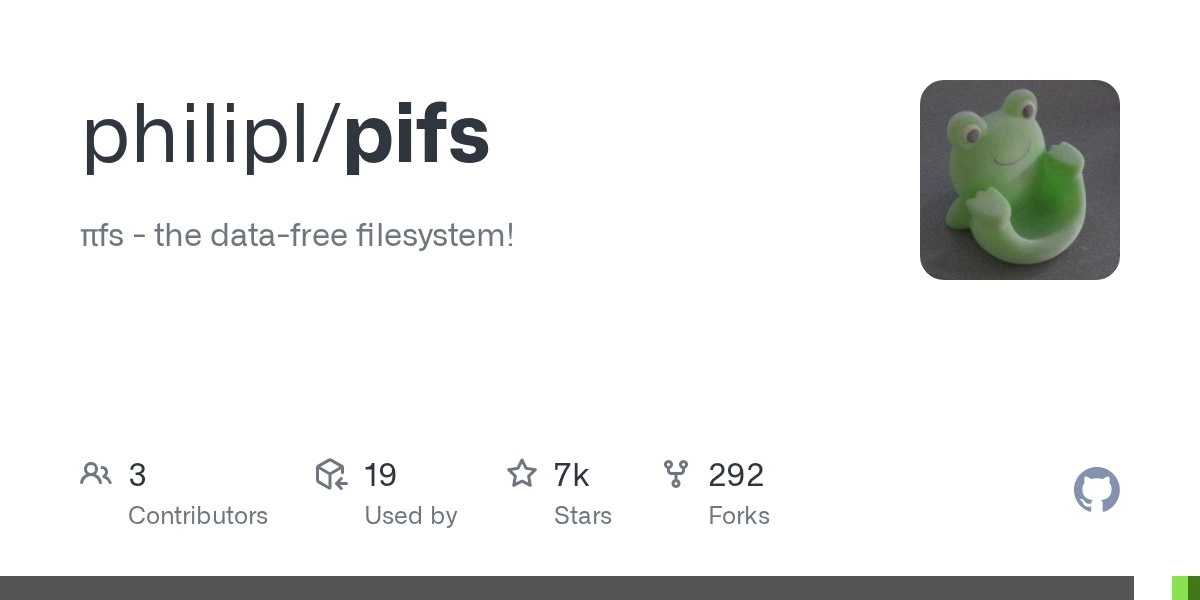
The image is funny because it uses the serious visual language of a GitHub project card for something that sounds like a dare. A filesystem is one of the most boringly critical abstractions in computing. It maps names to data, tracks metadata, handles reads and writes, and tries not to lose your work when power, hardware, kernels, or user behavior do exactly what they always do. Calling one the data-free filesystem! is like advertising a restaurant as "food-optional."

That absurdity lands especially well for people who have touched storage systems. Developers know that the hardest part of storage is not the happy path where bytes politely stay where you put them. It is durability, consistency, caching, crash recovery, permissions, file handles, partial writes, directory semantics, and the eternal question of whether fsync actually means what everyone in the room wants it to mean. The screenshot's small cheerful green figure on the right makes the whole thing look harmless, which is how many experimental repositories introduce themselves before ruining an afternoon.

There is also an open-source culture joke here. GitHub stars often reward cleverness, novelty, and "I cannot believe this exists" energy as much as production usefulness. A repo like the visible pifs does not need to be practical to be valuable; it can be a compact teaching tool, a mathematical gag, and a reminder that many beloved side projects are half proof-of-concept, half stand-up routine. The best ones make you laugh, then accidentally teach you why the real system is boring on purpose.

Level 4: Kolmogorov In Production

The screenshot shows philipl/pifs with the subtitle πfs - the data-free filesystem!, which is the kind of phrase that makes storage engineers instinctively reach for a whiteboard and a headache. The deep joke is that a filesystem is normally a contract about persistence: write bytes, later read the same bytes. A "data-free filesystem" suggests that the bytes are not stored at all, but derived from some external mathematical source, with pi as the implied infinite warehouse.

That premise brushes against data compression, information theory, and the uncomfortable reality that "not storing data" is only useful if the description needed to recover the data is smaller than the data itself. In Kolmogorov-complexity terms, a file is compressible when it has a short program or description that reproduces it. The digits of pi are generated by compact algorithms, so if your desired file appears somewhere inside pi, the "file" could theoretically be represented as an offset and a length. Congratulations, your storage layer is now a scavenger hunt inside a transcendental number.

The catch is doing the work. It is not known in the everyday engineering sense that pi conveniently contains every possible byte sequence where and when you need it, and finding a long arbitrary sequence inside a generated stream is not magic storage; it is computation, indexing, probability, and pain wearing a novelty badge. The GitHub-style stats visible at the bottom, 3 Contributors, 19 Used by, 7k Stars, and 292 Forks, make the absurdity sharper: open source will absolutely star a project that turns "write a file" into "argue with infinity."

Description

A GitHub repository screenshot shows the project title "philipl/pifs" with the subtitle "pifs - the data-free filesystem!" and a small green frog-like icon on the right. Along the bottom are repository stats reading "3 Contributors", "19 Used by", "7k Stars", and "292 Forks", with the GitHub logo visible in the lower right. The humor is that a filesystem is advertised as "data-free," implying an absurd storage abstraction where the filesystem's value comes from mathematical cleverness rather than actually storing bytes. For engineers, it reads like the kind of open-source project whose README is half proof, half punchline.

Comments

3
Anonymous ★ Top Pick A data-free filesystem is just compression taken to its logical endpoint: the restore process is a PhD qualifying exam.
  1. Anonymous ★ Top Pick

    A data-free filesystem is just compression taken to its logical endpoint: the restore process is a PhD qualifying exam.

  2. @NexonSU 1y

    So, if pi contains any information, then it contains illegal information too and should be banned! :D

  3. @azizhakberdiev 1y

    ah yes, infinite storage If I decide to store even 1 GB of data it gonna take so long that data would be stored as subatomic particles by that time

Use J and K for navigation