Skip to content
DevMeme
5573 of 7435
Microsoft's Audacious Bid to Copyright a Mathematical Constant
Microsoft Post #6115, on Jul 18, 2024 in TG

Microsoft's Audacious Bid to Copyright a Mathematical Constant

Why is this Microsoft meme funny?

Level 1: Claiming the Ocean

Imagine there’s a huge, endless ocean that literally contains everything you could ever think of somewhere in its depths. Now picture a big company finding a tiny bottle in that infinite ocean, and inside the bottle is a message or drawing that looks just like something they made. In response, the company jumps up and says, “Since we found our stuff in this ocean, we own the whole ocean now!” Sounds crazy, right? That’s basically what this joke is saying. π (pi) is like that endless ocean, full of infinite random digits. Microsoft found a pattern in those digits that looks like their Arial font (the style of letters they use), which is like finding their “message in a bottle.” Claiming they could copyright π is like claiming the entire ocean just because a piece of their property showed up in it. It’s a silly, greedy idea – and that’s why it’s funny. People who love math and open knowledge are laughing because they know no one can own a number that goes on forever. The joke feels like watching a child loudly insist they own the playground sandbox because they found a toy in it. Everyone else can see how ridiculous that is, and that’s exactly the point – it’s poking fun at how absurd it would be for anyone, even a big company, to try to take ownership of something as infinite and free as π.

Level 2: From Digits to Drawings

Let’s break down the key ideas in this joke in simpler terms. First, pi (π) is the famous number ~3.14 that you get when you divide a circle’s circumference by its diameter. It’s special because it’s irrational – its decimal part goes on forever without repeating (3.1415926535… and so on, infinitely). Now, because it never repeats and seems random, there’s this cool speculation that somewhere in those endless digits, you could find any sequence of numbers you want. Think of it like an extremely long string of random lottery numbers – given enough length, eventually any specific short sequence (like “12345” or your birthdate) might show up just by chance. In fact, there’s an idea (not proven yet) that π’s digits are “normal,” meaning every possible sequence of digits is equally likely to appear if you go far enough. People joke that if that’s true, π might contain literally everything encoded in numbers – your life story, a JPG of your cat, the code of Windows 11, you name it, it’s somewhere in there if you had an index to find it! This meme plays with that idea in a big way.

Next, Arial is a font – one of the basic text styles you see on computers (the text you’re reading might even be in Arial or a similar sans-serif font). A font like Arial defines how each letter or character looks when displayed or printed. Under the hood, fonts aren’t magic – they’re stored in files that contain a lot of coordinate data describing the shapes of letters. One common way to describe these shapes is using vector graphics: basically points, lines, and curves that outline each character. An important concept here is the Bézier curve, which is a smooth curved line defined by some control points; fonts use these curves to get nice smooth letter shapes (so letters don’t look blocky when enlarged). For example, the letter “O” in a font is defined by a couple of Bézier curves forming a loop. Font files (like TrueType .ttf or OpenType) encode all these curves as numbers (points on an X-Y grid). Similarly, SVG (Scalable Vector Graphics) is a format that describes drawings with text instructions. An SVG path is essentially a string of commands like “move here, draw a line there, curve through these points” accompanied by numeric coordinates. It might look like M 50 50 L 100 50 Q 120 80 100 100 Z which means “Move to (50,50), draw a Line to (100,50), then a Quadratic curve via (120,80) to (100,100), and close the path”. Those numbers 50, 100, 120, 80… are coordinates. So if you list out all the numbers and commands to draw the Arial letters, you’d get a big sequence of digits and letters (the commands). Think of it like the blueprint for each character.

The meme joke claims that inside the digits of π, starting at a specific point (the “3,141,592nd decimal place” – which is a cute self-reference to 3.141592…), they found a sequence that if you interpret it as an SVG path or font outline data, produces the entire Arial font! In simpler terms, imagine taking a very long segment of π’s digits and somehow reading them as the instructions to draw letters – and it perfectly draws A, B, C, … Z in Arial’s style. That’s an incredibly far-fetched idea – the chances of that happening randomly are near zero – but it’s funny because π’s randomness makes people imagine coincidences like that. It’s a bit like finding a secret message or a picture in static noise. The article even quotes a fictional expert “Dr. Calibri” (Calibri is the name of another font, which is an inside joke to clue us in that this is all tongue-in-cheek). Dr. Calibri explains how they noticed a pattern in π’s decimals and by “treating certain sequences as SVG path instructions,” the curves matched Arial’s character outlines. This is hilarious to programmers and designers because it mixes serious technical jargon with an absurd result. It’s like saying “we found order in chaos” – a hidden treasure in random data.

Now, why is Microsoft trying to copyright π in this story? Here’s where the humor targets corporate absurdity. Microsoft is a huge tech company known for its products (Windows, Office, and yes, fonts like Arial which ship with Windows). Companies protect their creations with copyrights and patents – that’s normal. Arial’s design is indeed Microsoft’s intellectual property (they paid for its design). But π is a mathematical constant – no one can own π; it’s a fact of nature like the sunlight or the Pythagorean theorem. The joke imagines Microsoft saying, “Hey, π contains our Arial font design (our property), so by extension π itself contains copyrighted material that belongs to us – maybe we should own π or at least control its use!” That’s a ridiculous leap, legally speaking, and that’s why it’s funny. It’s poking fun at how big companies sometimes seem to overreach in protecting their IP. We’ve seen real-world tech IP conflicts that felt silly – like lawsuits over rounded corner designs on phones, or attempts to trademark common words. This takes it up a notch: attempting to lock down a number that everyone from schoolkids to NASA uses daily.

The article mentions mathematicians and free software advocates being outraged. It makes sense: mathematicians would be like “You can’t own π! It’s a fundamental constant we all study and use. That’s like trying to patent the number 2.” They’d see it as a fundamental misunderstanding of how math works or an attack on academic freedom. Free software advocates (think open-source community) would likewise be upset because they believe knowledge (including software code, algorithms, and presumably numbers) should be free for everyone to use. They often fight against overly broad copyrights or patents – for example, they oppose when companies patent algorithms or when laws like DMCA restrict sharing knowledge. In the past, free software folks got very angry at things like software patents on common techniques, or when standards that everyone needs were locked behind patent licenses. So in this joke, the idea of a company claiming π – something used in every programming language and math library – would instantly rally these groups to protest, which the meme notes. It’s a playful nod to the kind of Twitter storm or hacker news outrage that would occur if, say, a corporation actually tried some legal shenanigans like this.

Finally, the jab that “Google is rumored to be searching for Roboto hidden in the digits of e” adds a cherry on top. Google is Microsoft’s big competitor in many areas (apps, operating systems, fonts, you name it). Roboto is a font that Google created (used in Android phones as the default typeface). And e (~2.71828) is another famous infinite number in math (the base of natural logarithms). So this line cracks a joke that Google, not to be outdone, is looking at another mathematical constant to see if it contains their font. It’s a humorous way to say “if one giant tech company can have this silly idea, of course the other is going to jump in too” – much like how big companies often quickly copy each other’s strategies. It parodies the competitive one-upmanship in corporate culture: “Oh, Microsoft found Arial in π? Quick, Google, go find Roboto in e!” It also doubles down on the geekiness – only someone in the developer/tech crowd would get why Roboto and e are referenced.

So, in summary, this meme is a satirical news article that combines a math geek’s dream scenario (π containing hidden messages) with a jab at corporate intellectual property culture. It’s funny because it takes something infinitely public (pi) and something proprietary (a font design) and mashes them together in an over-the-top scenario. The technical details (SVG paths, Bézier curves, specific decimal positions) make it flavorful for developers, while the overall premise is broad enough to make anyone familiar with Microsoft or math chuckle at the absurdity. It’s as if someone said, “What’s the most preposterous thing a big tech company could do with math?” and came up with this story. And now it lives as a screenshot shared among developers who enjoy a good TechSatire laugh in the morning. Good one, internet!

Level 3: Copyrighting Infinity

For seasoned developers and industry observers, this meme lands as sharp TechSatire about corporate overreach, especially poking fun at Microsoft’s historical reputation in the CorporateCulture. The absurd headline “Microsoft to Copyright Pi” immediately evokes a "wait, what?" reaction – everyone knows π (~3.14159) as a universal constant, not something any company could possibly own. Microsoft attempting to claim rights over π is an exaggerated play on the company’s past aggressive stance on IntellectualProperty (think of the days of “embrace, extend, extinguish” or battles over standards). It satirically suggests Microsoft wants to literally own infinity because they found a snippet of their property (the Arial font, one of their well-known MicrosoftProducts bundled with Windows) somewhere in it. It’s a perfect storm of CorporateHumor: a behemoth tech company asserting ownership over something that by its nature belongs to all humanity.

The humor builds as the fake article details how they found Arial in π’s digits. The researchers (led by the illustriously named Dr. Calibri – sly nod to another Microsoft font) claim that starting at the 3,141,592nd decimal place (notice that number – 3,141,592 – it’s literally the digits of π itself cleverly used as an index), they decoded segments of π as SVG path instructions. In plainer terms, they treated chunks of π’s decimal expansion as if they were coordinates and commands to draw lines and curves. The payoff: those instructions plotted out the exact Bézier curve outlines of Arial’s letters, in alphabetical order no less! This scenario is hilariously specific. It blends a programmer’s knowledge of how fonts work (SVG paths defining letter shapes) with a mathematician’s whimsical idea that π’s randomness could hide any pattern. For a senior developer, the sheer improbability is the joke – it’s akin to finding a needle in an infinite haystack by sheer luck. It also pokes fun at our tendency to find patterns wherever we want if we’re determined (or delusional) enough. The idea of bezier_curve_detection in random data is like seeing faces in clouds, taken to a geeky extreme.

Now, why target Microsoft? Because it amplifies the satire about corporate behavior regarding IP. Microsoft has a long, complicated history with fonts and formats (recall how they once fought over default fonts and file formats in Office vs others). Arial itself has some history: it’s often seen as Microsoft’s take on Helvetica, and the company has proprietary rights over it. The meme exaggerates this by implying Microsoft would go so far as to claim π contains their font, therefore they own π. It’s a dig at corporate logic: “if it contains our property, then the container is our property.” This is obviously flawed reasoning legally, but in the tech world we’ve seen some seemingly crazy IP grabs. For example, companies have tried to patent basic algorithms or sue over API usage (recall Oracle suing Google over the Java API – some saw that as trying to own fundamental building blocks). The meme plays on that vibe with a case so outrageous it lays the absurdity bare.

The faux news article format is itself part of the humor. It reads like something from The Onion or a beloved tech satire site, with a deadpan delivery of nonsense. It mentions Microsoft’s legal team filing the claim immediately – conjuring an image of lawyers rushing to the patent office to stake ownership on a number. This parodies how quick big tech companies can be to litigate and how out-of-touch those legal battles can feel to engineers and scientists. The “outrage among mathematicians and free software advocates alike” mirrors real life too. Mathematicians, of course, would be aghast – π is like a sacred universal constant, and the idea of commodifying it violates the ethos of math as a universal language. Free software advocacy groups (think the FSF, open-source community) are thrown in because they traditionally fight against privatization of knowledge (software source code, open standards, etc.). The meme humorously unites them against Microsoft’s laughable claim, which feels plausible given past tech controversies. It echoes real incidents – for instance, when a company claims ownership of an open protocol or when DRM or patents threaten something as basic as using a format. The comedic tension comes from “what if a greedy corporation treated fundamental math like licensed software?” – it’s both hilarious and a tiny bit reflective of genuine fears about corporate control.

There’s also inter-corporate ribbing: the closing line jokes that Google is scouring the digits of e (Euler’s number, 2.71828…) for their own Roboto font. This is a wink at the rivalry between tech giants. Google’s Roboto is the default Android font (an analogue to Microsoft’s Arial in importance) and e is another famous infinite constant. So the meme suggests a parody arms race: if Microsoft tries to “one-up” nature by hijacking π, Google will quickly follow suit with e. It’s a playful jab at how tech companies often leapfrog or copy each other’s ideas – here rendered absurd as copyrighting mathematical constants.

On the technical side, developers familiar with fonts and graphics get an extra layer of chuckles. They know fonts like Arial are defined by vectors, essentially lists of coordinate data for each character shape. The process described – reading π’s digits as SVG path data – is both utterly ludicrous and geekily imaginative. One can picture a script parsing millions of π digits looking for something that produces a recognizable shape when fed into an SVG renderer. It’s humor tailored for those who know about svg_path_interpretation and vector graphics: the kind of detail that makes a dev think “someone really did their homework to make this sound just plausible enough!” It’s the blend of accurate technical detail with an insane premise that tickles the techie funny bone.

In essence, this meme resonates on multiple levels for experienced folks: it mocks corporate hubris (Microsoft claiming ownership of π – the ultimate power move!), highlights the absurdity of extreme IP claims, and celebrates a nerdy concept of π containing all data. It’s a little cautionary tale too – as if saying, “Be careful with corporate logic; taken far enough, you’d try to monopolize infinity.” The fact that it’s fonts (something so everyday for developers/designers) hidden in π (something so sublime and mathematical) makes it all the more delightful and absurd. It underscores the gap between the boundless, chaotic nature of math and the controlling, order-imposing nature of corporate legal teams – a contrast any senior dev who’s sat through patent training or license compliance can appreciate with a smirk.

Level 4: Infinite Library of π

At the most theoretical level, this meme riffs on deep math and information theory concepts. The constant π (pi) is not just any number – it’s transcendental and believed to be a normal number (though not yet proven). A normal number’s infinite decimal expansion would contain every possible finite sequence of digits somewhere in it. In other words, if π is normal, then buried within its endless, random-looking digits you could find anything: your phone number, the entire works of Shakespeare in ASCII, or yes, even the data that describes a font like Arial. This idea turns π into an "infinite library" of digital information – a concept famously akin to Borges’ Library of Babel, which contains every possible book. It’s a mind-bending notion: π as the ultimate infinite_decimal_storage, where any file or text you can imagine appears at some absurd index if you search long enough.

To a theoretical computer scientist, this touches on algorithmic information theory. Any piece of data (say the binary of an image or a font file) can be seen as a very large integer. That integer might be lurking in π’s base-10 (or base-16) expansion at some position. There’s even a tongue-in-cheek idea of a “π-based file system” where you "store" data by just noting its offset and length inside π – exploiting the notion that π’s digits are a fixed, universally accessible sequence. Of course, actually finding a given file’s worth of data in π is astronomically impractical (like locating one specific grain of sand in the entire universe), but conceptually it’s possible if π is truly normal. In fact, π’s digits are so unruly and well-distributed that mathematicians and programmers often treat them as a source of pseudo-randomness. Modern formulas (like the Bailey–Borwein–Plouffe algorithm) even allow directly computing the digit of π at a given position in base-16 without calculating all prior digits, reinforcing that we can theoretically pluck data from deep within π if we know where to look.

Now, fonts like Arial are essentially collections of vector shapes defined by numeric instructions. In formats like TrueType or SVG, each character (glyph) is described by points, lines and curves – often Bézier curves – which are encoded as sequences of numbers (coordinates, control points, lengths). For instance, an SVG path for a letter might look like M100,100 L100,200 Q150,250 200,200 Z – a series of coordinates and commands. Those numbers can be stored as plain text or binary, but either way they boil down to digits. The meme’s faux-scientists claim they found a pattern in π’s digits that, when interpreted as an SVG path, produces the exact outlines of every Arial character. It’s an absurdly unlikely coincidence from a probability standpoint – by the 3,141,592nd digit (a cheeky nod to π’s value itself), the chance of stumbling on even one complex shape like a letter is virtually zero. But because π is conceptually an infinite random soup of digits, the idea that somewhere in there the data for “A, B, C…” through “Z” might appear in order is just barely plausible in a mathematician’s wildest dreams. It’s a hilarious exaggeration of the property of normal numbers: treat the digits with the right “decoder lens” (here the lens is interpreting numbers as vector drawing commands), and π can “contain” any Easter egg you want – even a whole font! This is like a nerdy twist on the infinite monkey theorem: given infinite randomness, eventually you get monkeys typing out the complete works of Dickens or π spelling out the drawings of Arial letters.

Finally, let’s consider the intellectual property angle in the abstract. Copyright law normally doesn’t apply to pure mathematics – you can’t claim ownership of a number or a formula because they’re considered discoveries, not creative works. So the notion of copyrighting π is fundamentally at odds with how copyright works at a philosophical level. It’s as if Microsoft is attempting to turn a mathematical constant into proprietary software. This raises theoretical questions: if a random process (like π’s digits) happens to output a copyrighted work, does that imbue the random source with copyright? Almost certainly not – that would be like saying the universe infringed copyright because a cloud’s shape resembled Mickey Mouse. In information theory terms, π has an infinite Shannon entropy and no intentional design, so finding structure in it is like pulling a coherent signal out of infinite noise. The humor at this deep level comes from how fundamentally impossible it is to truly appropriate an infinite, patternless entity like π – it belongs to everyone and no one. The meme pushes this to the extreme, making us marvel (with a chuckle) at the contrast between the boundless nature of mathematics and the sometimes absurd reach of human legal constructs.

Description

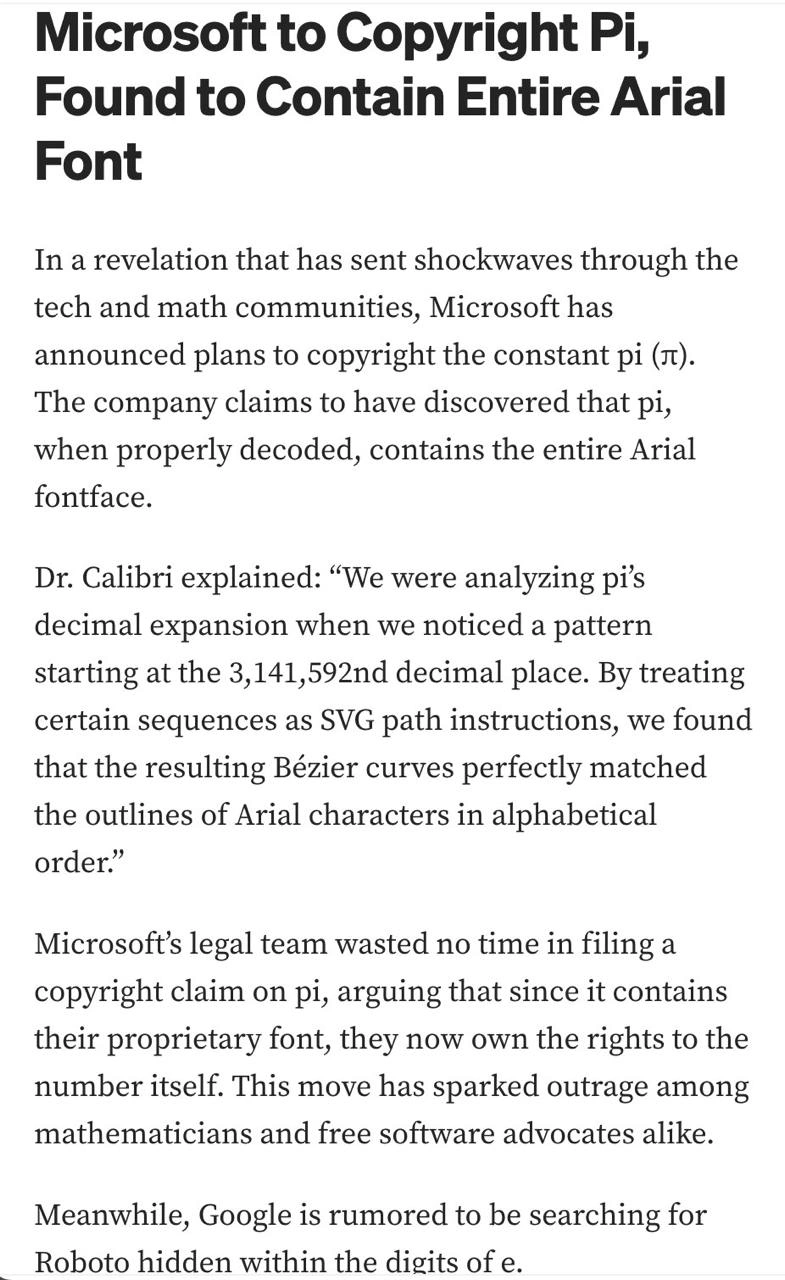
This image is a screenshot of a satirical news article with the headline, 'Microsoft to Copyright Pi, Found to Contain Entire Arial Font.' The text humorously claims that Microsoft has discovered its proprietary Arial font encoded within the decimal expansion of the mathematical constant pi (π), starting at the 3,141,592nd decimal place. The article invents a 'Dr. Calibri' (a pun on the Microsoft font) who explains the 'discovery' involved interpreting digit sequences as SVG path instructions. Consequently, Microsoft's legal team is filing a copyright claim on the number itself. The article concludes with a punchline that 'Google is rumored to be searching for Roboto hidden within the digits of e.' This is a sophisticated piece of satire that mocks corporate intellectual property overreach by applying it to the absurd concept of owning a fundamental, irrational number. The humor is aimed at an audience that understands the properties of transcendental numbers, font rendering technology (SVG, Bézier curves), and the corporate rivalry between Microsoft and Google

Comments

50
Anonymous ★ Top Pick I'm not worried. The Pi File System has infinite storage, but the `seek()` operation has an O(N) complexity where N is the starting decimal, and nobody has that kind of time
  1. Anonymous ★ Top Pick

    I'm not worried. The Pi File System has infinite storage, but the `seek()` operation has an O(N) complexity where N is the starting decimal, and nobody has that kind of time

  2. Anonymous

    If Microsoft can copyright the π offset that reconstructs Arial, how long before calling sin() in production triggers a lawyer’s telemetry ping - proof that Kolmogorov complexity now ships with an enterprise EULA

  3. Anonymous

    Next week's announcement: Oracle discovers the Fibonacci sequence contains their entire database licensing agreement, retroactively billing nature itself for unauthorized replication across pinecones and nautilus shells

  4. Anonymous

    This brilliantly skewers the tech industry's IP maximalism by extending copyright logic to its absurd conclusion - if you can encode data in anything, you can claim ownership of everything. The '3,141,592nd decimal place' detail and the fictional 'Dr. Calibri' (named after Microsoft's default font) are chef's kiss touches. It's the perfect commentary on how Big Tech's legal departments have become more aggressive than their engineering teams, and how we've reached a point where claiming ownership of mathematical constants feels only slightly more ridiculous than some actual IP lawsuits. The Google/Roboto/e punchline nails the competitive one-upmanship that defines FAANG culture - because of course they'd try to copyright a different fundamental constant

  5. Anonymous

    Microsoft can copyright π because its digits decode to Arial Béziers? Cool - Legal just made normal numbers a supply‑chain risk, so we replaced circles with taxicab geometry and called it compliance

  6. Anonymous

    Pi's decimals encoding Arial via SVG Béziers? Microsoft's ultimate type pun: infinite glyphs, zero public domain

  7. Anonymous

    Legal just found the shortest way to ship Arial: pi.seek(3_141_592).decode('svg'); compliance now wants royalties per floating point

  8. @mpolovnev 1y

    So, napstering Metallica music is not a crime, the music was encoded in Pi even before Hetfield's birth!

    1. @SamsonovAnton 1y

      Unfortunately, douchebag lawmakers invented such thing as illegal numbers.

  9. @VanuxaKR 1y

    🤓🤓🤓🤓🤓🤓 If something has infinite expansion, it doesn't mean it will contain anything Counter example: A number that has a repeated string 123456789 divided by increasing in size string of zeroes: 0.123456789012345678900123456789000... 🤓🤓🤓🤓🤓🤓

    1. @leRotten 1y

      This is not a problem as you have an infinite sequence of numbers without repeatable patterns (as we are dealing with an irrational number by definition). I have tried to implement that PI-file system 10 years ago and reached very obvious limitation: scientist have been calculated a millions of PI digits, but that roughly means that we have only several megabytes in file equivalence. And you guess - it's hard to find a lot of files inside several MB 😁 Even if you will try to search only parts of file you can reach fast ping when your "archived" data (offsets and lengths ) takes more size that original

      1. Felix 1y

        I guess it only serves to claim that there cannot be any drm

        1. @leRotten 1y

          Why? You can ship drm content to client and decode it via secure device only, so original data will be safe. And if you are trying to say that any content can be found inside the PI digits - good luck to white a "content miner" 😂 That's same effective like trying to find movie by slapping random data until it matches the hash... Btw you can try to repurpose mining farm for this, still that may be not worth it

      2. @mira_the_cat 1y

        haven't like trillion of pi digits been calculated?

        1. @leRotten 1y

          Oh, you are correct, they have calculated a lot more since I touched this topic... Then, you can ignore my complains of only several MB of data equivalent, and just download calculated Pi to find something useful in it! That's amazing feeling that something became better in ten years

        2. dev_meme 1y

          You can start calculation now starting from any arbitrary position. Look up Bailey-Borwein-Plouffe algorithm And yes, it’s made specifically for hexadecimal representation of Pi

          1. dev_meme 1y

            Actually it seems Simon Plouffe found how to calculate Nth number even in decimal, fantastic! https://mathworld.wolfram.com/Digit-ExtractionAlgorithm.html

        3. dev_meme 1y

          Wanna calculate 29385293592394230114512590129059120940912410294901290491024190249011092904109920409th digit of Pi after the dot? You got covered!

      3. @purplesyringa 1y

        This very much is a problem: there are infinite sequences of numbers without repeatable patterns that don't contain some of the patterns. For example, the string 011011100101110111... does not contain a 2 despite not being cyclic

        1. @purplesyringa 1y

          In fact, it is an open problem whether pi contains an arbitrary number as a substring

          1. @sylfn 1y

            (what base system do you consider?)

            1. @purplesyringa 1y

              Any base

        2. @leRotten 1y

          You will find any number on the infinity scale. That's it. Just skip a lot of "wrong" digits. But real systems have no infinity space for all that digits, nor infinite time/CPUs to calculate all that digits in realtime to find your file. So theoretically you can build file system which already contains all files and can operate with offset and lengths to define a file. In practice it is just a beautiful concept shows how abstract math is cool (and how it sucks when face applied math/computational theory)

          1. @purplesyringa 1y

            Do you have a proof of this statement? As far as I am aware, this is an open problem

            1. @leRotten 1y

              That was stated ten years ago that digits in PI has even distribution, which implies any combination has same chance to occur next. I was not checking all that math myself that time, and not going to check it this time as I said that other problems will sink this idea in reality. If something changed with PI - just use any another irrational number. What reason if it will not work in real world in the end?

              1. @purplesyringa 1y

                It is unknown whether pi is normal. I'm not sure where you got your information from, but that's very much an unsolved problem

                1. @leRotten 1y

                  Then, it's idea died twice 😁

              2. @purplesyringa 1y

                I'm not arguing that this storage method would be useless with any number, that seems clear. I just want to get the facts straight

        3. @mira_the_cat 1y

          don't digits in π distributed uniformly?

          1. @purplesyringa 1y

            Whether that's true is an open problem

    2. Felix 1y

      Though pi has no structure afaik

  10. Felix 1y

    https://github.com/philipl/pifs

  11. Felix 1y

    how could you claim ownership if this immaterial good exists in nature? it would be like owning a number

    1. @leRotten 1y

      That damned feds and corps will try to restrict or patent everything https://en.m.wikipedia.org/wiki/Illegal_number

    2. @leRotten 1y

      Basically you can sell a photo of a mountain, as you did this photo, but you don't own the mountain itself. Same with digital content - you found it in the ocean of a random information, so you can sell it as you were first one

      1. Felix 1y

        but cannot forbid others to sell the same numbers

        1. @leRotten 1y

          Basically piracy and slavery is banned, but this does not stop them to happen 🤷‍♂ Humans do love "free" money. From my point of view any good art (movies, music, drawings, games) should be payed as if you will not support people trying make real art - you will end up with pay-to-win clones of some stupid game every where

  12. @AmindaEU 1y

    https://libraryofbabel.info/

  13. @ZgGPuo8dZef58K6hxxGVj3Z2 1y

    LMFAO

  14. @ZgGPuo8dZef58K6hxxGVj3Z2 1y

    You are trying to tell me, if I start generating the decimals of PI and I calculated the 3,141,591st digit the following digits will have the beizer curve parameters for each glyph face in alphabetical order? Did I understand this correctly?💀

    1. @ZgGPuo8dZef58K6hxxGVj3Z2 1y

      This must be next level compression then /s

  15. @ZgGPuo8dZef58K6hxxGVj3Z2 1y

    Yeah thats true but what are the chnaces your font starts showing up at 3,141,592nd place which is also PI without a decimal point, I think thats the point (pun intended)

  16. @ZgGPuo8dZef58K6hxxGVj3Z2 1y

    Wait this is fake

  17. @ZgGPuo8dZef58K6hxxGVj3Z2 1y

    Since when do fake news count as memes

    1. dev_meme 1y

      Always?

      1. @AmindaEU 1y

        r/NotTheOnion /s

    2. dev_meme 1y

      Wait, how de fuck you considered second part to be real ?

      1. @ZgGPuo8dZef58K6hxxGVj3Z2 1y

        I have no clue man tbh

      2. @ZgGPuo8dZef58K6hxxGVj3Z2 1y

        I thought Dr. Calibri would never lie

  18. Deleted Account 1y

    that's.... 🤔🤯

Use J and K for navigation