Skip to content
DevMeme
1953 of 7435
The Evolutionary Ladder of IT Operations Buzzwords
DevOps SRE Post #2169, on Oct 18, 2020 in TG

The Evolutionary Ladder of IT Operations Buzzwords

Why is this DevOps SRE meme funny?

Level 1: It Got Out of Hand

Imagine you start with a very simple task, like building a small sandcastle by yourself. That’s like the basic Ops – one person, doing one job, in their own little sandbox. Then your friend comes along to help you build it faster and bigger. Now you have a team – that’s like DevOps, where two people cooperate to make something better together rather than separately. Next, another friend joins who says, “Hey, we should also make sure our sandcastle has a lock and alarm so nobody can kick it over!” This is like adding Security (DevSecOps) – you’re not just building fast, you’re also protecting what you build. The castle gets some sturdy walls now. Then a robot rolls up and says “I can help too! I’ll use my AI brain to make the best sandcastle design!” This is like adding Machine Learning (MLOps) into the mix – it sounds super clever, but now things are getting a bit weird because the robot’s ideas are new and experimental (a robot building sandcastles is like a fish growing legs – not something you see every day). Finally, before you know it, your little sandcastle project has turned into a giant, roaring sandcastle dinosaur 🦖 that’s stomping around the beach! It’s so huge and all-inclusive that it doesn’t care about who’s on what team anymore – it just does everything. The only thing that could stop it is something crazy like a meteor from the sky. At this point, you step back and think, “Umm, what were we doing again? We just wanted a sandcastle, right?”

The humor here is that a tiny simple thing (one person doing Ops) evolved into an over-the-top monster because we kept adding more and more layers (DevOps, then DevSecOps, then MLOps...). It’s like making a sandwich and then endlessly piling on more stuff: first bread and peanut butter, then jelly, then pickles, then ice cream, then spaghetti – until you have a huge bizarre sandwich that only a T-Rex would dare to eat. 🍔😆 By the end, you kind of forget that you just wanted a normal lunch! In the same way, the meme jokes that in the tech world we started with something simple (Ops) and kept expanding it with new ideas (which were each good in their own way), but eventually it became a bit absurd (TriceratOps the dinosaur). It’s funny and silly, and it reminds us how small things can grow into ridiculously big things if you just keep adding on.

Level 2: From Silo to Dino

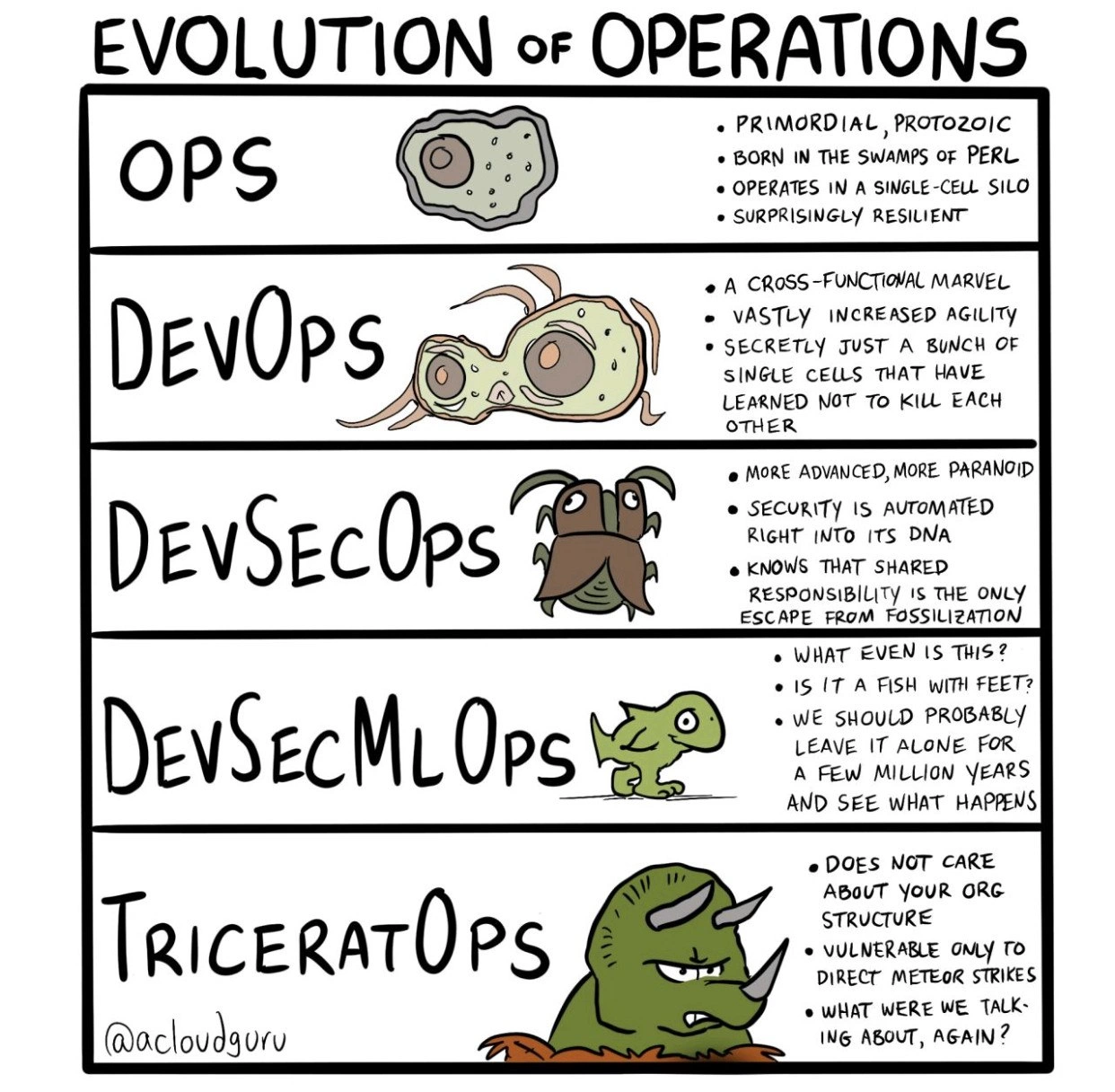
This meme shows a fun timeline of “Ops” evolution — essentially how roles in IT operations have changed (and gotten more complex) over the years. Each stage in the cartoon (Ops → DevOps → DevSecOps → DevSecMLOps → TriceratOps) corresponds to a trendy term:

  • “Ops” (Operations): This is the starting point, depicted as a tiny single-cell organism. In tech, Ops traditionally refers to IT Operations or system administration. These are the folks who keep servers running, deploy software, manage networks, etc. The meme’s labels (like “Primordial, Protozoic”) joke that this stage is ancient and simple. “Operates in a single-cell silo” means early Ops people often worked in isolation (siloed from others). For example, in a classic company setup 15-20 years ago, developers wrote code and then “threw it over the wall” to the Ops team to deploy and maintain. Ops was its own separate department – like a lone cell living by itself. The mention of “Born in the swamps of Perl” is a playful jab at the tools of that era. Perl is a programming/scripting language that was extremely popular for sysadmin tasks (especially in the 90s). Saying Ops was born in Perl’s swamps conjures an image of sysadmins writing countless Perl scripts in dark server rooms back in the day. It’s both a bit of tech nostalgia and a joke that early operations could be messy but organic (like a swamp). Despite being “protozoic”, this lone Ops stage is “surprisingly resilient” – meaning those old-school operations practices, though primitive by today’s standards, often worked reliably. Many junior folks might not realize it, but lots of critical infrastructure in the early web era was held together by simple scripts and one or two dedicated Ops people. This panel sets the stage: once, operations was simple (one “cell”), but also rigid and separated from others.

  • “DevOps”: The second stage shows a slightly more developed creature (imagine that single cell grew some limbs). DevOps stands for Development + Operations. This term started gaining popularity around 2009-2010 in the industry. It represents a cultural and technical shift: instead of developers and ops working separately (and often at odds), DevOps culture has them collaborate closely, sometimes even being on one unified team. The meme calls DevOps “a cross-functional marvel” with “vastly increased agility.” Cross-functional means a team composed of different expertise areas (in this case dev and ops working together, maybe also QA and others), and “agility” refers to the ability to move quickly and adapt (like rapid code deployments, quick responses to issues). So basically, DevOps is about breaking down silos so software can be delivered faster and more reliably. For a newer developer, think of it this way: under DevOps, the person who writes the code (dev) and the person who deploys/maintains the code (ops) are no longer separate strangers — they plan things together, use automation tools, and share responsibility for success. This often involves practices like CI/CD pipelines (Continuous Integration/Continuous Deployment), using tools such as Jenkins, GitLab CI, or GitHub Actions to automatically build and deploy applications. It’s a huge change from the old days of, say, a developer finishing code and then waiting weeks for an ops team to configure servers and release it.

    The funny part of the DevOps panel is the line: “Secretly just a bunch of single cells that have learned not to kill each other.” 😂 This is a humorous reality check. It suggests that even in DevOps, where teams are supposed to work as one organism, in reality you still have individuals or sub-teams (the “cells”) with their own specialties. The difference is now they communicate and cooperate instead of clashing. So inside a “DevOps team,” you might still have one person who’s more of a coder and another who’s more of a sysadmin, but they coordinate their efforts. They’ve “learned not to kill each other” meaning they avoid the old fights (for instance, devs blaming ops “Why is the server slow?” and ops blaming devs “Your code is leaking memory!”). In practice, a junior dev might notice that at a modern startup, there isn’t a separate ops department; instead, developers and infrastructure engineers work side by side, use the same DevOps tools (like Docker, Kubernetes, Terraform), and solve problems together. The team functions like a multi-cell organism where each cell knows its role but they share a common goal. The meme is winking at the fact that beneath the buzzword, DevOps is essentially about collaboration and not being siloed. Everyone still has their specialty (like different organs in a body), but they operate in concert. This greatly increases the “agility” of the whole (software gets delivered faster and more reliably). So, DevOps = better teamwork + automation, compared to the isolated “Ops” days.

  • “DevSecOps”: The third stage adds another prefix: Sec, for Security. Now the creature in the cartoon looks even more complex (the drawing looks like a bug or crab, implying hardened and watchful). DevSecOps means Development + Security + Operations. This concept rose to prominence in mid-2010s as people realized security should be part of the DevOps process, not a separate thing. The meme says “More advanced, more paranoid” and “Security is automated right into its DNA.” This essentially means that in a DevSecOps approach, security checks and practices are built into the development and deployment pipeline from the get-go. If you’re a junior dev, imagine you push code and automatically it’s scanned for known vulnerabilities (using tools like OWASP dependency-check or GitHub’s security alerts). Or your container images are scanned for security issues before deployment. That’s security automated in the DevOps workflow. “Paranoid” here is used affectionately – security-minded folks are always thinking of what could go wrong. In a DevSecOps culture, the team collectively adopts that mindset to preempt bugs and breaches.

    The phrase “shared responsibility is the only escape from fossilization” might sound grand, but it’s basically saying: if devs, ops, and security don’t share responsibility for outcomes, the process will become outdated (a fossil). In traditional setups, dev would be responsible for code, ops for uptime, sec for audits – and if something went wrong, each might say “not my fault, it’s their domain.” That old mode can slow everything down (imagine waiting for a security officer’s approval before every release) and leads to finger-pointing. Shared responsibility means everyone feels ownership for making the product secure and stable. No “us vs them.” This is actually a key principle of DevSecOps: a developer fixes security issues in code as part of their job (not “throw it to security team”), ops engineers think about security config, and security specialists work with the team continuously rather than gating releases at the end. By doing so, the team avoids becoming a “fossil” because they can adapt quickly without waiting on siloed approvals. For a concrete example: think of how companies deploy code to production dozens of times a day (that’s modern DevOps). If you had to get a separate security team’s green light each time, you’d slow to a crawl. Instead, DevSecOps would automate security tests in the pipeline and empower developers to make certain security decisions, so speed and safety go hand-in-hand. The meme’s mention of “fossilization” also cheekily ties back to the dinosaur theme — avoiding fossilization (becoming a stationary fossil) means you keep evolving and don’t get left behind. So DevSecOps is shown as this more evolved creature because it has security “baked in” and a culture that’s proactive about safety, which is indeed a more advanced way of operating in today’s world of constant cyber threats.

  • “DevSecMLOps”: Now it gets a bit crazy. They’ve added ML (Machine Learning) into the mix, making DevSecMLOps. The cartoon draws this as a weird little amphibian-like creature (a fish with legs). The text next to it literally asks “What even is this? Is it a fish with feet?” which acknowledges how odd and mashing-together-of-terms this is. To clarify, MLOps is a real term referring to practices that apply DevOps principles to Machine Learning workflows. Why is that needed? Because developing ML models (what data scientists do) and deploying/maintaining them in production (what ops or ML engineers do) has its own challenges — data versioning, model training pipelines, etc. Many organizations realized they need a “DevOps for ML”, hence MLOps. However, DevSecMLOps (all in one word) is not commonly used; it seems the meme creators humorously piled everything on to see if it floats. It’s like saying “not only do we develop and operate with security in mind, we also throw in machine learning too!”

    For someone newer: imagine you’re working on a web app, and now your team also wants to use an AI model in it (say, to recommend products). With MLOps, you’d treat the ML model training and deployment with the same rigor as you treat code. So you’d have version control for datasets, automated model training and testing, continuous deployment of models, monitoring model performance in production — all similar to how normal code is continuously integrated and deployed. Now, add “Sec” means you’re also ensuring that the ML pipeline is secure (e.g., guarding against data poisoning attacks, securing who can access model-serving endpoints, etc.). So DevSecMLOps would be the ultimate fusion: dev, sec, ops, and ML all working in concert. Sounds… complicated, right? That’s why the meme jokes “What even is this?!” because it’s a lot to chew on.

    The line “We should probably leave it alone for a few million years and see what happens.” basically means this idea is so new or strange that we don’t know how it will evolve. Translated to tech: maybe the industry needs time to figure out best practices when you combine all these things. If you’re a junior dev, you might not have encountered “DevSecMLOps” explicitly, but you might have seen how AI/ML is the new hot thing everywhere. Sometimes companies rush to sprinkle ML on everything (even when it’s not needed or not mature enough), much like that fish trying to walk on land before it’s fully ready. The meme humorously suggests giving it time. In other words, today’s ML in DevOps might be a bit premature or experimental, but who knows, it could find its footing later (like how the first amphibians eventually led to reptiles, etc.). From a learning perspective: DevSecMLOps isn’t a standard term to study, it’s more a joke about combining buzzwords. But it touches on real trends:

    • AI in Ops (often called AIOps) where machine learning is used to analyze logs and alerts to help ops teams (for example, using ML to predict outages or auto-resolve common issues).
    • Security with ML (using ML to detect security anomalies, or conversely securing ML systems).
    • These are cutting-edge areas, not fully settled. So the meme rightly portrays it as a strange newcomer in the evolutionary chain that we’re not 100% sure about yet.
  • “TriceratOps”: Finally, the meme goes to a totally made-up stage: TriceratOps. This is not an actual methodology; it’s a pun combining Triceratops (a dinosaur) with Ops. The cartoon draws a green Triceratops (three horns and all) looking menacing. The bullet points say: “Does not care about your org structure”, “Vulnerable only to direct meteor strikes”, and “What were we talking about, again?”. This is a humorous climax to the evolution story — basically an absurd “final form”. If you’ve ever played Pokémon or similar games, think of it like the ultimate evolution of an Ops creature (Ops → DevOps → DevSecOps → ... → TriceratOps!). It’s intentionally ridiculous, showing that if we keep adding more and more to “Ops”, we end up with a giant dinosaur that might be unstoppable.

    “Does not care about your org structure” suggests that by this point, the evolved Ops creature is so beyond the usual corporate setup that whether your company has separate departments or not is irrelevant. In an ideal (or comical) world, maybe Dev, Sec, Ops, ML are so integrated that the distinctions vanish — the TriceratOps just gets everything done regardless of traditional roles. It’s like it tramples over org charts 😄. For a junior dev, this might sound cool (no bureaucracy, just pure teamwork), but also impossible — and that’s sort of the joke.

    “Vulnerable only to direct meteor strikes” is referencing how dinosaurs famously went extinct: a meteor strike. By analogy, this suggests our TriceratOps approach is so robust that only something huge and external could take it down. Maybe think of it as: if you truly had Dev + Sec + Ops + ML all perfected and unified, nothing internal could beat your process — you’d be a high-performing tech beast. Only a giant external disaster (like maybe a total tech paradigm shift or a world event) could disrupt you. It’s hyperbole, of course, played for laughs.

    The final line, “What were we talking about, again?”, is the meme-maker basically winking at us that this has gotten out of hand. By the time we say “TriceratOps,” we’ve mixed so many concepts that we’ve lost the plot. It’s as if the conversation or evolutionary path became so convoluted that we don’t even remember why we started. This is a common comedic beat — escalating something to absurdity and then stepping back to highlight the absurdity. Here it underlines the buzzword overload. In real life, if someone in a meeting seriously said, “We need to implement DevSecMLOps, or better yet TriceratOps,” most of us would laugh or be utterly confused. The meme’s author (@acloudguru) is using this to poke fun at how every year there’s a new “Ops” term or fad. It reminds everyone not to get too carried away chasing the latest hype without remembering the core goals.

In simpler terms: the meme traces the transformation of Ops roles:

  1. Ops – lone, old-school system admin era, very siloed, lots of manual scripting (Perl).
  2. DevOps – devs and ops join forces, automation and collaboration increase, faster delivery.
  3. DevSecOps – add security into that mix from the start, making the process safer and still fast.
  4. DevSecMLOps – attempt to incorporate machine learning into the pipeline (either using ML to improve ops, or applying DevOps to ML projects), currently a bit experimental or “early evolution”.
  5. TriceratOps – a joke stage implying an ultimate form (maybe fully integrated everything or just a humorous exaggeration) that’s so extreme we’ve lost context.

Throughout these, the meme uses evolution imagery (from single cell to dinosaur) to mirror the progression from simple to complex in tech culture. Each caption carries a tongue-in-cheek truth about that stage:

  • Ops being resilient but stuck in its silo.
  • DevOps being agile but still composed of distinct parts working together.
  • DevSecOps being advanced and aware (paranoid) because it includes security and requires everyone to be responsible.
  • DevSecMLOps being weird and new – unclear but possibly significant later.
  • TriceratOps being literally beyond comprehension (and making fun of our tendency to overdo it).

For a newcomer in DevOps or IT, the key takeaways (and why it’s funny) are: the tech world loves compound buzzwords (“Ops” gets so many prefixes now), each one arose for a reason (to fix a gap in the previous approach), but taken together over time, it looks kind of crazy. The meme is a lighthearted way to learn that history. If you hear these terms:

  • DevOps: think collaboration and automation (Dev + Ops together).
  • DevSecOps: same as DevOps but security is everyone’s job too.
  • MLOps: applying those ideas to machine learning projects.
  • And if someone says TriceratOps… they’re probably joking, referencing this meme or implying something is overly complex!

One more detail: the TriceratOps pun also hides something funny for dinosaur enthusiasts: “Triceratops” literally means “three-horned face.” The name TriceratOps slyly implies maybe three “Ops” horns (Dev, Sec, Ops) combined into one beast. It’s just a fun play on words, not an actual term you need to know. So don’t worry, you won’t see a job listing for “TriceratOps Engineer” … at least, not until some joker in HR posts one as a prank.

In the end, this meme falls under DevOps humor and industry trends satire. It uses a simple evolutionary comic to convey how far modern operations has come from the old days, and it laughs at the hype that sometimes we create ourselves. For someone learning about these fields, it’s both a chuckle and a mini-history lesson of Ops: knowing these terms and their lineage can help you understand why certain practices exist (e.g., why we emphasize collaboration → that’s DevOps, or why we integrate security early → that’s DevSecOps). And perhaps it gently warns: don’t get too caught up in adding fancy buzzwords; focus on what each evolution was trying to achieve. Otherwise, you might end up with a TriceratOps situation where even you wonder, “Wait, what was the point of all this again?” 😉

Level 3: Organizational Darwinism

In this meme, DevOps culture literally meets Darwin’s theory of evolution. Each panel is a stage in the evolution of IT operations — from a lone, primordial Ops organism to the final tongue-in-cheek dinosaur “TriceratOps.” This satirical evolutionary tree pokes fun at how our industry keeps tacking on new prefixes (Dev, Sec, ML, etc.) to “Ops,” claiming each as a revolutionary species. Seasoned engineers recognize the pattern: buzzword-driven development of roles and methodologies. Let’s dissect the stages, tracing how we got from the “swamps of Perl” to a three-horned operations beast, and why it’s hilariously true.

  • OPS – Primordial, Protozoic: The journey begins in the primordial ooze of IT. The meme’s first panel shows a single-celled blob labeled Ops, with bullet points like “Born in the swamps of Perl” and “Operates in a single-cell silo.” This is a nod to the early days of system administration. Back in the '90s and early 2000s, Ops was often a solitary creature: system administrators writing scrappy Perl scripts and Bash one-liners to keep servers alive. The “swamps of Perl” evokes those rough-and-ready Perl scripts sysadmins used for everything from backups to CGI web pages (Perl was famously called the “duct tape of the internet”). It’s primordial because this was the era of highly manual, individualized work—each Ops engineer a lone amoeba in their own server silos.

    Despite its primitive nature, the meme notes this single-cell Ops is “surprisingly resilient.” And indeed, old-school Ops had to be tough. Veteran sysadmins recall 2AM pager calls and duct-tape solutions that somehow kept working. That resilience came from a survivalist mentality: when you’re the sole caretaker of fragile servers, you script and hack whatever keeps the system running. Many of those clunky Perl scripts became mission-critical (nobody dared touch them — if it ain’t broke, don’t fix it!). This panel nails the DevOps humor of legacy systems: seemingly simple, single-purpose scripts (single-cell organisms) that miraculously survive years of production use. Seasoned Ops folks chuckle because they’ve seen “simple” one-off scripts turn into irreplaceable infrastructure, living on like hardy protozoa in the corporate data swamp.

  • DevOps – Multi-Cellular Cooperation: Next, the cartoon evolution moves to DevOps, drawn as a slightly more complex amoeba sprouting limbs. The bullets praise it as “A cross-functional marvel” with “vastly increased agility.” This references the DevOps movement that emerged ~a decade ago, bridging Development and Operations. In biological terms, DevOps was the Cambrian explosion moment for IT organizations — a jump from single-celled work to multi-cellular teamwork. Suddenly, devs and ops were supposed to work in one organism (often a unified team or pipeline), enabling rapid evolution (er, deployment). The meme’s “vastly increased agility” is what DevOps promised: with collaboration and automation (CI/CD), software could evolve and ship faster than the old silo days.

    Yet the funniest line here is “Secretly just a bunch of single cells that have learned not to kill each other.” 😅 This is DevOps irony at its finest. In theory DevOps meant one smooth organism, but in practice many DevOps teams were collections of former silos (dev, ops, QA) now forced to cooperate. Like an early multi-cellular creature, the cells (specialists) still retain their identities, but they’ve agreed on peaceful coexistence. Any senior engineer who’s been through a DevOps transformation can relate: you break down the wall between Dev and Ops, but cultural differences remain. Devs push changes, Ops worries about stability — the two must learn not to “kill” each other’s efforts. The meme wittily implies DevOps is like an organism held together by a truce: the Dev cell and the Ops cell won’t wage war (no more “It worked on my machine!” fights) — at least most of the time. This hits home for those who have sat in post-mortems where Dev and Ops folks, now on the same team, navigate blamelessly instead of finger-pointing. It’s a cross-functional marvel, yes, but internally we know it’s “a bunch of parts cooperating.”

    Technically, DevOps also brought a toolchain Cambrian explosion: config management, CI servers, containers, cloud automation — vastly increased agility through new tools and shared responsibility. The elder crowd recalls how integrating these was messy. Like early multi-cell life, sometimes the cooperation fails (e.g., a CI/CD pipeline miscommunication where a deployment script “kills” a running service — echoing cells that haven’t learned not to kill each other). That line garners knowing laughs from war-torn DevOps engineers: it’s fair to say many so-called DevOps “organisms” can still fall apart if team harmony breaks down or if one component (say, QA or DB admin) wasn’t truly integrated. The meme calls out our tendency to rebrand old parts as a new whole, without magically erasing their boundaries. DevOps culture aims to fuse these roles, but we all remember times it felt like glued-together single cells moving in unison until someone trips.

  • DevSecOps – Security in the DNA: The third stage is DevSecOps, depicted as a more advanced bug-eyed crab-like creature (perhaps with armor plating?). By now, our evolving Ops creature has grown paranoid eyes and a thicker shell. The captions: “More advanced, more paranoid,” and “Security is automated right into its DNA.” This is a nod to how Security got integrated into the DevOps pipeline. Historically, after dev and ops learned to cooperate, the obvious next question was: “What about security?” In older models, security (InfoSec teams, auditors) were an external oversight — often a last-minute check before release, which could stop deployments cold if issues were found. DevSecOps (Development + Security + Operations) arose to bake security in from the start. Just as DNA encodes traits from birth, security checks and practices are built into the CI/CD pipeline in DevSecOps. This creature’s “DNA” has security automation: think code analysis, dependency vulnerability scans, container image checks, infrastructure-as-code security policies all running automatically at every code commit. To experienced engineers, the phrase “security in its DNA” screams “Shift-left” – the practice of moving security and testing earlier in the development lifecycle so it’s part of the process, not an afterthought.

    The “more paranoid” quip is a playful jab at security mindset. Let’s face it: security folks have to be a bit paranoid, always thinking about worst-case scenarios (“Who might attack? Did we lock every door?”). In a DevSecOps culture, the team collectively adopts some of that paranoia in a healthy way. The meme suggests this evolved creature is “more advanced” (higher up the evolutionary chain) because it’s cautious and armored. Seasoned DevOps engineers relate to the DevOps -> DevSecOps transition: initially, teams focused on speed and agility (DevOps) sometimes 🚀 moved fast and broke things (including security 😬). But high-profile breaches and production mishaps taught the industry that moving fast without security makes you a fossil. So DevSecOps evolved, adding a security exoskeleton to the agile DevOps amoeba.

    The bullet “Knows that shared responsibility is the only escape from fossilization” is especially insightful. It implies that if devs, ops, and sec don’t share responsibility, the organization risks becoming a slow, lumbering dinosaur (unable to adapt, headed for extinction aka fossilization). In real terms, a company where “that’s the security team’s problem, not mine” will struggle to innovate quickly and may get wiped out by security failures or slow response. Shared responsibility is the DevSecOps mantra: everyone is responsible for security, not only a separate silo. This line resonates with senior engineers because it references both evolutionary survival and a real DevOps pain point. We’ve all seen companies that don’t evolve — clinging to siloed security approvals, lengthy change control processes — and how they fall behind (turning into fossils in the era of cloud-native speed). The meme deftly combines a serious truth (integrate or die) with humor (a paranoid crab creature that’s somehow more advanced). The DevOps/SRE community often jokes that failing to adapt process is how you become the next “Blockbuster” in a Netflix world — in other words, meteor strikes (massive disruptions) wipe out the rigid.

  • DevSecMLOps – The Weird New Species: Now the evolution gets weird. The fourth panel lists DevSecMLOps, illustrated as a tiny lizard-fish with legs – a clear reference to a fish with feet (like Tiktaalik, the famous transitional fossil between fish and amphibians). The captions go full snark: “What even is this?”, “Is it a fish with feet?”, “We should probably leave it alone for a few million years and see what happens.” 😂 This is the meme’s jab at the latest AI/ML hype creeping into DevOps. MLOps (Machine Learning + Ops) is an emerging practice, and here they’ve tacked it onto DevSecOps, yielding the unwieldy DevSecMLOps. It’s not a widely used term (people usually say “MLOps”), which is exactly the joke — it sounds like we’re just adding every buzzword to the stew. To a senior engineer, this hits on the absurdity of trend-chasing: suddenly every team “needs AI/ML” in their processes, even if it’s unclear why. “What even is this?” is exactly what a lot of us thought the first time we heard someone earnestly say “DevSecMLOps”. It’s a chimera of buzzwords, like that poor fish with legs unsure if it belongs on land or water.

    Technically, what MLOps aims to solve is quite profound: bringing DevOps principles (automation, collaboration, continuous delivery) to Machine Learning workflows, and sometimes using AI/ML to enhance operations (e.g. predictive monitoring, a trend sometimes called AIOps or DataOps). But smashing Dev + Sec + ML + Ops together in one term feels like overkill. The meme encapsulates that skepticism. The “fish with feet” analogy suggests DevSecMLOps is a nascent experiment of nature (or rather, of the tech industry). It might eventually crawl out and thrive – or not. The line “We should probably leave it alone for a few million years and see what happens” is laugh-out-loud funny to those of us bombarded by new frameworks and methodologies every year. It implies “this needs time to evolve on its own” – i.e., maybe today’s DevSecMLOps ideas are half-baked or premature, and only time (and natural selection of ideas) will tell if it becomes a stable part of the ecosystem or a dead-end branch.

    A cloud engineer or ML engineer reading this might recall awkward early attempts to plug ML into DevOps pipelines. For example: companies hastily adopting AI for security analytics that produce more noise than insight (the fish’s legs aren’t working so well on land...), or data science teams struggling to integrate with DevOps processes, leading to kludgy pipelines (like a creature that’s neither a good fish nor a good lizard). The meme encourages a healthy cynicism: do we really need to slap “ML” into DevSecOps now, or are we doing it just because it’s trendy? A DevOps veteran can’t help but smirk because they’ve witnessed management fads—today it’s “Add AI to everything!” even when the value is uncertain. Much like biologists marvel (or wince) at a bizarre evolutionary offshoot, experienced engineers look at DevSecMLOps proposals and go “Uhh, maybe let’s observe this creature for a bit.” It’s a witty commentary on industry trends & hype: not every evolutionary leap is a good one, some end up like the weird amphibian that time forgot.

  • TriceratOps – The Ultimate (Extinct?) Form: Finally, we reach TriceratOps, drawn as a grumpy green three-horned dinosaur glaring at us. This is the pinnacle (or punchline) of the evolution chart, and it’s not a real methodology – it’s a punny amalgamation of Triceratops (the dinosaur) and Ops. By the time we get here, the meme has gone fully absurd, which is the point. The bullets for TriceratOps read: “Does not care about your org structure”, “Vulnerable only to direct meteor strikes”, and “What were we talking about, again?”. This exaggeration lands perfectly with those of us jaded by the endless X-Ops buzzwords. It suggests a hypothetical endgame: an Ops methodology so evolved and powerful, it’s like a dinosaur roaming the earth, impervious to everything short of an extinction-level event. In plain terms, maybe one day we’ll integrate Dev, Ops, Sec, ML – and every other trendy discipline – so thoroughly that team boundaries (org structure) truly don’t matter. That sounds awesome… except by then we might have created a bureaucratic behemoth or a prehistoric monster! 🦖

    The line “does not care about your org structure” reflects an ideal (or nightmare) scenario familiar to senior folks: an organization where the old divisions (dev team, ops team, security team, ML team, etc.) have completely dissolved. In theory, that could mean ultimate agility — no silos at all — everyone just builds and runs everything. This resonates with the DevOps mantra of breaking silos so much that even the word “DevOps” one day might disappear because it’s just “how things are done”. TriceratOps might be this fully integrated super-organism that doesn’t even notice organizational charts or department lines. It just gets the job done, like a rampaging dino not noticing the fences. Of course, that image is both inspiring and a bit scary (hence the angry Triceratops face). It hints that such total integration could also be uncontrollable. The only thing that can stop TriceratOps is a meteor – “vulnerable only to direct meteor strikes.” That’s a cheeky way to say “nothing internal can beat it; only a giant external shock could bring it down.” Perhaps in real terms, this suggests that once an organization or methodology reaches a massive, dominant scale, the only threats are catastrophic events (think of an enterprise so successful and streamlined that only something like a total market collapse, a regulatory earthquake, or a paradigm shift – their “meteor strike” – could derail it). Some senior engineers might even read into this a reference to big tech’s dominance: e.g., a company with perfect DevSecMLOps (TriceratOps-level integration) would steamroll competition and only something like an external shock (maybe a regulation meteor or a economic crash) could knock it out.

    But the punchline is the last bullet: “What were we talking about, again?”. This breaks the fourth wall to show that by the time we’ve added Sec, ML, and whatever else onto DevOps, we’ve lost sight of the original point. 😂 It gently mocks our tendency to over-complicate things. A grizzled ops veteran reading “TriceratOps” likely smirks and thinks: Yep, we’ve officially gone off the rails. The meme ends by underscoring the absurdity of chasing every trend to the point of nonsense. It’s as if the narrator of this evolutionary story steps back and says “Wait, how did we end up talking about dinosaurs?!” This self-aware humor resonates deeply in tech circles — we’ve all been in meetings where so many buzzwords pile on that someone has to pause and ask, “Remind me, what problem were we solving again?” Exactly. TriceratOps is that final over-the-top concept that makes everyone realize the buzzword train has gone too far.

In summary, the “Evolution of Operations” meme brilliantly compresses decades of IT history and hype into a few comic panels. It satirizes how we evolved processes: starting from lone Ops heroes hacking in Perl, evolving into DevOps teams with continuous delivery (but human nature still peeking through), adding DevSecOps for built-in security (to avoid becoming obsolete fossils), then experimenting with MLOps (a wobbly new mutation), and finally joking about a fantastical TriceratOps. It’s funny because it’s true — each step on this evolutionary ladder corresponds to real trends in DevOps/SRE culture, yet the way the meme personifies them (as creatures from amoeba to dinosaur) highlights the ridiculous side of our industry’s constant innovation (and constant jargon). Seasoned engineers laugh (perhaps a bit self-knowingly) at how something as straightforward as “Operations” split and morphed into this menagerie of DevOps buzzwords. The meme’s dinosaur crescendo reminds us not to take the hype too seriously: if you add too many prefixes to “Ops,” you might end up with a monstrous name that no one truly understands — a TriceratOps staring us down, making us wonder …what were we doing again? 😜

Description

A five-panel comic titled 'EVOLUTION OF OPERATIONS' illustrates the progression of IT methodologies through biological metaphors. The first panel, 'OPS', shows a primordial single-celled organism, described as 'BORN IN THE SWAMPS OF PERL' and operating in a 'SINGLE-CELL SILO'. The second panel, 'DEVOPS', depicts a more complex two-celled organism, a 'CROSS-FUNCTIONAL MARVEL' where cells 'LEARNED NOT TO KILL EACH OTHER'. The third panel, 'DEVSECOPS', features an armored, paranoid insect-like creature with 'SECURITY...AUTOMATED RIGHT INTO ITS DNA'. The fourth panel, 'DEVSECMLOPS', shows a strange fish with feet, questioning its own existence ('WHAT EVEN IS THIS?'). The final panel, 'TRICERATOPS', is a literal Triceratops dinosaur that 'DOES NOT CARE ABOUT YOUR ORG STRUCTURE' and is 'VULNERABLE ONLY TO DIRECT METEOR STRIKES'. The image is watermarked '@acloudguru'. The comic satirizes the ever-increasing complexity and buzzword-driven nature of IT operations, showing a linear evolution that culminates in a pun. It reflects a sentiment among experienced engineers who have witnessed the cyclical nature of industry trends and the tendency to add more labels to existing practices
Comments

8
Anonymous ★ Top Pick Our stack's evolution went from Ops to Triceratops directly. It's big, slow, doesn't care about our org structure, and the only thing it fears is a company-wide cloud migration, the corporate equivalent of a meteor strike
  1. Anonymous ★ Top Pick

    Our stack's evolution went from Ops to Triceratops directly. It's big, slow, doesn't care about our org structure, and the only thing it fears is a company-wide cloud migration, the corporate equivalent of a meteor strike

  2. Anonymous

    Every time we bolt another prefix onto “Ops”, my Perl cronjob grows a new limb - at this pace the Q3 OKRs will demand a DevSecFinComplianceAIOpsaurus that still pages me at 3 a.m. for the same segfault

  3. Anonymous

    We've evolved from "you build it, you run it" to "you build it, you run it, you secure it, you train models on it, and somehow you're also responsible for the Kubernetes cluster that nobody fully understands anymore."

  4. Anonymous

    The evolution from Ops to TriceratOps perfectly captures the industry's journey: we started as isolated single-cell silos running Perl scripts, evolved into DevOps organisms that 'learned not to kill each other,' added security paranoia into our DNA with DevSecOps, then bolted on ML to create something so confusing we should 'leave it alone for a few million years' - only to end up as a dinosaur that's impervious to organizational restructuring but still vulnerable to the inevitable meteor strike of the next paradigm shift. The real extinction event isn't the meteor; it's realizing we've forgotten what problem we were solving in the first place

  5. Anonymous

    We kept prefixing Ops - Dev, Sec, ML - like evolutionary traits, but the creature that survives every audit, budget cut, and reorg meteor is TriceratOps: the bash+cron monolith nobody’s brave enough to kill

  6. Anonymous

    Triceratrops Ops: Evolved horns perfect for goring silos, but mostly used headbutting through endless org chart realignments while velocity fossils

  7. Anonymous

    Every reorg adds a new suffix to -Ops; the pager still escalates to the same Perl‑swamp wizard - now rebranded “Head of DevSecMLOps.”

  8. dev_meme 5y

    Fixed, thanks

Use J and K for navigation