Skip to content
DevMeme
2916 of 7435
The Ironic Trajectory of a Senior Developer's Career
VersionControl Post #3222, on Jun 12, 2021 in TG

The Ironic Trajectory of a Senior Developer's Career

Why is this VersionControl meme funny?

Level 1: Follow Your Dreams

Imagine you started out not even knowing how to ride a bicycle. Ten years ago, you’d never seen a bike and didn’t know what pedals or brakes were. Now, after lots of practice, you’re a biker zooming around every day – but guess what? You still fall off at least once a day 😅. Maybe you take on trickier trails or go really fast, and sometimes you skid and tip over. It might sound silly, but falling is actually a sign that you’re getting better and trying new things.

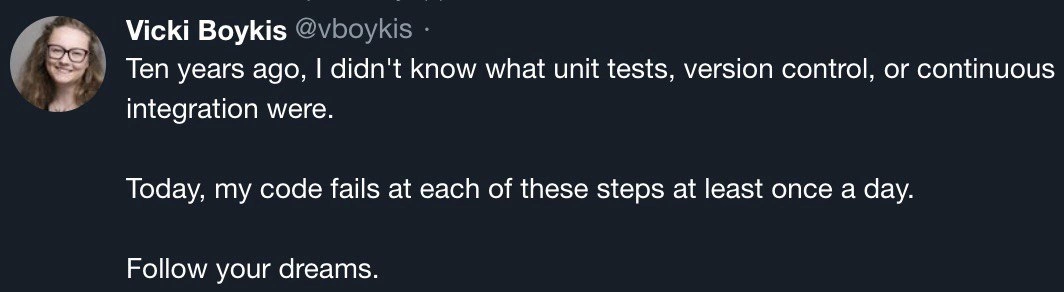
This meme is saying something similar about being a programmer. In the beginning, the person didn’t even know about certain important tools (kind of like not knowing what a bike is). Today, they use those tools all the time – they’ve become a real coder! – but they also make mistakes with them daily (like falling off the bike). The joke is that after working hard and “following your dreams,” you might not become perfect, but you’ll get to mess up bigger and cooler things than before 🤣. And that’s okay! It’s an encouraging kind of funny. It tells us that even if we spill the milk or burn the toast each day (in coding terms, break the tests or crash the build), it means we’re actually doing something and learning. So follow your dreams, because one day you’ll be so good that you’ll have brand-new, exciting ways to mess up – and you’ll be proud of how far you’ve come, even with a few scrapes and bruises.

Level 2: Failing Upwards

Let’s break down the technical terms and situations this meme references, and why they’re so relatable to developers at any level:

  • Unit Tests: These are short programs or scripts written to automatically test chunks of your code (usually functions or classes) in isolation. For example, if you have a function calculateInvoiceTotal(), you’d write a unit test to check that feeding it certain inputs returns the expected output. When a unit test fails, it usually means your latest code change caused some expected behavior to break. In early career, you might not have written or even heard of unit tests – many beginners just run their program and manually check the output. But as you gain experience (and work on larger teams/projects), writing unit tests becomes a daily habit. The funny part is that having a suite of unit tests means you get immediate bad news whenever you make a mistake. 🧪 Every dev remembers the first time they confidently changed some code, ran the test suite, and saw a wall of red failure messages. It’s a humbling moment. Now imagine doing that every day. Experienced devs do! A failing unit test is so common that seeing “Tests: 97 passed, 1 failed” in your console barely fazes you after a while. It’s not that you’re a bad programmer; it’s that you’re constantly pushing and refactoring code, and the tests are there to catch you when you slip. In this tweet, the author jokingly brags that now their code fails unit tests daily – which is tongue-in-cheek for “I write a lot of tests, and of course I break them often because I’m always changing the code.” It’s actually a sign of an active, evolving codebase. Better to break a unit test at 3 PM than break the actual app for users at 3 AM.

  • Version Control: This refers to tools and practices for managing changes to code over time, the most popular being Git. If you’ve ever used GitHub or typed commands like git commit and git push, that’s version control in action. For newcomers, version control can be an alien concept – you might have started coding by just keeping files on your computer, maybe naming them project-final-v2-REAL-FINAL.py because you weren’t sure how to track changes 😅. Ten years ago, our meme author didn’t know what version control was. Today, they likely live in Git all day – creating branches, merging code, resolving conflicts. “Failing at version control” could mean so many relatable hiccups:

    • Getting a nasty merge conflict because you and a teammate edited the same file. Now Git is asking you to choose which changes to keep, and it presents you with that ugly <<<<<< HEAD syntax in the file. Even senior devs groan at that sight – merge conflicts can be confusing and time-consuming to resolve.
    • Accidentally committing the wrong files (oops, did you include config.py with your secret keys in that commit? 😬). Or pushing code to the wrong branch (like deploying a half-finished feature to the main branch by mistake).
    • Rebase gone wrong: you tried git rebase to clean up history and ended up in a detached HEAD state or, worse, rewriting your teammate’s commits from history. Now everyone’s shouting “who force-pushed to main?!” and you sheepishly raise your hand. In short, nobody is immune to version control blunders. The meme’s author jokingly admits that they trip over Git daily, even after years of experience. It’s a way of saying: using version control is hard, and if you struggle with it, you’re not alone. The bright side? If you’re breaking things with version control, it means you’re actively collaborating and working on real codebases – something to be proud of, even if git occasionally makes you want to tear your hair out.
  • Continuous Integration (CI): This is a practice (and a set of tools) that continuously merges code changes from multiple developers into a single project and runs automated builds and tests to catch issues early. Popular CI services include Jenkins, Travis CI, CircleCI, or GitHub Actions. Imagine you and your team are all working on different features; instead of waiting weeks to combine your code (which would lead to a nightmare of conflicts and bugs), you integrate changes frequently (continuously). A CI pipeline is basically a robot teammate: every time you push code to the repository, the CI server automatically compiles the code, runs all the tests, maybe lints the code style, and sometimes even deploys it to a test environment. If anything is wrong – say one of those unit tests fails, or your code doesn’t compile – the pipeline marks that build as failed. This is super helpful… except it means you can’t hide from your mistakes. Everyone on the team gets to see that big red ❌ next to your commit, and often the CI system will send a chat message or email: “Build #542 failed: 1 test failed.” It’s a daily drumbeat in modern dev life. A broken build stops the show until it’s fixed; many teams have a rule that fixing the CI is top priority. So when the tweet says “my code fails at each of these steps at least once a day,” the CI failure is the grand finale. It implies that practically every day, some commit triggers a pipeline failure. Maybe the frontend tests didn’t pass because of a slight HTML change, or maybe a dependency wasn’t updated in the config, or perhaps the new code works locally but not in the containerized CI environment. It’s daily broken builds galore, and it’s incredibly relatable to anyone who’s dealt with complex CI setups. Even with years of practice, it’s hard to avoid the occasional red build. Sometimes it’s not even your fault – flaky tests or network issues can break CI – but as the developer who pushed the latest changes, you often feel the responsibility to fix it quick.

Now, why is all this funny? Because it’s self-deprecating humor that rings true for developers. The tweet sets us up with a classic “look how far I’ve come” setup – from not knowing these tools to using them daily – but then delivers the twist: using them daily means failing with them daily. The phrase “Follow your dreams” adds a layer of playful sarcasm. It mimics the inspirational posts where someone might say “10 years ago I couldn’t code, now I’m a Senior Engineer at Big Tech. Follow your dreams!” But instead of boasting about success, this developer boasts about daily failures. RelatableHumor like this resonates because aspiring devs indeed dream of mastering testing, Git, and CI, but the hidden truth is that no one is perfect at them, not even after a decade. In fact, the more you do these things, the more opportunities you have to mess up. And that’s okay! The message to junior devs is encouraging in a twisted way: Don’t be afraid of breaking things; even experts break stuff. That’s how we know we’re pushing forward.

For a junior developer, it’s common to feel bad the first time you break the build or get a test failure. You might think “Ah, I must be the only one messing up like this.” This meme tells you you’re not alone. Everyone’s code turns the pipeline red sometimes, whether you’ve been coding for 1 year or 10. In fact, if you never fail a test or never trigger a CI alert, you’re probably not moving fast enough or testing thoroughly enough. So in a weird way, this tweet is celebrating the growth from ignorance to daily failure. It’s saying: “Once I had no clue about these tools; now I use them so ambitiously that I break them often. And that’s progress.” That’s the concept of failing upwards in tech – each stumble is actually a sign you’re leveling up, tackling bigger challenges than before. So yes, follow your dreams, future developers: one day you too can have a pile of failing tests, a tangled Git history, and a blinking red CI server – and you’ll laugh, fix it, and keep coding anyway.

Level 3: Continuous Disintegration

In this meme, a developer proudly proclaims a decade-long journey from ignorance to expert-level failure. The punchline is a witty reversal: after ten years in the industry, they’ve mastered all the best practices – unit tests, version control, Continuous Integration (CI) – only to have their code break at each of these steps daily. It’s like a “glow-up” in the art of failing spectacularly. Seasoned engineers will smirk at this because we’ve all been there: you start out not even knowing what a unit test is, and years later you’re writing thousands of them… which promptly turn 🔴 red every morning.

Consider the irony: Ten years ago, this person didn’t even use git or know what a CI pipeline was. Now they’re pushing code to a complex CI/CD pipeline with a full suite of automated tests – and something still goes wrong every single day. This is the quintessential DeveloperExperience_DX rite of passage. When you’re a junior, you might ship a bug to production because you had no tests or CI to catch it. When you’re experienced, you’ve built all these safety nets... and yet your code still finds creative ways to faceplant. The humor lies in that shared industry truth: the more you learn, the more sophisticated your failures become.

This evokes the daily reality of modern development:

  • Unit tests failing: Perhaps you wrote a new feature and half the assertEqual expectations in your test suite now scream in protest. Writing tests is supposed to prevent bugs, but it also means you get immediate, humbling feedback on how your “perfect code” isn’t so perfect. Experienced devs have a love-hate relationship with that red failing test output – it’s frustrating, but it’s far better than a silent bug in production at 3 AM.
  • Version control mishaps: You might think after a decade you’d be a git merge ninja. Instead, you find yourself in merge-conflict hell or accidentally pushing a fix to the wrong branch twice a week. Even senior developers type git push with a slight wince, waiting for that “remote rejected” or conflict error. The tweet jokingly admits: now I know what version control is, I just manage to break it daily, perhaps by misusing Git commands or causing integration chaos with colleagues’ commits. It’s painfully relatable if you’ve ever unwound a tangled Git history on a Friday afternoon.
  • CI pipeline failures: Continuous Integration promises “It works on my machine” is no longer an excuse, because every commit triggers a build/test run on a clean environment. Great in theory—until your code hits the CI server and explodes in a cascade of failing tests and build errors. Maybe you forgot an OS-specific path, maybe the test depends on data not seeded in CI, or maybe that one darn integration test is flaky. Now the whole team’s staring at a red 🔴 “FAILED” badge on your pull request. As a senior dev, you essentially sign up for daily_broken_builds as part of the job. Waking up to a failed build report (again) becomes as routine as your morning coffee.

The comedic sting is the self-deprecating humor. The author effectively says: “Look how far I’ve come – from not knowing anything to being able to mess up everything!” This is RelatableHumor for anyone who’s dealt with unit_test_failures or a stubborn CI that fails daily. The phrase “Follow your dreams.” at the end flips the format of those motivational tech success stories on its head. Instead of boasting about big achievements (like launching a successful app), this dev’s “achievement” is breaking tests and pipelines consistently. It satirizes the idea that more experience makes things easier; in reality, you just take on more complex tasks, and thus new ways to fail. Every senior engineer has a war story of a CI pipeline fiasco or a catastrophic merge gone wrong – it’s practically a badge of honor in our field. The cynical veteran inside us chuckles because we know this truth all too well: progress in software is measured by the new and interesting ways you can break things. And guess what? If your code is failing in unit tests, version control, and CI before it ever hits production, congratulations – you’re doing it right! That failure is actually a sign of maturity and good processes catching issues early.

In essence, the meme delivers a double message. On the surface, it’s a joke about a developer’s daily struggles: testing, BuildSystems_CICD, and VersionControl woes on repeat. But underneath, it’s a bittersweet reassurance: if you’re constantly encountering these failures, it means you’re in the arena, improving and pushing limits. After ten years, you’ve grown enough to have continuous integration nightmares instead of ignorance. That’s the “glow-up” – your younger self wouldn’t even understand these problems, let alone have them. Now you do, and you fix them, day after day. Follow your dreams, indeed... because even if those dreams involve a lot of broken builds and test failures, at least you’re living the dream of being a real developer who fights these battles for a living. It’s a hilarious, almost comforting reminder that failing upwards is a genuine part of developer growth.

Description

This image is a screenshot of a tweet from user Vicki Boykis (@vboykis). The tweet is displayed in white text on a dark blue background, with the user's profile picture - a smiling woman with glasses and long hair - visible in the top left corner. The tweet reads: 'Ten years ago, I didn't know what unit tests, version control, or continuous integration were. Today, my code fails at each of these steps at least once a day. Follow your dreams.' The humor is a classic example of ironic, self-deprecating developer wit. It contrasts the ignorance of a junior developer with the reality of a senior's daily work. For experienced engineers, the joke is that adopting sophisticated best practices like testing, version control (like Git), and CI/CD pipelines doesn't eliminate failure; it just makes it more structured, frequent, and visible. The final line, 'Follow your dreams,' serves as a sarcastic punchline, highlighting the often frustrating reality that career growth means dealing with more complex systems and, consequently, more complex failures

Comments

30
Anonymous ★ Top Pick Career progression in tech is just finding faster, more automated ways to be told your code is wrong. At least the CI/CD pipeline doesn't leave passive-aggressive comments in the PR
  1. Anonymous ★ Top Pick

    Career progression in tech is just finding faster, more automated ways to be told your code is wrong. At least the CI/CD pipeline doesn't leave passive-aggressive comments in the PR

  2. Anonymous

    True seniority: shipping a commit that fails unit tests, triggers a merge conflict, and OOM-kills the CI runner - three layers of feedback in one push, aka “full-stack failure batching.”

  3. Anonymous

    The real 10x developer is someone who can make their code fail in 10 different CI/CD stages before lunch - and still remember when 'deployment' meant dragging files to an FTP server while praying to the demo gods

  4. Anonymous

    The beautiful irony of software engineering maturity: ten years ago you shipped broken code blissfully unaware; today you ship the same broken code but now you have three different automated systems telling you exactly how broken it is, complete with Slack notifications, failed pipeline badges, and a detailed breakdown of which architectural principle you violated. Progress is knowing precisely how you failed before your users do - and still merging to main on Friday afternoon

  5. Anonymous

    Peak seniority: the pager never rings because pre-commit, lint, unit tests, merge checks, and a flaky CI reject you first - failure successfully shifted left

  6. Anonymous

    Real seniority is when “follow your dreams” means shifting failures left - pre-commit, unit tests, and a flaky CI all reject you before prod does

  7. Anonymous

    Senior dev dream unlocked: unit tests flake, git conflicts erupt, CI ghosts your PR - before second coffee

  8. @SuperiorProgramming 5y

    The fuck?

  9. @Isaonn 5y

    how can anything fail just on version control without CI though? Code review?

    1. @beton_kruglosu_totchno 5y

      git triggers for example, automated code checks on push

    2. @y0un3v3rkn0w 5y

      Maybe it means git-tasks like PR, merge/rebase etc.

  10. Deleted Account 5y

    how does the code may fail at version control tests?

  11. Aleksander 5y

    Unresolvable conflicts with yourself, ha-ha

  12. @brbrmensch 5y

    inspiring af

  13. @Isaonn 5y

    oh I see

  14. @ZgGPuo8dZef58K6hxxGVj3Z2 5y

    Just put everything in a Try {} Catch {} and leave the catch block empty. /s

    1. @RiedleroD 5y

      I recently overheard a conversation between IT Students in public transport. Translated to english, it was something along the lines of "Try-catch is incredibly useful! If something throws an error, just put that around it and boom. The error is no more."

      1. @RiedleroD 5y

        CS students be like try{ … }catch(RuntimeException e){}

        1. @pavloalpha 5y

          Lol

        2. @ZgGPuo8dZef58K6hxxGVj3Z2 5y

          😂😂😂😂😂😂😂😂😂

    2. @alhimik45 5y

      Why everything? Just void Main(){ try{ ... }catch(e){ Main() } }

      1. @ZgGPuo8dZef58K6hxxGVj3Z2 5y

        Ufff tgat would cause an overflow but i forgot what type exactly

        1. @alhimik45 5y

          Yeah, just as planned. Emergency exit if program contains too many errors :)

          1. @ZgGPuo8dZef58K6hxxGVj3Z2 5y

            Looool

        2. Deleted Account 5y

          isn't that ub?

          1. @beton_kruglosu_totchno 5y

            what exactly?

            1. Deleted Account 5y

              calling main

              1. @beton_kruglosu_totchno 5y

                it's not main, it's Main

              2. @beton_kruglosu_totchno 5y

                But for lower case main - yes, it is IIRC

        3. @beton_kruglosu_totchno 5y

          tail call, no overflow with almost any compiler

Use J and K for navigation