A Casual Remark That Triggers Database Administrator PTSD
Why is this Databases meme funny?
Level 1: Not That Table!
Imagine you and your friends spent all day building a huge LEGO castle on a table. You’ve placed every tiny brick just right. Now your mom walks in after dinner and says, “Alright, time to clear the table!” 😨 You would instantly look up in panic and say, “Wait, not this table!” because you’re afraid she’ll sweep away your LEGO castle and break it apart.
In this meme, the “LEGO castle” is like the important data stored in a database table. The database team are like the kids who built something precious on the table. When they hear someone say “clear the table,” they all freeze with wide eyes, just like in the picture, thinking that their carefully built work (all the data) might get wiped out. It’s funny because normally clearing the dinner table is a totally harmless thing – you’re just cleaning up plates – but to the database team, it sounded like someone was about to throw away something very important. The meme makes us laugh by comparing a normal everyday chore to a terrifying misunderstanding in the computer world. It’s basically saying: one person meant “put away the dishes,” but the tech people heard “erase everything in the database,” and that mix-up gave them a scare!
Level 2: Clear and Present Danger
Let’s break down why this joke hits home for developers. In databases, a table is like a giant spreadsheet or a grid in which data is stored. Imagine a table of users, orders, or transactions. When someone says they want to “clear a table” in a database, they usually mean removing all the data from that table. There are SQL commands to do this, but they are very risky if used incorrectly. For example:
DELETE FROM table_name;– This removes rows from a table. If you add a condition likeDELETE FROM customers WHERE age < 18;, it will delete only certain rows. But if you forget theWHEREclause (the condition), it will delete every row in the table. 😱TRUNCATE TABLE table_name;– This is an even more powerful command that quickly wipes all rows from the table, no conditions allowed. It’s faster than deleting row by row because it literally throws away the storage pages for that table and gives you a fresh empty table. Because it’s so fast and thorough, it’s often irreversible without a backup.DROP TABLE table_name;– This one doesn’t just clear the rows, it completely deletes the table itself (the entire structure/definition and data). It’s like deleting a whole spreadsheet file, not just the content. After aDROP, the table is gone as if it never existed (you’d have to recreate the table and re-import data to get it back).
Now, the meme text says:
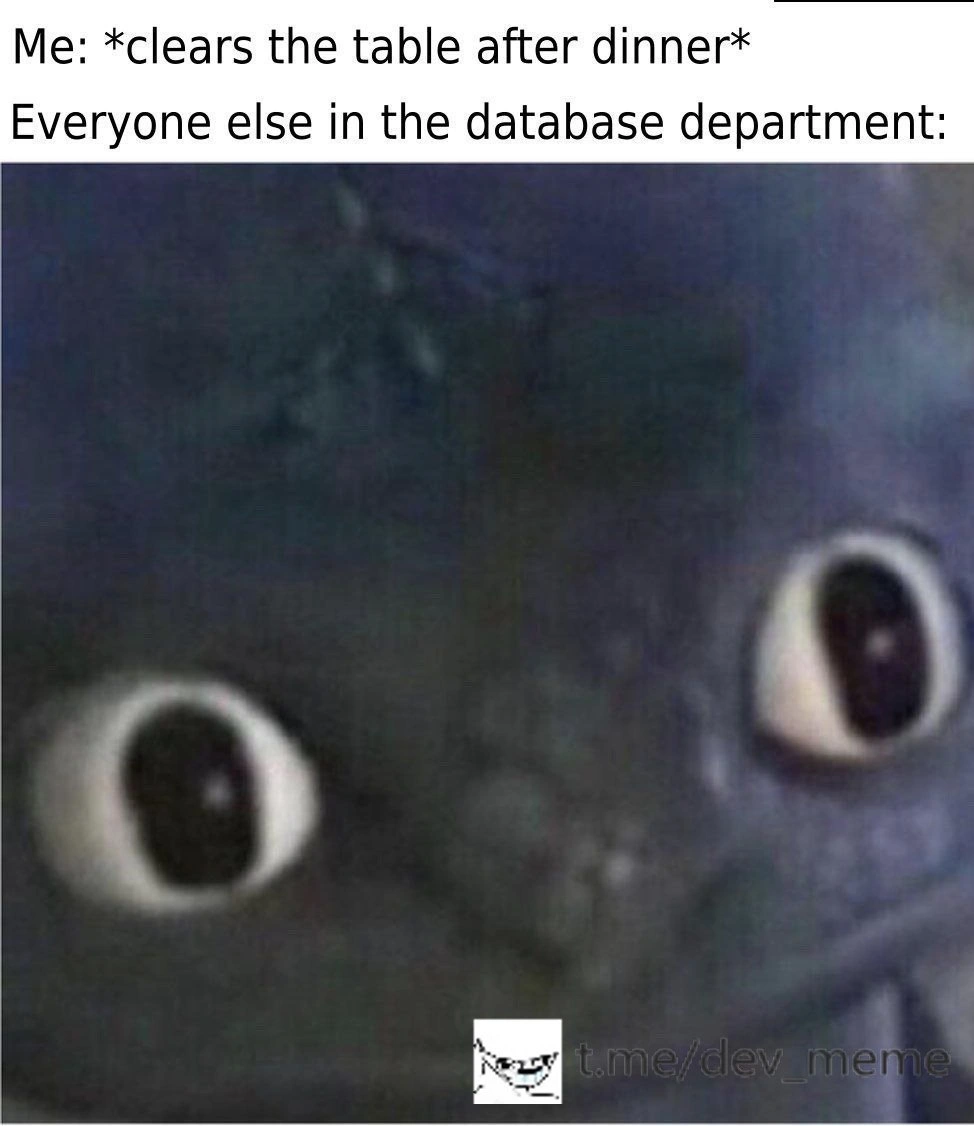
“Me: clears the table after dinner
Everyone else in the database department:” (shocked face)
In everyday life, “clearing the table” after dinner just means you’re cleaning up dishes. But the database department (the DBAs and developers who work with databases) hears the phrase “clear the table” and their minds jump to those dangerous SQL commands above. The humor comes from that contrast in meaning. It’s an example of a sql_language_ambiguity – the words “clear” and “table” together have a totally different meaning in a tech context.
The image below the text is a super zoomed-in shot of a creature with huge, wide eyes. It’s actually a well-known concerned cat meme image (often used to show shock or horror). The cat (or creature) looks absolutely alarmed. That represents “Everyone else in the database department” being terrified. Why are they terrified? Because if someone actually “cleared” a database table without caution, it could mean a critical data loss incident. That’s the kind of thing that causes on-call engineers to jump out of their chair. In a company, losing a whole table of data (like all user accounts, all orders, etc.) is a big emergency, often called a production bug or incident. It might require restoring from backups, apologizing to customers, and working overnight to fix things. No one wants to hear those words unexpectedly, much like nobody wants to hear “the server is on fire.”
This is classic DatabaseHumor because only people who have worked with databases (and perhaps caused or narrowly avoided a DROP TABLE disaster) really appreciate that gut reaction. It’s also relatable humor for developers: even if you haven’t done it yourself, you’ve heard cautionary tales. Maybe during onboarding, a senior dev told you, “Always double-check your WHERE clause on a DELETE!” The tag truncate_table_panic sums it up: just the thought of truncating a production table can induce panic. Likewise, dba_horror_reaction describes how a database administrator might react with horror to such news.
Even the watermark t.me/dev_meme with a tiny troll face in the corner is just the source of the meme (a Telegram developer meme channel). It’s not part of the joke’s content, but it signals that this image is part of developer meme culture. Basically, the whole department’s reaction is, “Wait, you did what to the table?!” followed immediately by relief (oh, it was just dinner plates, not the database). It’s a funny reminder that words can mean very different things inside the tech world versus outside. If you work with databases long enough, the phrase “clear the table” might never sound innocent again!
Level 3: TRUNCATE Trauma
For seasoned developers and DBAs, the phrase "clear the table" triggers a cold sweat. It's not about wiping crumbs off a dining table—it’s evoking nightmares of running a disastrous SQL command in production. In database terms, "clearing a table" means deleting every row or even dropping the table entirely. The meme plays on this double meaning: a harmless after-dinner chore versus the nuclear option in SQL. The text sets us up: Me: clears the table after dinner. To a normal person, that's fine. But “Everyone else in the database department” is depicted with bulging, terrified eyes. Why? Because these folks instantly imagine the worst: someone just executed a DROP TABLE or TRUNCATE TABLE on a critical production dataset. It’s a reflex born of experience—database humor often comes with a side of PTSD.
In relational databases (think SQL), a table isn’t furniture; it’s a collection of rows and columns holding valuable data. And clearing such a table isn’t routine cleanup—it means wiping data, possibly irrevocably. There’s an entire graveyard of war stories about junior devs running something like DELETE FROM users; without a WHERE clause, or accidentally executing a migration script against the production DB instead of staging. The horrified wide-eyed creature in the meme (a popular concerned cat reaction image) perfectly captures that “Oh no, did we just lose years of data?” feeling. Every senior engineer or DBA immediately recalls some truncate_table_panic incident: maybe an intern who thought TRUNCATE TABLE orders; was a quick way to tidy up old records, only to realize it blitzed all orders. Once that command is run, there’s no easy Ctrl+Z – it’s restore from backup (you did have one, right?) or nothing.
-- An innocent-looking but catastrophic SQL command:
TRUNCATE TABLE customers;
-- Boom: all rows in the 'customers' table are gone in an instant!
The humor here also lies in SQL language ambiguity. In plain English, “clear the table” means something mundane. But in tech jargon, those same words map to extremely dangerous operations. It’s a classic misunderstanding that gives database people goosebumps. A veteran DBA might even joke, “Sure, go ahead and DROP the dinner table—as long as you don’t do it to my database!” The inclusion of the trollface watermark (t.me/dev_meme) in the corner is a nod that this is a developer in-joke; it’s branding from a dev meme channel, telling us this scenario is relatable humor in IT circles. The reason everyone in the database department looks petrified is because they’ve all learned the hard way: clearing a table in the wrong context can be a career-ender. The meme brilliantly exaggerates that anxiety by applying it to a completely non-technical situation, highlighting how words that sound benign to most people can utterly terrify a DBA. It’s funny because it’s true – that wide-eyed stare is basically how a DBA’s soul leaves their body for a moment whenever they hear someone even joke about dropping data.
Description
The image is a two-part meme. The top section contains white text on a plain background that reads, 'Me: *clears the table after dinner*'. Below this, a second line reads, 'Everyone else in the database department:'. The bottom part of the image is a popular reaction picture showing a close-up of a dark, fish-like creature with huge, wide-open, staring eyes, conveying a sense of extreme shock and horror. A small watermark for 't.me/dev_meme' is visible in the lower right corner. The humor is a technical pun based on the double meaning of 'table'. To a layperson, it's a piece of furniture, but to a database professional, a 'table' is a fundamental data structure. 'Clearing a table' in database terms could mean executing a destructive command like 'DROP TABLE' or 'TRUNCATE TABLE', which would permanently delete vast amounts of data. The meme hilariously captures the panic-inducing potential of casual language being misinterpreted in a high-stakes technical environment
Comments
9Comment deleted
There are two types of DBAs: those who have accidentally dropped a production table, and liars. This joke is how you find out which is which
Say “let’s clear the table” and every senior DBA instantly remembers that Friday 18:03 TRUNCATE - no BEGIN, replicas 40 min behind, and six terabytes of “whoops” to replay from PITR
The real horror isn't when junior devs run DELETE without WHERE - it's when they discover TRUNCATE is faster and start 'optimizing' their cleanup scripts in production
The database team's reaction is perfectly justified - they've seen too many tickets that start with 'I just ran a quick DELETE to clean up...' and end with 'why is the production table empty?' The real horror isn't clearing tables; it's doing it in production on a Friday afternoon without a transaction, a WHERE clause, or a recent backup. At least when you clear the dinner table, there's no need for point-in-time recovery or explaining to the CTO why customer data from the last six months just vanished into the void
I said “I’ll clear the table,” and the DB team asked: DELETE with a WHERE, TRUNCATE after a snapshot, or DROP CASCADE - because my kitchen doesn’t support PITR
Say “clear the table” near a DBA and they’ll ask if you meant DELETE in a transaction, TRUNCATE WITH RESTART IDENTITY, or DROP CASCADE - then demand a PITR check before touching the dishwasher
'Clear the table' - harmless chorespeak to normals, prod-down panic trigger to DBAs sans WHERE clause
Me: *drops all columns after a game of connect 4* Everyone else in the database department Comment deleted
Username: "; DROP TABLE Comment deleted