Skip to content
DevMeme
3432 of 7435
The Four Stages of a Corporate Developer's Career
Career HR Post #3765, on Oct 1, 2021 in TG

The Four Stages of a Corporate Developer's Career

Why is this Career HR meme funny?

Level 1: No Extra Credit

Think of it like trying to make someone happy when they themselves aren’t sure what they want. At first, you’re really excited and you’ll do anything to please them — like a kid eagerly doing all their chores hoping for praise. But then you notice no matter how hard you try, the other person still isn’t satisfied. You start to feel bad, like you did something wrong. It’s as if you drew a picture for a friend, and they said “Hmm, not quite what I wanted,” even though they didn’t tell you what to draw in the first place. After a while, you realize the problem isn’t that you’re a bad artist — it’s that your friend never knew what they wanted to begin with. By the time you figure that out, you might feel a bit tired and frustrated. In the end, you stop trying so extra hard because you see that whether you spend all night on the picture or just an hour, your friend reacts the same way. In other words, you learn that doing more and more doesn’t always get you more reward. That’s the feeling this meme is joking about: starting off super eager to please everyone, and ending up a bit worn out, saying, “You know what, I’ll do my best, but I’m not going to go crazy over it — it’s all going to be treated the same anyway.” It’s funny in a bittersweet way because it’s true: you can’t always please everyone, especially if they don’t know what they want, so you have to take care of yourself too.

Level 2: From Blame to Burnout

Let’s break down the meme’s message in simpler terms. It’s describing a developer’s career journey and how their attitude towards work changes over time. In the beginning (around the first year on the job), a developer is usually very eager to impress and satisfy. They “aim to please” – meaning they want to make their bosses or clients happy. If the stakeholder (the person or group asking for the software) says “I need this feature,” the new dev enthusiastically replies, “Sure, I’ll build that exactly as you want!” At this stage, the developer assumes that if they write good code and work hard, the software will meet the business requirements (the things the business needs the software to do). The term business requirements just means the goals or conditions that the software must satisfy for the business – like “allow users to sign up” or “generate a sales report”. A newbie dev trusts that these requirements are clear and fixed, and they judge their own success by whether they can deliver exactly what was asked. The humor here is that new developers often don’t see the red flags yet – they’ll cheerfully start coding away, not realizing the target might move.

After a few years on the job (say 3 years in), the developer has delivered a couple of projects and inevitably hit some roadblocks. Perhaps one project didn’t meet the boss’s expectations, or a client said “This isn’t what we needed” even though you built what they described. At this point, the dev starts to blame themself. They might think, “Maybe my code wasn’t good enough,” or “I must have misunderstood the requirement.” This is a very common phase in a developer’s life. Many of us have felt impostor syndrome, where we believe we’re not skilled enough when something goes wrong. In reality, often the requirements were vague or changed mid-project. But a 3-year developer might not feel confident enough to say, “Hey, the goal wasn’t clear.” Instead, they internalize the failure: “It failed to meet the business requirements; I wrote the code, so I must be the failure.” This part of the meme captures that self-blaming mindset. It’s highlighting how easy it is for developers to beat themselves up when a project outcome is bad – even if it wasn’t entirely their fault. The text on the meme literally says your code failed “to meet business requirements.” For a junior dev, that phrase can feel like a punch in the gut: it implies your work didn’t deliver what the company needed. The meme is saying, around year 3, a lot of devs feel that disappointment and take it personally.

Fast forward to about 5 years in. By now, the developer has seen a pattern repeating. They’ve been through multiple projects or feature releases. Some went well, some went poorly. Crucially, they’ve noticed that often when things go wrong, it wasn’t because their code was terrible – it’s because the people in charge kept changing their minds or weren’t sure what they actually wanted from the start. The meme uses a great analogy: it says building software for a company can be “like being in a bad relationship where the other person knows they want something but never knows what they want.” In plainer terms, working with certain businesses or clients is frustrating because they keep shifting the goalposts. One week the priority is one thing, the next week it’s something else. Or they describe what they want, you build it, and then they say, “No, that’s not it. We actually need it to do something else.” This is just like being in a relationship with someone who is indecisive: imagine asking your friend what they want for their birthday, and they say “I’ll know it when I see it.” You buy a gift, they frown and say “Hmm, not that.” You ask for more clues, they still can’t explain, but they’re unhappy with whatever you do. 😣 After enough cycles of this in the workplace, a developer stops automatically assuming “I did a bad job,” and starts thinking “Maybe the requests were the problem.” This is a healthy realization! It’s when a dev learns to distinguish between issues in their code and issues in the requirements. In tech lingo, this stage is when you’ve seen enough scope creep – that’s a term for when a project’s requirements keep expanding or changing beyond what was originally agreed. Scope creep often leads to projects running late or missing the mark, and importantly, it’s not the coder’s lack of skill causing it; it’s a planning/communication problem. So, at ~5 years, the developer finally exclaims (maybe just to themselves), “Hold on, it’s not just me. They don’t know what they want!” This can be liberating because the dev stops unfairly blaming themselves for every project mishap. But it’s also disheartening in a new way: it means realizing that even if you do everything right technically, the project can still fail due to organizational confusion or poor leadership. That’s where the “bad relationship” feeling comes in – the dev might feel a bit “used and confused,” always trying to satisfy an ever-changing demand.

Now skip ahead to 10 years in – a full decade of experience. By this time, our developer has truly seen behind the curtain of corporate software development. The meme jokes that at 10 years, “You realize it’s all garbage and it all pays the same.” Let’s unpack that. “It’s all garbage” is a very blunt way of saying the developer has become extremely cynical about the quality and lasting value of the code they write. They don’t literally mean every piece of software is trash; it’s more an expression of frustration that so much code ends up messy or thrown away. Over 10 years, a dev might have built applications that later got canceled or rewritten. They’ve dealt with quick-and-dirty fixes to satisfy a deadline, and those fixes turning the codebase into spaghetti (a tangled mess). They might have moved jobs and seen their previous project, which they worked so hard on, get replaced by a new system. All of this leads to a feeling that “nothing I build lasts, and a lot of it ends up hacky or half-baked.” So, calling it “all garbage” is a bit of dark humor – like an exhausted chef saying “ugh, all the food we make here is junk” after serving fast food for years. It’s the developer kind of teasing their own work, not because they write bad code on purpose, but because the circumstances often force less-than-ideal outcomes.

The second part, “and it all pays the same,” is about money and recognition (categorized here under Career_HR realities). Ten years in, our developer is essentially saying: Whether I stress out and make myself sick trying to polish every project, or I just do the basic job and log off at 5 PM, my salary is the same. This is a comment on how many companies have pay structures that don’t necessarily reward extra effort or brilliance in proportion to the stress it causes. By this point in a career, a developer likely has a set salary (maybe with small annual raises or a title like Senior Developer). They’ve noticed that working late or delivering a miracle under pressure got them maybe a pat on the back, but not a dramatically bigger paycheck or lasting peace. In some cases, they might have seen colleagues who coast a bit or say “no” to crunch time still keep their jobs and get similar raises. So the incentive to go above and beyond fades. The phrase “it all pays the same” is practically a direct quote of many senior devs joking in the office. For example, if someone is debating whether to refactor a system all weekend or just apply a quick fix, a jaded dev might quip, “Don’t kill yourself over it, man – it all pays the same.” This means: as long as the job gets done, you won’t see extra reward for making it perfect, so why sacrifice your personal time or sanity? It’s a bit of a bitter pill, but it’s also advice born from experience with burnout. After burning out once or twice, developers learn to set boundaries. They’ve seen that a company will happily let you work 60-hour weeks, but that doesn’t guarantee you a promotion or equity windfall; more often it guarantees you exhaustion. So, by year 10, our dev has learned to work smarter, not harder. They focus on what’s needed, and they mentally protect themselves from the chaos around them. They’ve become an equal-pay cynic – they think, “All this fancy talk about passion and changing the world is nice, but at the end of the day, this is a job and I get paid X whether or not I stress out. So why volunteer for stress?”

All these stages are played for laughs in the meme because they ring true to those of us in tech. It’s developer humor drawn from real experiences. Early in a career, a dev might be a bit like a puppy eager to please its owner, 😊 wagging their tail and staying late to make everything perfect. Mid-career, that dev might be more like a puzzled detective, 🕵️ trying to figure out “Was it me? Did I mess up the code? Or was the assignment flawed?” Later on, they might become a jaded cat 😼 that’s seen it all, strolling in at 9, leaving at 5, not overly worried if the requirements are a mess because “I’ve learned not to chase laser pointers forever.” (To use a cat metaphor for not chasing every moving target.) Each panel of the meme is basically a milestone in developer experience:

  • Year 1: People-Pleaser Mode. Whatever the boss says, you do. If marketing wants a dancing button on the homepage, you add that dancing button with a smile. You’re building your reputation and you’re afraid to say “no” or push back on bad ideas.
  • Year 3: Self-Doubt Mode. You’ve seen your first project or two not meet expectations. You start combing through your code wondering why the outcome wasn’t great. Maybe you think, “If only I had written it better or used a different framework, maybe the users would have been happy.” It’s a very personal way to interpret project failure.
  • Year 5: Reality-Check Mode. By now, you’ve had meetings where higher-ups contradict each other. You delivered Feature A exactly as asked, but now sales says they actually needed Feature B. You begin face-palming 🤦‍♂️ because you realize no one ever knew what the end-users truly wanted. The problem was upstream, not in your code. You stop apologizing for things that were out of your control. You might even start pushing back: “We need clearer requirements” or “Let’s freeze the scope for this sprint, or else we’ll never finish.” You’re learning to manage stakeholder expectations.
  • Year 10: Cynic/Zen Mode. When a crazy new request comes in at 4 PM on a Friday, you just chuckle. You’ve seen this movie before. You might say something sly like, “Sure, we can try that… next week,” fully knowing Monday it might change again. You aren’t about to wreck your weekend for a half-baked idea. You do good work, but you also guard your work-life balance because you understand the job will take as much as you give and then some. Your young colleagues might be panicking over a deployment, but you’re the one saying “Relax, if it fails, we’ll fix it on Monday. It’s not the end of the world.” That’s the voice of experience (and a hint of “it’s all garbage anyway” humor). You also make more dark jokes about the codebase: when a junior says “This code is a mess, who wrote this?”, you raise your hand and say “me, 5 years ago, under duress” and everyone laughs. You’ve basically embraced that software engineering at big companies is part technical and part psychological survival game.

To illustrate this evolution in a code-y way, imagine printing the developer’s thought at each career stage:

# Developer's mindset progression by years of experience
for year in [1, 3, 5, 10]:
    if year == 1:
        print(f"Year {year}: Yes, boss, I'll get right on that!")
    elif year == 3:
        print(f"Year {year}: The project missed the mark... did I mess up?")
    elif year == 5:
        print(f"Year {year}: They keep changing their mind. It's not just me.")
    elif year == 10:
        print(f"Year {year}: I'll do what I can. No heroics – it all pays the same.")

If you run this pseudo-code, it would output something like:

  • Year 1: "Yes, boss, I'll get right on that!" (Keen and obedient 😇)
  • Year 3: "The project missed the mark... did I mess up?" (Worried and self-critical 😥)
  • Year 5: "They keep changing their mind. It's not just me." (Realizing the pattern 😒)
  • Year 10: "I'll do what I can. No heroics – it all pays the same." (Calm and a bit sarcastic 😌)

Each line corresponds to one of the meme’s panels. It’s a humorous way to see the mindset shift over time. The first line is all about eagerness, the second about self-doubt, the third about recognizing the real problem, and the final about settling into a pragmatic approach.

To sum up, the meme speaks to developers at different stages of their career and highlights a common journey:

  • Starting out, you’re enthusiastic and want to do everything right.
  • A bit later, you’re frustrated and think it’s your fault when things go wrong.
  • A few more years in, you wise up to the fact that unclear goals or constant changes were setting you up to fail.
  • Finally, with a decade under your belt, you become selectively laid-back – you work hard but you don’t martyr yourself, because you know a lot of the craziness is out of your hands and killing yourself over it won’t really change the outcome (or your pay).

This is relatable pain for many in tech. It combines elements of CorporateCulture (like how companies handle projects and pay), Stakeholder Expectations (how unclear demands affect developers), and good old CareerHumor (making light of how one’s attitude evolves on the job). The reason so many find this meme funny is because it’s rooted in truth. If you ask a room of senior developers, a lot of them will smirk and say, “Yep, been there.” It’s almost like a rite of passage in software development to go from bright-eyed to a bit burnt-out. Of course, not every workplace is this dysfunctional, and not every developer becomes cynical – but the meme exaggerates a real trend enough that it strikes a chord. It reminds junior devs that if they’re feeling down because a project failed, hey, maybe the problem wasn’t all you. And it gives props (in a teasing way) to the veterans who have learned to ride the rollercoaster without screaming at every dip.

Level 3: Baptism by Scope Creep

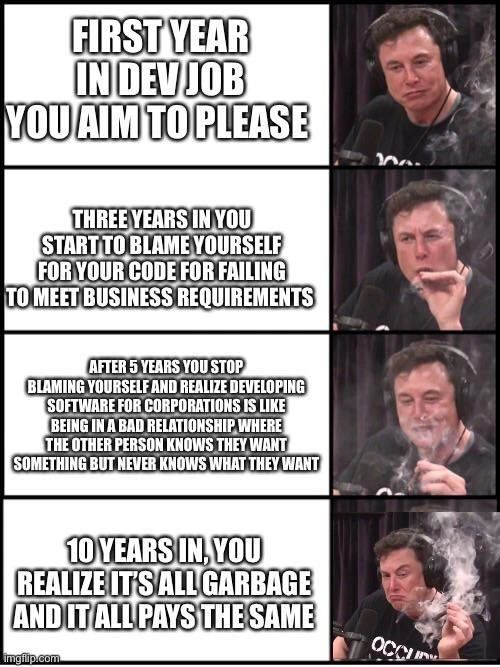
In the first panel of this meme, we see a fresh-faced developer (embodied by a calm Elon Musk calmly smoking) eager to please every request. This reflects the typical first-year dev mindset: deliver whatever the business asks, as perfectly as possible. It’s almost a rite of passage – a baptism by fire (or here, by scope creep). At this stage the dev believes if they work hard and write clean code, everything will meet specs. The humor kicks in because experienced devs know something the newbie doesn’t: in corporate software, those "specs" are often written on water. Requirements shift and swirl unpredictably, much like the growing cloud of smoke in each subsequent panel. The smoke metaphor is spot-on – each year that passes, the cloud (of confusion, frustration, burnout) grows larger. By panel four it’s a haze of cynicism. Seasoned programmers chuckle (or wince) at this progression because they’ve inhaled that smoke themselves.

After a few years (~3 years in as the meme’s second panel says), reality hits. The developer’s gung-ho attitude is eroded by misaligned stakeholder expectations and ever-changing goals. The meme text reads: “THREE YEARS IN, YOU START TO BLAME YOURSELF FOR YOUR CODE FAILING TO MEET BUSINESS REQUIREMENTS.” This is painfully familiar to any dev who’s been through a failed project or two. At around the 3-year mark, many developers grapple with impostor syndrome. They deliver a feature only to hear “This isn’t what we needed.” Their immediate thought? “I must have done it wrong.” They’ve likely been caught in a cycle of requirements churn – where each demo or review brings a stakeholder saying “Actually, what if we change X…”. The developer internalizes these pivots as personal failures. Industry veterans recognize this as a flawed blame culture where developers get maligned for not hitting a moving target. It’s a classic corporate anti-pattern: instead of questioning if the business requirements were vague or contradictory, the system often implicitly blames the implementer. The meme plays on this shared trauma – we’ve all had that project where we felt we just weren’t good enough because the outcome kept missing the mark. In reality, the target was moving all along. (As any battle-scarred coder will tell you, “It’s not a bug in the code, it’s a bug in the requirement.”)

By around 5 years in (panel three), the developer has seen the pattern repeat enough times to have an epiphany. The meme’s third caption explicitly spells it out: “AFTER 5 YEARS YOU STOP BLAMING YOURSELF AND REALIZE DEVELOPING SOFTWARE FOR CORPORATIONS IS LIKE BEING IN A BAD RELATIONSHIP WHERE THE OTHER PERSON KNOWS THEY WANT SOMETHING BUT NEVER KNOWS WHAT THEY WANT.” This is the turning point from self-blame to disillusionment with the system. In a bad relationship, one partner keeps shifting what they ask for – “I need something, I’ll know it when I see it” – leaving the other partner in a constant state of anxiety, trying to guess the right thing. Here the other person is the business side: product managers, clients, executives – the stakeholders who “know they want something” (profit, users, the next big feature ) but never give a clear definition of what that something is. This leads to a toxic cycle of scope creep and perpetual rework. The developer feels like they’re dating a fickle partner: one week the app needs to be a social network, the next week it’s suddenly an e-commerce platform. You deliver exactly what they asked last week, only to hear this week that it’s not what they meant. Senior devs reading this meme nod knowingly – this is the story of countless enterprise projects. It’s a darkly funny reflection of CorporateCulture dysfunction: the failure to pin down stakeholder requirements early, or the habit of constantly pivoting without regard for the code churn it causes. This is where the developer stops saying “I’m terrible at this” and starts muttering “who writes these specs, anyway?” They recognize the bad relationship requirements syndrome. In meeting after meeting (the ones that should clarify goals but often just create new PowerPoints), the dev realizes the people in charge are flying just as blind, only with higher pay grades. It dawns on them that no level of code perfection can compensate for ambiguous or moving goals.

By the 10-year mark (final panel), the transformation to full cynic is complete. The meme’s last line is the mic-drop: “10 YEARS IN, YOU REALIZE IT’S ALL GARBAGE AND IT ALL PAYS THE SAME.” Here career disillusionment reaches peak sarcasm. “It’s all garbage” isn’t literally saying software is worthless – it’s the jaded recognition that so much of what developers build under these chaotic conditions ends up being throwaway code or half-baked systems. Perhaps the project you poured your soul into in year 2 got sunset in year 4 when strategies changed. Perhaps that elegant architecture you designed was rendered “garbage” by a sudden requirement overhaul. Ten years in, you’ve likely seen entire codebases you wrote be deprecated or replaced. So you develop a gallows humor about it: shrug, all code becomes legacy, and legacy often gets trashed. The phrase “it’s all garbage” captures that nihilistic humor; everything we build is transient in the face of corporate whims. And “it all pays the same” is the fatalistic kicker: whether you grind 80-hour weeks to polish every edge case or you do the bare minimum to meet the spec, your paycheck at the end of the month is unchanged. 😏 This is a swipe at the equal pay illusion that often exists in companies — not literally that everyone has equal salary, but that extra effort isn’t proportionally rewarded. The senior dev has seen hot-shot “heroes” burn themselves out for a product launch, only to get the same 3% raise as the folks who quietly kept things running. In their cynical view, why bother over-delivering? In that smoky final panel, Elon’s expression (eyes half-open, exhaling a massive plume) says, “I’m so done.” It’s the look of a dev who has survived production outages at 3 AM, death-marched projects, and endless misaligned expectations. They’re not necessarily quitting the industry, but they’ve quit the hero mentality. They now practice a form of pragmatic development: build it good enough, don’t chase perfection for unclear goals, and protect your sanity because the company sure isn’t doing it for you.

The humor here is equal parts RelatablePain and grim truth. The meme satirizes the DeveloperExperience (DX) in many companies where the thrill of creating software gets smothered by bureaucracy and shifting demands. It highlights the unwritten career arc many devs go through:

  • Year 1-2: Bright-eyed, saying "Yes!" to everything, believing in clean code and on-time delivery as the ultimate goal. (“AIM TO PLEASE”)
  • Year 3-4: The honeymoon is over. Projects have failed or dragged. Dev starts thinking "Maybe I’m not cut out for this; my code didn’t meet the mark." They work late, refactor furiously, trying to hit ill-defined targets. (self-blame)
  • Year 5-9: Experienced enough to see the pattern. They attend yet another project post-mortem where it’s clear the requirement was a moving target. Lightbulb: "It wasn’t just me – this process is broken." They become more vocal about getting clarity (or at least they roll their eyes when clarity is absent). They joke about projects being like trying to land a rocket on a moving platform. They start using phrases like "garbage in, garbage out" when referring to requirements. They’ve mentally put some blame back on the organization. (system blame)
  • Year 10+: Fully jaded equal-pay cynic. They’ve settled into a stable senior/specialist role, but illusions of corporate grandiosity are gone. They know the codebase is mostly patched-together fixes. They know rewriting it (again) won’t fix the root problem of undefined goals. And crucially, they know their Career/HR trajectory (at least in that role) is relatively flat unless they jump companies or become a manager. So they stop losing sleep over work. They debug critical issues, sure, but you won’t catch them voluntarily pulling an all-nighter for a last-minute feature that somebody “thinks might be cool.” Their mental script is, "If you want miracle features overnight, you better provide miracle stock options – otherwise, tomorrow is fine." In short, "It all pays the same, so let’s not kill ourselves over it." This isn’t pure laziness; it's a form of self-preservation cultivated after years of seeing burnout claims and broken schedules.

This trajectory is funny because it’s true enough to resonate widely, yet exaggerated just enough to laugh instead of cry. It’s a commentary on CorporateCulture: how initial enthusiasm can be transformed into cynicism by systemic issues. The meme touches on a core irony in software development: the people who define “success” for a project (the business stakeholders) often can’t decide what they actually want, yet the people building it (developers) are the ones who feel guilty when it's “wrong.” The result? DeveloperFrustration that accumulates over time. The final stage of “it’s all garbage” is a tongue-in-cheek way of saying we eventually learn not to take these ups and downs personally. Seasoned devs have a bit of a dark sense of humor about crappy code and project failures – they joke about them as a coping mechanism. It’s not that every 10-year veteran is completely jaded, but there’s definitely a shared understanding that you must detach your self-worth from the whims of the corporation, or else you won’t survive a decade in this field with sanity intact. Thus, the meme’s cynical crescendo is oddly comforting to veteran developers. It says, “You’re not alone. We’ve all seen that everything becomes legacy. We’ve all realized that one year’s silver-bullet project is next year’s tech debt. So don’t beat yourself up – enjoy the ride (and collect your check).” The StakeholderExpectations won’t ever perfectly align with reality – after all, business folks and dev teams often speak different languages (cue “Conway’s Law”: products reflect the organization’s communication – confusing org, confusing product). So the final wisdom is delivered with a plume of smoke: do your best, but don’t inhale all that stress, because in the end, code is ephemeral and pay is pay. This mixture of bitter truth and deadpan delivery is exactly why developers find the meme both hilarious and cathartic. It’s a CareerHumor cautionary tale and a badge of honor: if you get the joke, you’ve probably earned a few scars in the trade.

Description

A four-panel meme that charts the evolving cynicism of a software developer over a decade. Each panel on the left has text describing a career stage, paired with a panel on the right showing Elon Musk during a podcast, with his expression and actions escalating in intensity. First panel: 'FIRST YEAR IN DEV JOB YOU AIM TO PLEASE' shows a neutral Musk. Second panel: 'THREE YEARS IN YOU START TO BLAME YOURSELF FOR YOUR CODE FOR FAILING TO MEET BUSINESS REQUIREMENTS' shows Musk lighting a cigar. Third panel: 'AFTER 5 YEARS YOU STOP BLAMING YOURSELF AND REALIZE DEVELOPING SOFTWARE FOR CORPORATIONS IS LIKE BEING IN A BAD RELATIONSHIP WHERE THE OTHER PERSON KNOWS THEY WANT SOMETHING BUT NEVER KNOWS WHAT THEY WANT' shows Musk exhaling a small amount of smoke. Fourth panel: '10 YEARS IN, YOU REALIZE IT'S ALL GARBAGE AND IT ALL PAYS THE SAME' shows Musk exhaling a massive cloud of smoke, looking completely checked out. The meme captures the journey from eager junior to disillusioned senior engineer, worn down by vague requirements, corporate dysfunction, and the realization that many projects are ultimately ephemeral or meaningless
Comments

9
Anonymous ★ Top Pick The final stage is architect, where you realize it's all garbage, but now you get paid more to draw diagrams of the garbage before anyone else writes it
  1. Anonymous ★ Top Pick

    The final stage is architect, where you realize it's all garbage, but now you get paid more to draw diagrams of the garbage before anyone else writes it

  2. Anonymous

    After 10 years I finally found the real singleton in our architecture: the salary band table - immutable, highly available, and totally untouchable

  3. Anonymous

    The real 10-year milestone is when you realize the junior who keeps asking "why don't we just rewrite it in Rust?" will eventually become the senior who maintains your legacy Node.js microservices while muttering "it all pays the same."

  4. Anonymous

    After a decade in the industry, you realize the real technical debt isn't in the codebase - it's the accumulated emotional baggage from trying to implement features for stakeholders who treat requirements gathering like improv comedy. At least the garbage code is deterministic; stakeholder expectations have worse complexity than the halting problem

  5. Anonymous

    After a decade, you realize enterprise software is just artisanal garbage: handcrafted, overpriced, and destined for the landfill

  6. Anonymous

    Ten years in, you learn the only idempotent operation in enterprise software is your salary - no matter how many times you refactor to fit shifting requirements, the result is the same

  7. Anonymous

    Enterprise requirements have eventual consistency - converging only post-GA - while payroll is strongly consistent; every pivot writes to the same salary row

  8. @tedspikes 4y

    honestly more like 2.5 years for the whole cycle

  9. Deleted Account 4y

    1=1

Use J and K for navigation