Skip to content
DevMeme
3433 of 7435
Library Correctly Categorizes Software Development
Bugs Post #3766, on Oct 2, 2021 in TG

Library Correctly Categorizes Software Development

Why is this Bugs meme funny?

Level 1: Now You See It, Now You Don’t

Imagine you have a little flashlight that sometimes refuses to turn on. One evening you click the switch over and over, and the light just won’t come. But when you take the flashlight to your dad to show him the problem – click – it lights up immediately, as if nothing was wrong! You try it again later by yourself and it doesn’t work, but in front of Dad it’s totally fine. It’s almost like a mischievous ghost is playing tricks on you. You can’t figure out why it happened, but you end up giggling a bit because it feels like a cheeky magic trick that’s been played on you.

Level 2: Ghost-Hunting for Bugs

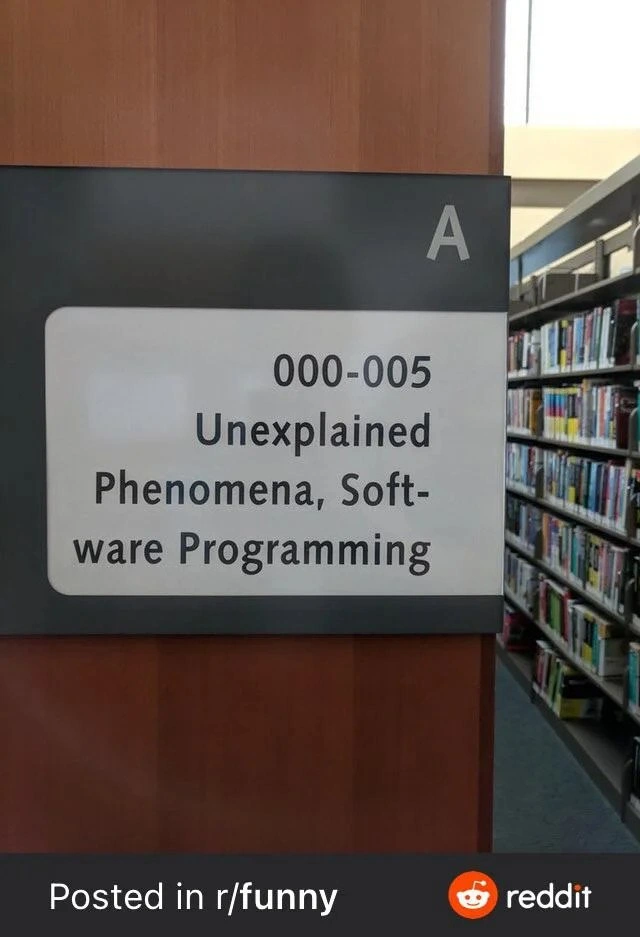
In the photo, the library’s shelf sign reads:

000-005
Unexplained Phenomena, Software Programming

The reason this is funny is because it suggests that software programming is full of “unexplained phenomena”. To someone browsing the library, it looks like books about ghost stories and UFOs are in the same section as books about coding! This odd pairing actually comes from the Dewey Decimal system (a way libraries organize books by topic and number). The range 000–005 covers both strange mysteries and computer science. For example, in Dewey’s catalog, 001.9 is where you’d find books on paranormal phenomena (Bigfoot, aliens, unsolved mysteries) and 005 is where books on programming live. The librarian just combined the labels for that whole range. It wasn’t meant as a joke originally, but programmers find it hilarious because it hits on a truth: writing code can sometimes feel as puzzling as investigating a haunted house.

Let’s break it down in simple terms. Software programming basically means writing instructions for computers to follow (that’s what coding is). A software bug is a mistake or flaw in those instructions that makes the computer do something wrong or unexpected. Even a tiny typo or a number that’s off by one can cause a program to act weird or crash. Debugging (or troubleshooting) is the skill of finding and fixing those mistakes. Now, most bugs are pretty straightforward once you find them – maybe you spelled a variable name incorrectly or forgot to handle a certain case. But some bugs can be really sneaky and strange. For instance, a bug might only show up once in a blue moon, or only when you do things in a very particular order.

Developers even have playful names for the especially weird issues. One example is the Heisenbug, which is a bug that disappears or changes its behavior when you try to examine it. (The name comes from a physics principle where observing something can actually change what it does.) Imagine a problem in your app that only occurs when you don’t run the debugger – as soon as you start looking into it, the problem refuses to happen again. Frustrating, right? There’s also something called a race condition, which is basically a timing bug: it happens when two parts of a program are trying to do things at the same time and the result depends on who wins the “race.” A race condition bug might show up only one time in a million, depending on luck and timing. When you encounter issues like these, it truly feels like the computer has a mind of its own or is playing tricks on you.

Every programmer, from newbie to expert, eventually runs into a baffling problem that makes them scratch their head. It might be a game that crashes only when a certain sound plays, or a website that glitches only on leap years – something super specific and weird. In those moments, you start joking, “Huh, maybe my PC is cursed!” Of course, there’s always a real cause behind the scenes – some overlooked code error or unforeseen combination of events – but it feels inexplicable at first. That’s why this library sign makes us laugh. It’s saying, in effect, that coding has its share of mysteries. It’s a relatable joke because almost every developer has experienced that “what on Earth is going on?!” feeling at least once. Even as a beginner, you might have a moment where your program isn’t working, and then when you try to show a friend or teacher, suddenly it works perfectly (cue the eyeroll!). When we see “Software Programming” lumped in with “Unexplained Phenomena”, we chuckle because we’ve been there – sometimes debugging code really does feel like ghost-hunting.

Level 3: Ghost in the Machine

To any seasoned programmer, this library sign isn’t just a quirky coincidence – it’s painfully relatable. We’ve all encountered software bugs so baffling that you half-jokingly suspect your computer might be haunted. When veteran developers see “Unexplained Phenomena, Software Programming” lumped together, they crack a knowing smile. After years in the industry, we jokingly admit that certain bugs truly feel like paranormal occurrences. It’s a form of collective therapy: acknowledging that debugging can sometimes be as spooky and confounding as chasing a poltergeist. This is classic coding humor, and it resonates because it captures a real aspect of the developer’s life – the gut-level frustration (and absurd comedy) of hunting down a bug that just refuses to obey the laws of logic.

Think about those late nights debugging where things just don’t add up. One infamous scenario is the “works on my machine” mystery: the code runs perfectly on your computer, but crashes on the production server or a colleague’s laptop. You comb through configurations and logs as if searching for ghostly footprints, because something invisible is clearly messing things up. Another classic head-scratcher is when adding a simple console.log() or print statement suddenly makes the problem disappear. It’s like the act of peeking scared the bug away – a real-life coding specter! We call those vanishing acts Heisenbugs, and if you’ve been in the trenches, you probably have a war story about “that one bug” which only showed itself when nobody was watching. Senior engineers love to swap these tales: the query that only timed out on leap day, or the microservice that crashed only under a blue moon. (Was it a threading issue? A memory leak? Or just a mischievous gremlin in the system?) The details differ, but the punchline is always that exasperated feeling of “This defies all explanation!”

Debugging such issues often feels like conducting a paranormal investigation. Instead of EMF detectors and night-vision cameras, developers use profilers, log files, and unit tests to sniff out the elusive cause. You might scatter print statements like magical wards, hoping to catch the bug in the act. When that fails, you end up staring at the code like a detective puzzling over an X-Files case, muttering “I know it’s out there…” For particularly eerie bugs, engineers will joke about needing to perform an exorcism on the codebase or appease the "software spirits" with a sacrificial rubber duck. It’s both humor and coping strategy: when logic fails, a bit of dramatic flair keeps us sane. (There’s even an old tongue-in-cheek saying: “When in doubt, blame cosmic rays.” — a nod to the fact that cosmic radiation can occasionally flip a bit in memory and cause truly random errors. Yes, solar particles causing a software crash is a real, albeit rare, phenomenon – how’s that for an unexplained event?)

Within a development team, these ghostly bugs can create legendary debugging frustration. Teams might spend days in all-hands-on-deck mode troubleshooting a glitch that behaves inconsistently. Post-mortem talks for such incidents often sound like ghost stories: “No one could reproduce it for weeks. Then at 3:14 AM on a Sunday, it happened on the live server — and after that night, it never showed up again.” The shared experience of battling an unseen, almost supernatural enemy brings developers closer – we’ve all felt that mix of dread and determination during a mysterious outage. Over time, you get better at handling the unknown. You expect the unexpected, build in extra logging (our equivalent of setting up CCTV in the haunted house), and design systems with a bit of defensive paranoia. But we also develop a dark sense of humor about it. Calling an anomaly a “ghost” or “gremlin” is our tongue-in-cheek way of saying, “Yes, it’s a bug, but it’s one that plays by its own rules.”

In the end, every “unexplained” bug does turn out to have a logical explanation – maybe a subtle thread synchronization flaw, a missed edge case, or that one config file nobody knew about. But until we uncover that root cause, it truly feels like chasing phantoms. The library’s Dewey Decimal catalog accidentally nailed this truth: software programming can involve moments of pure mystery until you shine a light on the problem. That’s why this meme is so spot-on and hilarious to developers. It’s poking fun at our reality: we work with machines built on binary logic, yet now and then we find ourselves ghost-hunting in the debugger at 2 AM. We laugh at the absurdity because, frankly, the only other option is to scream.

Level 4: Heisenbug Uncertainty Principle

At the deepest level, this meme wittily nods to the concept of the Heisenbug — those infamously elusive software bugs that disappear or change behavior the moment you try to observe or debug them. The term Heisenbug is a tongue-in-cheek reference to Heisenberg’s uncertainty principle in quantum physics: just as measuring a particle disturbs it, observing a running program can alter its state. When a developer attaches a debugger or inserts extra logging (the coding equivalent of shining a spotlight), it can change the program’s execution timing or memory layout, causing a bug that was manifesting in normal runs to vanish without a trace.

For example, consider a subtle race condition in a multi-threaded program: two threads might only collide in just the wrong way under very specific timing. If you run the program normally (especially in a highly optimized release build), they hit that race and weird behavior ensues. But the moment you step through it with a debugger – which pauses threads and slows everything down – the timing changes, and the issue miraculously disappears. It’s as if the code is playing possum. Similarly, in low-level C/C++ programming, adding a simple printf can move variables around in memory or flush CPU caches, accidentally sidestepping a memory corruption bug. One minute your program is crashing in unexplained ways, the next minute (with an extra print statement or running under gdb) it works perfectly. Poof! – the bug evaporates when observed, like a quantum particle whose behavior changes under measurement.

This highlights just how complex and non-deterministic real software systems can be. Modern computing involves countless layers of abstraction and unpredictable interactions: compiler optimizations reordering instructions, CPU pipelines and caches, operating system thread schedulers, asynchronous events – all of it. Tiny changes in one of these layers (say, the slight delay from a log statement) can ripple through the system and completely change the program’s behavior. In such a chaotic environment, some problems genuinely feel like unexplained phenomena. In fact, from a theoretical computer science perspective, fully predicting a program’s behavior in all cases is often impossible – akin to solving the Halting Problem. There’s simply no surefire way to analyze every path through a complex codebase and foresee every weird combination of events. Certain bugs are effectively emergent properties of the system, arising only from intricate, hard-to-reproduce state interactions.

Veteran engineers even have a folklore classification for bugs that hints at this scientific surreality. A Bohrbug (named after the stable, predictable Bohr model of the atom) is a regular bug that’s solid and repeatable – you hit it every time under the same conditions. In contrast, a Heisenbug is capricious: observing it (with debugging tools or extra instrumentation) changes its behavior, making it devilishly hard to pin down. There’s even the notion of a Mandelbug, honoring Benoit Mandelbrot’s chaotic fractals, for a bug whose causes are so convoluted that its behavior appears random or “chaotically” irregular. These whimsical names acknowledge that beyond the neat and tidy logic of code we learn in textbooks, real-world systems can exhibit almost spooky unpredictability.

So, grouping “Software Programming” together with “Unexplained Phenomena” on a library shelf feels hilariously apt at this deep level. It’s as if the Dewey Decimal classification itself recognizes that the realm of coding holds riddles as perplexing as any UFO sighting or ghostly encounter. After all, when you’ve chased a bug for days only to find it vanishes when you try to demonstrate it, it sure feels like your computer is haunted by a poltergeist. The humor here taps into a fundamental truth: complex software behavior can defy ordinary explanation, and sometimes debugging a program really does resemble investigating the paranormal.

Description

A photograph taken inside a library, focusing on a sign attached to the end of a bookshelf aisle. The sign is grey and white with black text. At the top right, a letter 'A' indicates the aisle. The main text on the sign reads '000-005' followed by 'Unexplained Phenomena, Software Programming'. In the background, rows of library books are visible on the shelves. At the very bottom, a watermark from Reddit is visible, showing it was 'Posted in r/funny'. The humor stems from the library's classification, which groups software programming with unexplained phenomena, treating it like a mystical or paranormal subject. This resonates deeply with experienced engineers who frequently deal with bizarre bugs, non-deterministic behavior in complex systems, and legacy code that works in mysterious ways no one on the team understands anymore. It perfectly captures the sentiment that modern software development can often feel less like engineering and more like debugging the supernatural

Comments

7
Anonymous ★ Top Pick The 'Unexplained Phenomena' section is where you'll find books on race conditions, CSS vertical alignment, and why the legacy cron job that restarts the server every Tuesday at 3 AM is the only thing keeping the entire system from collapsing
  1. Anonymous ★ Top Pick

    The 'Unexplained Phenomena' section is where you'll find books on race conditions, CSS vertical alignment, and why the legacy cron job that restarts the server every Tuesday at 3 AM is the only thing keeping the entire system from collapsing

  2. Anonymous

    Dewey 000-005: Unexplained Phenomena, Software Programming - the aisle with the Heisenbug survival guide and that quantum race condition that collapses the moment you attach the debugger

  3. Anonymous

    Finally, a library that accurately categorizes why that race condition only happens in production on Tuesdays during a full moon

  4. Anonymous

    Ah yes, Dewey Decimal 000-005: where we file race conditions that only manifest in production, heisenbugs that disappear when you add logging, and that one integration test that passes locally but fails in CI for reasons that violate the laws of causality. Right next to the section on quantum mechanics and paranormal activity - because at 3 AM when your distributed system is exhibiting emergent behavior nobody predicted, they're functionally equivalent

  5. Anonymous

    The only Dewey section more accurate: Heisenbugs under 'Observes itself into non-existence.'

  6. Anonymous

    Honestly, 000 - 005 is the right aisle - most postmortems read like ghost stories: reproduces only at 2 a.m., behind a load balancer, with NTP drift

  7. Anonymous

    Dewey 000 - 005: Unexplained phenomena, software programming - finally a shelf for Heisenbugs, timezone arithmetic, and deploys that only succeed while someone is staring at Grafana

Use J and K for navigation