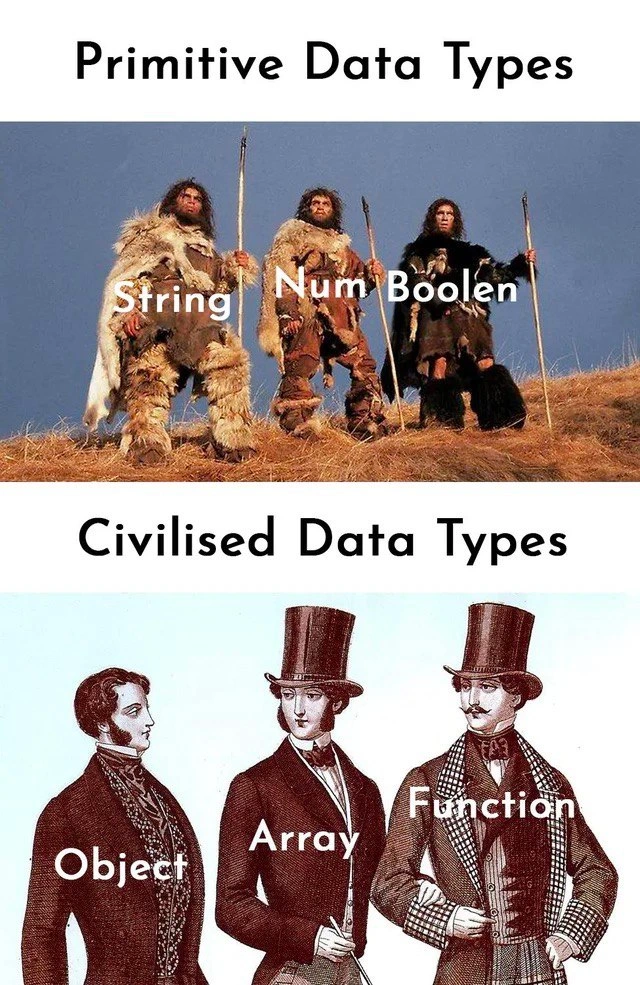
From caveman primitives to top-hat objects: the data type class divide
Why is this CS Fundamentals meme funny?
Level 1: Same Data, Different Dress
Imagine two people: one is a caveperson wearing furs and carrying a club, and the other is a fancy gentleman in a suit with a top hat and a cane. They look very different, right? The caveperson seems simple and old-fashioned, and the gentleman seems sophisticated and modern. But underneath the outfits, they’re both just humans. This meme is making the same kind of comparison with programming stuff. The cavemen represent really simple pieces of information, like a single number or a single word – nothing complicated. The gentlemen in suits represent more complicated collections of information, like maybe a whole bunch of data lumped together or a set of instructions packaged up (the kind of things that in code we call objects, arrays, or functions). We tend to think the guy in the suit is more “civilized” than the caveman, just like people might think fancy data structures are more advanced than plain variables.
The joke is that we’re dressing up our data types as if they’re people with social status. It’s funny because obviously data isn’t actually primitive or civilized – a number isn’t actually a caveman, and an array isn’t actually a Victorian gentleman – but in a way, programmers do talk about “primitive” types and more complex types in a hierarchical way. The meme is like a little cartoon saying: “See these three cavemen? That’s your basic data (just raw info). See these three fancy gentlemen? That’s your advanced data (info organized neatly).” And it makes us laugh because it’s a silly comparison that kind of rings true. It also teaches a little lesson: even if something looks fancier or more complex, it’s built on the simple stuff. The fancy-dressed gentlemen started out as cavemen long ago, and in the same way, those complex data types are built from lots of simple values inside. In the end, whether in furs or in a top hat, a person is a person — and whether it’s a plain number or part of a big object, it’s still data. The meme playfully reminds us not to judge by looks: just because something in code is simple doesn’t mean it’s bad, and just because something is elaborate doesn’t mean it’s automatically better. It’s a cute way to show that both simple and fancy have their place in the programming world, and really, they’re all part of the same family of data.
Level 2: Prim and Proper Types
Let’s break down the joke in simpler terms. In programming, data types are like categories for information, and there are generally two big categories being contrasted here: primitive types and more complex types (often objects/structures). The top panel of the meme shows “Primitive Data Types” with three cavemen labeled String, Num, and Boolen. Those correspond to basic data types:
- A String typically means a sequence of characters, i.e. text (like
"Hello"or"JavaScript rocks!"). It’s a primitive type in many languages, meaning it’s a basic building block provided by the language. - Num is referring to a Number. That could be an integer (like
42) or a floating-point number (like3.14), depending on the language. It’s another fundamental type to represent numeric values. - Boolen is a playful misspelling of Boolean, which is the type for logical values
trueorfalse. A Boolean answers yes/no or true/false questions and is as basic as it gets in logic and computing.
These are called “primitive” because they are simple: each holds just one piece of data (one string of text, one number, or one true/false value). They don’t have complex internal structure (at least from a programmer’s point of view) and often the language treats them in a special efficient way. The caveman imagery (fur pelts, spears) is saying “these are the old school, bare-bones basics” – just like cavemen using simple tools. Even the word primitive in everyday language means “early, unsophisticated, basic,” so it’s a pun here since that’s exactly what we call those types in code.
Now the bottom panel, “Civilised Data Types,” shows Victorian gentlemen in suits and top hats labeled Object, Array, and Function. These correspond to more “advanced” or composed kinds of data:
- An Object in programming usually means a bundle of data that can have multiple named properties (and possibly functions attached). Think of an object like a record or a small box containing many labeled slots. For example, an object might represent a person with properties for name, age, etc. It’s a step up in complexity: instead of one number or one word, an object can hold many pieces of data (and even behavior).
- An Array is an ordered list of elements. For example, an array could be
[1, 2, 3](a list of numbers) or["apple", "banana", "cherry"](a list of strings). Arrays are data structures that can hold multiple values indexed by position (0, 1, 2, ...). They’re more structured than a primitive because they organize lots of data under one variable name. In many languages (like JavaScript, Python, Java), an array is a kind of object – it’s a fancy container that comes with abilities (like knowing its length, or methods to add/remove items). - A Function (in the context of this meme’s labels) is referring to functions as first-class data values. Normally, a function is a set of instructions or code that does something (you “call” or execute it). But in languages like JavaScript, functions themselves can be treated like objects/data: you can pass a function around, store it in a variable, give it properties, etc. This is a more “civilized” concept in the sense that not every basic language treats functions as data. In JavaScript, a
Functionis actually a special object that can be invoked.
The joke highlights how programmers sometimes act like these complex types are the refined, modern way to handle data, whereas using primitives is old-fashioned. Why would one think that? It might come from how programming has evolved. Early on, you might learn to use simple variables (int count = 5; or let name = "Alice";). As you learn more, you start grouping data into objects (let user = { name: "Alice", age: 30 };) or using arrays (let scores = [10, 15, 20];). So there’s a feeling of progression: first you use caveman tools (single values), then you use more structured approaches (collections and objects) as you tackle bigger problems. In a class on CS Fundamentals, a teacher might introduce primitives as the basics and later introduce objects and data structures as more powerful abstractions.
However, the meme is tongue-in-cheek; it’s poking fun at the notion that primitives are “uncivilized.” In reality, languages like JavaScript blur this line. For example, in JavaScript, almost everything is an object or acts like one when needed. If you have a string, you can do someString.length to get its length, which feels like using an object’s property. If you have a number, you can call methods like toFixed() on it (to format it) as if the number were an object. What’s happening is that JavaScript behind the scenes temporarily treats that primitive as an object so you can use the property or method — this is that boxing concept mentioned above (though at this level you can just think of it as a quick costume change for the number so it can use object tricks).
A beginner might not even realize this is happening and just think “cool, I can use .toUpperCase() on a string literal or .length on a string/array and it works.” That’s the language being friendly by making primitives behave in a civilized manner when required. In some other languages, the difference is more strict: for example, in Java (not JavaScript, but the Java language), you have primitive int versus an Integer object class. An int is just a number with no frills, while an Integer is an object wrapper around a number. You can’t call methods on an int directly; you’d have to use an Integer object to do OO-style things. Java will automatically convert (auto-box) int to Integer in some cases, but if you’re a new coder, that difference can be confusing. It’s the same general idea depicted: the caveman int versus the gentleman Integer.
The type coercion tag relates to how dynamic languages implicitly convert values. Type coercion means the language might change a value’s type automatically to make an operation work. For example, in JavaScript if you do "5" * 2, it will coerce the string "5" into the number 5 to do the multiplication, giving you 10. If you do "5" + 2, it will coerce the number 2 into a string "2" (because + with a string means concatenate), giving you "52". These kinds of quirks are often joked about; they show that under the hood everything is somewhat fluid – the language is converting between primitive forms and more complex forms as needed, almost like those cavemen sometimes don a suit or the gentlemen sometimes roll up their sleeves and get primal, depending on context.
For a newer developer, the core takeaway from the meme is the characterization of basic vs. advanced data types:
- Primitive types (cavemen) are your most basic pieces of data: one number, one word, one true/false value. They’re simple, efficient, but they don’t directly provide structure beyond their single value.
- Object/Array/Function types (gentlemen) are more complex containers or constructs: they can hold multiple values or represent bigger concepts (like a list of things, or an entity with many attributes, or a chunk of behavior). They are “fancier” in that sense, but also come with more overhead (more things to manage).
The meme uses a funny analogy (cavemen vs Victorian gentlemen) to help you remember or visualize the difference. It’s like saying: primitive types are the raw ingredients, whereas objects and such are like a prepared dish or a multi-course meal made from those ingredients. One isn’t strictly better than the other — they serve different purposes in coding. The humor works because we normally don’t think of data types as having social status, so seeing them portrayed that way is absurd and playful. And if you’ve been around programmers, you might have noticed we jokingly confer human traits to technology (calling a simple solution “elegant” or a clunky one “barbaric”). This meme just takes that to the extreme in a visual way.
Level 3: Class Warfare
On a more practical level, this meme strikes a chord with seasoned developers because it humorously captures an age-old tension in programming: primitives vs. objects, simplicity vs. abstraction, or as the title pun hints, a "class divide". We’ve all seen (or written) code that treats humble values like second-class citizens compared to elaborate object hierarchies. The top panel’s fur-clad cavemen labeled String, Num, and the misspelled Boolen (clearly meant to be Boolean, but spelled like a grunting caveman might say it) represent the primitive data types. These are the raw, simple values: text, numbers, and true/false flags. The intentional spelling error “Boolen” is a cheeky detail – a senior dev chuckles because it signals how “primitive” these types are portrayed, as if they can’t even spell their own type correctly. It’s a subtle nod to newbie mistakes (who hasn't seen a junior dev accidentally call it Boolen or Boolean with an E?) and underscores the whole caveman vibe: primitive, a bit unpolished, but functional.
In contrast, the bottom panel presents the “Civilised Data Types” (notice the British spelling "civilised" with an s, a classy touch to match those Victorian top hats!). Here we see gentlemen in tailored suits labeled Object, Array, and Function. This taps into a common developer mindset: these are higher-level constructs, seen as more “refined” or powerful in many languages. An Object is like the basic unit of object-oriented programming – a suave container holding data fields and methods. An Array is essentially an organized collection (in JavaScript, an Array is actually a special kind of object with indexed keys and a length property, but conceptually it’s a step up from a single value – it can hold many values in an orderly fashion). And a Function (particularly in JavaScript and other high-level languages) is a first-class citizen: not just a piece of code, but a value you can pass around – basically an object with executable behavior. Seeing a Function in a top hat is extra amusing if you know your language quirks: in JavaScript, typeof function(){} === "function" (they get their own type label) but they are still objects under the hood that carry properties and can be invoked. A senior dev reading this immediately recalls that in JavaScript and many dynamic languages, everything not primitive is an object one way or another. Arrays? Just objects with fancy accessor etiquette. Functions? Objects with a callable [[Call]] method in spec terms. Even a simple {} object is the basis of civilized society in JavaScript’s world (it’s the prototype from which others inherit).
The humor comes from anthropomorphizing the hierarchy: we’re projecting a kind of social class system onto programming types. Primitive types are portrayed as the rough, unfashionable working class of values – straightforward, no-nonsense, but sometimes considered “less advanced.” Meanwhile, the object types are the élite – cultured, multi-faceted, capable of more. Seasoned devs recognize this tongue-in-cheek exaggeration because in reality, we need both and neither is “better” in an absolute sense. But in the day-to-day, developers do joke about “primitive” implementations versus “object-oriented” ones. For example, an old joke or gripe is about a simple integer being wrapped by layers of classes in enterprise code – when did our innocent little int grow up to require a full class with getter/setter methods and a factory pattern? 😅 Those of us who’ve seen over-engineered codebases immediately think of the term “primitive obsession” (a classic design smell where a coder overuses primitives for everything) and its polar opposite, over-abstraction (where you can’t even print “Hello World” without five objects and a framework). The meme leans into that contrast: caveman code vs. gentlemanly architecture.
There’s also a sly nod to JavaScript’s reality: it’s a dynamically typed language where primitives and objects intermix freely. In JS, you might start with a primitive like 42 (just a number), but if you treat it in a fancy way — say, call a method or put it in a context that requires an object — the runtime will quietly dress it up in an Object costume (the Number object wrapper). Seasoned devs grin at this because they’ve debugged those weird cases where a primitive momentarily acted like an object. For instance, consider the quirk:
console.log(typeof 42); // "number" (a primitive)
console.log(typeof new Number(42)); // "object" (explicitly wrapped number)
let x = 5;
x.y = 10; // Trying to set a property on a number primitive
console.log(x.y); // undefined – the number was boxed then the box was thrown away
In the snippet above, x.y doesn’t stick because when we do x.y = 10, JavaScript auto-boxes x into a temporary Number object, tries to set y on that object, then immediately discards that object. It’s like a caveman put on a top hat for a second, said “I have a property now,” and then took the hat off and forgot everything that happened at the high society club. Type coercion is another facet of this dynamic: add a primitive string and number ("5" + 5), you’ll get "55" (the number got coerced into a string – an upper-class twist for a caveman value!). Multiply a string by a number ("5" * 5), and you get 25 (the string was coerced into a number – the caveman was forced to do math). These sometimes bewildering behaviors are the “language quirks” developers learn over time, and they underscore the truth that the boundary between primitive and object is often porous in high-level languages.
From an architectural perspective, veterans have seen how code “evolves” over a project’s life much like in this meme. You might start simple: just a few primitive variables to hold config values or user data (like cavemen content with sticks and stones). As requirements grow, you refactor these into objects and structured classes (society forms with rules and roles). That one boolean flag you began with (“isActive”) might later turn into an object with state and behavior because more logic was needed — it put on a top hat and became part of a class. There’s an inside joke here about over-engineering too: sometimes teams needlessly transform simple data into convoluted class hierarchies (the simple int mutated into an opinionated class hierarchy!). Many experienced devs have endured a code review where someone insists a plain array of settings be turned into an SettingsObjectFactorySingleton or some such grandiose construct. The absurdity of three cavemen versus three gentlemen captures that feeling: do we really need our data to wear a monocle and speak with an accent? 😂
Conversely, there’s also the scenario of under-engineering: a newbie might represent everything with just primitives (like using parallel arrays for related data or a bunch of loose strings and numbers) when a well-defined object would make the code cleaner. We’ve seen “caveman code” that works but is brittle, and we’ve seen “civilized code” that is elegant but maybe a tad pompous and heavy. Best practices in programming often lie somewhere in between. The meme pokes fun at the tendency to idolize one side or the other. It reminds the seasoned engineer of all those spirited debates: “Should we use a simple struct here or build a full class? Are we being too primitive or too fancy?” It’s relatable humor because every developer eventually learns that neither approach is universally superior.
Historically, the industry pendulum swung between minimalism and abstraction: early low-level coding was all primitives (because memory and compute were scarce — our cavemen had no resources for fancy attire). Then came the OOP revolution where everything was an object or class (the Victorian era of programming, flourishing with design patterns and elegant UML diagrams). Some modern trends (like data-oriented design or the resurgence of functional primitives) have partly returned to simpler, more primitive constructs for performance-critical sections (back to the basics, the caveman diet, if you will). Through all this, the shared experience — the reason developer humor like this lands so well — is that we personify our code and laugh at ourselves. We have all, at times, been the caveman hacking something together with raw strings and ints at 3 AM, and other times the gentleman architect crafting object models with a top-hat, convinced it’s the civilized way. The meme wittily assures us that this dichotomy is as old as computing itself, and recognizing it is almost a rite of passage in becoming a well-rounded developer.
Level 4: Boxing Day at the VM
At the deepest technical level, this meme hints at how type systems manage data behind the scenes, especially in dynamic languages like JavaScript. In a running program (inside the virtual machine or VM), those caveman primitive values ("String", "Num", "Boolen") often get boxed into the sophisticated object forms (the top-hat-wearing "Object", "Array", "Function") whenever needed. Boxing is a process where a raw value is wrapped in an object so it can behave like one of the "civilized" types. For example, when you call a method on a string in JavaScript, the engine will temporarily wrap the primitive string in a String object so it can attend the fancy party of object methods:
let greeting = "hello";
// The JS engine invisibly boxes the primitive into a String object to use the method
console.log( greeting.toUpperCase() ); // Outputs "HELLO"
Under the hood, the CPU only understands primitive bits and bytes, not high-level objects. A number might be represented in a register or as a simple bit pattern (the real caveman stuff), whereas an object is a more complex structure in memory (a pointer to data on the heap, with metadata like type info or a v-table for methods). The top-hat gentlemens’ world of objects is an illusion crafted by language runtimes: eventually, everything boils down to primitive operations (addition, comparison, moving bytes around). The meme playfully exaggerates this type system societal evolution, but fundamentally it's pointing to a design choice in languages: some, like Smalltalk or Python, decided “everything is an object” (even numbers and booleans don top hats under the covers), while others like C or early Java choose bare-bones primitives for performance, treating objects as a luxury to be used only when needed.
This primitive vs object divide has real consequences in compilers and interpreters. In languages with autoboxing (e.g., Java, C#), assigning a primitive into an object slot triggers the runtime to create an object container (putting a top hat on the caveman). Conversely, unboxing takes the raw value out for down-to-earth computation. These conversions carry a performance cost. A senior engineer knows that those "civilized" abstractions (Array, Object, etc.) incur overhead: extra memory allocation, pointer dereferences, and garbage collection (the GC is basically the butler cleaning up all those discarded wrappers). For instance, if you treat an integer as an object 1000 times in a loop, a naïve implementation might allocate 1000 little integer objects — a lot of fancy hats for one caveman number to wear and discard repeatedly! Modern runtimes get clever with optimizations like pointer tagging (sneaking small integers directly into object references) and inline caches so that the cavemen and gentlemen can cooperate efficiently without too much costume-changing. Still, the fundamental truth remains: the CAP theorem of data representation (not to be confused with the CAP theorem of distributed systems 😉) is that you can't have absolute elegance, speed, and simplicity all at once — choosing a fully object-oriented (civilized) universe often sacrifices a bit of raw speed or memory, whereas sticking to primitives (caveman style) can make abstraction and flexibility harder.
Even academic type theory touches on this divide: primitive types are like the axioms or base atoms in the universe of discourse, and object types (or composite types) are constructed, complex elements with internal structure and behavior. The meme’s evolutionary ladder evokes how computer science fundamentals progressed historically — from primordial binary and simple data types (think of early Assembly or C with just ints, chars, booleans) to the more evolved societies of objects and first-class functions enabling OOP and high-level abstractions. In the 1960s and 70s, languages like Simula and Smalltalk put top hats on everything, introducing class hierarchies where even a number might be an instance of a Number class. This was a radical leap in design: treating data structures and behaviors as unified objects. It’s as if programming went from the stone tools of raw bits to the refined etiquette of objects sending messages to each other. JavaScript inherited a bit of both worlds: it has primitive types for simplicity and automatically boxes them so they can act high-class when needed. The meme’s Victorian theme is a tongue-in-cheek nod: the VM’s “Boxing Day” is every day, and unlike the British holiday, it’s not about charity – it’s about making primitives temporarily posh so they can play with the aristocrats of the type system.
Description
Two-panel meme. Top panel captioned “Primitive Data Types” shows three spear-holding cavemen in fur pelts on a hill; over each figure white text labels the types “String”, “Num”, and the intentionally misspelled “Boolen”. Bottom panel captioned “Civilised Data Types” shows three Victorian gentlemen in tailored suits and tall top hats; over them are the labels “Object”, “Array”, and “Function” respectively. The contrast pokes fun at how programmers treat low-level primitives as unsophisticated compared to higher-order structures, implicitly nodding to dynamically typed languages where everything eventually gets boxed into objects anyway. The visual gag relies on anthropomorphising the type system’s evolutionary ladder, a joke most seasoned engineers recognise from years of debating when a simple int mutated into an opinionated class hierarchy

Comments
6Comment deleted
Somewhere between “Boolen” and a curried higher-order Function lives the ticket where QA asks why the caveman can’t be JSON-serialised
The civilized types look sophisticated until you realize they're just the primitives wearing fancy wrappers and pretending they don't still throw null pointer exceptions when nobody's watching
The irony here cuts deep: we call them 'primitive' types, yet after 20 years of wrestling with deeply nested object hierarchies, circular references, and prototype chain nightmares, those 'cavemen' string, number, and boolean suddenly look like the enlightened ones. They're immutable, predictable, and never surprise you at 3 AM with 'Cannot read property of undefined.' Maybe the real primitives were the complex abstractions we built along the way
Primitives club their way to truthy; civilized types chain prototypes endlessly, hoping for coherence
JavaScript is where primitives go feral until autoboxed, Arrays introduce themselves as “object,” Functions demand a unique typeof, and the enterprise fix is always “add TypeScript and a linter” - Victorian etiquette for runtime chaos
Cute - though in JS the caveman primitives quietly hire wrapper classes while the top‑hat crowd all RSVP as “object”; even null sneaks in with a forged title