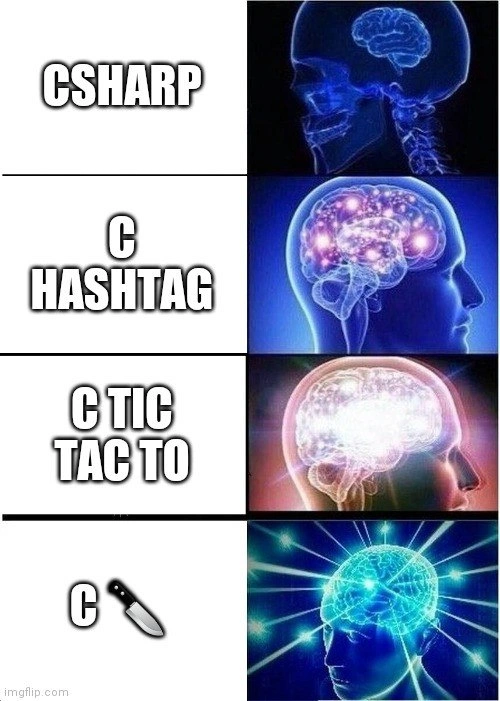
Evolving brain meme rebrands C# with increasingly cursed naming conventions
Why is this Languages meme funny?
Level 1: One Symbol, Many Names
Imagine you see the “#” symbol – you might know it as the sign for playing tic-tac-toe, or maybe you’ve heard it called a hashtag on Instagram. Now picture someone taking the name of a programming language, C#, and instead of saying “C Sharp” (which is the correct name), they start calling it funny things based on that # symbol.
It’s like if you have a toy that’s a little round ball:
- One friend calls it “ball” (normal name),
- Another friend, trying to be clever, calls it “circle toy” (describing its shape),
- And a silly friend calls it “O thingy” (just saying the letter it looks like),
- Finally, one friend just shows you a 🍏 emoji to represent it (imagine an apple emoji if the ball is apple-green, for example).
Each name gets a bit goofier and more over-the-top, right? Yet, they’re all talking about the same exact toy. That’s what’s happening in this meme, but with the programming language C#. At first they call it by its normal name. Then they call it “C Hashtag,” as if the # is a social media hashtag. Next, they call it “C Tic Tac Toe,” because # looks like a tic-tac-toe grid. Finally, they just use a little knife picture (🔪) to mean “sharp,” since knives are sharp. It’s all pretty silly!
Why is it funny? Because we expect people to just call the language “C Sharp.” Hearing all these wild, wrong names is like a little comedy skit for coders. It’s the same feeling as when a friend intentionally mixes up words to make you laugh. Even if you’re not a programmer, you can giggle at how absurd the names get. By the end, the joke is obvious: no matter what you call it, it’s still C#, and sometimes geeks love to get ridiculously creative with something as simple as a name. It’s a playful reminder that even in serious tech stuff, we have fun with words and symbols.
Level 2: Hash vs Sharp
Let’s break down the meme in simple technical terms. C# (C Sharp) is a popular programming language developed by Microsoft, part of the .NET ecosystem. It’s used for everything from building web applications to game development (with Unity) and desktop software. The language’s name is unusual because it includes a symbol: the #. In music notation, # denotes a sharp note, so “C#” is read as “C Sharp.” This is the intended pronunciation.
However, the # character itself has many names in everyday life and tech:
- Programmers and Brits often call it a “hash” (hence terms like hash mark, or hashing in algorithms, though that’s a different concept).
- On telephones in the US,
#is the “pound” key (you might have heard “press the pound key” in voicemail systems). - On social media,
#became known worldwide as a “hashtag,” because it’s used to tag topics (e.g., #TechHumor). - Visually,
#looks like a tic-tac-toe board (the grid for the game where you draw X’s and O’s). Some people jokingly call it that for fun. - Rarely, you might hear the word “octothorpe.” That’s a quirky historical name from old telephone engineers for the # symbol – a fun trivia fact for computer history nerds!
So, even though the language is pronounced “see-sharp,” someone unfamiliar might read C# in one of those other ways. The meme humorously imagines a developer (or perhaps a clueless friend) doing exactly that, and then some. Each panel shows a different “rebranding” of C# by reading the # symbol in an alternative way. The images of the brain expanding are a well-known meme template signaling that each idea is (supposedly) more enlightened or imaginative than the previous one. Here’s a breakdown of the four panels and what each caption means:
| Meme Panel Text | Interpretation & Joke |
|---|---|
| "CSHARP" (all one word) | The language’s name written plainly as if it were an English word. It implies C# = C Sharp, just spelled out. This is the normal, correct name, nothing fancy. |
| "C HASHTAG" | Treats the # as the word “hashtag.” This jokes that someone thinks of # in terms of social media. So they’d pronounce C# as “C Hashtag.” It’s a mix-up of contexts – using a Twitter/Instagram term to read a programming language name. |
| "C TIC TAC TO" | Describes the # by its shape. A tic-tac-toe board is a # drawn on paper for the game. So “C Tic Tac Toe” imagines someone reading C# by literally calling the symbol “tic tac toe.” It’s a very literal description instead of using the actual word sharp. (Notice they wrote "TO" instead of "TOE" – likely just to fit the text or be extra goofy). |
| "C🔪" (C followed by a knife emoji) | Replaces the word “sharp” with an emoji of a knife/cleaver (since knives are sharp to the touch). This effectively says “C Sharp” without words. It’s using a visual pun – the emoji stands in for the word sharp. This is the most extreme and humorous re-imagining of the name. |
In each case, the programming language C# is the subject, but the # symbol is being read in wildly different ways. The meme’s joke is that these names get increasingly exaggerated or "cursed," even though they all refer to the same thing. It highlights a LanguageQuirk: the symbol # can mean so many things. For a newcomer to programming, it might be genuinely confusing – “Why is it C sharp? That’s a # sign!” This meme plays on that confusion for laughs.
To appreciate why this is funny in a tech context, know that developers often have strong opinions on naming and pronunciation:
- We always correct each other on how to say things properly (for example, is it “GIF” with a hard G or a soft G? 🐧). Similarly, calling C# “C Hashtag” would prompt a good-natured correction (and some giggles).
- The meme exaggerates this by showing an obviously wrong way to say it (tic-tac-toe, really?!), which no one would earnestly use. It’s humor through absurdity.
- It also taps into the idea of over-complicating something simple. C# is just C Sharp. But what if someone insisted on describing it in the most roundabout way possible? That imagination runs wild in the meme.
We should also mention the Expanding Brain meme format: it’s a series of images (usually four) of brains with increasing levels of illumination or cosmic energy, paired with text. The first panel is a normal idea, and by the last panel the brain is ridiculously “enlightened.” The twist is that often the final idea is tongue-in-cheek or nonsensical despite being shown as the “ultimate” brainpower. In this case:
- Panel 1: Small brain = just say C Sharp (the sensible thing).
- Panel 2: Bigger brain = say C Hashtag (a silly misinterpretation, but maybe someone might say it).
- Panel 3: Glowing brain = C Tic Tac Toe (nobody says this; it’s humorously over-literal).
- Panel 4: Brain blasting with cosmic rays = C🔪 (using an emoji to communicate “sharp” – an idea so bizarre that it’s depicted as the most brilliant, sarcastically).
Because the categories here are Languages and tags like LanguageComparison and TechHumor, it’s worth noting: Developers often joke about programming languages and compare their features or names. C# is part of the C-family of languages (C, C++, etc.), but it stands out by having a musical symbol in its name. Other .NET languages follow the trend (there’s also F# “F Sharp”). It’s kind of a branding thing. But if you’re new, you might not catch that and instead see “C hashtag” – which sounds like C got trendy on Twitter! This meme is gentle teasing of that misunderstanding.
Finally, consider why a knife emoji got used. Emojis aren’t part of programming language names normally, but developers do use emojis informally (in commit messages, Slack chats, variable names in joke code, etc.). A knife represents “sharpness.” It’s a visual gag – you wouldn’t ever write C🔪 in a serious context, but as a meme, it instantly conveys the pun. It’s combining text with an image for a laugh, showing how creative (or crazy) you can get with language name play. This falls under programming_language_puns – taking a coding term (here a language name) and making a pun out of it.
So, at the junior level: this meme is a funny take on pronouncing the name of a programming language. It lists four versions of the name C#, each treating the # in a different way (from normal to very silly). The humor comes from recognizing that no matter what you call it – hashtag, tic-tac-toe, or even showing an emoji – it’s referencing the same C# language. It’s like an inside joke among coders, illustrating both a bit of tech knowledge (knowing that # is read as “sharp” here) and a bit of geeky whimsy (coming up with ever more ridiculous alternatives).
Level 3: Octothorpe Odyssey
This meme taps into programmer naming humor using the classic expanding brain format, escalating a simple idea to absurd heights. It’s riffing on the various ways people might refer to the programming language C# (pronounced “C Sharp”). Each panel rebrands “C#” with a more cursed naming convention than the last – from correct, to quirky, to downright galaxy-brain. Here’s what’s happening, from a seasoned developer’s perspective:
Panel 1 – “CSHARP”: The small-brain tier just spells out the name normally. In plain English, C# is called C Sharp, deriving from the musical sharp (♯) symbol. Experienced devs know the name is a playful nod: C# was created as an evolution of C++, and “sharp” suggests one step up (musically a sharp raises a note by a semitone, just as C# was meant to advance the C lineage). By writing it as “CSHARP,” the meme highlights the straightforward interpretation—no gimmicks, just the language name.
Panel 2 – “C HASHTAG”: Now the brain is glowing. Here someone reads the
#literally as a “hashtag” (the social media term for#). This is where dev humor kicks in: hearing “C Hashtag” is hilarious (and a bit cringe) to any C# developer. It conjures the image of a clueless newcomer or a non-techie HR person reading C# off a resume as “C Hashtag”. 🤦♂️ It riffs on the idea that the#symbol, ubiquitous in code, has been culturally rebranded by Twitter and Instagram. For a senior dev, C Hashtag sounds as wrong as calling Java “Coffee Script” – it immediately marks you as someone who doesn’t quite get the context. The meme is winking at that shared experience among programmers: “Remember when we had to correct someone’s pronunciation of C#?”.Panel 3 – “C TIC TAC TO”: The brain grows more cosmic. Now we’re over-explaining the symbol by describing how it looks: a
#has the shape of a tic-tac-toe grid. Calling C# “C Tic Tac Toe” is ridiculously literal – it’s the kind of convoluted explanation that only extremely online humor would invent. No one actually says this, and that’s the joke. It’s a playful jab at how far one can stretch a naming convention: instead of just saying “sharp,” this panel treats#as if an alien asked “What’s that symbol?” and you answered, “It’s the grid for a game of tic-tac-toe.” It’s absurd, and that absurdity gives seasoned devs a hearty chuckle. This is language-quirk comedy at its best – we’re laughing at how a simple name can be mutated into something so needlessly elaborate. By the third panel, the meme is basically screaming, “Get it? We’re deliberately misinterpreting the symbol!” The senior perspective here appreciates the layers: an innocuous language pun has escalated into pure silliness, reflecting the nerdy tendency to overthink everything, even how we say a language’s name.Panel 4 – “C🔪”: Galaxy brain achieved. The final form abandons text for an emoji: a knife (cleaver) emoji next to “C”. Why? Because knives are sharp. This panel is the punchline, converting the word “sharp” into a literal pictogram. It’s a visual pun that redefines cursed naming convention – almost like the language name is so advanced now, it transcends text and requires an image. For devs, this is hilariously over-the-top. It’s as if someone thought, “Why even bother saying ‘sharp’ when I can just drop an emoji in there?” It’s mock-genius and mock-insanity at the same time. Practically, using an emoji in a programming language name is unthinkable (imagine a file named
HelloWorld.c🔪– not gonna fly in any OS!). But that’s the tongue-in-cheek point: the meme’s final stage parodies the idea of being ultra-intellectual by doing something undeniably impractical and wacky. Seasoned devs recognize this as first-class “inside joke” material – mixing a Unicode emoji into a language name to show you’re so enlightened, you’ve left behind the confines of normal naming. It satirizes our penchant for over-engineering: the more “brain power” we claim to use, the more ludicrous the solution. In other words, peak galaxy brain = peak ridiculousness.
This escalating joke resonates with developers because it touches on real quirks of tech culture. Naming things is famously one of the hardest problems in computer science (as the joke goes), and here we’re watching that problem go off the rails in a comedic way. The meme implicitly asks: How far can we go in misnaming a simple concept and still recognize it? Each step abuses the poor # symbol in a new way:
- First panel, it’s correct but dull.
- Second panel, it’s a modern misnomer (hashtag, like we’re mixing programming with Twitter trends).
- Third, it’s an overly literal visual description – something only a pedant (or a jokester) would use.
- Fourth, it’s not even text, it’s an emoji – a totally different context imported into the name.
For veteran devs, there’s an extra layer of chuckling here. We’ve all seen how jargon and symbols confuse outsiders. Think about how many names # has collected over decades: hash, pound, number sign, octothorpe, and now “hashtag.” In C#, it’s meant to be “sharp,” but if you’ve ever taught or mentored someone new, you might’ve heard them read # out loud as something bizarre. (Some of us have that story of a junior dev saying "I love C hasht... er, C-sharp!" 😅). This meme just cranks that scenario up to eleven for comedic effect. It’s winking at DotNet developers specifically, since C# is a flagship language there, but the humor is broad enough that anyone who’s wrestled with programming language names can relate.
In summary, the meme is a celebration of language quirks and the nerdy joy of over-analysis. It takes the innocent C# name and gives it the full expanding-brain treatment: each panel is a progressively more “creative” (read: insane) reinterpretation of the # symbol. For an experienced developer, the brilliance lies in how it captures a slice of dev culture: we bond over silly things like mispronouncing C#, and we love to push a joke to the extreme. This is why you’ll find it in every DeveloperHumor thread about naming – it’s a perfect storm of tech humor: clever, a bit educational, and totally relatable if you’ve been around code (and memes) long enough.
Description
The image is a four-panel 'expanding brain' meme arranged vertically. 1) Top panel shows a dimly lit skull X-ray with a small brain and the bold white caption “CSHARP.” 2) Second panel shows a brighter, glowing brain and reads “C HASHTAG.” 3) Third panel’s brain is even more illuminated, captioned “C TIC TAC TO.” 4) Bottom panel shows a cosmic, neon-lit brain with light beams and the caption “C” followed by a small cleaver / knife emoji, implying the word 'sharp.' The meme humorously illustrates progressively “galaxy-brain” ways developers mispronounce or over-explain the programming language C#, riffing on language naming, pronunciation, and inside jokes common in developer culture
Comments
7Comment deleted
Can’t wait for the final form: C♯ written as the literal Unicode ♯ - so every build script, git hook, and Kubernetes label breaks simultaneously, achieving true microservice enlightenment
Still waiting for a junior dev to call it "C Octothorpe" in a standup and watch the principal engineer's eye twitch while mentally calculating how many sprints until retirement
Pedantically it's not even C# - the language uses U+0023 NUMBER SIGN because U+266F wouldn't fit in 1990s keyboards, so 'C hashtag' is accidentally the most accurate one
The journey from 'C Hashtag' to understanding that C# is literally 'C with a sharp object' perfectly captures every developer's evolution - from cargo-culting syntax to grasping that Anders Hejlsberg basically said 'let's take C, make it sharper, and add garbage collection so we stop stabbing ourselves with memory leaks.' The real galaxy brain moment is realizing the # preprocessor directive in C was the OG hashtag before Twitter made it cringe
It’s “C sharp”; put the Unicode ♯ in a repo or package name once and you’ll get a crash course in normalization, URL encoding, and why your CI can’t resolve dependencies
C# pronunciation by role: developer “C sharp”; recruiter “C hashtag”; architect “IL on the CLR”; on-call during a 99th-percentile GC pause “C knife”
Senior arch: C# for the facade, but when latency bites, it's C knife time - trading GC pauses for segfault stabs