Skip to content
DevMeme
250 of 7435
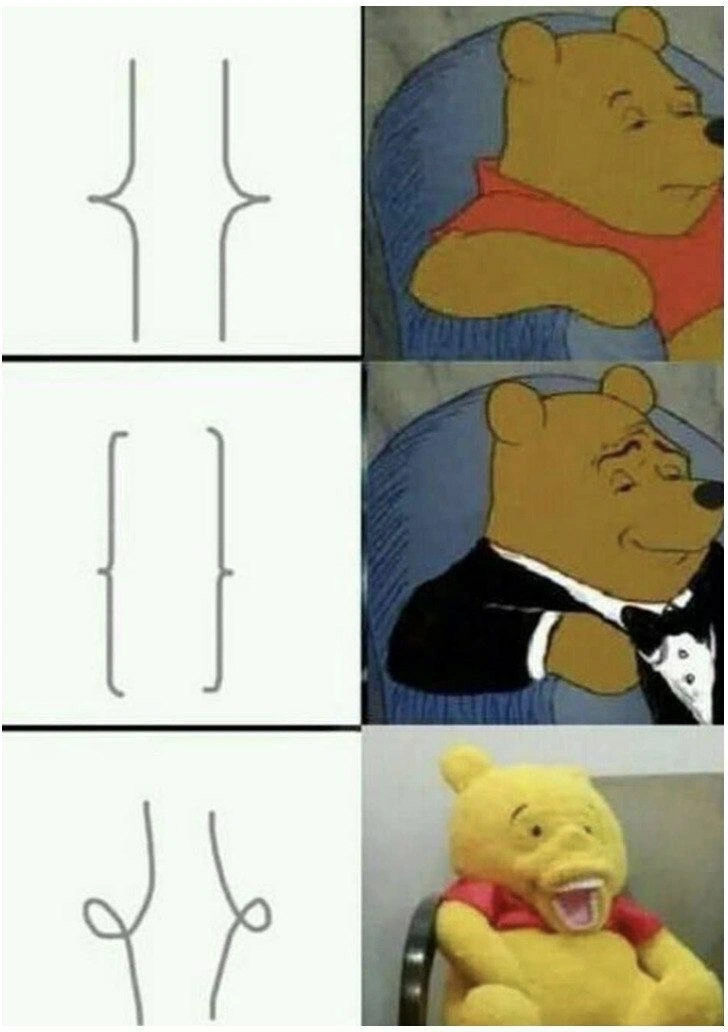
Developers ranking brace drawing styles with progressively fancier Pooh reactions
Languages Post #303, on Apr 6, 2019 in TG

Developers ranking brace drawing styles with progressively fancier Pooh reactions

Why is this Languages meme funny?

Level 1: Silly Style Fights

Imagine you and your friends are drawing the same shape, but each of you does it a little differently. Let’s say you’re all drawing a pair of curly squiggles (kind of like two mirror-image curvy lines). One friend draws them really plain and straight – you look at it and just shrug, not very excited. Another friend draws nice, evenly curved squiggles – you nod with a smug smile, like “Hmm, yes, that’s the right way, very nice.” Then your most playful friend draws super fancy squiggles with big loopy curls on the ends, like a crazy decorative design – and everyone bursts out laughing because it’s so over-the-top. This meme is doing exactly that, but with the special curly brackets that programmers use in code. The little bear (Winnie the Pooh) on the right is showing how a programmer might react. First he’s bored, then he’s looking proudly satisfied in a tuxedo (like he’s pretending to be very fancy about it), and finally he’s a toy bear laughing really hard. It’s funny because it shows how people (especially computer programmers) can get into silly fights over style – in this case, how to write or draw a simple curly shape. The truth is, all the drawings mean basically the same thing, just like different handwriting of the same word. But the joke is that we sometimes act as if one tiny style difference is a huge deal. It’s like two kids arguing that their way of drawing a heart or a star is the “best” and getting ridiculously excited about it. The humor comes from seeing someone treat a tiny detail so seriously (or joyfully) – it’s exaggerated to the point where it’s just plain silly. Even if you’re not a programmer, you can laugh at how overreactions build up in each panel. It reminds us of when we’ve gotten too excited about something small and our friends found it funny. In simple terms: the meme is poking fun at how people argue about unimportant little details, by showing a bear getting fancier and more excited about a curly line. It’s a goofy, relatable laugh at ourselves for sometimes making a big fuss over something small.

Level 2: Brace Style Showdown

In this meme, we’re looking at three different ways to draw or style curly braces (the { and } symbols you see in many programming languages). Curly braces are used in languages like C, Java, and JavaScript to mark the beginning and end of blocks of code (for example, the contents of an if statement or a function). The joke here is about how programmers have preferences for exactly how those braces should appear and be placed, and how they sometimes argue about it as if it were a big deal. On the left side of each panel, someone has sketched a pair of braces. On the right side, we have Winnie the Pooh showing a reaction. As the braces get more neatly or elaborately drawn from top to bottom, Pooh’s reaction goes from disinterested to pleased to absolutely thrilled. It’s a visual metaphor for a ranking: the brace style in the top panel is considered “meh,” the one in the middle is “fancy and proper,” and the bottom one is “over-the-top awesome (or hilarious).” This mirrors how developers might rank code styling from plain to fancy and get more excited (or opinionated) with the fancier options.

Why do developers care about brace style at all? It comes down to code formatting conventions. In a team or project, having a consistent style (including how braces are placed) makes the code easier to read and maintain – this falls under CodeQuality and good DeveloperExperience. Different style conventions have names. Two of the most common brace placement styles are K&R style and Allman style. K&R (Kernighan & Ritchie) style means you put the opening { on the same line as the statement before it. For example: if (x < 0) { goes on one line. In contrast, Allman style means you put the { on a new line by itself, so you’d write if (x < 0) on one line, then the next line has just the {. These might seem like tiny differences, but developers often strongly favor one or the other. It’s a bit like punctuation style in writing – not technically important for the content, but people feel their way is clearer or more elegant. Many programming language communities adopt one style by convention. For instance, the Java and JavaScript communities often use K&R style by default, whereas some C# or older C++ codebases use Allman style. These preferences get documented in style guides or enforced with tools (like linters and formatters) so that everyone’s code looks the same. That consistency can help with readability, but sometimes programmers take these rules very seriously. This meme is making fun of how serious and snooty we can get about something as simple as brace characters.

Let’s connect the panels to real scenarios. The first panel shows very plain, almost straight braces drawn with minimal curve. Pooh’s expression there is dull, indicating that this style isn’t impressive. This could represent a scenario where someone’s brace style is considered ugly or too minimalistic – maybe like drawing braces sloppily on a whiteboard, or using a style that others find unpleasant (for example, some might jokingly say “those barely-curved braces look wrong”). The middle panel braces are nicely formed, the classic curly shape you’d see typed in code or in a textbook. Pooh in a tuxedo gives a half-smile of approval, suggesting “Ah, yes, this is the proper way.” This aligns with a typical agreed-upon style (like a standard convention that most people accept). The tuxedo Pooh image (often called the fancy Pooh meme) is commonly used online to humorously show someone acting high-class or connoisseur about a topic. Here it implies that the traditional brace style is being treated as the classy, correct choice – Pooh is basically saying, “Now this is a brace style with class.” Then we get to the third panel, where the braces are drawn with big loops at the ends, almost like decorative flourishes or knots. This is not a style you’d normally see in actual code – it’s more like an artistic doodle, maybe what a very imaginative programmer might draw in the margins of a notebook. In response, we have a photo of a Pooh bear doll leaning back and laughing with mouth wide open. This image is often used as a meme to show uncontrolled laughter or extreme giddiness. The combination here implies that this ultra-fancy, looped brace drawing is so outlandishly fancy or unexpected that it’s hilarious or amazing to the viewer. Essentially, it’s saying, “This brace style is so extra that it’s killing me (with laughter).”

The humor comes from contrast and exaggeration. In real life, most programmers won’t ever see hand-drawn curly braces quite like that, and certainly not argue about loops on braces – but they will argue about where braces go or how code is formatted. This meme takes that idea of code formatting preferences to a silly extreme by focusing on the literal shape of the braces. It’s making a mountain out of a molehill for comedic effect. If you’re a newer developer, you might not have experienced it yet, but things like brace placement, indent size (4 spaces vs 2 spaces vs tabs), whether to put a space before a parenthesis, etc., often lead to long discussions. We even have the term “holy war” or “style war” for debates like Tabs vs Spaces or brace style because of how heated they can get. Here, Pooh’s increasingly delighted reactions are a tongue-in-cheek way of saying, “Oh yes, we devs sure do love arguing about our beloved braces – the fancier, the better!” It’s both a celebration and a gentle mocking of developer obsessiveness. By using a familiar cartoon character and an internet meme format, it delivers the joke in a lighthearted, universally understandable way. Even if you don’t know Pooh, the images clearly show the emotional progression: indifferent, pleased, and overjoyed. And even if you don’t know the exact term for each brace style, you can sense that the second style is considered “good” and the third is “so fancy it’s hilarious.” In summary, the meme humorously highlights a DeveloperHumor in-joke: that we sometimes treat our code format styles with the seriousness of ranking fine art, and that itself is pretty funny.

Level 3: Braces Arms Race

At first glance, this meme is a syntax humor masterpiece for seasoned developers. It presents three pairs of hand-drawn curly braces in a column, each pair slightly different in style, and Winnie-the-Pooh reacts with escalating approval as the braces become more elaborate. This comical ranking of brace drawing styles riffs on real programming LanguageQuirks: the almost religious debates over how to format { curly braces in code. In the top panel, the braces are thin and nearly straight – Pooh looks bored and unimpressed. By the middle panel, we see nicely curved, traditional braces – Pooh dons a tuxedo and smiles in smug approval (the classic Fancy Pooh meme format for feeling sophisticated). Finally, the bottom panel shows ridiculously exaggerated braces with big loopy flourishes – now Pooh (as a plush doll) leans back laughing in wild delight. The joke is capturing how developers can have disproportionate reactions to minor differences in code style, treating something as trivial as brace shape or placement like a big CodeStyleGuides fashion show. It’s poking fun at how code formatting preferences spark LanguageWars in programming communities, where each brace style has its proud champions. In reality, these styles make zero difference to the computer, but to humans reading the code (and arguing in code reviews), they can feel oddly important.

Why is this funny to an experienced developer? Because it’s painfully relatable. We’ve all witnessed (or participated in) a “brace style” argument during a code review or on an online forum. The meme exaggerates it: as the braces get fancier, the reaction goes from meh to classy to over-the-moon — reflecting how some developers act as if proper brace styling is a mark of elite sophistication. It satirizes the bikeshedding phenomenon, where teams spend excessive time debating trivial issues like indent styles or brace placement instead of focusing on hard problems. The Pooh bear’s increasingly refined/enraptured expressions mirror the absurd level of DeveloperHumor and pride we attach to something as superficial as how curly our {} look. It’s a gentle roast of our tendency to nitpick code aesthetics: the first simple brace pair is “wrong” or boring, the standard curly braces are “acceptable” or even posh (hence Pooh in a tux, as if approving fine wine), and the over-the-top squiggly braces are hilariously extra — so much so that it sends Pooh into a hysterical fit. In other words, the meme suggests that the more outrageously fancy your brace style, the more “refined” (or ridiculous) your taste must be, parodying the snobbery some devs have about style.

This resonates strongly with veteran programmers because brace style wars have a real history. In C and Java, there’s the classic Allman vs. K&R showdown (tagged as allman_vs_knr in the context). Allman style (also called “BSD style” or OTBS for One True Brace Style by its supporters) puts the opening { on a new line, neatly aligned under its control statement. K&R style (named after Kernighan & Ritchie, the authors of C) keeps the { on the same line as the if/while/function header, saving vertical space. Neither is objectively “better” – it’s purely about readability and team convention – but oh boy, will developers defend their favorite as if it’s part of their identity. The meme’s middle braces (nicely curved, textbook shape) evoke a well-proportioned K&R style brace or just the idea of a properly styled brace according to a typical style guide. The top panel’s skinny, awkward braces look a bit like a half-hearted attempt – maybe reminiscent of a poorly drawn brace or a style that just doesn’t look right (to a picky coder, this could symbolize “some other team’s ugly style”). Then the bottom panel’s loopy braces go beyond any real standard – it’s a goofy exaggeration, akin to adding ornamental calligraphy to code. No one actually writes code with such loops (fonts don’t allow that), but it symbolically represents taking pride in making braces as fancy as possible. It’s like the braces version of flexing. The plush Pooh laughing could imply that by the time you’re arguing for ultra-fancy braces, it’s so absurd that even Pooh can’t keep a straight face – or conversely, Pooh is so delighted by this über-fancy style that it’s comedic. The humor cuts both ways – it mocks the DeveloperExperience_DX of getting way too happy about a meaningless aesthetic tweak.

To put it in real terms, here’s how two common brace styles look in actual code. Imagine a simple if statement in C/Java/JavaScript:

// K&R style (opening brace on the same line)
if (isFancy) {
    doSomething();
}

// Allman style (opening brace on the next line)
if (isFancy)
{
    doSomething();
}

Both snippets function identically – the difference is purely in formatting. Yet teams often adopt one style as a rule, and switching the placement of that { can trigger a surprisingly strong reaction. Veteran developers chuckle at this meme because they recall endless discussions in commit comments and style guide docs about where those braces should go. In large codebases, consistency is part of CodeQuality – it does help readability if everyone does it the same way. However, the meme is highlighting the comedic extreme: ranking brace aesthetics as if we’re judging fine art. It’s a playful jab at how we sometimes treat code style guides as holy scripture. The Winnie-the-Pooh template is perfect here because it’s widely used to joke about ascending levels of taste or classiness. In the second panel, Pooh’s smug tuxedo look conveys, “Ah yes, excellent choice, my good sir,” which is exactly how a self-satisfied senior might react after reformatting your code into their preferred style. By the last panel, Pooh’s unrestrained laughter suggests that this has gone off the deep end – much like a code review comment chain that devolves into GIFs and sarcasm over brace positions.

There’s also a sly nod to how DeveloperExperience can be affected by these debates. Many of us have spent late hours tweaking lint configurations or arguing in pull requests about trivial style points while the actual features or bugs wait on the sidelines. It’s funny because it’s true: we get fiercely opinionated over things like space vs. tab or brace placement – classic LanguageWars that are ultimately about personal comfort and habit. Modern tooling tries to save us from ourselves: languages like Go bring auto-formatters (gofmt) that enforce one true style (no configuration, no debate), and teams using JavaScript/TypeScript often adopt Prettier or ESLint rules so the bike-shedding stops and everyone can focus on real problems. The meme gently ribs the fact that, left to our own devices, developers will always find a silly formatting hill to die on. It’s a shared joke that lightens the mood: “Remember, we got into a heated debate over curly braces, of all things – how ridiculous and endearing is that?” In short, the meme takes a small quirk of coding humor – our tendency to treat code style as a status symbol – and turns it into a visual punchline. Brace yourself, indeed, because something as simple as {} can ignite surprisingly strong feelings in the programmer mind!

Description

Three-panel Winnie-the-Pooh meme: each row’s left half shows a pair of hand-drawn braces, while the right half shows Pooh with escalating enthusiasm. Top: thin, almost straight braces; Pooh sits in a red shirt looking unimpressed. Middle: traditional curly braces with proper curves; Pooh now wears a tuxedo, eyes half-closed in smug approval. Bottom: exaggerated braces whose ends loop like knots; a plush Pooh doll leans back laughing with mouth wide open. The joke riffs on programmers’ strong opinions about brace style and code formatting conventions across languages such as C, Java, and JavaScript, poking fun at how minor syntax choices spark disproportionate reactions among developers

Comments

7
Anonymous ★ Top Pick We can argue K&R vs Allman all day, but nothing rallies an incident bridge faster than discovering the outage came from a “LEFT CURLY BRACKET ORNAMENT” (U+2774) someone copy-pasted into production YAML
  1. Anonymous ★ Top Pick

    We can argue K&R vs Allman all day, but nothing rallies an incident bridge faster than discovering the outage came from a “LEFT CURLY BRACKET ORNAMENT” (U+2774) someone copy-pasted into production YAML

  2. Anonymous

    The third one is when you discover the previous developer wrote their own template engine because "Handlebars was too opinionated" and now you're maintaining 10,000 lines of regex-based string replacement that somehow became business critical

  3. Anonymous

    Teams that survived tabs-vs-spaces and brace-on-same-line wars were not ready for the third front: how you loop your braces on the whiteboard

  4. Anonymous

    Every senior engineer has lived through all three phases: the naive 'braces are just braces' phase, the pretentious 'my formatter enforces K&R with trailing commas' phase, and finally the PTSD-inducing 'I just spent 4 hours debugging a missing brace in a 2000-line legacy config file' phase. The real horror isn't the syntax - it's realizing that cursed bottom panel is actually production code someone wrote in 2003, and you're the one who has to refactor it because you're the only person left who understands both the business logic AND why those braces are nested 47 levels deep

  5. Anonymous

    Brace style debate in three acts: K&R, Allman, and “Unicode ⦃⦄ pasted from Notion” - elegant right up until the JSON parser politely resigns

  6. Anonymous

    Prod API docs say 'array of items', backend ships {} - cue the schema validator's revenge and your fastest rollback ever

  7. Anonymous

    Brace-style bikeshedding is a Byzantine consensus problem - let Prettier or clang-format be the leader; the calligraphic braces are the byzantine node nuking quorum

Use J and K for navigation