Microsoft's Priorities: Quantum Breakthroughs vs. Fixing Teams
Why is this Microsoft meme funny?
Level 1: Broken Bike vs Rocket
Imagine you have a bicycle that you ride to school every day, but lately it’s been a bit broken – the chain keeps coming off and the tires are wobbly. You’ve told your parents about this because it makes your daily ride pretty frustrating (and sometimes you’re late to school when the bike acts up). Now picture this: instead of fixing your bike, your parent spends all their time building a super advanced rocket ship in the garage. This rocket is amazing and high-tech – it could maybe go to the moon! That’s undeniably cool and everyone in town is talking about how your parent is a genius for inventing this new rocket. But… you still have to ride that broken bike to school every morning. The rocket doesn’t help you with that at all.
In this story, Microsoft is like the parent, the rocket ship is the fancy quantum computer they’re building (with a brand new kind of matter – something really futuristic), and the broken bicycle is the Teams app that people use every day for work calls and messages. The joke – what makes us laugh – is the silliness of the situation: focusing on the super fancy rocket while ignoring the simple bike that needs fixing. It’s funny because you’d think fixing the bike (something immediately useful) should come before building a rocket (something amazing but not immediately helpful to the everyday problem). People find this relatable and humorous, because we all know what it’s like when someone (or some company) has mixed-up priorities. It’s as if Microsoft is saying, “Look at this incredible new thing we made!” and users are responding, “That’s cool and all, but can you please just make our daily meetings a little smoother?”
Level 2: Majorana vs Meetings
Let’s break down what’s going on in simpler terms. Microsoft Teams is a software application that a lot of companies use for communication. It does things like chat, video meetings, screen sharing – basically a tool for colleagues to talk and collaborate, especially when working remotely or in different offices. Now, Teams has a bit of a reputation among developers and office workers: it can be slow, use a lot of computer memory, and occasionally you hit annoying bugs (like calls dropping or the app freezing at the worst moments). It’s built on a framework called Electron (which means it’s kind of like a web browser running a website, even though it looks like a desktop app), and while that makes it cross-platform and feature-rich, it also can make it less efficient. Many users have quipped about teams_slow_performance, noting how it can lag or consume resources. So that’s one side of the meme – the everyday tool that people need to just work reliably, but which often frustrates them. This is where the enterprise_communication_tool_frustration tag comes in: if you’ve ever been in an important meeting and the app crashes as you’re about to present, you know that feeling.
On the other side, we have QuantumComputing – something straight out of advanced science. Unlike normal computers that use bits (which are either 0 or 1), quantum computers use qubits that can be 0 and 1 at the same time (a concept called superposition). They can also be linked together through entanglement, which means two qubits can be connected in such a way that changing one instantaneously affects the other, even if they’re far apart. This all sounds magical, but it’s real physics. The catch is that qubits are super sensitive – almost anything can mess them up (vibrations, temperature changes, electromagnetic noise). So building a stable quantum computer is extremely hard. Companies like Microsoft, Google, IBM, and others are in a global race to make qubits that last longer and make fewer errors, so that one day we can solve problems with quantum computers that we can’t with normal computers.
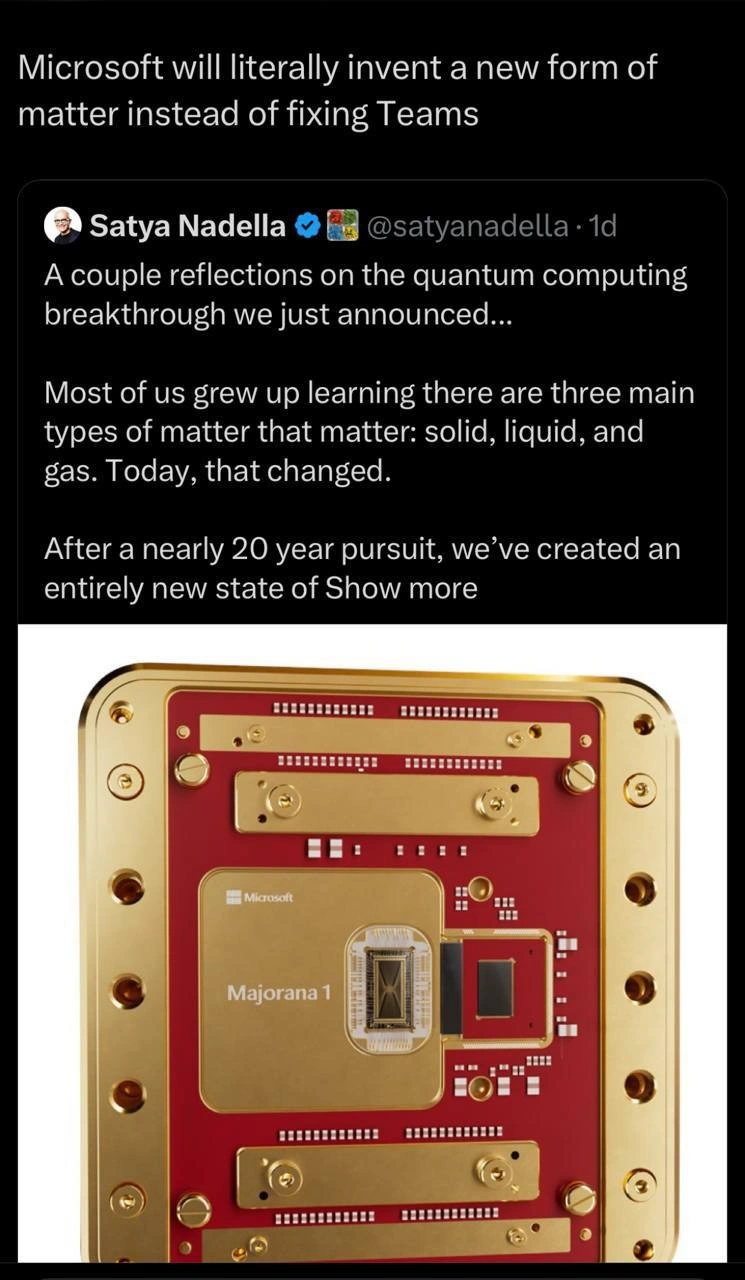
Now, Microsoft’s approach to this involves something called Majorana qubits. A Majorana particle (or Majorana fermion) is a weird concept in physics – basically a particle that is its own antiparticle. For our purposes, what matters is that Microsoft has been trying to use this concept to create a very stable qubit. The tweet from Satya Nadella in the meme references a “quantum computing breakthrough” and “an entirely new state of matter”. That’s a dramatic way of saying: after 20 years of research, they managed to make a special material or chip where these Majorana quasi-particles actually appear and behave predictably. In plain English: they made a new kind of stuff (not quite solid, liquid, or gas – something more exotic) where quantum information can live more safely. The Microsoft Majorana 1 chip shown in the image is likely a piece of hardware designed to host these special qubits. It’s red and gold in the picture, looking all high-tech and shiny, reminiscent of sci-fi movie props. But it’s a real thing – probably a module that has to be super-cooled and isolated from vibrations, in which the new state of matter exists for those qubits.
So why is this funny when you put it all together? Imagine you’re a developer who every day has to use Microsoft Teams to attend meetings. You’re well aware of its glitches – maybe you even joke with coworkers about how “Teams is acting up again, surprise surprise.” Now you see Microsoft’s CEO proudly announcing that the company basically did something revolutionary in physics and technology. On one hand, you’re impressed – this is really cool science! On the other hand, you can’t help but think, “Umm, could we maybe get a stable video call first?” It’s a contrast of priorities. The tag quantum_prioritization_over_bugfix nails this: it humorously suggests Microsoft is prioritizing quantum innovation over fixing simple software bugs. Of course, in reality, different teams handle these things – Microsoft has a big research division for quantum, and a different product team for Teams. But from an outsider’s perspective (or a frustrated user’s perspective), Microsoft is one big entity. All you see is that this big company would rather talk about quantum states of matter than acknowledge your daily pain of glitchy software.
For a junior developer or someone new to tech, it’s also a peek into how large tech companies operate. Big companies often invest in long-term research (which can seem unrelated to their current products) because they’re thinking 5-10 years ahead. At the same time, they have to keep their customers happy in the present. This meme jokes that Microsoft might be leaning a bit too much into the future and not enough into the present. TechHumor like this often exaggerates to make a point. The line “literally invent a new form of matter instead of fixing Teams” is hyperbole – obviously Microsoft isn’t maliciously choosing not to fix Teams bugs; bug fixing is ongoing all the time. The joke is just that it feels like they’d do anything but address those persistent annoyances. It’s funny to imagine a conversation where a Teams user is pleading, “Can we improve screen-sharing performance?” and Microsoft responds, “How about we give you a new state of matter and some Majorana particles instead?” – completely missing the ask.
In simpler terms, it’s like the company built a Ferrari engine (quantum computer) while the car you drive to work (Teams app) has a wonky wheel. For newcomers, the takeaway is: Microsoft does some really advanced stuff and also maintains everyday software. Sometimes the advanced stuff gets spotlighted, and users joke about the everyday stuff being neglected. It’s good-natured ribbing that reflects a common sentiment in the dev community: cool tech is cool, but don’t forget to polish the basics. And hey, if Microsoft really did crack a new state of matter, who knows – maybe one day your Teams calls will be powered by quantum magic. But until then, we’ll poke fun at the situation to cope with those occasional “Reconnecting...” messages during our stand-ups.
Level 3: Quantum Over Quality
This meme hits home for seasoned developers because it highlights a familiar frustration: big tech companies often pour resources into overengineering moonshot projects while neglecting the mundane quality-of-life fixes users actually beg for. Here, we see Microsoft trumpeting a quantum computing breakthrough – essentially declaring, “We’ve advanced the frontier of physics!” – juxtaposed with the caption that implies, “...but we still haven’t bothered to make Teams stop randomly consuming 1 GB of RAM.” The humor arises from that jarring mismatch of priorities. Anyone who has suffered through a laggy Microsoft Teams call or waited forever for a channel message to load can relate. It’s as if Microsoft will tackle the hardest known science problems yet won’t (or can’t) allocate a few more devs to polish their everyday software.
MicrosoftTeams is infamous in developer circles for being slow or clunky. It’s a running joke that Teams might suddenly hog your CPU during a meeting or that hitting the “Mute/Unmute” button sometimes feels like it’s running on a 10-second delay. These aren’t life-or-death bugs, but in aggregate they cause real frustration, especially when you’re on your fifth video call of the day. Many devs have poked fun at how Teams is built on Electron (essentially a Chromium browser under the hood), which often means higher memory usage and less native performance. This context makes the meme’s claim “Microsoft will literally invent new matter instead of fixing Teams” so snarky-perfect – it exaggerates, but not by much. We’ve all seen companies chase the new shiny tech while the existing tools creak under technical debt.
The screenshot of Satya Nadella’s tweet is an actual reflection of Microsoft’s focus: Satya (the CEO) is enthusiastically talking about a 20-year pursuit culminating in something revolutionary. If you’re a senior dev reading that, you might chuckle and think, “Great, the quantum future is here. Meanwhile, yesterday Teams wouldn’t let me copy-paste into a chat... again.” The meme’s author is essentially voicing what a lot of employees and developers half-jokingly say: “Could you maybe fix the stuff we use everyday before splitting atoms or whatever?” It’s a bit of a cheap shot (the teams working on quantum computing obviously aren’t the ones who maintain Teams), but the TechSatire lands because it feels like corporate culture in a nutshell.
We recognize in this the classic pattern of overengineering vs. basic maintenance. For instance, perhaps you’ve been in a company where leadership pushes for adopting a fancy new microservice architecture or an AI initiative, all while the core product has glaring bugs that never get prioritized. Here, quantum research is the ultra-fancy new thing – a potential game-changer for the future, sure – but Microsoft Teams is the core product today for millions that still has rough edges. The meme wryly implies that Microsoft’s priority stack might be upside-down (quantum first, quality second). It’s poking fun at how enterprises sometimes invest in PR-friendly innovation (because “Microsoft invents new form of matter” makes headlines) more than in refining the day-to-day user experience (nobody writes headlines for “Teams uses 200MB less memory now”).
Historically, Microsoft has balanced being a practical software company and a research powerhouse. Under Satya Nadella, they’ve pushed hard into cutting-edge fields: AI, cloud, AR, and now quantum. That’s exciting, but it creates a disconnect for the average user. A senior engineer might recall similar ironies from the past: remember how Microsoft was exploring Hololens and mixed reality while Windows Phone users were begging for basic app support? Or how they touted AI in Office while Outlook would still crash from a large attachment? It’s that déjà vu of priorities that makes this meme so relatable and funny. There’s an unwritten collective understanding: big companies often have silos, and the “cool research” silo doesn’t always translate to improvements in the “boring product” silo.
The enterprise_communication_tool_frustration is real: for developers and office workers, a glitchy call or a slow chat app means lost time and frayed nerves. We joke about it to cope. This meme basically says, “Sure, Microsoft, go ahead and solve quantum computing… just maybe fix the tool I need for my 9am stand-up meeting first, okay?” It’s a bit of gallows humor for those of us who’ve been burned by a screen freeze right when the boss asks a question on a Teams call. And of course, the hyperbole “literally invent a new form of matter instead of fixing Teams” gives it that spicy, exaggerated edge that makes the point clear. After all, no one literally believes Microsoft set out to ignore Teams bugs – but it can feel that way when headlines scream about quantum breakthroughs on the same week you’re cursing at yet another Teams update with no noticeable improvement.
In summary, the meme is satire.exe running on two threads: one, awe (and sarcasm) at Microsoft’s majorana_qubits research triumph; two, commiseration over the everyday annoyance of a slow, memory-hogging chat app. Seasoned devs laugh because they’ve lived this dichotomy: groundbreaking innovation and grinding frustration, side by side in the same company. It’s a coded message: We love the tech progress, but seriously, fix your basics. And if you’ve ever been on an on-call rotation at 3 AM due to a neglected bug, you know exactly why that mix of admiration and exasperation is so funny and so true.
Level 4: Majorana vs Minor Bugs
At the cutting edge of QuantumComputing, Microsoft’s research labs are dealing with phenomena that sound straight out of a physics textbook. The meme references a real breakthrough: Microsoft claims to have engineered a new state of matter using Majorana qubits. In quantum physics terms, that’s huge – we’re talking about exotic particles and topological states that only exist under extreme conditions. Majorana quasiparticles (named after physicist Ettore Majorana) are peculiar because they act as their own antiparticle. They’ve been theorized for decades in condensed matter theory and are a sort of holy grail for quantum engineers. To create them, Microsoft had to cool materials to near absolute zero, apply strong magnetic fields, and fine-tune nanowire circuits so that electrons pair up in just the right quantum state. When they finally succeed, those paired electrons form a topologically protected state – essentially a new phase of matter where information can be stored much more robustly than in a normal quantum bit. This is not just adding a new chapter to a textbook; it’s like writing a whole new textbook in quantum theory.
Why does this matter (pun intended)? In conventional qubits (like the superconducting loops used by IBM or Google), quantum information is fragile – a stray electromagnetic noise or a slight temperature fluctuation can knock a qubit out of its delicate superposition. But a Majorana qubit encodes information non-locally: it spreads the quantum state across two Majorana particles such that local disturbances (like a little burst of heat or radiation at one particle) won’t easily destroy the encoded data. This leverages the weird properties of topological matter – think of it like tying a knot in a rope; as long as the knot’s topology is intact, the information (the knot) remains, even if the rope jiggles. Microsoft’s claim of creating a new state of matter basically means they’ve tied a brand-new kind of “quantum knot” in the fabric of reality, something beyond the conventional solid, liquid, gas (and even beyond plasma or Bose-Einstein condensates that physicists already knew about). It’s a topological superconducting state supporting Majorana zero modes, extremely esoteric and groundbreaking.
From a theoretical standpoint, this breakthrough intersects quantum physics and computer science: it validates ideas from the 1930s (Majorana’s theory) and the 2000s (Kitaev’s models of topological quantum computing). It suggests we might finally build quantum chips (Microsoft Majorana 1 as the image shows) that can perform computations with far fewer errors. In essence, Microsoft is trying to leapfrog the competition by solving the error-correction problem at the physics level rather than purely with software algorithms. It’s an ambitious bet: invest 20 years in research to literally change physics so that your qubits are inherently stable, instead of battling noise the hard way with thousands of redundant qubits. And by the sound of it, that bet is starting to pay off – they’re announcing success in creating these elusive Majorana-based qubits, a milestone many thought might be impossible.
However, the meme’s dark humor highlights the surreal contrast: Microsoft can manipulate quasiparticles and quantum states that few people on Earth fully understand, yet the company still struggles with the prosaic task of making Microsoft Teams run without hogging memory or randomly freezing. It’s a classic case of quantum superposition of priorities – one part of the company exists in a futuristic realm of Majorana fermions and non-abelian anyons, while another part can’t collapse the wavefunction of a simple video meeting without glitches. The quantum_prioritization_over_bugfix vibe here suggests an almost cosmic joke: they unlocked new secrets of the universe instead of fixing a well-known, earthly software annoyance. In other words, Microsoft mastered entangled particles, but an everyday Teams call can still feel like a roll of the dice. The fundamental irony is almost scientific itself – as if solving decoherence in a quantum system is easier than solving lag in a collaboration app.
Description
This meme juxtaposes a monumental scientific achievement with a common user frustration. The top of the image features a caption that reads, 'Microsoft will literally invent a new form of matter instead of fixing Teams'. Below this is a screenshot of a real tweet from Microsoft CEO Satya Nadella. In the tweet, Nadella announces a major breakthrough in quantum computing after a 20-year pursuit, claiming the creation of 'an entirely new state of matter'. The tweet includes a high-tech photo of the 'Majorana 1', a quantum processing unit, which looks like a complex chip with gold and red components. The humor is satirical, highlighting the disconnect between a tech giant's ambitious, long-term research goals and the persistent, everyday usability issues of its widely used software, Microsoft Teams, which is notorious among tech professionals for being resource-heavy and buggy

Comments
17Comment deleted
It's impressive that Microsoft created a new state of matter. Now they just need to apply that knowledge to make Teams exist in a state where it uses less than 2GB of RAM
Microsoft just trapped Majorana quasiparticles; next quarter’s OKR is collapsing the Teams wavefunction where it’s simultaneously “Not Responding” and chewing 2 GB of RAM
After 20 years of quantum research, Microsoft finally discovered a superposition state where Teams both works and doesn't work simultaneously - turns out they've been shipping it to production all along
Microsoft's quantum computing team just achieved superposition: simultaneously existing in a state where they can manipulate exotic matter at near-absolute zero while Teams still can't reliably handle a screen share at room temperature. It's the ultimate demonstration of the observer effect - management observes the quantum breakthrough but remains fundamentally uncertain about when basic collaboration features will actually work
Microsoft got Majorana qubits to stay coherent, but Teams still decoheres my audio device every standup - apparently topological protection is easier than sticky settings
Stabilizing Majorana zero modes is hard; keeping a Teams meeting stable across a dozen Electron processes and microservices is apparently harder
Quantum supremacy in topological qubits achieved, yet Teams' race conditions stay classically unbeatable
>created an entirely new state of Show more Ms are gods of clickbate Comment deleted
Funny Comment deleted
throughout heaven and earth, I alone am the quantum one Comment deleted
Last year bill liberated a genetically modified mosquito over Colombia, supposed to end with them, today it's more aggressive and bigger mosquito... Now his company created a new type of matter for Quantum computing... A new type of problem... 😒 Comment deleted
Teams is 💩 Comment deleted
s/Teams/all MS products/ Comment deleted
Elaborate Comment deleted
Noted: Instead of fixing Teams, Microsoft released some gases. Comment deleted
Fixing Steams Comment deleted
Lets be honest...this is just that ai boy from the kinect wrapped in a different package Comment deleted