Famous Last Words: 'It's Just a Timezone Issue'
Why is this Bugs meme funny?
Level 1: Different Clocks, Same Time?
Imagine you and a bunch of friends around the world want to have a group video chat. You say, “Let’s all meet at 5 o’clock my time!” You figure it’s simple – everyone looks at a clock and shows up, right? But one friend lives on the other side of the country, another friend is far away across the ocean. When it’s 5:00 PM for you, it might be 8:00 PM for your friend on the East Coast, and 5:30 AM the next day for your buddy in India! Now planning that call suddenly isn’t so easy: if you pick a time that’s afternoon for you, it might be very late at night for someone else. You might say, “Okay, let’s adjust a bit.” Just when you think you’ve found a good time, one friend’s country changes their clocks by one hour (because of a daylight savings rule that started that week) and nobody told you – now the plan is all mixed up again. 😵 Your friend who isn’t aware of all this might say, “Can’t you just make it one time for everyone? Should be easy!” But you’re thinking, “Each of us has a different clock reading – finding one ‘same moment’ that works for all is actually kind of tricky!” The joke in the meme is just like that: somebody who doesn’t see all these different clocks and rules says it’s a “super easy fix”, while the person who has to actually coordinate those clocks (the developer) knows it’s a bit of a headache. It’s funny in a face-palm kind of way – we laugh because the person calling it easy clearly has no idea how complicated it really is, and we’ve all been in that situation where something sounds simple but turns into a big mess because of hidden details.
Level 2: Hidden Time Traps
Let’s break down why that “just a timezone issue” line is so misguided, especially for newer developers. First, what is a time zone? It’s basically a region of the world that shares the same local time. The world is divided into roughly 24 main time zones, one for each hour difference from a base reference time (which we call UTC – Coordinated Universal Time, the modern standard roughly equivalent to old GMT). For example, if it’s 0:00 (midnight) UTC, in London it’s also 0:00 (since London is UTC+0 in winter), in Berlin it’s 1:00 (UTC+1), in New York it’s 19:00 of the previous day (UTC-5), and in New Delhi it’s 5:30 (UTC+5:30). Notice not all offsets are neat hours – India’s IST being +5:30 means a half-hour difference, which surprises many people at first!
Now, add Daylight Saving Time (DST) to the mix. DST is a practice in many countries where clocks are moved forward by 1 hour in spring (“spring forward”) and moved back by 1 hour in autumn (“fall back”) to supposedly save evening daylight. Not every place does this (e.g., Arizona state doesn’t observe DST while California does, even though both are in the “same” time zone part of the year). When DST is in effect, the time zone’s offset from UTC changes. For instance, New York is usually UTC-5 (Eastern Standard Time, EST) in winter, but switches to UTC-4 (Eastern Daylight Time, EDT) in summer. This means a city’s local time can shift relative to UTC depending on the date. So a datetime edgecase would be something like: what happens at 2:00 AM on the day the clocks change? In March, 2:00 AM might instantly become 3:00 AM (the hour from 2:00-2:59 is skipped entirely). In November, 2:00 AM might repeat twice (the clock hits 1:59, then goes back to 1:00 again). If you have events or logs during those times, it’s easy to get confused or to program something incorrectly. Imagine a naive program that assumes each day is always 24 hours – on DST change days, that rule breaks (23 or 25 hours exist instead), and voila, a HiddenComplexity bug appears. This is jokingly referred to as DST hell by developers, because handling these once-a-year scenarios can be very tricky and easy to get wrong if you forget to account for them.
Another layer: leap seconds. Unlike leap years (which add a day in February every 4 years – another thing software has to handle!), leap seconds are one-second adjustments added at unpredictable intervals (roughly every couple of years, but not on a fixed schedule) to account for Earth’s rotation slowing down a tiny bit. When a leap second happens, the UTC time might hit 23:59:59 and then 23:59:60 before rolling to 00:00:00 of the next day. Many systems just ignore this (or “smear” it by slightly slowing clocks), but if a system doesn’t know about a leap second, it could mis-order events or think a second lasted twice as long. This is a datetime_edgecase that’s rare but has caused real bugs (some databases and programming languages historically had issues when a leap second occurred, leading to crashes or high CPU usage).
Now, when the PM in the meme says “It’s just a timezone issue,” they’re drastically underestimating what timezone_handling involves. For a developer, timezone handling means ensuring that a timestamp from one system or region is correctly interpreted in another. A classic best practice is to store and transmit times in UTC (which doesn’t ever have DST changes, it’s a constant reference) and only convert to local time for display to the user. But this requires that you know which timezone a user or event is in. If a system was not built with that in mind, it might just store “June 14, 2021 5:00 PM” with no indication of timezone. Is that 5:00 PM in New York, 5:00 PM in Los Angeles, or 5:00 PM in London? The difference is huge (it could be the middle of the night elsewhere). This is where systems_integration_timezones issues pop up: one service might assume all times are UTC, another assumes times are local. When they talk to each other, you get bugs — e.g., an appointment shows up at the wrong hour or even on the wrong day for someone. A database timestamp conversion issue might occur if, say, the database stores UTC but the application mistakenly applies another offset on top of it (double-converting), shifting times incorrectly by several hours. For instance, a user schedules a meeting for 10 AM their time; it goes into the DB as UTC, but then the app reads it and adds the same timezone offset again, so it ends up displayed as 4 PM – oops, six hours off. These kinds of mistakes are common if developers aren’t very careful with time libraries.
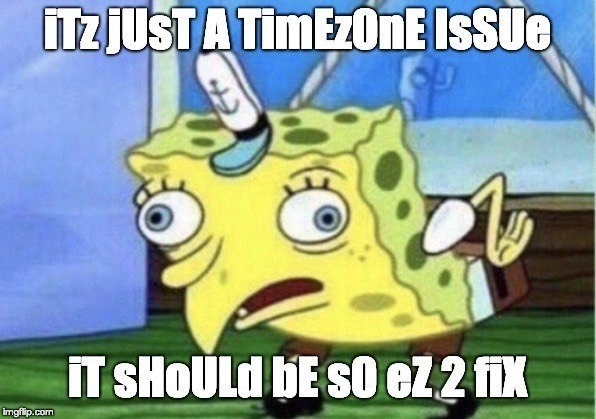
Let’s talk about the Mocking SpongeBob format of the meme itself. The image shows SpongeBob looking silly and bent over, and the text is written in a mix of uppercase and lowercase letters: “iTz jUsT A TimEzOnE IsSUe, iT sHoUld bE sO eZ 2 fiX”. This writing style is an internet trend used to indicate a mocking tone – it’s like writing out a sentence the way a parrot or a sarcastic voice might say it. Essentially, it’s repeating someone’s words in a way that makes them sound foolish. So here, SpongeBob is mimicking the PM’s quote “It’s just a timezone issue, it should be so easy to fix,” implying that this statement is naive. This meme format became popular to ridicule any statement seen as ignorant or silly, by making it look and sound childishly dumb. In our case, it highlights how out-of-touch the stakeholder’s comment is from the developer’s perspective.
For a junior developer or someone new to these concepts, the takeaway is: TimeZonesAreHard – much harder than they appear at first glance. What seems like a simple problem of converting hours can hide a ton of edge cases and gotchas. When you see tags like HiddenComplexity or MisalignedExpectations on this meme, it’s because the non-engineer (PM/client) expects a quick solution, but the engineer anticipates a tricky challenge. DeveloperFrustration comes from experience: maybe the first few times you encounter these, you also think “how hard can it be to add an hour or subtract an hour?” Then you hit your first weird bug on daylight savings or discover that some users are 30 minutes off standard offsets, and you realize why senior devs groan when dealing with dates and times. This meme is a form of DeveloperHumor – it’s the kind of thing developers share with each other to commiserate. They’re basically saying, “Haha, remember when management thought fixing that date bug would be trivial, but it turned into a week-long firefight? Been there!” It emphasizes learning that in software, some of the hardest bugs come from things that non-developers don’t even know exist (like leap seconds or timezone database updates). So next time someone says “it’s just a small time difference issue,” you’ll understand why the dev team exchanges knowing looks – they’re thinking of all those hidden time traps that you now know about too.
Level 3: Time Zone Trauma
This meme hits home for every developer who’s been scarred by a “quick” date-time bug that spiraled out of control. The scene: a well-meaning Product Manager (PM) or client shrugs off a bug with “It’s just a timezone issue, should be super easy to fix.” The meme uses the Mocking SpongeBob image to parrot that line in a silly, alternating caps way ("iTz jUsT a TiMeZoNe IsSuE, iT sHoUld bE sO eZ 2 fiX"). That goofy SpongeBob stance and scrambled lettering perfectly convey how ridiculous that statement sounds to an engineer who’s been through DST hell. It’s basically the internet’s way of saying, “Listen to how dumb you sound right now.” The humor is darkly cathartic: every developer can hear that phrase and instantly recall late-night debugging sessions or weekend hotfixes caused by date/time mishaps that were anything but easy.
Why is this scenario so comically relatable? Because time zone bugs are the quintessential hidden complexity. On the surface, it does seem simple: “Oh, the timestamp is off by a few hours, just adjust the time zone setting.” But seasoned devs know that these bugs are like cockroaches – if you see one, there are likely dozens more hiding behind the wall. Perhaps an event reminder is arriving at 3 PM instead of 6 PM for users in London because somewhere a piece of code assumed PST for everyone. You patch that, feel smug, and then discover all your recurring calendar entries in Brazil shifted by an hour because of a DST rule change last year that the system wasn’t aware of. The PM’s confidence (“so easy to fix”) comes off as almost taunting when you’re in the trenches unraveling a chain reaction of date-time issues across multiple systems.
StakeholderExpectations vs. Reality: Non-engineers often assume a bug like this is a minor display issue – adjust a setting and done. They don’t see that maybe your database stores timestamps in UTC but the front-end is interpreting them as local time without conversion. So that “quick fix” might require auditing how every service handles time, updating libraries, and reprocessing stored data. If the system wasn’t built with global time in mind from day one, you often uncover fundamental design gaps. For example, a PM scheduling tool might have saved "2021-06-14 09:00" in a database without time zone info. It worked fine when everyone using it was in California (because 9:00 meant Pacific Time by unwritten convention). Fast forward to expansion in New York – suddenly 9:00 for one team is showing up as 12:00 for another, or worse, still 9:00 but interpreted wrongly as local when it's actually Pacific. Untangling this isn’t a one-liner fix; it could mean migrating data to a new timestamp with timezone field and carefully converting existing entries, while not breaking historical records. Super easy, right?
The meme’s Mocking SpongeBob tone reflects the developer’s internal voice after hearing countless “should be easy” requests that turned into fiascos. It’s practically a rite of passage in engineering to learn that “there’s no such thing as just a timezone issue.” Maybe you remember the first time you scheduled something for end-of-month and it mysteriously ran a day early/late for some users – surprise, there was a DST transition or the server was in a different zone. Or that time an overnight job’s logs looked like this due to DST ending:
2021-11-07 01:59:50 - Starting batch job
2021-11-07 01:00:15 - Batch job completed
// The job "finished" 59 minutes *before* it started, thanks to the clock rolling back at 2 AM DST shift
Yes, that actually happens – at 2:00 AM on certain nights, clocks jump back to 1:00 AM, so an hour repeats. If your monitoring system isn’t aware, it might think half your tasks took “negative” time or trigger false alarms. Conversely, in spring, a scheduling script might crash or skip tasks because 2:30 AM never happened on DST jump day. These are the kind of nasty edge cases lurking behind the phrase “timezone issue.” They’re the reason developers have learned to be paranoid around date-time code: double-checking libraries, adding unit tests for “last Sunday in March” or “October 31st vs November 1st” scenarios, and praying that the next government decree doesn’t throw a wrench in their calendar logic.
From a senior engineer’s perspective, the humor also pokes at the eternal misalignment between stakeholders and developers. The PM isn’t trying to be ignorant – they just operate in a world of features and deadlines, where a bug is a line item to close out. But devs operate in the world of systems and consequences, where a “small” fix can have ripple effects. The SpongeBob meme exaggerates the PM’s voice to highlight how oblivious it sounds: “It should be so easy, why aren’t you done yet?” This often leads to developer frustration because it downplays the skill and careful thought required to not break other things when fixing it. The truth is, many BugsInSoftware related to time aren’t isolated – they’re symptoms of deeper issues like inconsistent data formats or missing timezone info in APIs. Untangling that is a delicate surgery, not a band-aid.
In practice, teams often develop a healthy cynicism about anything involving dates or times. A common tongue-in-cheek saying is, “No code change needed? Probably just a timezone config.” – often said right before a long night of discovering it’s never “just” that. The meme resonates because it’s the collective eye-roll and PTSD-flashback of developers remembering all those late nights around daylight savings or year-end when date bugs love to surface. We laugh (maybe with a groan) at this SpongeBob parody because if we didn’t, we might cry. After all, when a non-coder cheerfully insists it’s a one-hour fix, the experienced dev knows that hour could very well stretch into days of debugging and a cascade of “why on Earth is this so complicated?” moments. It’s funny because it’s true – and every time zone veteran has the battle scars to prove it.
Level 4: Temporal Turbulence
At the deepest technical level, time itself is a surprisingly chaotic system to model in software. A so-called “simple” timezone fix can unravel into a tangle of astrophysics, international politics, and legacy computing quirks. Consider that Coordinated Universal Time (UTC) is kept by ultra-precise atomic clocks, yet UTC has to be adjusted with leap seconds because Earth’s rotation isn’t perfectly regular. Those leap seconds mean a minute can occasionally have 61 seconds (like 23:59:60), a bizarre scenario that can crash software expecting MM:SS to always wrap from 59 to 00. Many operating systems and databases either smear that extra second across hours or risk high CPU spikes and deadlocked timers at the stroke of midnight. Yes, we’ve seen servers freak out because an official time update said “one more second please” – temporal turbulence at its finest.
Now toss in time zones – regions where local time is a fixed offset from UTC – except that offset isn’t fixed at all! Thanks to Daylight Saving Time (DST) and shifting political decisions, the offset for a given region can change multiple times a year or not follow any uniform rule. One year Brazil might decide to abolish DST entirely; another year Egypt might flip a switch on its timezone a week before Ramadan, leaving software engineers scrambling to update the timezone database with a patch. In the U.S., Congress extended DST in 2007, which left many pre-programmed clocks and software libraries out-of-sync until they were manually updated (cue a wave of missed meetings and cronjobs running at odd hours). Every OS and programming language relies on the constantly updated IANA tz database (a global registry of timezone rules) to keep up with these changes. If your systems folks forget to update it, your app might still think DST ends on October last weekend when the law now says November – boom, you’ve got an instant “bug” purely from outdated data, not code logic.
We also confront the non-intuitive offsets that shatter any naive assumption of “just subtract X hours”. Not all zones are whole-hour offsets from UTC; some are 30 or 45 minutes off (India’s IST at +05:30, Nepal’s even quirkier +05:45). Historically, there were even quarter-hour zones and weird wartime adjustments — chaos for any simple calculation. If you schedule something for 12:00 UTC, it’s straightforward, but scheduling 12:00 local time in a system means you have to lookup what offset that locale had on that date (which could be +10:00 or +11:00 depending on DST, for example in Sydney). Formally, converting local time to UTC might be expressed as:
$$
UTC_time = local_time - offset(region,\ date)
$$
The kicker is that offset(region, date) is a complex function: it depends on the region’s historical rules and the specific date and even exact time because of DST transitions. That’s why date-time libraries (like Java’s java.time, Python’s pytz/zoneinfo, or JavaScript’s Intl) have to embed huge tables of rules or call OS services – there’s no simple formula for all cases. And if two systems disagree on those rules (say, one has old data), you’ll get mis-synchronized timestamps even if both are “following the rules.” Distributed systems especially feel this: if microservices live in different data centers, each set to local time, you might see event logs jump backward or forward when aggregated. A naive global log timeline can actually violate causality, with an event in New York at 1:30 PM EST appearing to occur “before” an event in California at 10:30 AM PST on the same absolute moment. Without careful use of UTC or distributed clock protocols like NTP (Network Time Protocol) to sync things, your “easy” timezone fix becomes a nightmare of inconsistent data. Seasoned engineers have learned (often the hard way) that time is one of the trickiest shared states in computing – so much so that classic jokes claim the hardest problems in CS are “cache invalidation, naming things, and off-by-one errors,” often adding, “oh, and handling timezones!”
Even fundamental limits of computing hardware come into play. The old 32-bit Unix time (counting seconds since Jan 1, 1970) will overflow in the year 2038 (the infamous Y2038 bug), causing clocks to go haywire on any system still using a 32-bit time_t. It’s a distant cousin of Y2K – not about time zones per se, but it highlights how representing time can break down spectacularly if you assume it’s straightforward. The spongebrained notion of “super easy fix” evaporates when you realize you’re wrestling with deep timekeeping issues that have burned even the biggest tech companies. Remember when a leap second in 2012 triggered outages on sites like Reddit and LinkedIn due to untested corner cases? Or the countless scheduling systems that double-book or miss appointments around DST changes? Time in computing is a multi-headed beast. Every “timezone issue” lives at the intersection of physics (the Earth’s rotation), standardization (global time protocols), politics (time zone laws), and software design (data schemas and libraries). As a veteran might dryly note, “Sure, it’s just a timezone issue – much like Everest is just a hill.”
Description
An image of the 'Mocking SpongeBob' or 'SpongeMock' meme. The character SpongeBob SquarePants is shown in a distorted, chicken-like pose, which is used to sarcastically mimic someone. The text, written in the alternating upper and lower case style typical of the format, reads: 'iTz jUsT A TiMeZonE IsSuE' at the top, and 'iT sHOuLd bE s0 eZ 2 fiX' at the bottom. The meme humorously targets the naive underestimation of timezone-related bugs. To non-developers or juniors, timezones might seem like a simple offset calculation. However, experienced engineers know that handling timezones is fraught with peril, involving complexities like daylight saving time, historical changes, and coordinating across distributed systems. The meme perfectly captures the weary frustration of a senior developer hearing a notoriously difficult problem being dismissed as trivial
Comments
15Comment deleted
A junior dev thinks a timezone is just an offset. A senior dev knows it's a politically-defined, non-linear nightmare that changes twice a year for reasons no one can remember
“Absolutely, I’ll ‘just adjust the timezone’ - right after I get the Java 6 service that stores dates as VARCHAR, the Oracle replica frozen on GMT, and the leap second at 23:59:60 to agree on what ‘now’ means.”
After 20 years in the industry, I've learned there are only two hard problems in computer science: cache invalidation, naming things, and convincing stakeholders that their 'simple timezone fix' requires rewriting half the codebase because someone stored local time without zone info in 2008
Ah yes, timezone bugs - the gift that keeps on giving. Every senior engineer has that thousand-yard stare from the time they discovered their 'simple' UTC conversion didn't account for DST transitions, or worse, learned that some timezones have 45-minute offsets. You think you've handled it by storing everything in UTC, until a product manager asks why the recurring 9 AM meeting is now at 10 AM for half the year. Then you discover historical timezone data changes, political boundary shifts, and the fact that some countries decided to abolish DST last Tuesday. The real kicker? Explaining to stakeholders why this 'trivial' fix requires refactoring half your datetime logic, updating your database schema, and sacrificing a weekend to the gods of temporal consistency. Pro tip: if someone says 'just add/subtract hours,' they've never debugged a production incident at 2 AM caused by a leap second
'Just a timezone issue' - the four words that turn a 30-min fix into a tzdata deep-dive and 4am prod rollback
Translation: replace every LocalDateTime with Instant, backfill two years of aggregates after Brazil killed DST, and pray the tzdata update doesn’t turn your Kafka windows into Schrodinger’s SLA
“It’s just a timezone issue” - PM-speak for “we discovered time isn’t linear, cron isn’t idempotent, and midnight is a distributed system.”
Fixing timezone issues is the easiest thing in the world. I know because I've done it thousands of times Comment deleted
> thousands of times That indeed sums up the problem of timezones) Comment deleted
try next level - fix winter\summer time shifts cause of client->server time zones with reproduction only twice a year😂 Comment deleted
It is not as simple as it sounds, see I am a daughter of a timezone myself Comment deleted
swatch time, pls Comment deleted
Why do you switch the same 2 pfps lol Comment deleted
It switches when I go to sleep, and switches back when I wake up Comment deleted
OHH, that's smart Comment deleted