The 'Can You Fix My...' Shutdown Protocol
Why is this DevCommunities meme funny?
Level 1: Chef vs Broken Oven
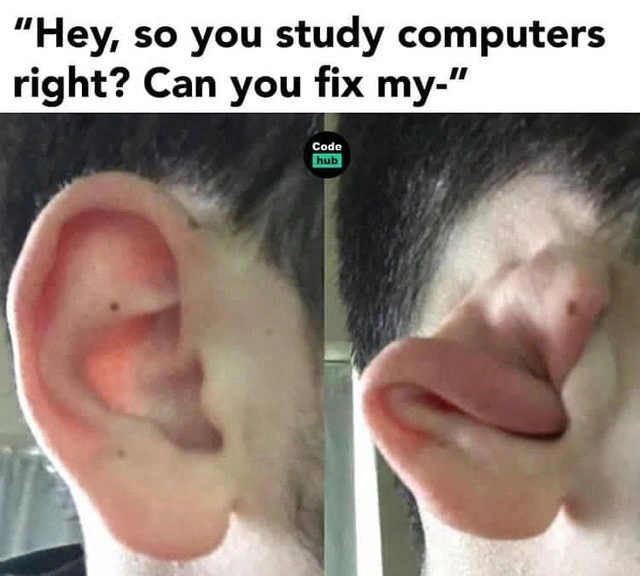
Imagine you spent years learning to be a really good chef, mastering the art of cooking gourmet meals. Now, a friend sees that you’re great in the kitchen and says, “Hey, you know all about cooking – can you fix my broken oven?” 😅 See the problem? Cooking delicious food and repairing an oven are completely different skills. The chef might laugh and quietly pretend not to hear the request, because fixing appliances isn’t what they trained for. In the same way, a computer programmer is like a master chef with code – they know how to create software (like recipes for a computer). But when someone asks them to fix a broken printer or a glitchy phone just because they “know computers,” it’s like asking the chef to be a mechanic. It feels a bit silly and frustrating. That’s why the picture is funny: the ear closing up means the programmer is playfully “not listening” to the request, just like the chef who doesn’t want to deal with the oven repair. It’s a goofy way to show that just because someone is an expert in one area, it doesn’t mean they can (or want to) do everything related to it. And the best response sometimes? Smile, cover your ears, and let them know fixing ovens (or printers) isn’t on the menu you learned.
Level 2: Fix My Printer
At this level, let’s break down what’s happening in the meme in plain terms. The phrase “Hey, so you study computers right? Can you fix my–” is something many tech students or professionals hear a lot from friends and family. CS degree stands for Computer Science degree, which means the person has studied how to design software, write code, and understand the theory behind computing. It’s a field focused on things like algorithms (step-by-step solutions to problems), data structures (ways to organize information), and maybe very advanced topics like artificial intelligence or network protocols. Importantly, a CS degree usually does not cover how to repair hardware or troubleshoot everyday devices. That kind of work is often called IT support or tech support – basically, helping people fix common technology issues. So, when Aunt Sally or Cousin Bob sees “Computer Science” on your diploma, they might assume you’re basically an on-call Geek Squad (a term for professional tech helpers), ready to fix their laptop or set up their smart TV. This is the big misunderstanding at the heart of the meme: the relative’s expectations are misaligned with the reality of the graduate’s expertise.
Now, the meme image itself reinforces this joke visually. In the left panel, we see a regular ear, meaning the person is listening normally at first. In the right panel, the ear is bizarrely folded in on itself, which looks funny and a bit shocking. This illustrates the idea of “selective hearing mode” – basically the ear “turning off.” When the relative starts to say “Can you fix my…”, the developer figuratively turns off their hearing the moment they realize a tech support favor is coming. It’s as if their ear had a power button and they just slammed it to mute. Of course, in real life one can’t fold their ear like that (at least, not without a great deal of pain!), but that exaggeration is what makes it a meme. It’s taking the internal reaction (“Oh no, not again… I don’t want to deal with this”) and showing it in a single outrageous image. The little green and black circle with “Code hub” between the panels is just a watermark indicating the meme came from a coding humor page or group, confirming that this joke is circulating among developers. Essentially, it’s an inside joke for people who code.
Let’s clarify some terms and why this scenario occurs so often. A communication gap means two people think they’re talking about the same thing, but they actually understand it very differently. Here, when someone says “you study computers,” a non-technical relative might think “computers” as one giant category covering everything from fixing printers, removing viruses, setting up Wi-Fi, to maybe hacking or “doing that internet thing.” But the developer or CS student hearing that knows that “computers” can mean a thousand different specialties. Their knowledge might be very deep in, say, writing Java programs or building websites, but quite shallow in printer troubleshooting or phone repairs. That mismatch is the communication gap: the relative doesn’t realize there’s a difference between software development (writing and debugging code) and technical support (diagnosing and fixing device issues).
The meme’s caption, “When relatives confuse CS degree with free tech support hotline,” sums it up. Relatives are confusing two roles: software engineer vs. tech support specialist. And they treat the CS grad like a free hotline – meaning they can call anytime with any problem, expecting help for free (because you’re family, or a friend). You might have experienced this if you’ve ever been the “computer person” in your family. For example, maybe you just learned to code a simple website, and suddenly your cousin hands you their virus-infected laptop like, “You’re into computers, you can fix this, right?” You’re left thinking, “Umm, I write code, I’m not sure how to clean this virus…” but to them it’s all the same magic. The meme exaggerates the response – instead of politely explaining or trying, the person literally doesn’t hear it.
Why do developers find this funny? It’s relatableDevExperience 101. Imagine spending all week debugging a complex app, and on the weekend you get roped into debugging Uncle Joe’s ancient inkjet printer. It’s ironically funny because the skills sound like they should transfer (“a computer is a computer, right?”) but often they don’t. And even when they do, the context-switch is tiring. Developers share these stories as a form of commiseration – that feeling of “ugh, yes, that happens to me too!” It’s an inside joke and a bit of a vent: you love your family, you want to help, but sometimes you just wish you could fold your ear closed and not even get into it. After all, you probably became a coder because you enjoy creating things and solving logical problems, not because you dreamed of being everyone’s on-call IT person for printer jams and forgotten passwords. This meme communicates that in one hilarious, over-the-top image.
Level 3: CS ≠ IT Support
This meme lands squarely in the SharedPain of developer culture: the moment when your well-meaning relative or friend cheerfully mistakes your software engineering skill set for a free all-purpose tech support hotline. The top text sets up the familiar request: “Hey, so you study computers right? Can you fix my–”. Seasoned developers know exactly how that sentence ends (…printer, …Wi-Fi, …phone, you name it) and likely have a reflexive internal groan ready. The two-panel ear image perfectly captures that reflex: in the left panel, the ear is normal, signifying the developer initially listening like any polite person. In the right panel, the ear is literally folded over, a grotesque physical metaphor for selective hearing mode being activated. It’s as if the developer’s ear did an Alt+F4 on the conversation the instant “can you fix my” was detected. The abrupt cutoff “Can you fix my–” (with a dash) in the meme’s caption is exactly how it feels — the developer mentally closes the connection before the request is fully parsed.
Why is this so funny and so true for developers? It highlights a massive CommunicationGap between what a developer actually does and what non-tech folks think they do. In day-to-day work, a software engineer might be wrestling with a gnarly race condition in a multi-threaded application, tuning a database query, or debating the merits of event-driven microservices – highly specialized tasks that live in the realm of abstract code and system architecture. But to the outside world (especially to relatives from a less tech-savvy generation), “you work with computers” means you must be a wizard at anything vaguely computer-related. Your grandma doesn’t differentiate between writing an algorithm and running a virus scan, or between knowing Python and knowing why the printer is jammed. It’s all just “computer stuff” to her. This misalignment of understanding – these MisalignedExpectations – is ripe for humor because it’s a daily reality for many of us.
In developer communities (like the one watermark “Code hub” hints at), memes like this circulate with captions like “me at family dinner” or “when you’re the designated family IT person.” It’s an inside joke that elicits a knowing chuckle (and maybe a sigh). We laugh because we’ve all been there:
Relative: “You’re good with computers, can you set up my new Wi-Fi router and also it keeps disconnecting...?”
Developer: (internally triggers `self.mute()) “Sorry, what? Must’ve not heard you.” 😇
The ear-fold image is an over-the-top embodiment of what every dev wishes they could do in that moment – physically tune out the request without seeming rude. It lampoons the unwilling tech helpdesk role developers often slide into. The humor has an edge of exasperation: you spend your day solving logically complex problems or writing elegant code, yet here you are on Saturday, crawling under your uncle’s desk to plug in cables or explain for the tenth time that the DVD tray is not a cup holder. It’s not that developers look down on these tasks; it’s that being volun-told to handle them constantly (and for free) gets old fast. Especially when the person asking assumes it’s trivial (“It’ll only take you five minutes, right?” – famous last words).
From a senior dev perspective, there’s also an ironic role reversal. At work, developers are problem solvers and often knowledge experts in their niche. But confronted with a misbehaving home printer or a mysteriously slow laptop, they might be just as stumped (and annoyed) as anyone else. There’s a running joke that the more advanced a programmer’s skills, the more comically inept they feel when faced with consumer electronics issues. You might be deploying a containerized cloud application with zero downtime one day, and the next you’re on the phone with your dad trying to figure out why his email won’t sync – an entirely different skill set! The meme nails this disconnect with dark humor: the developer doesn’t even want to hear the request, because they know it ropes them into a realm of troubleshooting they have little patience (or sometimes knowledge) for. It’s the classic “not my circus, not my monkeys” sentiment – the ear folds as if to say, “Nope, I’m not the IT guy here.”
Culturally, this is super relatable in dev circles. It’s a bonding experience to swap “family tech support” horror stories: the cousin who called about a “broken internet” which turned out to be the Wi-Fi switch off, or the parent who handed you a phone with 42 toolbars and malware because they clicked every pop-up. The meme’s popularity stems from how universal this scenario is—practically every developer has a tale, often equal parts funny and frustrating. And underlying the laughter is a tiny plea: please understand that my Computer Science skills are specialized, and asking me to fix your random tech is like asking a car designer to change your tire for free. We’ll do it out of love (sometimes 😅), but as the folded ear suggests, we’d rather not hear the ask in the first place.
Level 4: Algorithmic Deafness
At the most granular level, this meme highlights a kind of selective input filtering akin to an algorithm dropping unwanted data. Picture the developer’s mind as an operating system managing interrupts: a relative’s “Can you fix my...” request is like a low-priority interrupt that gets masked (ignored) by the OS because it doesn’t meet the criteria of relevant input. In computing terms, the developer has installed a mental filter (think of a spam filter or firewall rule) that detects phrases like "fix my" and immediately routes them to /dev/null (the proverbial data trash can). The grotesquely folded ear in the image symbolizes this filter in action – a physical I/O port shut down to avoid processing an incoming “request” that doesn’t belong to the expected domain of operation.
From a theoretical perspective, this scenario underscores the specialization in computing fields. A person with a CS degree might be deep in the weeds of, say, distributed systems theory – optimizing a consensus algorithm for fault-tolerant databases or fine-tuning a microservice’s latency budget – which is an entirely different problem domain than home gadget troubleshooting. In computer science, we learn that solving one class of problems (like designing an algorithm with $O(n \log n)$ efficiency or implementing a Paxos consensus module) doesn’t automatically grant the knowledge to solve an unrelated class of problems (like why a printer is flashing a weird error code). It’s akin to how an expert in cryptographic math might not know how to recover a forgotten Gmail password – the knowledge silos are that distinct. This meme playfully implies an internal “if-else” mechanism in the developer’s brain that immediately hits the else (ignore) branch when a non-software request comes in:
def on_relative_request(sentence: str):
if "fix my" in sentence.lower():
# Unwanted input detected: engage selective hearing
enable_selective_hearing() # Ear folds, request is ignored
return "🔇 ignored"
else:
return acknowledge(sentence) # Continue normal listening
The humor here is layered for those who think in code: the developer has essentially hard-coded a rule to drop any packets (spoken requests) containing "fix my", treating them like malformed input to a server. It’s a comically over-engineered coping algorithm. In practice, of course, our ears can’t literally fold shut like that – but the meme exaggerates a very real cognitive response. It’s the brain’s exception handler kicking in to avoid a dreaded context switch from the abstract realm of code to the mundane realm of amateur tech support. In a sense, the developer is maintaining focus isolation: protecting the “main thread” (their specialized work or peace of mind) from being hijacked by an unsolicited service request. This visual gag resonates with any programmer who has wished for a biological mute button upon hearing the telltale “Hey, you work with computers, right...?” prompt. It’s an absurd but satisfying depiction of manual garbage collection for real-world interruptions.
Description
A two-panel meme addressing a common social burden for tech professionals. The top text reads, '"Hey, so you study computers right? Can you fix my-"'. The left panel shows a close-up of a normal, open human ear. The right panel shows the same ear, but now it is grotesquely folded in on itself, completely closing the ear canal, as a visceral, physical representation of shutting down and refusing to listen. A small circular logo for 'Code hub' is visible between the two panels. The humor stems from the universally relatable experience of software developers and other IT professionals being treated as free, all-purpose tech support by friends and family. The moment they hear the preamble 'you know computers...', they anticipate a request to fix a printer, remove a virus, or troubleshoot a phone - tasks often far outside their specialized field. The image of the ear closing is the immediate, instinctive reaction of wanting to avoid this conversation entirely
Comments
6Comment deleted
Sure, I can try to fix it. My rate is $250/hour, two-hour minimum, and I don't guarantee I won't just install Gentoo on it. Suddenly, their cousin who's 'good with computers' seems like a much better option
After two decades of building fault-tolerant distributed systems, the only outage I still can’t prevent is my aunt’s Wi-Fi - so I enabled graceful degradation by folding my own ear
After 20 years in distributed systems architecture, I've mastered CAP theorem, Byzantine fault tolerance, and consensus algorithms - yet somehow I'm still the designated printer whisperer at every family gathering because 'you work with computers.'
The moment someone says 'you study computers' instead of 'software engineering,' every developer's internal exception handler triggers. We didn't spend years mastering distributed systems, algorithmic complexity, and concurrent programming just to become the family's unpaid Geek Squad. There's a reason our LinkedIn says 'Senior Software Architect' and not 'Will Debug Your Printer For Thanksgiving Dinner.' The irony is we can orchestrate microservices across three continents but somehow we're expected to know why Aunt Karen's 2008 Dell won't connect to WiFi
My ears run an inbound ACL at family gatherings: drop all L1 tickets without a Jira link, repro steps, and an SLA
Printers: the legacy monolith where CAP theorem fails hardest - no consistency, availability, or partition tolerance