Skip to content
DevMeme
877 of 7435
Learning to Code in One (Very Long) Night
Learning Post #992, on Jan 24, 2020 in TG

Learning to Code in One (Very Long) Night

Why is this Learning meme funny?

Level 1: No Shortcuts

Imagine your friend asks: “Can I become a basketball star in one night?” 🤔 Of course, that sounds impossible, right? You’d probably joke back, “Sure – but only if you find a magical night that lasts for six months, and you practice the entire time!” In other words, you’re telling your friend that one normal night just isn’t long enough to get really good at something big. You need a lot more time than that. That’s exactly what’s happening in this coding joke. Someone wants to learn programming super fast, in just one night. The funny answer says: go to a place (the North Pole in winter) where one “night” goes on for half a year. That way, they still get only “one night” – but it’s a really, really long night so they can use all that time to practice coding. It’s a silly, playful solution that really means: there’s no real shortcut. If you want to get good at coding, you have to put in the hours and practice, just like anything else. The joke makes us smile, because it takes the idea of “overnight success” and shows in a creative way that learning something well always takes longer than one ordinary night. In simple terms: no quick tricks – you just need time, patience, and a lot of practice (and maybe a warm coat if you actually head to the North Pole!).

Level 2: Overnight Coding Myth

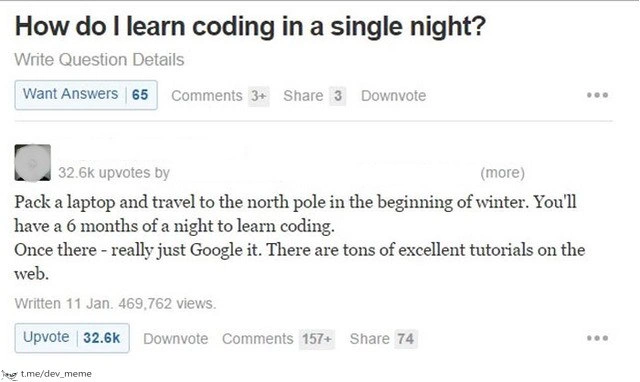
For a newcomer (or anyone outside the dev world), let’s break down what’s happening in this meme. The image is styled like a Q&A site (think Quora, a popular forum where people ask questions and get answers from the community). Someone has asked the question: “How do I learn coding in a single night?” That question itself reflects a common myth – the idea that you could pick up a complex skill like programming instantly or in an extremely short time. It’s like asking, “How can I become a doctor in one week?” or “Can I master the guitar in one day?” It shows the person might not realize how much learning and practice coding typically involves.

Now, the top answer given is a humorous trick answer. It says, essentially, “If you want to do it in one night, go to the North Pole at wintertime – where one night lasts about six months. Then you’ll have six months (which is still one single continuous night up there) to learn coding. And once you’re there, just use the internet and Google programming tutorials, because there are tons of great resources online.”

Let’s unpack that. North Pole in winter = six-month night. This is referencing a real phenomenon: in the Arctic (and Antarctic) circles, because of the Earth’s tilt, the sun can stay below the horizon for a very long time. At the very top of the world (the North Pole), when winter comes, the sun sets and doesn’t come back up for about half a year! That period is called the polar night – it’s continuous night-time lasting months. So, if you literally must do something “in one night,” and you need a lot more than 12 hours, the North Pole’s six-month night is a clever loophole. The answer is basically a big wink: “Sure, you can learn coding in one night… if that night is ridiculously long!” It’s using a bit of science humor to highlight that normally one night isn’t enough, unless you change the definition of night.

The second part of the answer, “Once there – really just Google it. There are tons of excellent tutorials on the web,” is half-joking, half-serious advice. On one hand, it continues the playful tone – after making you imagine traveling to the Arctic with a laptop, it casually says just use Google like you normally would. On the other hand, it’s giving genuine guidance: to learn coding, one of the best things you can do is search online for tutorials and resources. There are countless free ways to start coding: interactive websites, YouTube videos, documentation for different programming languages, etc. Seasoned programmers often say “just Google it” to newbies, meaning: try searching your question on Google (or any search engine) first, because you’ll likely find answers or tutorials immediately. It’s a bit of an in-joke in programming communities that much of our day-to-day problem solving is done by reading search results and online forums. So the answer is basically telling the learner: you have to put in the time (months of practice) and use the available resources on the web — there’s no magic pill.

Why is this funny to developers? Well, it highlights the “overnight success” myth in learning to code. A lot of beginners, or sometimes even advertisements for coding bootcamps (intensive training programs), suggest that you can go from zero to hero in an extremely short period. But any experienced developer will tell you that learning to code is a journey. It takes more than a day or a week – usually it’s many months just to get comfortable with the basics, and then years to master. By answering with the North Pole trick, the responder is basically saying in a cheeky way: “If you only give yourself one normal night, it’s impossible – you’d need a much, much longer time!” They’re pointing out the unrealistic expectation behind the question without directly scolding the person. Instead of saying “that’s not possible,” they crafted a fun answer that indirectly teaches the lesson.

This also subtly introduces the idea of an edge case (a term developers use for unusual or extreme scenarios that rarely occur). Here, the North Pole winter is an edge case for the concept of “night” – it’s the longest night imaginable. In programming, we often think about edge cases when writing code (like the weirdest or most extreme inputs and situations our code might encounter). The community finds it humorous when someone applies that same kind of extreme thinking to a question like this. It’s a bit like saying: “Well, technically, if you exploit a loophole in how nights work, you could meet the requirement.” Developers enjoy precise, literal logic, so this answer scratches that itch and makes us laugh.

For a junior coder reading this, the takeaway is: there’s no true instant way to become a coder. Don’t be disheartened by that – instead, embrace the process. The answer in the meme finally suggests doing what every beginner should do: use those six months (or however long it takes) to follow online tutorials, practice, and build projects. The phrase “tons of excellent tutorials on the web” is absolutely true. Whether it’s free courses on Codecademy, problem-solving on HackerRank, or beginner YouTube series on Python, the resources are out there. The real secret to learning coding “fast” is consistent practice over time, not literally overnight. Even if someone jokingly tells you to go to the North Pole, what they mean is: set aside a good chunk of time to focus and learn. Think of it as your own coding retreat (minus the polar bears 🐻‍❄️). In summary, this meme uses humor to debunk the overnight coding myth and to remind new developers that while you can’t become an expert in one regular night, you can definitely make a lot of progress by dedicating significant time and using the vast knowledge available online. Just maybe you can do it from the comfort of your home without a trip to the Arctic Circle!

Level 3: Polar Edge Case Bootcamp

Seasoned developers can’t help but smirk at the Quora-style question, “How do I learn coding in a single night?” It’s the kind of overly optimistic query that pops up in dev communities and immediately triggers eye-rolls from veterans. Why? Because any programmer who’s been through the grind knows there’s no such thing as an overnight coding miracle. But instead of a lecture, the top answer delivers a brilliant tongue-in-cheek loophole:

“Pack a laptop and travel to the North Pole at the beginning of winter. You’ll have 6 months of night to learn coding. Once there – really just Google it. There are tons of excellent tutorials on the web.”

This answer is basically an expert-level edge case hack – literally using an astronomical anomaly to exploit the wording of “one night.” In the polar winter, the sun doesn’t rise for months, so one continuous “night” can last ~6 months. It’s a playful interpretation that technically satisfies the question (one very long night!), while implying that you’ll still need half a year of hard work. This kind of humor lands perfectly with developers because we’re used to thinking in edge cases and literal logic. We often joke that if a requirement is absurd, we might satisfy it by taking it dead literally – here the requirement is “overnight”, so the “solution” is to redefine night to be insanely long. It’s the same energy as coding around a ridiculous spec: “Oh, you need it done in one night? Sure, I’ll just find a night that lasts 4,000 hours.”

The witty North Pole bootcamp scenario also jabs at the “learn to code fast” hype. In recent years, you see flashy ads promising to turn you into a full-stack wizard in 24 hours or a coding bootcamp graduate in a few weeks. Experienced devs know that’s unrealistic – becoming proficient at coding is more of a marathon than a sprint. By suggesting an Arctic sabbatical spanning six months of darkness, the answer pokes fun at those get-skilled-quick schemes. It’s saying, in effect, “Sure, you can become a coding guru ‘overnight’ – if your night happens to last an entire winter!” That subverts the whole quick-fix mindset. LearningCurve reality check: there’s no cheat code for gaining programming skill; you earn it with time and practice, not tricks of phrasing.

Another layer of humor is the casual kicker: “Once there – really just Google it.” This line is pure developer humor gold. After sending the poor asker to one of the harshest, coldest places on Earth for six months, the actual advice is basically the same thing any senior dev would tell a newbie anywhere: Google it and find online tutorials. In other words, the secret to learning coding in one night is… there is no secret! You’d have to put in months of effort and use the readily available resources (search engines, documentation, tutorials) just like everyone else. This resonates with the dev community because “just Google it” is a refrain we know well – half of programming feels like Googling error messages or reading Stack Overflow. The answerer is essentially saying: stop looking for magical shortcuts and start doing the real work.

The popularity of this answer (tens of thousands of upvotes and hundreds of comments) shows how strongly it struck a chord. It’s a gentle roast of the naïveté behind the question. Every senior developer remembers encountering folks (or even being the person!) who think they can become a coding ninja overnight. This meme encapsulates that shared experience with clever sarcasm. It highlights a fundamental truth in tech (and any complex field): mastery takes time. You can’t compress a journey into an instant. If only we could manipulate time zones or Earth’s tilt to meet impossible deadlines – imagine deploying a critical feature “overnight” by moving your team to Svalbard for continuous darkness! 😜 But until we invent a way to bend time, the only real solution is the boring one: learn steadily, bit by bit. The north_pole_learning_hack here is a funny reminder that when a request is impossible, sometimes the best answer is a nerdy joke that unveils the impossibility. It’s an inside joke among devs: we’ve all wanted that extra-long night to meet a deadline or cram new knowledge, but even a 6-month night might not be enough to become a coding pro from scratch. In the end, the meme’s humor lies in using a cosmic-scale edge case to underscore a very down-to-earth lesson in software development: there are no true shortcuts, just longer paths disguised as shortcuts.

Description

A screenshot of a Q&A forum post, likely from a site like Quora or a similar platform. The question, in a large bold font, asks, "How do I learn coding in a single night?". Below this is a highly upvoted answer, with 32.6k upvotes. The answer provides a sarcastic and literal solution: "Pack a laptop and travel to the north pole in the beginning of winter. You'll have a 6 months of a night to learn coding. Once there - really just Google it. There are tons of excellent tutorials on the web." The post shows metrics such as 'Written 11 Jan', '469,762 views', '157+ Comments', and 'Share 74'. A watermark for 't.me/dev_meme' is visible in the bottom-left corner. The humor lies in the witty, literal interpretation of 'a single night'. It mocks the naive and unrealistic expectation that programming, a complex and deep skill, can be mastered overnight. The answer cleverly points out that while a very long 'night' might provide the time, the actual method of learning remains the same: self-study and using online resources, poking fun at the get-rich-quick mentality sometimes applied to learning to code


Comments

7
Anonymous ★ Top Pick The plan is solid, but it omits the most critical dependency: a satellite internet connection with acceptable latency. Good luck pushing to GitHub from the arctic circle
  1. Anonymous ★ Top Pick

    The plan is solid, but it omits the most critical dependency: a satellite internet connection with acceptable latency. Good luck pushing to GitHub from the arctic circle

  2. Anonymous

    If your delivery timeline relies on polar-night semantics, you might be overloading the time-to-learn constructor

  3. Anonymous

    This is the same energy as spending three sprints architecting a microservices solution for what could've been a cron job, except at least the north pole approach actually delivers on the literal requirements

  4. Anonymous

    This answer perfectly captures the senior engineer's response to junior devs asking for shortcuts: technically correct (the best kind of correct), geographically creative, and ultimately redirecting to 'just Google it' - because after 15 years, you realize that knowing *how* to find answers is more valuable than memorizing syntax. Though I'd argue six months at the North Pole might still be insufficient to truly understand JavaScript's 'this' keyword

  5. Anonymous

    When PM says “learn it in one night,” the architect spins up a North‑Pole region and calls it schedule optimization via axial‑tilt sharding

  6. Anonymous

    20+ YoE truth: We're all still 'just Googling it' during those eternal 3AM prod nights - no polar expedition required

  7. Anonymous

    Scope redefinition by latitude is some A+ PM energy; sadly, experience acquisition isn’t O(1) - you can’t gzip two decades of debugging into a single Arctic night

Use J and K for navigation