Skip to content
DevMeme
3302 of 7435
The unspoken truth of game dev, spoken four times
GameDev Post #3626, on Aug 31, 2021 in TG

The unspoken truth of game dev, spoken four times

Why is this GameDev meme funny?

Level 1: Broken Puzzle Pieces

Imagine you have a big puzzle that you love to play with, and over time you keep changing the pieces a little bit. First you cut one piece into a new shape, then later you paint another piece a different color, and then you swap out a piece for a completely new one. You also promise your friend that the puzzle will always still fit together with the old pieces. At the start, it’s easy to fit old pieces with new ones, but each time you change the puzzle, it gets harder to make sure the old pieces still connect right. After many changes, almost none of the original pieces are left untouched – the puzzle barely looks like it did before – yet you’re somehow still trying to use all those old pieces in the new puzzle. That’s essentially what happens with video game saves when a game updates. The meme is joking that game developers feel this way: every time the “puzzle” (game) changes, they struggle to make sure old saved games (old pieces) still work. In the end, the only thing they’re really doing is maintaining the mess, and it feels a bit ridiculous. It’s funny in the meme because they show the sentence about this problem getting crossed out more and more, like the original idea is disappearing – just like our puzzle’s original picture is almost all gone. The humor comes from that growing absurdity: keeping old things working in new systems can feel like trying to use really old puzzle pieces in a brand new puzzle. It’s a lot of extra work, and every change makes you hold your breath and hope everything still fits together!

Level 2: Patching the Past

Okay, let’s break this down in simpler terms. The meme is showing a Reddit comment thread about game development, specifically about “maintaining backwards save compatibility.” If you’re newer to programming or game dev, that phrase refers to making sure that save files from older versions of a game still work in newer versions of the game. In other words, if a player saved their game on version 1.0, and now the game is updated to 1.5, they should be able to load that old save without problems. This is a common expectation in gaming: players don’t want to lose progress just because they updated or patched their game. But from the developer’s side, ensuring that compatibility is tricky. Every time the game changes (new features, new data, different balancing etc.), the structure of the save file might change too. Data formats (like the layout of information in a save file) that worked for version 1.0 might not directly work for version 1.5.

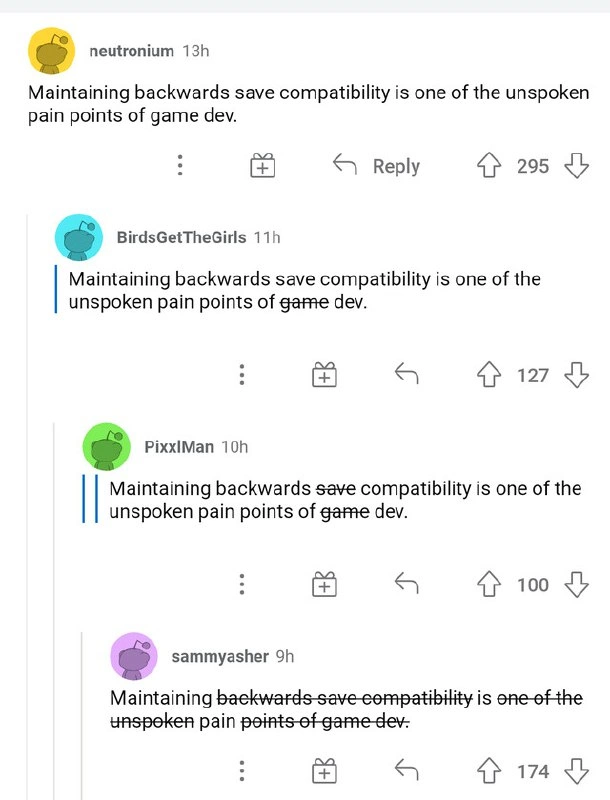
The conversation in the meme is a humorous exaggeration of how much gets “crossed out” or messed up over time. The top comment by user neutronium states a truth: “Maintaining backwards save compatibility is one of the unspoken pain points of game dev.” A pain point is basically a problem that causes a lot of difficulty or “pain.” It’s unspoken in the sense that game developers often deal with it behind the scenes, but players or outsiders don’t hear about it. They just assume their saves will work. The next replies each quote that sentence but use Markdown formatting to strike out certain words, as if those parts are being removed or becoming irrelevant.

  • The blue-avatar user (BirdsGetTheGirls) quotes the sentence and strikes through “game dev.” That leaves the sentence looking like: “Maintaining backwards save compatibility is one of the unspoken pain points of game dev.” Visually, it implies maybe it’s not just game dev where this is a pain point – perhaps all software has this issue of backward compatibility.
  • The green-avatar user (PixxIMan) then quotes that and strikes through the word “save,” making it read: “Maintaining backwards save compatibility is one of the unspoken pain points of game dev.” That could imply maintaining backwards compatibility in general is a pain, not only save files but any system where old stuff must work with new versions. It’s like the scope of the complaint is getting bigger.
  • Finally, the purple-avatar user (sammyasher) quotes and strikes through almost the entire sentence except “Maintaining.” It looks like: “Maintaining backwards save compatibility is one of the unspoken pain points of game dev.” This is basically saying everything about that statement got wrecked. The only word not crossed out is “Maintaining,” which humorously suggests that all you end up doing is “maintaining” with nothing else left of the original idea. It’s an exaggeration that after so many attempts to keep old saves working, you’re doing maintenance for maintenance’s sake.

So what’s the joke? It’s that each new reply crosses out more of the original sentence, similar to how each new game patch might invalidate or complicate parts of your original save system. It’s a running gag: the pain grows with each layer. Developers reading this will nod because they know every update can introduce compatibility issues. They have to write code to handle old versioned data. For example, maybe Version 2 of a game added a new quest system – so older saves (which have no data for this new quest system) need defaults or conversion when loaded. Maybe Version 3 changed how player stats are stored – so the loading code must detect “Oh, this save is from v2, the stats are stored differently, let’s translate it to the new format.” This can lead to a lot of conditional logic and careful testing. If you miss something, the old save might fail to load or, worse, load incorrectly (imagine a bug where everyone’s swords turn into carrots because an item ID shifted between versions – yikes!).

From a junior developer’s perspective, you might not have run into this yet, but think of it like this: have you ever opened a very old project file or document in a newer program and had it complain or convert the file? That’s similar to what game devs do for save files. In the context of game development pipelines, teams often include tools or scripts to migrate old save data to new formats. But it’s extra work that doesn’t add new gameplay – it’s just to keep things running. That’s why it’s a “pain point”: it’s necessary but not glamorous. When you’re new, you might assume “Oh, we updated the game, let’s just load the old save, it’ll be fine,” then you learn about why it breaks.

Let’s define a few terms to make sure they’re clear:

  • Backwards compatibility: The ability of newer software to still handle data or files from older versions. In backwards save compatibility, it means the new game version can read old save files. (The opposite is forward compatibility, rarely needed in games – that would mean an old game reading a save from a future version, which is usually not possible or needed.)
  • Save file: This is the file where a game stores a player’s progress (their character, inventory, game world state, etc.). Technically, it’s data written to disk in some structured way.
  • Data format / Schema: The structure or layout of that save data. For example, perhaps in version 1 a save file might have: {playerName, level, health, position}. In version 2, they introduce experience points, so now it’s {playerName, level, health, position, experiencePoints}. That change in format needs handling.
  • Serialization: This is how you convert objects or game state in memory into a storable format (like writing into the save file), and deserialization is reading it back. If you use something like Unity or Unreal Engine, under the hood when you save a game, they serialize objects into some form (could be binary or JSON or some custom format).
  • Technical debt / Legacy code: These refer to old code that sticks around because you need it for things like compatibility. For example, you might have a function specifically to load “old version” saves and translate them. That’s legacy code that you carry forward.

The categories and tags given (GameDev, DataFormats, LegacySystems, Versioning) all point to this idea: this meme is about the intersection of game development and handling legacy data formats. It’s highlighting an inside-baseball kind of joke among developers: everyone knows it’s important to not break old saves, but few outside the dev team realize how much work that is. The “progressive strikethrough” is just an absurd, funny way to portray the progressive difficulty or degradation. Each strike-through in the text is like saying “this part got ruined by the next step.” By the end, the implication is maybe that backward compatibility efforts often end in a situation where you’re supporting something so old, hardly any of the original design remains intact (except your obligation to maintain it).

One more thing: The format of the meme (Reddit comments quoting each other) is also part of internet culture. It’s done to stack jokes or emphasize a point layer by layer. In coding terms, it’s like a recursive joke (the title even says “recursive strikethrough chain”). Each reply takes the previous text as input and produces a new output by crossing something out. This recursion parallels how each new game update takes the previous version’s code/data and then modifies it further. If you’re new to Reddit or Markdown, by the way, putting ~~ around text is how you do a strikethrough. So the meme is visually literal about “crossing out” bits.

In junior terms: Imagine you wrote a piece of code that worked for version 1. Now requirements change for version 2 and you can’t just delete the old code because you need it to handle old files, so you add more code. By version 4 or 5, you have layers of code, each partly ignoring or crossing out assumptions of the old code. This is what’s being shown. And yes, it’s as messy as it sounds! New developers eventually learn that maintaining old stuff is often harder than building new stuff. This meme is a lighthearted way to learn that lesson. So next time you plan a save system, you might think ahead about versioning and compatibility – or you’ll end up in a strikethrough saga yourself. 😅

Level 3: Compatibility Cascade

At the highest level, this meme is poking fun at the tortuous journey of maintaining backward save compatibility in games. The nested Reddit comments visually depict a progressive erosion of a sentence about backwards compatibility, with each reply adding more Markdown strikethrough than the last. This is a clever metaphor for how each new game patch or version can “cross out” pieces of the original save data format. In game development, every time you update your game’s code and data structures, you risk breaking old save files. Maintaining compatibility means your new code must understand and accept data created by older code. The further apart those versions get, the more contortions and special cases the developers have to introduce – just like each reply in the meme crosses out more words until barely anything of the original statement remains. It humorously illustrates that after enough updates, supporting ancient save files can feel like supporting something barely recognizable.

From a seasoned developer’s perspective, this is both funny and painfully true. Backward save compatibility is one of those unspoken pain points most players never think about, but game devs lose sleep over. If you’ve ever built a game with persistent worlds or RPG save files, you know that initial design decisions about the save data format can haunt you for years. The top comment’s phrase, “unspoken pain points of game dev,” rings true: studios rarely advertise how much work goes into just making old saves still load. Yet if they fail, players will definitely speak up (often angrily). Imagine telling users their 100-hour save file is now useless because of an update – that’s how you trigger a gamer revolt. So developers bend over backwards to avoid that scenario, writing code to translate “version 5” save data back from “version 1” format. Each version might add new game features (new fields in the save) or change how data is stored. Ensuring compatibility means carrying all that historical baggage forward. Over time, more code is dedicated to importing old data than writing new features. The meme’s strikethrough of “game dev,” then “save,” then practically everything highlights that with each iteration, more of the original context gets struck out. In practice, by the tenth patch, maintaining backward compatibility can feel like maintaining backwards save compatibility is one of the unspoken pain points of game dev – where the only thing left is the act of “Maintaining” itself, propping up a pile of legacy assumptions. It’s a recursive headache.

On a technical level, this problem lives in the realm of serialization and versioning. Serialization is how you turn game state in memory into a file (the save), and later parse it back. If you change the game state structure (say you add a new inventory slot or a new skill tree), the serialized data format must also change. Backward compatibility means the new code must still read the old format and interpret it correctly. Often this involves writing conversion or migration code: if an PlayerStats object saved in v1 has fields A, B, and now in v2 we add C, the loading code for v2 might detect an old file with no C and assume a default value. Multiply that by dozens of changes over years and you have loads of conditional code. Real-world game dev pattern: you’ll see something like a save_version number in the file, and a big switch or if ladder in the loading function:

// Pseudocode for loading a saved game with backward compatibility
switch (file.version) {
  case 1:
    player.health = file.readInt();
    player.mana   = file.readInt();
    player.experience = 0;       // v1 had no XP field
    break;
  case 2:
    player.health     = file.readInt();
    player.mana       = file.readInt();
    player.experience = file.readInt();
    break;
  // ...and so on for each newer version
  default:
    // Unknown version: can't load or try best effort
    break;
}

Each new version case appends to this chain, never able to delete the earlier ones – much like the comment chain grows with more crossed-out text. The irony is that the longer a game lives (think of a game with expansions or years of updates), the heavier this legacy load becomes. The “pain” is unspoken because, externally, everything just works – players load their old saves and continue playing blissfully unaware of the dark magic under the hood. Internally, developers joke that their save-loading code starts to resemble an archaeology dig through the game’s history. Every field or feature ever added must be accounted for. This is reminiscent of legacy systems in enterprise software too: support some old data format or API version from 2005 because someone, somewhere might still be using it. It’s technical debt but also a customer service: break it, and you break trust.

The meme specifically uses Markdown strikethrough (the ~~ syntax) to visually convey things being crossed out or deprecated. Each nested comment quotes the previous one, striking out different parts of the sentence: first game dev, then save, then basically everything except “Maintaining.” This is a tongue-in-cheek way to say that by the end, the original statement “Maintaining backwards save compatibility is one of the unspoken pain points of game dev” has been obliterated – much like how successive game updates can obliterate the original save format design. Why is this humorous? Because it’s absurdly true. Veteran game developers have felt this: after many iterations, the idea of true backward compatibility is almost a joke – you’re technically still “maintaining” it, but so much has changed that the original concept is barely intact. The meme resonates with anyone who’s had to deal with version drift – when your current software is so far removed from the old version that making them talk is fragile and complex. It’s the “Ship of Theseus” paradox in code: after so many changes, is it even the same save format anymore? Yet, you keep it limping along, because you have to.

This backward-compatibility tax isn’t unique to game development, but it’s especially visible (and painful) there. In enterprise apps or OS development, they call it maintaining backward compatibility and devote whole teams to it (ensuring new MS Word opens documents from 20 years ago, for example). In gaming, resources are tighter and schedules shorter, so it becomes a real headache. The meme’s nested Reddit format is a perfect comedic vehicle because Reddit often does that quoting gag to amplify or twist a statement. Here it’s like each “developer” in the thread is saying “Yes, and it gets worse: not just game dev, ANY dev; actually not just save compatibility, ANY compatibility; actually, this wrecks everything!” Each strike-through amplifies the truth of the previous comment with a darker twist, much as each patch amplifies the complexity. The final commenter “sammyasher” crossing out almost the whole sentence except “Maintaining” suggests that, in the bitter end, continual maintenance is the only constant and the only thing not crossed out. It’s a bit of dark humor: game devs often joke that they spend more time maintaining old stuff than creating new stuff – “maintaining” is basically the job. The agony mentioned in the title is real: maintaining backward save compatibility can feel like performing surgery on a house of cards. One wrong move and someone’s save file crashes the game.

In summary, the meme is hilarious to developers because it takes a very real software engineering challenge – keeping old data viable in new systems – and demonstrates its cumulative toll with a simple visual metaphor. It’s the cascading compatibility nightmare: the longer your game lives and evolves, the more your original bold vision gets struck through by the hacks and patches needed to keep everything working. And just like the upvote counts in the image indicate (each reply in the chain got a lot of upvotes, sometimes more than the one above), there’s strong communal agreement – a chorus of “yep, been there, suffered that.” It’s funny because it’s true, and a bit sad because it’s funny. Any senior engineer reading this might chuckle and then quietly recall that one project where supporting an ancient file format or API version felt exactly like this chain of strikethroughs: a slow, painful erosion of sanity.

Description

A screenshot of a Reddit comment thread that captures a widely shared sentiment in the game development community. The first comment, by user 'neutronium', states: 'Maintaining backwards save compatibility is one of the unspoken pain points of game dev.' Below this, three other users have replied by quoting the original comment verbatim, creating a chain of identical statements. This Reddit-specific behavior is a form of strong, silent agreement, where the original point is so universally true that it requires no further explanation, only amplification. The meme highlights the immense technical challenge of ensuring that when a game is updated, players' old save files from previous versions still work. This involves complex data migration, versioning, and serialization, a tedious and error-prone process that is invisible to players but a major headache for developers
Comments

9
Anonymous ★ Top Pick Backwards save compatibility is just technical debt with an emotional support animal in the form of a player who hasn't loaded their Day 1 save file in six years but will absolutely file a bug if it breaks
  1. Anonymous ★ Top Pick

    Backwards save compatibility is just technical debt with an emotional support animal in the form of a player who hasn't loaded their Day 1 save file in six years but will absolutely file a bug if it breaks

  2. Anonymous

    Our save-file loader now reads like that comment thread - only “Maintaining” still survives; the rest is buried under a matryoshka of if(version < n) migrations and silent catch-all blocks we’re too scared to delete

  3. Anonymous

    The real backward compatibility nightmare is when you realize your save system from v1.0 used raw memory dumps and now you're maintaining a virtual archaeology department just to parse saves from players who haven't updated since 2015

  4. Anonymous

    Ah yes, the classic game dev paradox: you spend months architecting an elegant save system with proper versioning and migration paths, only to realize players are still loading saves from your 0.1 alpha build where you stored everything as a single JSON blob with hardcoded array indices. Now you're maintaining a Rosetta Stone of serialization formats, each one a archaeological layer documenting your past architectural sins, because breaking someone's 200-hour save file is the one bug that turns players into your most dedicated code archaeologists - armed with hex editors and an unforgiving memory of every promise you made about 'forward compatibility.'

  5. Anonymous

    Backward save compat: refactoring player state across versions without bisecting a decade of edge-case exploits

  6. Anonymous

    Backwards save compatibility: rename a field and suddenly your rollback procedure is called ‘Steam reviews.’

  7. Anonymous

    Backwards save compatibility is API versioning without a spec - your clients are immortal blobs on disk and rollback is archaeology

  8. @fortrest 4y

    Paintaining

  9. @mpolovnev 4y

    My work is a huge Paintainement Park

Use J and K for navigation