My AI-Powered Coding Prowess
Why is this AI ML meme funny?
Level 1: When Help Interrupts
Imagine you’re writing a story in class, and you’re really proud of it because you think it’s going great. You’re in your groove, the ideas are flowing, and you smile to yourself thinking, “Wow, this is an awesome story!” Now, picture a super helpful friend sitting next to you who suddenly reaches over and says, “Hey, I know a better ending!” and starts trying to write your story for you. They mean well and their idea might even be good, but it totally breaks your focus. You didn’t ask them to help, and now you’re a bit annoyed because you wanted to do it on your own. That’s basically what’s happening in this meme. The developer is like you writing the story, feeling confident and happy, and ChatGPT (the AI helper, like that friend) is jumping in uninvited to “improve” the code. It’s funny because the helper is so eager that it interrupts without asking, leaving the poor programmer thinking, “Ugh, I had it under control, but thanks… I guess!” The meme makes us laugh at this situation, because we can all relate to that moment when a well-meaning helper just can’t wait to chime in and it catches us off guard.
Level 2: AI Coding Buddy
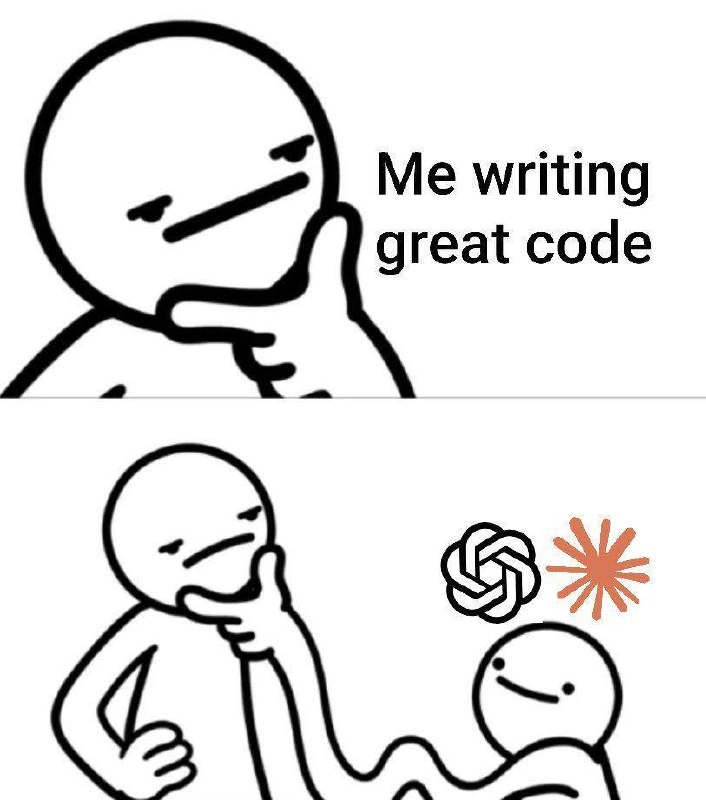
Let’s break down what’s happening in simpler terms. The meme has two panels. In the first, you see a stick figure looking proud and the caption says “Me writing great code.” This represents a developer who is confident that the code they’re writing is awesome. In the second panel, that same person’s face is being grabbed and turned by another wiggly stick figure sneaking in from the side. Above this invading figure are two symbols: one is the OpenAI swirl logo (which stands for ChatGPT, a famous AI assistant), and the other is an orange spark icon (hinting at some AI magic or a tool like GitHub Copilot which often uses a spark or stars to indicate it’s doing something). Essentially, the meme is personifying an AI coding assistant as this second character who’s interrupting the programmer.
So why is this funny? It’s showing a situation many developers experience now: you’re in the middle of coding, feeling good about it, and an AI tool butts in with a suggestion or correction. The text literally says it: ChatGPT barges in on your confident coding session. ChatGPT (and similar AI assistants) are known to do things like auto-complete your code or even give you ideas if you pause for a moment. They’re like super-smart helpers built into your programming environment. For example, GitHub Copilot is an AI tool that lives in your code editor and tries to finish your lines of code for you or generate entire functions based on what it thinks you need. It’s powered by an LLM (Large Language Model), which is a type of machine learning model trained on tons of text and code (ChatGPT is one of these too). These models are part of the AI/ML wave that has hit programming in recent years.
Now, normally if you want help with code, you might search Google/Stack Overflow, or ask a colleague, or explicitly type a prompt to ChatGPT in another window. But with tools like Copilot, the help comes to you automatically, sometimes even when you don’t expect it. That’s why the meme shows the AI as kind of intruding. It’s an AI pair programming scenario: pair programming is when two people work on code together, but here one of them is an AI. The AI is basically acting like a super eager teammate who doesn’t wait for permission to jump in. It sees what you’re doing and goes, “Oh oh, I know how to do that better, let me show you!”
For a newer developer (or really any developer), this can be both awesome and a little startling. On the plus side, having an AI coding buddy means you can get instant suggestions. It’s like having a mentor sitting with you, pointing out “Hey, you could use a different approach here” or “I’ve seen this problem before, here’s a solution.” For instance, perhaps you’re writing a function and you pause—Copilot might automatically suggest the rest of the function for you. Cool, right? It can save time, help you learn new tricks, and catch mistakes early. This is a big part of modern Developer Experience (DX) now: leveraging AI tools to code smarter and faster. Many devs have adopted these AI assistants as everyday aids, similar to how we use auto-complete on our phones but way more powerful.
However, the funny (and human) side of this is how it affects the person typing. The meme humorously captures that slight irritation or surprise you feel when the AI jumps in without warning – kind of an “I got this, no need to interfere!” feeling. Think of it this way: you’re proudly solving a puzzle and someone suddenly leans over your shoulder with the answer. Even if they’re right, you’re like, “Hey, I was working on that!” That’s the vibe here, which the meme labels as great_code_interrupted. The developer’s flow (concentration) is broken by the AI’s interjection. In the image, the AI literally turning the person’s head symbolizes how it redirects your attention. The term uninvited_code_review is perfect: a code review is when someone checks your finished code to suggest improvements, but here it’s uninvited and happening while you’re coding. It’s as if the AI is reviewing each line the moment you write it. For developers, that’s both handy and a bit nerve-wracking!
Some keywords from the tags make a lot of sense now:
- copilot_takeover: This refers to the feeling that GitHub Copilot (or a similar AI) might almost “take over” the coding process by generating so much code or so many suggestions. Sometimes, Copilot can write whole chunks for you; if you accept them without thinking, it’s like the AI wrote the code. The meme exaggerates that by showing the AI physically taking hold of the dev, as if saying “I’m in charge now.” It’s tongue-in-cheek; the AI isn’t literally conscious or grabbing you, but it feels like your control is momentarily yanked away.
- llm_intrusion: LLM stands for Large Language Model, which is the tech behind ChatGPT and Copilot. Intrusion highlights that element of surprise or unwanted entry. So LLM intrusion means the AI model is inserting itself into your workflow unexpectedly. The bottom panel is exactly that – an LLM popping up in your “zone.”
- dev_pride_vs_ai: This is about the little battle between a developer’s pride and the AI’s input. Developers often take pride in crafting solutions. If an AI suggests something, a dev might feel, “Wait, was my solution not good enough?” It can be a blow to the ego or just a funny reality check. The meme’s joke is built on this conflict: the human thinks “I’m doing great!” and the AI effectively responds “Actually, here’s something else…”. It’s both helpful and a tiny ding to the confidence.
So, in summary, this meme is playing on a very current developer experience: coding with AI assistants looking over our shoulder. It’s categorized under DeveloperHumor/CodingHumor and specifically AIHumor because it’s making light of how AI tools like ChatGPT (by OpenAI) and GitHub Copilot have become part of programming life. The top panel is every coder’s inner smugness, and the bottom panel is that AI helper popping up like an overly excited puppy, inadvertently saying “Psst, your code could be even better!” We find it funny because it’s true – this situation happens a lot now, and sometimes you can only laugh at how perfectly an AI’s timing can puncture your confidence or concentration. In the end, most developers do appreciate the help (it does often lead to better code), but memes like this are a fun way to vent about the tiny frustrations of our new AI-enhanced workflows.
Level 3: Uninvited Code Review
In the top panel of this meme, a developer stick-figure exudes smug confidence, captioned “Me writing great code.” We’ve all been there: that moment of quiet pride when you think you’ve crafted a slick solution. But in the bottom panel, an AI assistant (represented by the OpenAI swirl logo and an orange sparkle that evokes tools like GitHub Copilot) literally reaches in and grabs the developer’s chin. It’s as if the AI is saying, “Hold on, buddy, let me have a look at that.” The humor hits home for any seasoned programmer: just when you’re full of dev pride, an AI sidekick barges in with an uninvited code review.
This captures a very modern form of pair programming – except your pair is a Large Language Model. Picture being deep in a coding flow, convinced your solution is elegant, and suddenly your IDE (integrated development environment) lights up with a ChatGPT suggestion. It’s like a colleague peeking over your shoulder, going, “Oh hey, I rewrote that function for you.” The meme exaggerates it as a literal chin-grab, which is perfect because that’s how it feels: the AI yanking your attention away, mid-keystroke. There’s comedy in the role reversal too. We used to joke that Clippy (the old Microsoft Office assistant) would pop up saying “It looks like you’re writing a letter…” — now OpenAI’s tech is actually popping up saying, “I see you’re writing code, let me help with that.” The difference is today’s AI helpers are a lot smarter (think less paperclip, more Transformer-based overlord assistant).
Behind the scenes, these AI coding assistants are trained on millions of lines of code, so they often recognize patterns or gotchas that even experienced devs might miss in the moment. That’s why the AI’s intrusion can be equal parts annoying and impressive. One second you’re confidently implementing a function, and the next second the AI suggests a tweak or a completely different approach. Imagine writing what you think is a pristine loop, and an AI pops up with a more Pythonic one-liner or reminds you of an edge case. It’s helpful, yes, but also a tad deflating to the ego. The meme nails this dev_pride_vs_ai clash with a simple cartoon scene we can all chuckle at.
To make it concrete, consider a scenario in code form. Say you’re proud of a neat little function you just wrote:
# Developer's original code (I’m feeling good about this!)
def greet(name):
return "Hello " + name
# AI assistant's unsolicited "improvement" (pops up out of nowhere)
def greet(name: str) -> str:
"""Return a friendly greeting."""
return f"Hello, {name}!"
Without you even asking, your AI buddy suggests adding type hints, a docstring, and using an f-string. Objectively, that is a cleaner implementation — more explicit types, a nice documentation string, and proper formatting. But in the moment, you might react like our stick-figure: “Hey, I was writing great code here, do I really need your two cents?” It’s the LLM intrusion feeling illustrated: the AI offers an upgrade just when you were ready to pat yourself on the back.
What makes this meme so resonant among developers is that it highlights a shift in Developer Experience (DX). A few years ago, your flow might be interrupted by a syntax error or maybe a colleague doing a code review the next day. Now it’s an AI model interjecting in real-time. The uninvited code review has become a norm if you have tools like ChatGPT plugins or Copilot enabled. It speaks to our new reality of AI pair programming: we have a tireless, overly enthusiastic junior developer in the form of an AI, forever lurking in our editors. And just like a real junior dev (or that one overly helpful teammate), it can be a mixed blessing. Sometimes it speeds you up, catching dumb mistakes or generating boilerplate in a flash. Other times it suggests something off-base that breaks your concentration, or it “solves” a problem in a way that’s correct but totally different from what you intended – leaving you momentarily bewildered.
The meme’s comedy is ultimately about interruption and ego. The developer in the first panel is self-assured, maybe even a bit too pleased. The second panel’s AI interruption is the punchline: “Not so fast, hotshot.” In real life, that dynamic plays out when, say, you’re confidently refactoring a module and ChatGPT chirps up with a code snippet that makes you second-guess your approach. It’s funny because it’s true – even the best of us have moments where an AI has humbled us by pointing out something obvious or simply by being an ever-present backseat coder. We laugh at this meme because we recognize the scenario: our human developer hubris meeting the relentless (and sometimes unsolicited) helpfulness of AI tools. It’s a snapshot of today’s DeveloperHumor: coping with the fact that now even our code editor has opinions about our work. The result? A mix of frustration and appreciation – and a really good meme-worthy moment we can all share a laugh over.
Description
A two-panel meme featuring simple, black-and-white stick-figure characters. In the top panel, a character is depicted in a classic thinking pose, hand on chin, with a look of concentration and confidence. The text next to it reads, 'Me writing great code.' The bottom panel reframes the scene: the same character is in the thinking pose, but a smaller, smiling character is physically holding the first character's hand to its chin, as if puppeteering the thoughtful gesture. Positioned between the two figures are the logos for OpenAI and Google's AI (appearing to be Gemini/Bard). This meme humorously deconstructs the idea of individual coding genius in the age of AI. It satirizes developers who might take full credit for their work, while heavily relying on AI coding assistants like ChatGPT or Gemini to generate the 'great code' they're so proud of. The joke is on the developer's inflated sense of self, oblivious to the AI acting as the ghostwriter
Comments
53Comment deleted
My new pair programmer is amazing. It never gets tired, types at the speed of light, and only occasionally hallucinates an entire API that doesn't exist
ChatGPT leans over my shoulder and within two suggestions converts my tidy functional pipeline into an AbstractFactoryBuilderFactory - proof its training data peaked in 2006
After 20 years of arguing about tabs vs spaces and defending our hand-crafted abstractions, we've finally found the ultimate code review partner: one that never questions our architectural decisions because it helped write them, creating the perfect echo chamber where every pull request is just us agreeing with ourselves at different confidence levels
Every senior engineer knows this feeling: you're in the zone, abstractions are elegant, patterns are pristine, and you're convinced you've just architected the Sistine Chapel of code. Then you step away for coffee, return with fresh eyes, and realize you've actually built a distributed monolith with circular dependencies that would make a graph theorist weep. The real wisdom isn't avoiding this trap - it's recognizing that the gap between 'writing great code' and 'having written great code' is exactly one code review, three production incidents, and a humbling conversation with your future self at 3 AM
About to model aggregates and invariants; the LLM autocompletes a 500‑line singleton utils.ts, swallows errors, and asks me to press Merge - apparently I’m the rubber duck now
Intending SOLID principles, shipping a dependency graph that defies Tarjan's algorithm
Pairing with ChatGPT: my “great code” becomes a confident, elegant snippet that aces the happy-path test, ignores idempotency, and deadlocks the moment reality introduces concurrency
Gemini 2.5 pro is better Comment deleted
I am better Comment deleted
I am prompt developer Comment deleted
Does that means you develop apps promptly ? Comment deleted
Yes, still counting as apps maker tho. Comment deleted
Idk, for now llm struggle to even understand my ideas. Right now my pet project is some ecs like data structure that allow multithreading processing. And llm struggle to even understand how it work in general way, not to saying about a lot of corner cases with addition/deletion of components Comment deleted
yea imo LLMs at the current level can't comprehend problems actual programmers are hired to solve Comment deleted
or maybe I just suck at prompting. it's not a skill I care to hone Comment deleted
Skill issue still 🪦 Comment deleted
if you're only working on problems LLMs can solve, that speaks about your skills more Comment deleted
That's strange take LLM is just an instrument. It's how you use it what defines if it can solve some problem or not Comment deleted
There's a ton of problems LLMs can't solve, or at least can't solve at a smaller cost than a human (including time spent). Riedler's (and mine as well) point was that a majority of tasks developers do, or at least good developers, are of this category Comment deleted
And this is what I’m talking about, because "solve" needs definition in that context, otherwise it depends solely on personal expectations Comment deleted
Okay Comment deleted
Thanks to gemini 2.5 and it's context of 1M tokens I just solved a problem with reverse-enginering on which I gave up 2 years ago I had to load context for 700k tokens, full of different networks dumps, etc Its completelly different reality we live in right now Comment deleted
Naah. I’m using LLMs to create problems to solve 💸 Comment deleted
It's funny cause I've tried some different LLMs to write a C++ OpenGL app with basic functionalities (such as zoom, pan, rotate). Neither of them could deliver a working one. It's even funnier cause every time i tried to debug and modify a portion, it's like you are talking to a new guy with a completely new mindset 😂😂 Comment deleted
yes. even trying some small things, like parts of the program, particular algorithms, which usually works out quite well. I noticed, they are oftentimes in different styles. while you can keep the leafs of the architecture a blackbox, it is a huge problem when one lets AI develop abstraction layers, because they need to be in consistent style, but after a while they look like you hired 50 different people and fired them immediately after they wrote 1 function. Comment deleted
at some point it becomes a huge problem resulting in unmaintainable and inextensible codebase Comment deleted
and by trying to feed LLM code to an LLM to fix it, you run into ML-autofagia, because of which it starts to produce even worse and worse results over time. Comment deleted
it actually follows from the underlying math models, but some people don't know why, and some people don't tell why. Comment deleted
Maybe LLMs perform good in other languages like python,... I've never tried. But they can give an overall example how your code structure should look like. Comment deleted
no Comment deleted
and yes for the second part Comment deleted
I use LLM for inspiration, not for writing Comment deleted
this works out well Comment deleted
especially because llms produce errors uncommon for people, and they look okay at the first glance, and at the second and third oftentimes too, but people with a bit of proffecionality could never fail in such places, this results in very hardcore debugging. that's why I better read the code, and write it in a same manner as everything else by myself. Comment deleted
I work with lawyers, they tried sometimes to spare themselves some work, they can code what they need most of the time if it's simple enough. and recently they tried to use Claude to write code they could write in 2 days. and then I had to fix it for a week. Comment deleted
You could get the same results by paying a tweaker $10 Comment deleted
here I get it for free and in plenty of contexts. I'm more than full stack. Comment deleted
Which one did you used? Comment deleted
Copilot, Qwen coder, Deepseek, Hermes, Mercury(this one feels different, it's a diffusion model, it's real fast) Comment deleted
Btw, did you already found any devmeme's page where webgl is used? Comment deleted
Not really, I'm not a web developer actually. Sometimes i build small Desktop apps for my own use. Mainly in C/C++ and WxWidgets for GUI. Comment deleted
You don't need to be a webdev to know about basics of how internet/browsers work tho Comment deleted
The client will pay "only 10 USD" to make their software with LLMs (Vibe Coding).... then they need to pay me 10k to solve all the holes and crash of the software made by using the LLM Comment deleted
A good thing for us, no? Comment deleted
💯 Comment deleted
Rage bait Comment deleted
That's a funny gag, but that's it Comment deleted
This was funny some time ago, but really, tokenizers are not complicated https://platform.openai.com/tokenizer Comment deleted
Tho to be honest I'm not even sure if this screenshot is real 🌚 Comment deleted
Just took it in t3 chat Comment deleted
It's 4o) Comment deleted
Would you say that it could've been AI generated? 😈 Comment deleted
or it could just be devtools'd Comment deleted