The Sacrificial Swap of a Funny Variable Name for Production
Why is this CodeQuality meme funny?
Level 1: Nicknames vs Real Names
Think about when you have a fun nickname for something, but you don’t use that nickname in front of important people. Let’s say you have a stuffed toy you call “Mr. Fuzzy Butt” at home with your siblings. It’s a silly, secret name that makes you laugh. But one day, the teacher asks about your toy during show-and-tell. Are you going to announce it as “Mr. Fuzzy Butt”? Probably not! 😛 At the last second, you might quickly call it “Mr. Fuzzy Bear.” That sounds much more normal, right? You basically swapped the funny name for a polite name just before anyone could giggle or get upset.
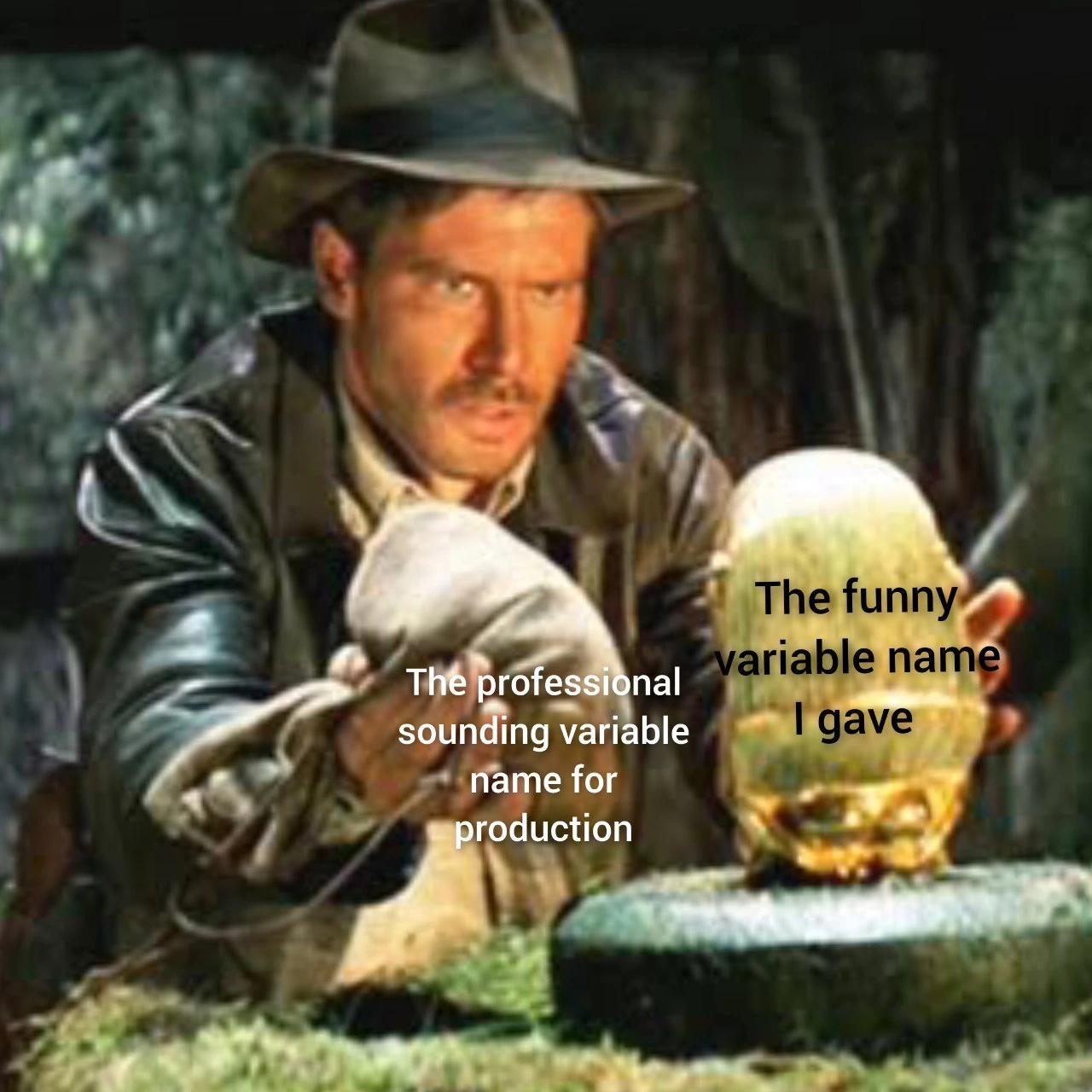
In the same way, programmers sometimes use funny nicknames when they’re playing around with their code alone. But when it’s time to show the code to others or use it for real, they quickly change those nicknames to real names. It’s a bit like cleaning up a joke before anyone else reads it. The meme shows this idea as an adventurer swapping a golden treasure for a bag of sand – a sneaky switcheroo! It’s amusing because we understand the feeling: you don’t want to get in trouble or be embarrassed by a joke name, so you change it just in time, and phew! everything is safe and sound.
Level 2: From Silly to Serious
Picture a programmer at their desk, testing out an idea. They need to name a variable – basically a container for data in code – and in a moment of whimsy they call it dragonTreasures or doNotShip_me. It works fine while they’re coding alone. No one else sees that name except their own eyes and maybe a friendly teammate who gets the joke. VariableNaming can be fun when it’s just you and your code. But now comes the day the code will go to production – meaning it’s going to be deployed on a real server or delivered to a client who will rely on it. Suddenly that goofy name doesn’t seem like such a good idea. This image humorously shows that scenario: the developer (as Indiana Jones in the famous adventure movie) is swapping out the silly name (golden idol) for a serious name (sandbag) right before the code “goes live.”
Why does this matter? In coding, using clear and respectful names is part of good code quality and professionalism. NamingConventions are basically agreed-upon rules or patterns for naming things in code so that everyone on the team can understand each other’s work. For example, a convention might be “use camelCase for variables” or “function names should clearly describe what they do.” A big part of these conventions and clean code principles is “be descriptive and avoid surprise.” A variable named totalScore instantly tells other developers what it holds. But a variable named llamaDrama… well, who knows what that is? It might make your friend giggle, but it will confuse anyone trying to figure out the code later!
Newer developers (and, let’s be honest, even experienced ones on a silly day) might slip in a placeholder like temp or a joke like magicNumber just to get the code working. We often do this when we’re not sure what to call something yet, or when we’re focused on solving a problem quickly. It’s akin to scribbling a quick note or using slang in a rough draft of an essay. But before handing the essay in, you’d replace that slang with formal language, right? Similarly, before the code is handed off to others or put on a live site, those informal names should be replaced with clear, proper ones. This final pass is sometimes called a pre-commit cleanup or refactoring. You comb through and tidy up things like debugging printouts, commented-out code, and yes, those funny variable names that seemed okay in the moment. It’s about not leaving any embarrassing Easter eggs for your coworkers or users to find.
The meme is funny to developers because it exaggerates this clean-up process by comparing it to a high-stakes treasure swap. In the movie scene, Indiana Jones is literally sweating, trying to avoid death-by-booby-trap when swapping that idol. In real development life, swapping a name won’t unleash a poison dart or giant boulder, but it can feel tense if you’re doing it moments before a deadline! Imagine noticing a variable named sillyBugFix right as you’re about to deploy the code to your company’s main app. Your heart skips a beat – oops! – and you quickly rename it to orderRetryFlag or something sensible, hoping no one notices the last-second change (and that you didn’t break anything by renaming). It’s a mix of relief and adrenaline.
Also, consider code review: this is when other developers look at your code before it’s merged to the main codebase. If they see a weird or unprofessional name, they will likely comment, “Hey, what is doTheWeirdThing? Can we use a more descriptive name here?” It’s a bit embarrassing to have a joke name called out in front of the team. That’s why many devs preemptively do this swap – to avoid that situation. It’s all about presenting your work in the best light. Just as you’d put on a clean shirt for a meeting, you give your code clean names for deployment. In the end, this improves the developer experience for everyone, because when someone revisits the code later (maybe months down the line), they’ll find well-named variables that make the logic easier to follow. No puzzles, no ancient riddles – the code will read more like a clear story rather than a mystery novel with joke clues.
Level 3: Raiders of the Lost Var
In the dimly lit temple of a late-night codebase, a developer plays archaeologist, carefully swapping out a golden idol of a goofy variable name for a sandbag of a serious one. This meme riffs on the iconic Indiana Jones idol-swap scene, making it an allegory for a last-minute code cleanup. The golden idol here represents “the funny variable name I gave” – perhaps something like cheeseMonsterCounter or doTheThingLOL tucked away in the code during development. The weighted sandbag stands in for “the professional sounding variable name for production” – a bland, safe replacement like customerCount or processFlag that our hero hopes will avoid triggering any traps (i.e., avoid raising eyebrows in code review or causing chaos in production). It’s a dramatic visualization of a routine developer ritual: the pre-deploy rename to uphold CodeQuality standards.
Why is this scenario so humorous and so relatable? It’s poking fun at a common secret among programmers: sometimes, in the privacy of our local dev environment, we christen variables or functions with hilariously unprofessional names. Maybe it’s out of boredom, or as an inside joke (“I’ll fix it later, promise!”). We’ve all seen code with a wtfCounter or an omgReally placeholder. But the moment that code is about to see the light of day – perhaps in a production deploy or a formal code review – panic sets in. Just like Indiana Jones knows a misstep could trigger a booby trap, experienced devs know a leftover silly name could set off alarms with teammates or bosses. A variable named haxorz making it to production is the software equivalent of a giant boulder chasing you out of the temple! It might not literally crush you, but the peer reviews, bug tickets, or Slack jokes that follow can sure feel like it. 😅
From a senior developer’s perspective, this meme brilliantly captures a tension between DeveloperExperience (DX) and professional polish. On one hand, using playful names during development can make coding more fun and the logic instantly clear to you (you might chuckle each time monkeyCounter increments, remembering why you wrote it). On the other hand, CleanCodePrinciples and NamingConventions exist for good reasons: code is read far more often than it’s written. Meaningful, precise names are crucial for maintainability. A name like totalUsers communicates intent; a name like stupidHack123 communicates… well, someone was in a hurry. The industry has collectively learned (sometimes the hard way) that code quality suffers when naming is treated as a joke. Imagine another developer inheriting your code: stumbling across whimsical names slows down understanding and erodes trust in the codebase’s professionalism. This is why teams enforce naming conventions as part of overall code quality standards – they want to ensure every identifier in production is crystal-clear and workplace-appropriate.
The humorous idol-swap analogy also hints at the risky nature of last-minute changes. Renaming a variable under deadline pressure can itself be precarious. If Indy miscalculates the idol’s weight, the temple collapses; if a dev carelessly find-and-replaces a name, they might refactor in a bug or miss a spot, potentially breaking the build (pro tip: always run tests after a big rename!). The meme exaggerates this pressure to hilarious effect: you can almost hear the John Williams score as the dev holds their breath and hits Ctrl+Shift+R (refactor rename) moments before merging to main.
At its core, this meme resonates because it’s grounded in truth. There’s a famous saying in programming circles:
“There are only two hard things in Computer Science: cache invalidation, naming things, and off-by-one errors.”
Seasoned devs laugh (and groan) at this quote because it encapsulates how deceptively difficult naming can be – it’s listed as one of the hardest problems, tongue-in-cheek. Coming up with good names is tough! We frequently use placeholders (foo, temp, thingy) or joke names just to get the code working, intending to refine them later. The meme is the later. It humorously dramatizes that crucial moment of reckoning when a programmer must sacrifice their beloved silly name and replace it with something boring but professional. The thrill and relief of getting away with that swap (and the code still running) is real – a small victory for code quality, snatched from the jaws of chaos at the last possible second.
Description
This meme uses the iconic 'Indiana Jones swapping the idol' scene from the movie 'Raiders of the Lost Ark'. In the image, Indiana Jones is carefully replacing a golden idol on a pedestal with a bag of sand. A label on the golden idol reads, 'The funny variable name I gave'. The bag of sand that he is using to replace it is labeled, 'The professional sounding variable name for production'. The meme humorously illustrates a common developer behavior: using amusing, temporary, or nonsensical variable names during the creative chaos of development. Before the code is finalized for production, these playful placeholders must be swapped out for clear, professional, and maintainable names. The scene perfectly captures the feeling of reluctantly giving up a small piece of personal humor for the sake of professionalism and code quality, a familiar ritual for many programmers before a code review or deployment
Comments
16Comment deleted
The real trick is weighting the professional variable name perfectly, so the linter doesn't trigger the giant rolling boulder of pull request comments
Nothing says “enterprise maturity” like a sed-i swap from chaosMonkeyCounter to transactionRetryBudget 30 seconds before the SOX auditor opens the repo
After 20 years in the industry, I've learned that 'tempFinalFinalV2_ACTUALLY_FINAL' in production is just a monument to all the sprint retrospectives where we promised to allocate time for technical debt but somehow never did
Every senior engineer knows the pain of that final commit before the PR: renaming `yeetTheData()` to `processDataTransfer()`, `potatoCounter` to `itemQuantity`, and `thisWillNeverHappen` to `edgeCaseHandler`. We tell ourselves it's about maintainability and team standards, but deep down, we're mourning the loss of the only joy we had during that 3 AM debugging session. The real treasure wasn't the clean code we shipped - it was the `// TODO: fix this absolute dumpster fire` comments we made along the way
That moment when 'yeetTheCache' gets renamed to 'IdempotentCacheInvalidationStrategy' five minutes before the arch review, and everyone pretends the ubiquitous language was always there
From 'wtfThisWorks' to 'legacyCompatibilityOverrideArtifact' - the true curse of prod code reviews
Doing the Indy swap: rename “boatyMcBoatface” to “customerSegmentId” - and trigger the boulder when you realize it’s also a DB column, a Kafka key, and half your Grafana dashboards
Upper caption missed: Refactoring Comment deleted
It's literally that scene when you do it in python, when PyCharm offers you to change ALL the variables with that name 😅 Comment deleted
Does not it understand the context where the variable you want to rename is visible in? Comment deleted
I guess it should, yet sometimes it just won't 😕 Comment deleted
https://ffmpeg.org/doxygen/3.0/vf__subtitles_8c.html#a4e356e78a8d67670e8970a2ab7e9a063 Comment deleted
static void overlay_ass_image Comment deleted
https://ffmpeg.org/doxygen/3.0/structAssContext.html Comment deleted
AssContext Comment deleted
haha funny Comment deleted