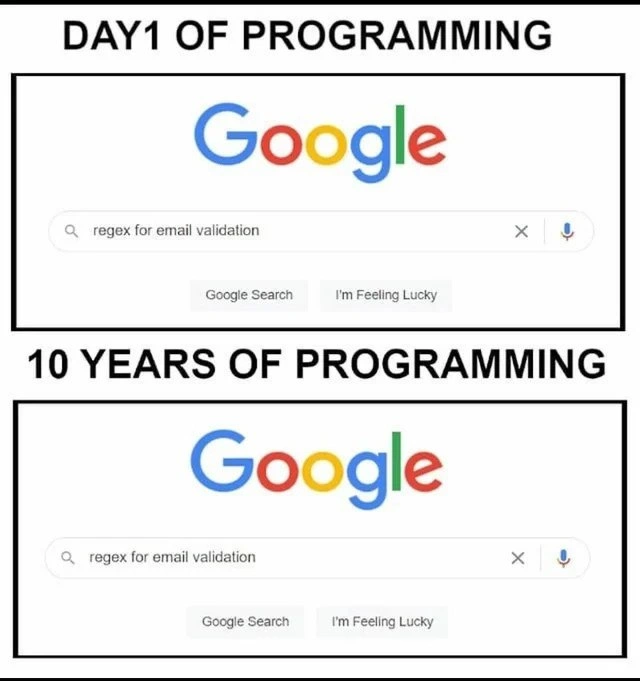
Email Regex: The Eternal Developer Struggle
Why is this DevCommunities meme funny?
Level 1: Even Chefs Use Recipes
Imagine you’re learning to bake a cake. On your very first day, you’ll definitely open a cookbook or Google “how to bake a cake,” right? Now picture a master baker with 10 years of experience – you’d think they know every recipe by heart. But one day, the master baker needs to make a very special, complicated cake. What do they do? They pull out the recipe book or search online to double-check the steps! It’s not that they forgot how to bake; it’s that this particular cake has so many little details, and they want it to be just right.
This meme is saying the same thing about programming. A newbie programmer and an expert programmer both end up doing the identical thing – looking up instructions for a tricky task. It’s funny because you’d expect the expert to just know it all, but in reality, even experts need a reminder sometimes. Just like even the best chefs use recipes for complex dishes, the best programmers use references (like Google) for complex problems. The feeling behind it is comforting and humorous: no one ever stops learning, and it’s totally okay to ask for help or look things up, no matter how experienced you are. The meme makes us smile because it shows that in the world of coding (and in life), even after years of practice, we sometimes still say “Hmm, let me double-check how to do this!”
Level 2: Google Is Your Friend
Let’s break down what’s happening in this meme in simpler terms. In both panels, we see the familiar Google search page. The query typed out is "regex for email validation". Now, “regex” stands for regular expression, which is a special sequence of characters that helps match patterns in text. Think of it like a extremely picky checklist for strings: using a regex, you can test “does this text look like an email address?”. “Email validation” means checking if an email address (like [email protected]) is written in a proper format (has a username, an @ symbol, a domain, etc.).
In the top image labeled "DAY 1 OF PROGRAMMING", a brand new coder is literally googling “regex for email validation” because they need a quick way to check user emails in their code and they might not know how to write that pattern. This is totally common when you’re learning to code – you constantly look up syntax and examples. In the bottom image labeled "10 YEARS OF PROGRAMMING", we see essentially the exact same Google search query. This implies that even after a decade of coding, the developer still doesn’t remember that darn email regex! Instead of coding it from memory, they’re again searching for it online. The punchline: nothing has changed about this particular habit.
For a junior developer or someone learning, this meme sends an encouraging message: even experienced programmers use Google to solve problems or remember specifics. It’s not because they’re not knowledgeable – it’s because programming involves so much detail that you aren’t expected to memorize everything. Developer tools and documentation are a huge part of daily work. In fact, a seasoned dev might recall what needs to be done (e.g., “my regex needs to allow letters, numbers, dots, plus signs, etc., before the @”), but instead of writing it manually and risking a mistake, they’ll just search for a trusted pattern that’s already been vetted by others. It’s a bit like having a cheat-sheet always accessible.
Think of it this way: In school, you might memorize formulas, but in the real world, knowing how to find the formula or use a reference is just as important. Programmers have a saying: "Google is your friend." This means if you’re stuck or need a quick refresher on something (like the correct regex syntax for emails), searching online is a smart and acceptable solution. In fact, part of the learning curve in software development is becoming adept at finding answers in documentation, on Q&A sites like Stack Overflow, or via a quick Google query. After 10 years, a developer has usually seen a lot of problems – but they’ve also learned that tech is always changing, and it’s impossible to keep everything in your head. What they have gained is the experience to know where to look and how to phrase the question.
So, the meme uses the specific example of an email regex because it’s almost an inside joke among developers: everybody Googles it. It’s a rite of passage to realize that even the person who might have taught you initially does the same thing. In terms of DeveloperExperience and productivity, relying on search engines and existing code snippets is actually a skill. It means you can solve problems faster by using available resources rather than doing everything from scratch. The bottom line: Whether it’s day one or year ten, good developers never stop learning and never hesitate to use the tools at their disposal – Google included.
Level 3: Search, Code, Repeat
At this level, the meme lands squarely in the realm of relatable developer experience. The top panel “DAY 1 OF PROGRAMMING” and bottom panel “10 YEARS OF PROGRAMMING” are identical Google searches for "regex for email validation". This juxtaposition is hilarious to seasoned developers because it rings so true: no matter how senior you become, you still Google things that are fiddly or rarely memorized. The humor comes from the expectation that a decade of coding would eliminate “basic” queries – yet here we are, ten years later, typing the very same search. It’s a gentle jab at the myth that experts have every solution memorized.
Why this specific query? Email validation via regex is a classic developer pain point. It’s notorious: simple in concept (“check if this string looks like an email”) but devilishly complex in practice (due to countless allowed formats and weird edge cases). Many of us have tried to craft a quick regex for emails, only to discover we missed something like an + or a subdomain, or inadvertently allowed invalid formats. There’s even a famous saying: “Some people, when confronted with a problem, think ‘I know, I’ll use regular expressions.’ Now they have two problems.” This tongue-in-cheek quote (often attributed to programmer Jamie Zawinski) captures why regex can be a double-edged sword – it’s powerful but easy to get wrong. A senior developer knows this well, so they’d rather reuse a known pattern than reinvent it under pressure. It’s not about laziness; it’s about efficiency and correctness.
The meme also highlights a core truth of the coding journey: the learning never truly stops. In fact, one could say an experienced programmer’s real superpower is not remembering everything, but knowing how to find answers quickly. Over ten years, you develop Google-Fu (a tongue-in-cheek term for skilled search query crafting) and a mental index of reliable sources (Stack Overflow threads, official docs, that one gist you bookmarked). The bottom panel isn’t showing weakness – it’s showing wisdom. Seasoned devs have likely internalized the patterns of problem-solving rather than the minutiae of every solution. They know which keywords will lead to the right Stack Overflow answer or MDN page. In terms of Developer Productivity, this reliance on search engines and community knowledge is a feature, not a bug: why waste time and risk errors coding a complex regex from memory when you can grab a proven one in seconds?
There’s also a hint of shared developer camaraderie here. Practically everyone in software has Googled the exact same snippet or error message at some point. The tags like google_search_addiction and senior_developer_struggles point to an open secret: Googling is part of the job. The meme normalizes it across all experience levels. The “DAY 1” newbie is learning that programming often means knowing how to research. The “10 YEARS” pro is practically saying, “Yup, I’m still researching. That’s normal.” It’s a comforting message to junior devs: even the pros don’t have it all in their heads. We just have better strategies (for example, a senior might recall “there was an official W3C recommendation or StackOverflow regex for this” and search for that specifically).
In a broader context, this speaks to constant_learning in tech. Languages, libraries, and best practices evolve, but one constant is the need to adapt and seek information. The meme’s comedic punch is that after a decade of supposedly mastering your craft, you’re effectively in the same posture as your first day: hands on keyboard, Googling a solution. It’s the circle of (developer) life. Instead of being shameful, it’s portrayed as universal and even efficient developer experience (DX). Seasoned engineers often joke that being a good developer is 80% knowing how to search for answers. So the bottom line is: searching isn’t a rookie move – it’s a lifelong habit in programming. And nothing illustrates that better than the timeless quest for the perfect email regex.
Level 4: Regex vs RFC 5322
At the deepest level, this meme touches on the theoretical complexity of email validation and the limits of what a single regex can elegantly handle. Regular expressions are based on formal automata (they can define Regular Languages in computational theory), and a properly formatted email address is defined by the exhaustive rules of RFC 5322 (and related specs). Those rules allow for a surprisingly wide set of characters (like +, _, quoted strings with spaces, and even literal IP addresses in domains). Formally, matching all valid emails via regex approaches the border of what regex engines (even with advanced PCRE features) can do. It leads to monstrous patterns that are neither obvious nor short. For instance, a full RFC-compliant email regex often spans hundreds of characters:
^(?:[a-zA-Z0-9_'^&/+-]+(?:\.[a-zA-Z0-9_'^&/+-]+)*)@(?:(?:[a-zA-Z0-9-]+\.)+[A-Za-z]{2,}|[\d.]+)$
(Don’t worry if that looks unreadable – that’s exactly the point!)
The sheer size and intricacy of such a pattern illustrate why even a veteran developer won’t keep it in their head. In theory, any pattern that matches a valid email must account for local-part rules, an @ symbol, domain name rules, top-level domain length, etc. Ensuring a regex respects all those constraints is error-prone and tedious. It’s a kind of ad-hoc formal verification using a single line of punctuation gibberish. Experienced coders know that relying on a well-tested standard solution (often found via Google or documentation) is safer than attempting to derive this from scratch every time. In other words, the meme humorously nods to the fact that even after a decade, the fundamental complexity hasn’t changed – it’s rooted in the very nature of the problem (validating emails is inherently tricky, and no amount of experience turns a complex formal grammar into simple magic). The veteran programmer isn’t lacking skill; they’re acknowledging the inherent complexity of the task by quickly reaching for the time-honored, battle-tested regex rather than reinventing it.
Description
A two-panel meme that humorously illustrates a universal developer experience that never changes with time. The top panel is labeled 'DAY 1 OF PROGRAMMING' and shows a screenshot of the Google search homepage with the query 'regex for email validation' typed into the search bar. The bottom panel, labeled '10 YEARS OF PROGRAMMING,' shows the exact same screenshot, with the identical search query. The joke is that writing a regular expression for email validation is so notoriously complex and error-prone that no developer, regardless of their experience level, bothers to memorize it or write it from scratch. It highlights the practical reality that even seasoned professionals rely on searching for established, reliable solutions for common, yet tricky, problems. This meme is a nod to the fact that experience is less about rote memorization and more about knowing what to look up and where to find the best answer

Comments
24Comment deleted
Seniority with regex isn't about writing it from memory; it's about knowing which of the top 5 Stack Overflow answers is the least wrong
Ten years in and I can autoscale Kubernetes across three continents, but one user enters “dev@[IPv6:2001:db8::1]” and I’m back on Google hunting for that six-kilobyte email regex I still refuse to memorise
After 20 years, you finally memorize the email regex... just in time for everyone to switch to magic links and OAuth because nobody wants to deal with RFC 5322's 6,857 word specification for what constitutes a valid email address
After 10 years, you've learned that email validation regex isn't something you memorize - it's something you've bookmarked in three different browsers, saved in a gist you can never find, and ultimately just Google again because the RFC 5322 spec is 3,000 lines of 'technically valid' edge cases that make you question whether anyone actually needs to receive email from 'user@[IPv6:2001:db8::1]' anyway
Ten years in and I still Google “regex for email validation” - not for the monster pattern, but for the Stack Overflow link I send to Product: the only correct validator is “.+@.+” and a magic link
Email regex: the one pattern where time complexity is eternally O(Google), no local optimization beats the cloud
Seniority is realizing the only correct email validator is send-a-verification-mail, yet my fingers still type “regex for email validation” before the coffee finishes pouring
ihateregex.io Comment deleted
Оххх Comment deleted
🔥🔥 Comment deleted
the best way to validate email is to email a link to the user Comment deleted
Why for 10 years Google didn't change design? Comment deleted
Are you satisfied now? Comment deleted
Yep Comment deleted
Oh no no no😔 You should never validate email with regex... Comment deleted
Why not? Comment deleted
https://davidcel.is/posts/stop-validating-email-addresses-with-regex/ Comment deleted
got habr 4 u, if u know russian :) https://habr.com/ru/post/175375/ Comment deleted
I know russian, that's for the articles :) Comment deleted
and in this article you can find really crazy examples of valid addressees, that will not pass regex validation https://haacked.com/archive/2007/08/21/i-knew-how-to-validate-an-email-address-until-i.aspx/ Comment deleted
My world was a lie, I'm outta create some crazy unique email Thanks for opening my eyes :D Comment deleted
Ahahah, no prob 🙃 Comment deleted
same on habr in Russian https://habr.com/ru/post/274985/ Comment deleted
Тру... Comment deleted