Skip to content
DevMeme
6372 of 7435
Just One More Teraflop, Bro: The AGI Delusion
AI ML Post #6986, on Aug 2, 2025 in TG

Just One More Teraflop, Bro: The AGI Delusion

Why is this AI ML meme funny?

Level 1: “Just One More” – The Big Machine Gamble

Imagine you have a friend who’s obsessed with winning a giant prize at the carnival. He’s at one of those coin-push games or maybe the claw machine with the stuffed animals. He’s already spent a ton of money and hasn’t won the big teddy bear yet. But he turns to you with wild eyes and says, “Just one more coin, bro, I swear! Just one more and I’ll hit the jackpot and get the huge teddy! Please, one more – give me $20, I promise I’ll win it this time!” You’d probably laugh a little because he said the same thing the last ten tries. Each time, he truly believes that the next coin will magically make all the difference.

This meme is basically doing the same thing, but with computers and AI. The guy in the meme is like that friend begging for one more coin – except instead of a coin, he wants more computing power (and 22 billion dollars, which is like an astronomically huge stack of coins!). He’s saying if he just gets a bigger machine, he’ll create an ultra-smart computer (like a genius robot, almost a digital god). It’s funny because it’s such an extreme, exaggerated ask – kind of like believing one more try at the claw machine will guarantee the biggest prize. We all know that feeling when someone keeps insisting “just one more” even though the promise sounds too good to be true. The meme makes us picture this over-eager person and shake our heads with a smile. The humor is in that desperate confidence: we find it silly (and a bit endearing) that he thinks solving one of the hardest problems in the world (making a machine as smart as a human) is just about getting a slightly bigger computer. It’s as if someone thought they could build a real-life superhero just by buying more parts from the store. In everyday terms, it’s laughing at the idea that the next big push will instantly fulfill a crazy dream, when deep down we suspect it’s not that simple.

Level 2: More GPUs, More Hype (Explained)

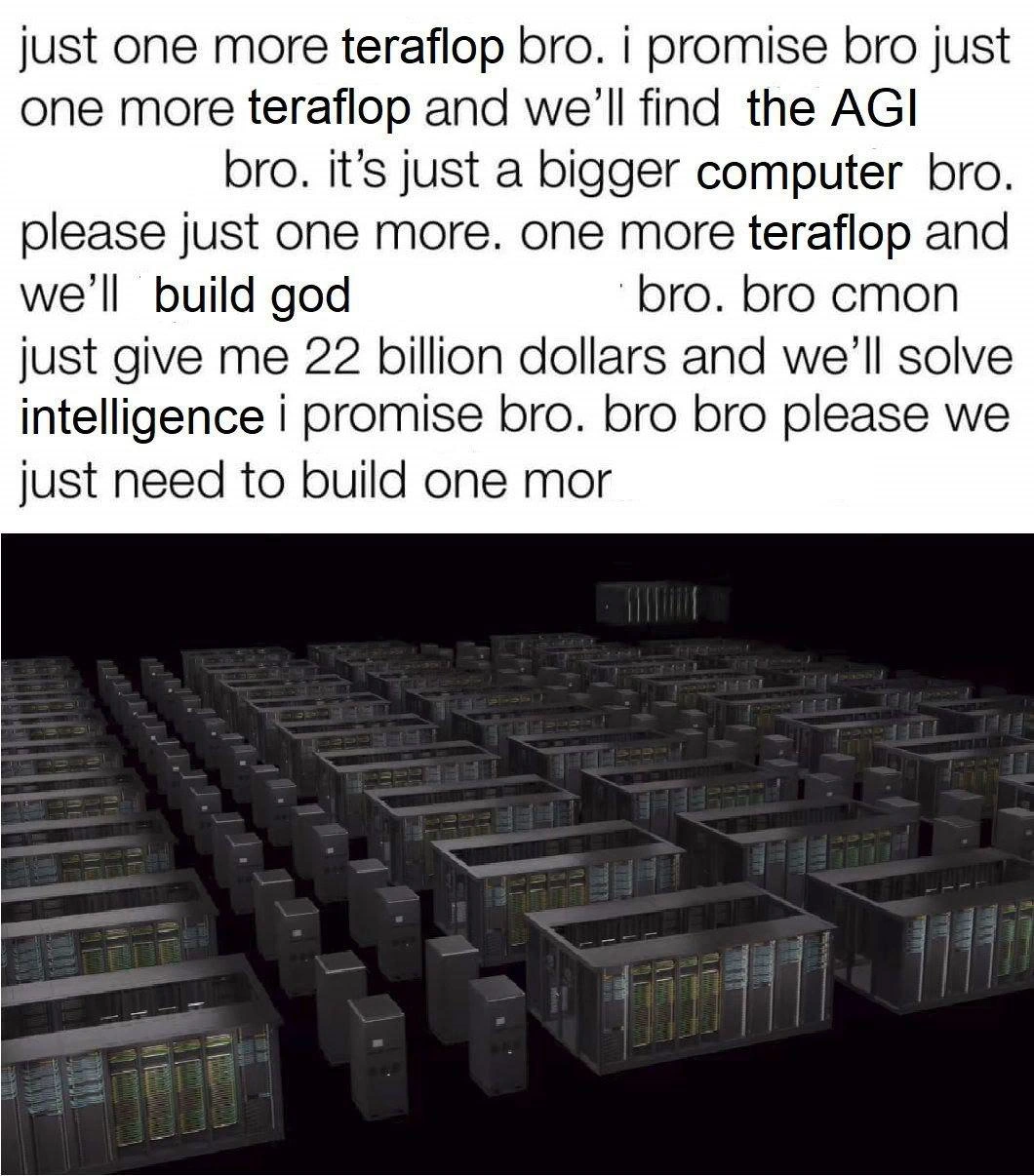
Let’s break down what’s happening in this meme. The phrase “just one more teraflop” is repeated in a frantic way at the top. A teraflop is a measure of computing speed – it means one trillion floating point operations per second. In simpler terms, that’s a lot of calculations happening super fast. Modern high-end graphics cards (GPUs) can do dozens of teraflops. When the meme character says “just one more teraflop, bro”, he’s essentially begging for a slightly more powerful computer. It sounds like an addict needing another fix – one more hit of compute power. He also asks for 22 billion dollars to build a bigger machine, which is an absurd amount of money (even by tech industry standards). For perspective, $22B could buy multiple state-of-the-art supercomputers or run a large tech company’s R&D for years. So he’s not literally asking for a single PC upgrade; he’s asking for an entire server farm the size of a warehouse. That’s why the bottom image shows a gigantic room full of servers. Those black boxes with blinking green lights are rack-mounted servers (likely packed with GPUs). This is what we call infrastructure: the physical hardware and data centers needed to run big AI models. In real life, companies like OpenAI, Google, or Microsoft build similar (though maybe not quite so endless-looking) GPU clusters to train their advanced AI systems. They consume megawatts of power and need industrial cooling – think of rows of computers humming loudly, with fans blasting like a jet engine to keep them cool.

Now, why is he so fixated on “finding the AGI”? AGI stands for Artificial General Intelligence. That’s the holy grail of AI research – an AI that can understand or learn any intellectual task a human can, basically a machine that’s as smart and versatile as a human (or smarter). Today’s AI, like a program that only does face recognition or only chats about what it was trained on, is considered “narrow AI”. AGI would be “general” – not just specialized, but able to think and learn broadly. The meme jokes that this guy truly believes we’re just one big computer away from achieving that god-like AI. “It’s just a bigger computer, bro. I promise we’ll solve intelligence.” This is poking fun at a real attitude some people have in the AI field: that scaling up (making models and datasets bigger and bigger) is the simple key to reach human-level intelligence. There’s even a term in the community called “scaling laws” – basically observations that as you make neural networks larger (more parameters, more training data, more compute), their performance on tasks keeps improving in a predictable way. For example, a larger language model might make fewer errors or handle more complex prompts than a smaller one. Some researchers published papers showing smooth improvement curves, which led to a mindset of “just keep going bigger”. This meme is a satire of that mindset, taking it to an extreme: give me unlimited money and compute and I’ll create a digital god.

For a junior engineer or someone new to this, it helps to know the context. In the last few years leading up to 2025, there’s been an AI boom. Big tech companies and startups alike are in a race to build more powerful AI models (especially things like large language models – think super-advanced chatbots). This has become an industry trend and, frankly, a hype-fueled competition. There are headlines about how many billions Company X is investing in AI, or how Company Y just bought tens of thousands of GPUs for their data center to train the next GPT-like model. Venture capital firms (which provide funding to high-risk, high-reward startups) have been throwing huge sums at AI companies, hoping to back the next big breakthrough. That’s where the idea of “venture_capital_to_gpu_conversion” comes in – it’s a cheeky way to say that all that investor money basically gets spent on buying more hardware (GPUs) and paying electricity bills, converting dollars into FLOPs. This strategy isn’t purely delusional – scaling up has indeed led to more capable AI (the dramatic improvements in things like language translation or image generation came from training bigger models on bigger compute). That’s why the meme’s poster commented “I mean, it kinda worked last time”. Each time researchers made the models bigger with more compute, they saw a jump in what the AI could do. For example, the leap from a smaller GPT-2 model to the huge GPT-3 really stunned people – the larger model could produce much more coherent and interesting text. So the “just one more” mentality comes from real, recent evidence that bigger has meant better.

However, everyone who’s been around the block in engineering knows there’s a catch: nothing scales infinitely smoothly. Eventually, you hit diminishing returns or unforeseen obstacles. That’s why many developers find this meme funny – it jokes that these AI hype-men are ignoring all the practical limits. It calls out the delusion that if something worked with 10× resources, it will keep working with 100× or 1000×. In reality, you could spend those billions and only get a system that’s a tiny bit better or just as clueless in certain areas (because maybe the algorithm itself has shortcomings). Plus, from an engineering perspective, more hardware means more complexity. Think about maintaining a single server vs an entire warehouse of servers: with one server, if something breaks, you fix one machine. With thousands, something is always breaking – a disk fails here, a network cable there, a cooling unit over there. It becomes a huge operational challenge. So the meme is pointing at the absurdity of somebody casually saying “we just need to build one more” as if it’s plugging in one extra PC, when in fact it’s an undertaking of massive scale with diminishing returns.

Let’s also decode the humor in the language: the repeated use of “bro” gives it a certain tone – like two college buddies or crypto bros hyping each other up. It’s informal, almost self-mocking. The person speaking sounds kind of desperate and possibly a bit naive or high on their own hype. It mirrors how online communities sometimes parody the way overly enthusiastic startup founders talk. Imagine a guy in a hoodie at a tech meetup who’s had too much caffeine, grabbing your arm and ranting about building a conscious AI if he just had a few more GPUs. It’s funny because it’s a caricature – a little based in reality, but largely an exaggeration. AIHumor often uses this kind of exaggeration to point out real issues. Here, the issue is AIHype – the tendency to over-promise revolutionary outcomes if one constraint (like computing power) is lifted. The meme writer has taken that to the extreme (“build god” level promises) to make us laugh and also think, “wow, it does feel like some people believe this.”

In summary, for a newcomer: the meme is saying “Some folks in AI act like getting to true human-like intelligence is just a matter of using a slightly bigger, more expensive computer. Look how silly that sounds!” It uses the image of a gigantic server farm to drive home the scale of how crazy “one more teraflop” really is in context. And it uses the over-the-top phrasing (“we’ll build god, just give me $22B, I promise bro”) to parody the hype pitches. It’s both a tech joke (because of the teraflop/GPU references) and a commentary on tech culture (the hype and massive funding in AI right now). The HardwareHumor is in showing off an overkill hardware solution, and the AIHypeVsReality humor is in the unlikely promise that this will magically yield an all-solving intelligence. If you’ve just started in tech, this meme is basically a seasoned dev putting an arm around your shoulder and saying: “See this? This is what happens when excitement about a technology goes a bit off the rails.” It’s a gentle warning wrapped in a joke.

Level 3: GPU Gold Rush Reality Check

The top half of this meme reads like a panicked late-night pitch deck, one we’ve all heard in the age of AIHype:

“just one more teraflop bro. i promise bro just one more teraflop and we’ll find the AGI bro... one more teraflop and we’ll build god bro. bro c’mon just give me 22 billion dollars and we’ll solve intelligence…”

It’s a parody of the AGI promise pitch dialed up to absurdity. The speaker (we’ll call him an “AI bro”) is basically begging for an epic hardware upgrade and a blank check (“just $22 billion”) to create Artificial General Intelligence. Seasoned engineers can practically hear the desperation and flimsy logic. The humor comes from that IndustryTrends_Hype we know too well: someone wildly oversimplifying intelligence to “yeah, just a bigger computer, bro”. It lampoons the mindset that if scaling a neural network from 1 billion to 100 billion parameters made it smarter, then scaling to 100 trillion will surely produce a digital Einstein (or “build god”, as the meme mocks). This is the scaling_laws_satire at the heart of the joke: the blind faith that gpu_hunger – an insatiable appetite for more GPUs and more FLOPs – is a substitute for actual breakthroughs in understanding.

Now, the bottom half of the meme slams us with visual reality: a dark expanse of an infrastructure warehouse filled with endless server racks. It’s almost cathedral-like – rows upon rows of identical cabinets lit by green and amber LEDs, stretching into the black. This is what “one more teraflop” actually looks like when you cash that $22B check: a supercomputer_cluster of such immense scale that it practically becomes its own power plant. The image screams server_farm_overkill, a tongue-in-cheek portrayal of how absurd the hardware-first approach can get. There’s a dystopian vibe – as if we’ve built an altar of blinking machines to summon the deity of AGI. Seasoned devs recognize the dark humor: this is the temple of the “Church of Big Compute”, where believers pray that piling up enough silicon will spark consciousness. Meanwhile, the rest of us are nervously eyeing the electric bill and wondering when someone will pull the fire alarm.

The meme skewers real AIIndustryTrends. In recent years, we’ve seen an arms race to train ever larger models. Tech companies are pouring money into AI like it’s the new space race. (In the post text, the OP notes “we're talking about hundreds of billions now, invested by multiple companies” – and that’s not an exaggeration. It’s 2025, and collectively the industry has funneled astronomical sums into AI projects.) Every few months there’s an announcement: another startup or Big Tech lab claiming they’ll achieve AGI by scaling up a mega-model. It’s a cycle of AIHypeVsReality that older engineers have seen before. The meme’s frantic plea “bro c’mon... we’ll solve intelligence i promise” echoes the overconfidence of countless project leads from past decades. Remember the 1980s AI winter story? Back then, researchers promised thinking machines with enough computing power and got lavish funding (Japan’s Fifth Generation Computer project, for one). A decade later, they fell short, and funding dried up – cue the AI winter. Fast forward: in the 2010s, deep learning boomed; we did get impressive narrow AI by throwing GPUs at neural networks. It kinda worked last time, as the OP wryly says: scaling up from GPT-2 to GPT-3 (a 100× parameter jump) suddenly produced shockingly fluent text. That success is exactly why today’s venture_capital_to_gpu_conversion machine is in overdrive. VCs hear “bigger model = better results” and FOMO kicks in. The result: every AI lab is asking for a Minecraft world’s worth of GPUs and a budget that could fund a Mars mission, promising that this time they’ll hit the intelligence jackpot.

As experienced engineers, we find this both funny and frightening. The AIHypeCycle is on full tilt. Top researchers are being treated like rockstars – the post mentions individuals turning down nearly $1B total compensation packages with big firms. Imagine that: someone saying “nah, $900 million isn’t enough, I’m gonna build my own god-machine instead.” It sounds insane, but it reflects the gold rush mentality. The meme exaggerates with “just give me 22 billion dollars”, but honestly… it’s only slightly satire. We’ve seen startups with zero revenue get valuations in the tens of billions just because they have a big-model compute roadmap. It’s the ultimate infinite_budget_request: invest colossal money into GPUs and electricity today, reap a digital God tomorrow. EngineeringHumor often comes from exactly this kind of scenario where management or founders have a near-magical belief in tech. Those of us who’ve racked servers or been on-call for GPU clusters know that more hardware usually means more headaches, not necessarily more intelligence. We chuckle because we can picture the on-call DevOps engineer hearing “we just need to build one more” and facepalming – knowing that means another 10,000 overheating GPUs to babysit at 3 AM.

Another layer of humor is the casual “bro, I promise” tone about a project as monumentally complex as AGI. It’s like a college kid saying “trust me bro, I just need a few billion and I’ll create a thinking machine smarter than humans.” The mismatch in tone versus ambition is golden. It hints that the people making these pitches might not fully grasp the depth of the problem – or are deliberately oversimplifying to score that sweet VC money. It satirizes how AIHumor in our community often targets the hubris of thinking intelligence is just an engineering scaling problem. Sure, we engineers live by metrics and scaling stats (FLOPs, GPU counts, parameter sizes); and yes, much progress in machine learning came from scaling data and models. But the meme is a reality check: AIHypeVsReality, as the tag says. In reality, chasing AGI might need more than a brute-force approach – perhaps new algorithms, better understanding of cognition, or just more time.

Finally, consider the implicit dark joke: “we’ll build God”. It’s hyperbole, but many AI pitches do flirt with grandiosity. The meme writer picks up on that almost cultish vibe. Building a superintelligence is often likened to creating a god or a god-like entity. Hearing someone earnestly plead for funding in those terms (“We’re basically gonna build God, just fund us one more round!”) — how can an engineer not roll their eyes? It’s both awe-inspiring and absurd. We’re simultaneously skeptical and a tiny bit hopeful (“who knows, maybe those crazy kids will pull it off... and hopefully not Skynet us in the process”). The bottom-line: this meme resonates with veteran developers because it pokes fun at the Hardware-first optimism that we’ve seen crash and burn before. It’s a humorous reminder that bigger isn’t always better, especially when it comes to complex problems like intelligence. And if nothing else, it’s cathartic to laugh about the fact that while the big bosses talk about birthing digital gods, someone still has to figure out why half the GPU cluster went down at midnight.

Level 4: Infinite Compute, Finite Returns

At the bleeding edge of AI/ML research, there’s an almost religious belief that scaling up compute will unlock artificial general intelligence. But from a theoretical standpoint, this compute_scaling_delusion runs into hard limits. More Hardware (say, another trillion-operations-per-second of compute) yields diminishing improvements, not magic leaps. In machine learning, empirical scaling laws show performance gains taper off: to get a model only slightly better, you often need exponentially more data and FLOPs. It’s like an asymptotic curve edging toward some ceiling of intelligence—each extra teraflop (trillion FLOPs) gives a smaller boost than the last. Formally, if model error $E \sim N^{-\alpha}$ (a power-law with $\alpha < 1$), then achieving even modest reduction in $E$ demands massive $N$ (compute or parameters). In plain terms: throw $10\times$ more compute, maybe get 5% better results. That’s the law of diminishing returns haunting these billion-dollar plans. Eventually, scaling becomes pouring money into microscopic gains. No Free Lunch Theorem whispers that no single brute-force approach works for every problem – you can’t just crank up the volume of data centers and expect human-level reasoning to pop out without new ideas.

Beyond algorithms, consider the physical and engineering limits. Modern supercomputers already flirt with the edges of Moore’s Law and thermodynamics. Each additional “one more teraflop” in a supercomputer_cluster means more chips, more power draw, and more heat to dissipate. We’re constrained by things like Landauer’s limit (the minimum energy to flip a bit) and communication bottlenecks between thousands of GPUs. Amdahl’s Law kicks in hard: even if 99% of an AI training task parallelizes perfectly across tens of thousands of GPU cores, the remaining 1% that is sequential or bottlenecked by network overhead will dominate run time as you add more nodes. In huge clusters, synchronization of model weights (the dreaded all-reduce of gradients in distributed training) can become a traffic jam on the interconnect. You have an army of GPUs, but many sit idle waiting on data from slower memory or networking. The result? That shiny extra teraflop often isn’t utilized efficiently – it’s like adding another gear to an engine that’s already redlining in top gear. There’s also the memory bandwidth wall: feeding data to millions of compute cores fast enough is a major hurdle. Throwing $22 billion of silicon at the problem doesn’t defeat the speed of light or the realities of I/O throughput.

Crucially, algorithmic innovation tends to leap ahead of brute force. The meme hints that current AI approaches might be missing some key insight – you can’t brute-force your way to general intelligence if your algorithms plateau. Historically, breakthroughs (like the Transformer architecture in 2017) unlocked huge progress without requiring immediately infinite compute – they used compute smarter. A cynic with a PhD might note that an AI capable of reasoning about the world might require structures or algorithms that current neural networks don’t have, no matter how big we make them. We’re essentially trying a brute-force search in a space we only partly understand. Yes, increasing compute yields unexpected emergent behaviors in large models, but there’s no guarantee that somewhere around, say, 1 quintillion FLOPs, a machine suddenly wakes up. It’s just as likely we hit a wall where more GPUs just produce more confusing outputs or trivial improvements. At some point, fundamental epistemic limits (like not having the right data or the right model of reality) become the barrier, not the compute. In short, the scaling_laws_satire in this meme has a grain of truth: infinite brute force won’t automatically deliver infinite intelligence – real AGI might demand new paradigms, not merely a warehouse of silicon burning megawatts.

Description

A two-part meme. The top section contains white text on a plain background. The text reads: "just one more teraflop bro. i promise bro just one more teraflop and we'll find the AGI bro. it's just a bigger computer bro. please just one more. one more teraflop and we'll build god bro. bro cmon just give me 22 billion dollars and we'll solve intelligence i promise bro. bro bro please we just need to build one mor". The bottom section is a 3D rendering of a massive, dark server farm with countless racks of computer hardware, stretching into the distance. The image conveys a sense of immense scale and computational power. This meme humorously critiques the "scaling hypothesis" in AI development, which posits that increasing computational power and model size is the primary path to achieving Artificial General Intelligence (AGI). The text mimics an addict's desperate plea, satirizing the belief that monumental breakthroughs are always just "one more" hardware upgrade or funding round away. It resonates with senior engineers who are often skeptical of hype and understand that intelligence is a complex problem not necessarily solvable by brute-force computation alone. The mention of billions of dollars reflects the massive investments currently being poured into the AI industry
Comments

11
Anonymous ★ Top Pick The only thing scaling faster than the models is the valuation. We're basically trying to brute-force a ghost in the machine by building a bigger machine
  1. Anonymous ★ Top Pick

    The only thing scaling faster than the models is the valuation. We're basically trying to brute-force a ghost in the machine by building a bigger machine

  2. Anonymous

    At this point the only emergent property we’ve proven is the 1:1 exchange rate between venture capital and datacenter heat output

  3. Anonymous

    After 20 years in the industry, I've learned that every problem looks like a nail when your only tool is a venture capitalist's checkbook and a fervent belief that intelligence is just floating-point operations per second with extra steps

  4. Anonymous

    This perfectly captures the current AI funding climate: VCs throwing billions at the 'just scale it bigger' hypothesis while conveniently ignoring that we still don't understand intelligence, consciousness, or why adding more parameters sometimes makes models dumber. It's the tech equivalent of thinking you can reach the moon by building a taller ladder - except the ladder costs $22B and uses enough electricity to power a small country. The real kicker? We're all complicit, watching NVIDIA's stock soar while pretending that GPT-5 with 10 trillion parameters will somehow spontaneously develop sentience because... more teraflops, bro

  5. Anonymous

    AGI seems monotonic in capex - right up until NCCL hits 35% on the interconnect and your $22B ‘build god’ cluster is memory-bandwidth bound

  6. Anonymous

    Scaling hypothesis: because paradigm shifts are hard, but provisioning 10^27 FLOPs is just a bigger YAML file

  7. Anonymous

    If your path to AGI is “add teraflops until god emerges,” you’re running a very expensive while loop with no base case - the exit condition is the CFO’s tolerance

  8. @grinya_a 11mo

    Teraflops must flow

    1. @qtsmolcat 11mo

      What a flop

  9. @artem_sidorin 11mo

    'hunders' as in 'hunding' (as in shidding)? 🤓

    1. dev_meme 11mo

      Nah, hunders more like "ffs admin go get some sleep"

Use J and K for navigation