MrBeast's AWS Hunger Games for Junior Developers
Why is this AWS meme funny?
Level 1: Jungle Survival Challenge
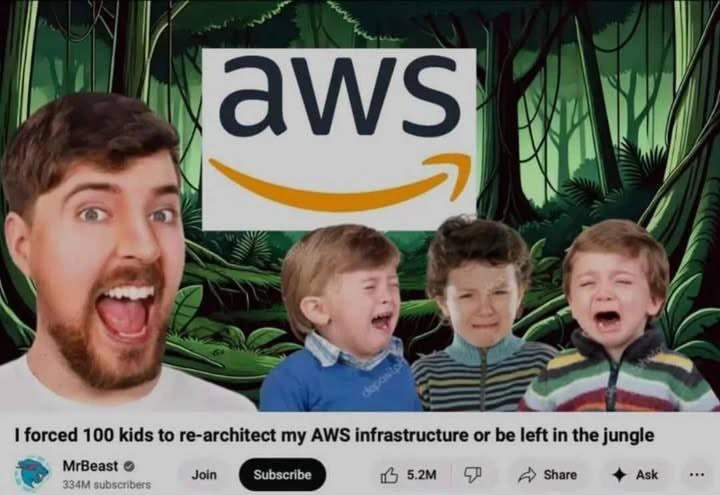
Imagine you and a bunch of friends are dropped in the middle of a huge jungle and told to build a entire treehouse village from scratch. If you fail, you’re stuck there! That’s the kind of crazy challenge this meme is joking about, but with technology. Here, the “jungle” is actually Amazon’s big online world of computers and services (AWS), and the people being challenged are 100 kids. In real life, setting up AWS is super complicated – kind of like building a city out of LEGO with no instructions. Even grown-up engineers often feel confused and lost when doing it. So the meme pretends a famous YouTuber (MrBeast, who loves wild challenges) said: “Hey kids, rebuild my complicated computer system or else you can’t leave this jungle.” The picture shows MrBeast smiling enthusiastically, while the kids in front are crying because they have no idea how to do it – which is exactly how any of us would feel if we were in their shoes. The humor is pretty simple: it’s a ridiculously unfair and impossible challenge, and that contrast is silly and funny. Even if you don’t know AWS, just seeing the big AWS logo like a scary jungle monster and those poor crying kids tells you this is a goofy, make-believe scenario. It’s poking fun at how complex tech stuff can be by imagining something totally outrageous: kids being left alone to figure it out, Survivor-style. In plain terms, the meme is funny because it’s like saying, “This tech job is so hard that it would be like expecting little kids to survive in a jungle – completely absurd and destined to go wrong!”
Level 2: AWS Jungle 101
At its core, this meme is comparing Amazon Web Services (AWS) to a wild jungle and making a joke that setting it up is so complicated, you’d have to be crazy (or MrBeast) to force 100 kids to figure it out. Let’s break down the pieces: AWS is a huge collection of cloud services – basically, Amazon’s giant toolbox of technology that companies use to run their websites and apps. Need a server to run your code? AWS has it. Need a database to store user info? AWS has several options. Want to send out emails, process videos, analyze data? AWS has services for all that too. By 2025, AWS isn’t just a toolbox, it’s a whole warehouse of tools – hundreds of different services. For someone new (like a junior developer, let alone an actual child), opening the AWS console is overwhelming. It’s like walking into a dense jungle with no map: you see endless green icons and service names (Lambda, S3, EC2, DynamoDB, CloudFormation, and on and on) and it’s easy to get lost. That’s why people often call it the “AWS jungle” – navigating it requires knowledge and a good guide.
Now, MrBeast is a famous YouTuber known for wild challenge videos. He does things like put people in extreme situations and offers big prizes or dramatic stakes (for example, “Stay in this circle the longest to win $500,000”). The meme imagines a fake MrBeast video titled: “I forced 100 kids to re-architect my AWS infrastructure or be left in the jungle.” This reads exactly like one of his sensational titles – except instead of a physical challenge, it’s a super-nerdy tech task: “re-architect my AWS infrastructure.” Infrastructure here means all the underlying tech stuff that keeps a website or app running: servers, networks, databases, etc. Rearchitecting infrastructure means redesigning or rebuilding that whole setup, usually to make it better, faster, or more efficient. It’s a bit like remodeling a huge building’s foundation while people are still living in it – quite complex and delicate. So picturing 100 little kids being told to do this is absurd. The subtitle says “or be left in the jungle”, which is the kind of over-the-top stakes you’d see in a MrBeast video (obviously played for drama – nobody is actually abandoning kids!). This part of the joke emphasizes how dire and difficult the task is: if you fail, you’re stuck in this wild place. It’s a funny way to stress that rearchitecting AWS is a survival challenge.
The image itself has a lush cartoon jungle background with the AWS logo floating like a big boss monster in the trees. That logo – “aws” in lowercase with the orange smiling arrow – is Amazon’s logo (the arrow famously goes from A to Z, hinting Amazon has everything from A to Z). In context, it looks almost like the kids are up against the AWS beast in its own habitat. The foreground shows four kids and an adult host (MrBeast, presumably) in a classic YouTube thumbnail pose. The kids’ faces are pixelated but you can tell some of them are crying or distressed. They’re wearing everyday kid clothes, and MrBeast (the adult with a big grin and beard) is on the side looking excited. This contrast – MrBeast’s huge excited smile vs. the kids bawling – is part of the comedic effect. It’s like he’s saying, “Isn’t this fun?!” and they’re completely overwhelmed. Developers find this funny because it mirrors how we feel when dealing with AWS sometimes: the execs or project leads might be excited about a big cloud project, but the folks actually doing the work (the “kids” in the trenches) are crying from frustration.
Let’s talk about CloudFormation and why the tag “kids_write_cloudformation” is mentioned. AWS CloudFormation is a service where you write a template (in JSON or YAML text format) that describes all your infrastructure – basically, you write code to create cloud resources. For example, instead of clicking around to launch a server, you put it in the template code, and CloudFormation will launch the server exactly as specified. It’s part of a trend called Infrastructure as Code (IaC), which treats servers and networks setup similar to software code (so it can be version-controlled, reviewed, replicated, etc.). This is powerful for DevOps teams because it ensures consistency and repeatability. However, writing CloudFormation templates is notoriously tricky even for experienced engineers. The syntax has to be perfect, and you need to understand dependencies between resources (like “this database must exist before that server can connect to it”). Now imagine giving a bunch of kids a CloudFormation template and saying “here, redesign my whole system!” That’s like handing a complex LEGO instruction manual to someone who can’t read yet. It’s a recipe for tears and chaos. The meme is making a tongue-in-cheek point: setting up AWS is so non-intuitive at times that it would make anyone cry who isn’t trained for it – and if actual kids tried, it would be a total disaster.
The DevOps/SRE angle: DevOps is all about developers taking on operations tasks (like deployment, monitoring, infrastructure) and SREs (Site Reliability Engineers) focus on keeping systems running reliably. Early in your career, if you get assigned to set up something on AWS without guidance, you might recall feeling utterly lost. Maybe you tried to deploy your first web app and AWS asked you to configure a VPC, choose instance types, set up an Auto Scaling Group, attach an Elastic Load Balancer, configure Security Groups (firewall rules), and you’re scratching your head like “Why is this so complicated?!” Many of us have been there: clicking around the AWS console, googling every other step, maybe accidentally launching things in the wrong region or forgetting to turn off a service and getting a surprise bill later. It’s really a rite of passage in cloud learning. So the idea of kids — who presumably have zero experience — being forced to handle something as advanced as a full AWS architecture re-do is a hilarious exaggeration of that beginner experience. It draws on the memory of feeling like a confused child in a very adult, very complex world of cloud tech.
We can also unpack the “sensational project management” vibe. Sometimes in the tech industry, big bosses or companies will start some massive initiative with a lot of fanfare, almost like a publicity stunt. For example, a CEO might announce “We’re going to move ALL our systems to the cloud in 3 months!” to get headlines, without realizing how hard that is for the engineers who actually have to do it. The meme’s fake video title pokes fun at that by using YouTube challenge language. It’s as if someone treated a super complex project (rearchitecting AWS infrastructure) as something you can just challenge people to do on the fly, with a dramatic twist. In reality, if you tried that, you’d end up with a bunch of very upset people and a broken system – exactly like those crying kids in the thumbnail. The DevOps culture element here is that DevOps emphasizes collaboration, gradual improvement, and learning – quite the opposite of a one-shot, high-pressure challenge with untrained participants. So the meme is funny to DevOps folks because it’s a scenario that completely disregards all best practices (no planning, no training, just chaos). It’s like an anti-example of how to run a tech project, blown up to cartoonish proportions.
In summary, this meme uses the jungle metaphor and a parody of a popular YouTuber’s style to highlight how incredibly complex cloud architecture can be. It’s saying: “Wouldn’t it be ridiculous if we treated something as intricate as AWS architecture like a quick, sensational game?!” For anyone who knows even a bit about AWS or has tried to set up a server online, the joke lands because we know it’s not that simple – in fact, it can be a hair-pulling experience. And if you don’t know AWS, just seeing those poor kids crying in a jungle while an enormous tech logo looms overhead tells you everything: this task is way over their heads! It’s an exaggeration that brings laughter, especially to those of us in tech who have felt equally lost at times (though hopefully not literally left in a jungle!).
Level 3: Lord of the Instances
This meme cleverly mashes up the absurd, high-stakes style of a MrBeast YouTube challenge with the daunting reality of modern cloud infrastructure on AWS. Seasoned developers and DevOps engineers chuckle (and maybe cringe) because it captures a familiar feeling: being dropped into a vast, overgrown AWS setup where even adults feel as lost as kids in a jungle. The humor works on multiple levels. First, AWS (Amazon Web Services) is notorious for its sprawling array of services and convoluted configurations – often jokingly referred to as the “AWS jungle.” Even experts sometimes struggle to navigate its thicket of VPCs, subnets, security groups, IAM policies, auto-scaling groups, load balancers, databases, and dozens of three-letter acronyms lurking behind every tree. So picturing 100 literal children tasked with rearchitecting a complex AWS deployment is a hyperbolic spin on how bewildered seasoned engineers can feel when facing an unfamiliar or poorly documented cloud environment. It’s the ultimate DevOps humor: a job so complicated and frustrating that it might as well be a sensational survival game for YouTube.
The YouTube thumbnail parody is spot-on. MrBeast is known for over-the-top challenges (“Last to leave the circle wins $500,000!” etc.), so “I forced 100 kids to re-architect my AWS infrastructure or be left in the jungle” nails that tone. This highlights a real DevOps culture joke: sometimes management or upper leadership treat massive tech undertakings like some dare or quick competition – “We’ll rewrite everything in the cloud in one sprint, easy!” In reality, large-scale re-architecture is a meticulous, months-long process requiring careful planning and experienced architects. By framing it as a quick challenge done by kids, the meme satirizes those unrealistic project expectations. It’s a wink to every SRE and cloud engineer who’s been handed an impossible task by someone who vastly underestimates the complexity (“It’s just a cloud, how hard could it be? Maybe the interns can handle it…”). In other words, the meme screams “sensational project management” gone wrong – the kind of decision that would make any reliable engineer facepalm.
We also see a parody of the Architecture Trade-offs that professionals grapple with. Real AWS re-architecture involves tough decisions: e.g., monolith vs. microservices, SQL vs. NoSQL, multi-region redundancy vs. cost, or how to migrate data with zero downtime. These are delicate balancing acts. Now imagine 100 hyperactive juniors (or in this case, literal kids) trying to make those calls while lost in a metaphorical rainforest of AWS consoles and CloudFormation scripts. The likely result? A tangle of misconfigured resources and tears all around. Those pixelated crying children faces in the meme are a perfect metaphor for junior developers when they first encounter AWS quirks. (Heck, many of us have been that person crying internally when an CloudFormation template kept failing or when an innocuous config change took down the whole system.) The meme is essentially saying: “Even grown pros get overwhelmed by this stuff; so isn’t it hilarious to imagine how 100 clueless novices would fare?”
In true DevOps humor fashion, the scenario isn’t far off from the nightmares some of us have experienced. Think of a chaotic on-call shift: it’s 3 AM, an urgent alert goes off because someone’s “small change” to the infrastructure caused a cascade of failures. Suddenly it feels like 100 unsupervised kids have been tinkering with your AWS environment. Databases disappearing here, EC2 instances spawning there, S3 buckets inadvertently made public – total chaos! The meme exaggerates it to actual children and a literal jungle, but it resonates with real war stories from tech. Many seniors recall a “jungle project” where documentation was non-existent and the architecture diagram might as well have been drawn with crayons. In those projects, cleaning things up was basically a survival challenge requiring a machete (figuratively speaking) to cut through layers of hacked-together spaghetti infrastructure.
Let’s talk specifics that make experienced folks smirk knowingly. AWS re-architecture by 100 kids would likely produce:
- Security Mayhem: One kid might accidentally set every S3 bucket to public read access (“Oops, now our confidential data is open to the world!”). Meanwhile another kid deletes critical IAM roles because “we don’t need these, right?” The result is a security nightmare. Seasoned DevOps engineers have seen how one misclick in AWS Identity and Access Management can expose or break an entire system – it’s not child’s play (pun intended).
- Compute Chaos: Imagine dozens of kids enthusiastically launching EC2 instances or Lambda functions without any cost control. They’ve effectively started a DDoS attack on the credit card. AWS bills could skyrocket as 100 well-meaning “architects” each spin up duplicate servers because they can’t coordinate. This echoes the real-world cautionary tales of junior admins accidentally leaving a test cluster running over the weekend and incurring a huge bill, or configuring auto-scaling wrong so it multiplies out of control.
- Networking Nightmare: AWS networking (VPCs, subnets, routing tables) is intricate. In the hands of novices, you’d get a maze of VPC peering connections and security group rules that make no sense – some parts of the system can’t talk to each other at all, while others are wide open to the internet. It’s the equivalent of building roads in a city that randomly dead-end or connect wrong towns. Senior engineers know that one misconfigured route or DNS setting can bring down a service and be insanely hard to debug (“It’s always DNS” we joke). Now imagine 100 rookies messing with Route 53 records in a hurry – it’s comic, but also a scenario from our worst on-call nightmares.
Another layer to the joke is the “kids write CloudFormation” angle (as indicated by the context tags). CloudFormation is AWS’s Infrastructure-as-Code service where you define resources in JSON/YAML templates. It’s powerful but extremely finicky – even skilled DevOps engineers need to double-check syntax and dependencies to avoid errors. The thought of children banging out CloudFormation templates is hilarious and horrifying. It conjures an image of a 6-year-old typing {"Resources": { ... }} with crayon drawings of architecture in hand, trying to debug a stack deployment error that seasoned engineers dread. It riffs on the idea that AWS infrastructure is essentially code – if you don’t understand programming logic and the underlying architecture, you’ll be hopelessly lost. In reality, companies invest in experienced Cloud Architects or SREs to do this properly; you wouldn’t actually crowdsource it to a bunch of random kids on YouTube. But the meme plays with that absurd inversion, much to the amusement of anyone who’s struggled through a gnarly CloudFormation (or Terraform) deployment.
Finally, let’s not overlook the YouTube UI details in the meme (likes, subscribe count, etc.). MrBeast having “334M subscribers” and framing this as a flashy challenge is part of the joke: it exaggerates how popular yet ridiculous such content can be. It’s poking fun at how anything – even the arcane task of AWS rearchitecture – could be sensationalized for clicks. This winks at tech folks who’ve seen serious topics get oversimplified or hyped by media or managers. The humor here is that nobody in their right mind would treat a critical cloud architecture overhaul as a game show… unless, of course, you live in a world where clout and clicks matter more than reality. And that’s where the meme lands – a perfect absurdist satire of both the complexity of AWS and the modern trend of turning everything into viral entertainment. Every senior dev watching those crying kids in front of the AWS logo is nodding and laughing, thinking, “Yup, that’s exactly how it feels trying to sort out a messy AWS environment… pure survival mode.”
Level 4: Strangler Vines of Architecture
Deep in this meme’s cloud jungle, we find allusions to advanced software architecture strategies and the inherent complexity of large-scale AWS systems. Rearchitecting a mature cloud infrastructure is not trivial – it’s a high-dimensional optimization problem, almost like solving a NP-hard puzzle with hundreds of interlocking pieces (one for each AWS service). In fact, AWS offers over 200+ services (compute, storage, databases, machine learning, you name it), and figuring out the optimal combination and configuration is combinatorially complex. Even seasoned architects sometimes joke that choosing the right AWS service is like navigating a dense rainforest with no clear trails. Here the meme cranks that up to 11 by imagining inexperienced children attempting this feat, which hints at deep truths about system design and chaos.
One advanced concept hiding in the humor is the Strangler Fig Pattern – a real software architecture strategy named after a jungle vine. This pattern is used to incrementally replace a legacy monolith by gradually wrapping it with new microservices, much like a strangler vine slowly overtakes a tree. In a serious rearchitecting effort, a senior engineer might use this approach to avoid a risky “big bang” rewrite. The meme’s jungle vines visual is a clever nod: the kids in the jungle are ostensibly trying to rearchitect an old AWS setup piece by piece, but without the expertise to do it methodically. Instead of carefully refactoring, 100 kids hacking away would probably wrap the system in chaos – the vines strangling everything indiscriminately. It’s a darkly comic take on how a poorly managed redesign effort can actually choke a system, the exact opposite of what the strangler pattern seeks to achieve.
Moreover, unleashing 100 unsupervised individuals on a complex cloud environment evokes the principles of chaos engineering – except dialed up to absurdity. In professional settings, chaos engineering (like Netflix’s famous Chaos Monkey tool) means intentionally introducing failures into a system to ensure it can survive random disruptions. Here, each child is effectively a “chaos monkey junior”, pressing buttons at random, deleting resources, misconfiguring networks – a recipe for discovering every weak point in the architecture. The theoretical underpinning is that robust architectures should handle faults gracefully; however, a horde of kids poking at AWS is an extreme fault injection scenario that no sane SRE (Site Reliability Engineer) would ever sign off on. Still, it highlights an important idea: large architectures must be designed to handle unpredictable events (machine failures, spikes in traffic, or yes, even someone clicking the wrong thing). In a way, the meme posits a wild experiment: can an AWS infrastructure survive 100 chaotic actors poking it?
On a more formal note, there’s also a hint of Conway’s Law and Brook’s law lurking in this scenario. Conway’s Law states that the architecture of a system reflects the communication structure of the team that built it. If you substitute a coordinated engineering team with 100 children who can’t even tie their shoelaces in sync, the resulting system design would mirror that disarray – likely an incoherent tangle of services glued together incorrectly. Brook’s law (from The Mythical Man-Month) famously warns that adding more people to a late software project makes it later. Here we have the ultimate absurd extension: adding dozens of unqualified people to a complex project wouldn’t just slow it down, it’d send it hurtling backwards into the Stone Age of outages and downtime. The meme’s over-the-top premise is funny precisely because it violates these well-known principles of software project management and distributed system design in a spectacular fashion. It’s a tongue-in-cheek way to acknowledge fundamental constraints: architecting a reliable, scalable cloud system is intrinsically hard, governed by theories like the CAP theorem (consistency vs. availability in the presence of network partitions) and by practical limits of human coordination. When done wrong – say, by an army of hapless kiddos – you end up with a fragile kludge of services that breaks under the slightest pressure. In summary, this outlandish “MrBeast challenge” scenario secretly shines light on why cloud architecture and DevOps require such skill and experience: behind the scenes are thorny theoretical trade-offs, intricate design patterns, and the need for disciplined chaos-taming, none of which can be conquered by brute force (or brute children) without descending into mayhem.
Description
A parody of a MrBeast YouTube video thumbnail. The image features YouTuber MrBeast with a wide-eyed, open-mouthed expression on the left, set against a cartoon jungle background. To his right are three distressed, crying young children. The AWS (Amazon Web Services) logo is prominently displayed above the children. The video title below reads, "I forced 100 kids to re-architect my AWS infrastructure or be left in the jungle". The YouTube channel is shown as "MrBeast" with 334M subscribers, and the video has 5.2M likes. The meme humorously critiques the immense complexity and high-stakes nature of cloud infrastructure projects by framing it as an absurd and cruel MrBeast-style challenge. It exaggerates the feeling of being overwhelmed by complex tech tasks, equating it to a survival scenario, a sentiment deeply familiar to engineers who have dealt with large-scale cloud migrations or re-architectures
Comments
10Comment deleted
The most unrealistic part is the 5.2M likes. A video of someone else suffering through an AWS re-architecture would get way more engagement from senior engineers
Finally, a use case where Control Tower’s “landing zone” really is a jungle - just be ready when the auditors ask why your CloudFormation templates are written in crayon
The real challenge isn't surviving the jungle - it's explaining to the CFO why your 're-architected' infrastructure now costs 3x more because the kids discovered Lambda@Edge and thought 'serverless everywhere' meant infinite scaling without consequences
When your AWS bill hits six figures and suddenly re-architecting from a monolith to microservices isn't a technical decision anymore - it's a Hunger Games-style survival challenge. Nothing motivates proper use of Reserved Instances and Spot Instances quite like the threat of being abandoned in a jungle with only a Lambda cold start for warmth. At least the kids learned about multi-region failover the hard way: if you can't architect your way out, you're staying in availability zone 'jungle-east-1'
The real jungle isn’t the thumbnail - it’s the 20‑account AWS org where NAT Gateways hunt budgets, IAM trusts are feral, and re‑architecture means teaching microservices they don’t each need their own VPC
If 100 kids can ‘re‑architect’ your AWS, you didn’t have architecture - you had ClickOps taped to three NAT Gateways; the real boss level is finding terraform.tfstate and surviving the egress bill
At least jungle kids won't rack up egress fees while fleeing anacondas - AWS always charges for outbound chaos
... or be drown in the Amazon river. 👿🛒 Comment deleted
I will choose the jungle Comment deleted
In the jungle, Welcome to the Jungle! Whatch it bring you to your sha-na-na-na-na-na-na, knees, knees Oah-ah, I, I wanna watch you bleed! Comment deleted