Skip to content
DevMeme
1872 of 7435
The Unspoken Truth of Production Environments
DevOps SRE Post #2082, on Sep 23, 2020 in TG

The Unspoken Truth of Production Environments

Why is this DevOps SRE meme funny?

Level 1: No Practice Run

Think about putting on a big school play or playing in a championship game. Usually, you’d have a practice or a rehearsal first, right? Imagine instead that there’s no practice at all – the very first time you perform is in front of the whole audience on opening night. 😬 If something goes wrong, everyone sees it as it happens. That’s pretty scary! This joke is saying some software teams do exactly that: they only try out new things on the real stage with real users watching. It’s funny in a kind of “oh no!” way because we all know it’s much safer (and less stressful) to practice behind the scenes first. The lucky folks are the ones who get to practice separately and make mistakes where no one’s looking, then do it for real. The unlucky ones? They’re discovering mistakes live in front of everyone and just hoping nothing breaks. It’s like a chef serving a new recipe to guests without taste-testing it beforehand. It might turn out amazing... or it might be a disaster that everyone will remember! The humor comes from recognizing this risky situation and feeling relieved that, hopefully, we get to practice before the big show.

Level 2: Works On My Machine

Let’s break this down in plain terms. In software development, we use different environments as separate playgrounds or stages for code:

  • Development (Dev) Environment: Your personal or team’s space for writing code. It’s where you tinker on features. Bugs here don’t hurt anyone (except maybe your pride). You might hear the classic excuse "But it works on my machine!" — meaning the code seemed fine in the dev environment, even if it fails elsewhere.
  • Testing Environment: A general term for any place you try out code changes before they go live. This could include a QA environment (for Quality Assurance testers to manually poke at the new stuff) or automated test setups. It’s like a sandbox. If the app crashes in testing, real customers aren’t impacted.
  • Staging Environment: This is a specific kind of testing environment meant to be almost a twin of production. Think of staging as a full dress rehearsal. It’s loaded with data similar in shape/size to real user data, and configured similarly to prod (same type of servers, similar scaling). The idea is to catch issues here that only show up under “real-world” conditions. Not every company has a staging environment, but those that do feel more confident that “if it works in staging, it’ll work in prod.”
  • Production (Prod) Environment: This is the real deal – the live environment that actual customers or users interact with. When you open your favorite app or website, you’re hitting its production servers. Bugs here are ProductionIssues: they can cost money, reputation, and sleep. You want this environment to be rock-solid because any error here is visible to the world.
  • Deployment: This is the process of moving new code through these environments. A deployment pipeline might automatically run tests, then deploy to staging, run more tests or checks, and finally deploy to production. Deployment is like delivering your code to each stage. It’s a tense moment for developers; if you’ve ever seen someone nervously watching a loading bar and biting their nails, they’re probably deploying to prod. This anxiety is real – we even call it deployment anxiety – because you’re hoping nothing goes wrong.
  • DevOps & SRE: These are roles/practices dealing with how we combine development and operations. DevOps engineers set up the pipelines and tools to make releasing code smooth and scalable. They aim to automate testing, make deployments frequent and reliable, and bridge the gap between devs and IT ops. SRE (Site Reliability Engineer) is a role Google popularized – SREs focus on the reliability of production. They monitor systems, create alerts, and jump in when production has issues. In smaller companies one person might wear both hats. When you hear “on-call engineer,” that’s often an SRE or DevOps person who gets paged if production breaks at 2 AM. They carry the proverbial pager (or just a loud phone) and are the first responders to ProductionIssues.

Now, the meme joke: “Everybody has a testing environment; some are lucky to have a separate one for production.” This is saying every team ends up testing their code, but not all have a dedicated testing environment. In many unfortunate cases, the first time code gets truly tested with real data and heavy traffic is when it’s already in production. That’s risky! It’s like saying the production environment is being used as the testing ground. When code hasn’t been tried anywhere else similar, you deploy and cross your fingers.

Why would anyone do that? Sometimes it’s due to lack of resources or time. Setting up and maintaining a staging environment that mimics production can be complex and costly. For example, if your production runs on 50 servers and huge databases, having a mini-version of that for testing might be expensive. So a startup in a hurry might skip it, thinking “our unit tests and maybe a small QA test are enough.” Other times, it’s just bad planning or ignorance of best practices. A junior team might not realize how different production can be from a local laptop or a small test. They learn the hard way when something that “worked on my machine” explodes in prod because the real environment had a different configuration or 1000 times more users hitting it.

Here’s a simple scenario a junior dev might encounter: You write a web app and test it on your laptop (dev environment). Everything looks great with 1-2 users (just you clicking around). Then you deploy it directly to the company’s live server (production). Suddenly, when 100 users try it at once, the app crashes or slows to a crawl. Oops! Why didn’t you see that coming? Because your laptop test didn’t recreate the load and scale of real usage. If you had a staging environment, you could have simulated more users or used production-sized data and seen the problem beforehand. Without it, the first time you witnessed the issue was in front of real users. That leads to some scrambling: maybe you quickly push a fix or roll back to an old version, all the while your heart is pounding. Lesson learned: prod isn’t as forgiving as a test box.

This meme is popular in TestingHumor circles because it highlights that awkward truth: testing is not optional. Either you test before release, or you’ll test in production with real users (whether you meant to or not). Seasoned developers will gently rib their teams with this quote whenever someone suggests skipping thorough testing. It’s also beloved as SREHumor – the Site Reliability Engineers often quip, “Well, everything gets tested in prod eventually…” with a wry smile, because they’re the ones who get the call when that approach goes wrong. If you’re new to DevOps, take it as friendly advice wrapped in a joke: always push for a safe place to test your code. If you don’t have one, know that you’re effectively treating your users as testers. They won’t enjoy that (and neither will you at 3 AM fixing a crash!). In summary, the meme emphasizes the importance of a separate production environment — separate from testing, that is — so that deploying new code isn’t a nerve-wracking leap of faith.

Level 3: Staging Envy

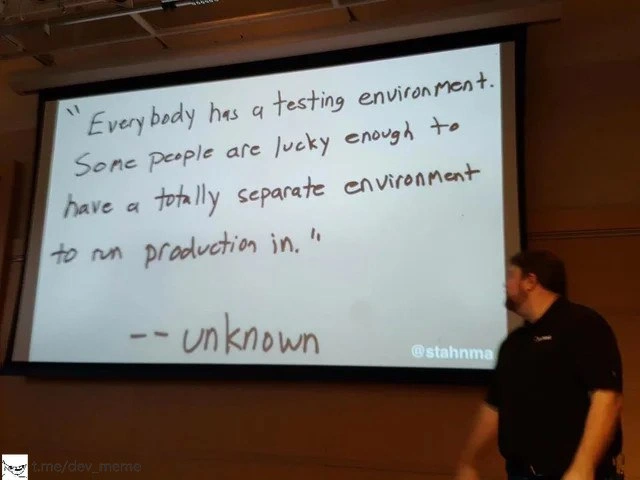
The conference slide's scribbled quote hits seasoned engineers right in the feels: “Everybody has a testing environment. Some people are lucky enough to have a totally separate environment to run production in.” This bit of DevOpsHumor gets a laugh because it’s a truth wrapped in a joke. In practice, every company tests their code somewhere — it’s just that in some unlucky shops the only real testing environment is the live production system itself. When the speaker credited it to “-- unknown” (with the handle @stahnma on the slide), it signaled that this wisdom has been passed around so often no single author remains – a classic folk truth of on-call war stories.

On the surface, the humor pokes fun at poor environment separation. Ideally, you have multiple stages: maybe a QA or staging environment that’s a clone of prod where you safely run tests, and only then deploy to production. But plenty of teams (especially under tight deadlines or tight budgets) cut corners and end up deploying unproven changes straight to prod. The quote implies those teams are unlucky – they don’t have the luxury of a true staging setup – so their Production environment doubles as their testing playground. It’s essentially a tongue-in-cheek way to say: “Sure, you can skip a staging server... if you enjoy living dangerously.”

Why is this funny to experienced DevOps and SRE folks? Because we’ve all seen it or done it. Picture a Friday 5 PM deploy (because of course big releases happen on Fridays) where someone says, “It passed dev tests, what could go wrong?” Next thing you know, an obscure bug blows up in prod that night. Suddenly you’re frantically rolling back changes while real users encounter errors. Every senior engineer has a mental scrapbook of 3 AM outages caused by something that “worked on staging” — or worse, by a feature that had no staging at all. This shared trauma is exactly what the meme taps into. It’s TestingHumor born from ProductionIssues we’d rather forget. The laughter in that conference room was half genuine amusement, half deployment anxiety. It’s the kind of joke you laugh at with a groan, because you remember being that on-call engineer, bleary-eyed and debugging a live incident wondering, “Why oh why didn’t we catch this earlier?”

From a systems design perspective, having faithful copies of production for testing is hard. You aim for “prod-parity” (making testing and prod as identical as possible in config and data) but true parity is expensive and sometimes impossible. Data volumes, user traffic, third-party integrations – some things you just can’t perfectly mimic. So even with a staging environment, you occasionally get a nasty surprise when you hit real scale or weird real-world data. The cynical reality is that testing in production isn’t always a sign of incompetence; sometimes it’s the only way to observe certain conditions. High-profile tech companies have made “testing in prod” almost a philosophy – but importantly, they do it in a controlled way. They use feature flags, canary releases, and blue-green deployments to limit blast radius. In those setups, a small subset of users gets the new code first, essentially acting as guinea pigs (often unknowingly). If metrics go red, they rollback fast. That’s a far cry from a YOLO deploy where all users are hit at once, but it’s still essentially using the real environment to learn things you couldn’t in the lab. As the meme suggests, everyone will eventually test on prod – the difference is whether you plan for it or not.

The quote resonates strongly in DevOps/SRE circles also because it highlights the human side of system failures. Who deals with the 2 A.M. fallout when production is the testing environment? The on-call engineers do – and they often get shell-shocked by repeated nightly disasters. (Oncall_shellshock isn’t a literal shell vulnerability here, but the PTSD-like state of being paged awake too many times because something blew up in prod.) This dark humor is a coping mechanism. Site Reliability Engineers (SREs) and DevOps folks swap these quotes the way soldiers swap gallows-humor jokes, bonding over the shared chaos. It’s SREHumor at its finest: we laugh so we don’t cry. The quote “Everybody has a testing environment...” acknowledges that no matter how polished the process, something always slips through until prod. And if you’re lucky (the slide’s word is perfect), you have safeguards like staging or robust automated tests. If you’re not, well… welcome to deployment pain points city.

To put it in perspective, consider how release pipelines are supposed to work versus how they sometimes actually work:

# Ideal world: multiple environments and thorough testing
environments = ["development", "staging", "production"]
deploy_chain = "dev -> staging -> prod"

# Reality in some orgs: no true staging, just straight to prod
environments = ["development", "production"]  # 'testing' is effectively done in prod
deploy_chain = "dev -> prod"  # Gulp.

In the ideal case, new code goes through a deployment pipeline: developers merge code, automated tests run, then it’s deployed to a staging environment that closely mimics production. You do final checks there with production-like data. Only after that do you promote the code to production. This way, you catch many issues early. In the wild “YOLO” case, you merge code, maybe run basic tests in isolation, and then push straight to the live site. Any hidden bug or performance problem will only become apparent once users are clicking and the system starts to strain. It’s like skipping all the dress rehearsals and going straight to opening night – pray everything goes right.

The meme’s bittersweet punchline is that every organization ends up testing in production to some degree, but only some treat production as a separate, sacred space that isn’t also their test bed. Those are the “lucky” ones with proper processes (or lots of cash for extra servers). The rest of us end up doing hot-fixes on live systems and saying things like, “It’s fine, we’ll test in prod” with an eye roll. The audience laughs because they know that exact feeling: it’s funny because it’s true. It’s a reminder that best practices aren’t always practiced, and it pokes at the gap between ideal-world DevOps and real-world crunch. In summary, this conference_slide_meme delivers a classic prod_equals_test_joke – a snarky one-liner that echoes through startup offices and Ops war rooms alike, eliciting knowing nods and a few sighs from the unlucky souls deploying without a net.

Description

A photo taken at a tech presentation. A presenter is visible on the right side of the frame, looking at a large projector screen. The screen displays a quote in a casual, handwritten-style font. The quote reads: '"Everybody has a testing environment. Some people are lucky enough to have a totally separate environment to run production in."'. Below the quote, it is attributed to '-- unknown'. A Twitter handle, '@stahnma', is also visible on the bottom right of the slide. This meme captures a cynical but often true observation in the software industry. The humor lies in the subversion of best practices. While the standard is to have distinct development, testing/staging, and production environments, the quote suggests that many organizations are so undisciplined that their live production environment is where testing effectively happens. This resonates deeply with experienced engineers who have worked in places with immature DevOps practices and have had to deal with the fallout of 'testing in prod.'
Comments

7
Anonymous ★ Top Pick The fastest way to find out if you have a separate production environment is to push a change on a Friday afternoon and see if you still have a job on Monday
  1. Anonymous ★ Top Pick

    The fastest way to find out if you have a separate production environment is to push a change on a Friday afternoon and see if you still have a job on Monday

  2. Anonymous

    Our stack absolutely has three environments: staging, production, and “CEO demo.” They’re all the same Kubernetes namespace - only the Prometheus alert thresholds change

  3. Anonymous

    After 20 years in tech, I've learned there are only two types of companies: those who admit their staging environment is nothing like production, and those who discover it during their next P0 incident at 3 AM

  4. Anonymous

    The quote perfectly captures the uncomfortable truth that separating test and production environments is a privilege, not a given. For many teams, 'testing in production' isn't a meme - it's Friday afternoon's deployment strategy. The real luxury isn't having a testing environment; it's having stakeholders who understand why you need one before they ask why the production database just got truncated

  5. Anonymous

    We have a separate test environment: it’s a 1% canary in prod, separated by p99 latency and wishful thinking

  6. Anonymous

    We finally achieved environment parity with Terraform - staging points to prod DNS, and prod points to PagerDuty

  7. Anonymous

    Staging that mirrors prod? That's the real unicorn - rarer than a monolith that scales

Use J and K for navigation