When a Low Priority Bug Meets a High-Anxiety Customer
Why is this Stakeholders Clients meme funny?
Level 1: Mountain Out of a Molehill
Imagine you spill a tiny bit of milk on the kitchen floor – just a few drops. You figure, “No big deal, I’ll wipe it up in a minute.” But your friend sees the spill and completely freaks out. They run and pull the fire alarm, screaming that there’s a flood in the house! Suddenly the whole family comes rushing into the kitchen in a panic, expecting a huge disaster, only to find… a tiny puddle of milk. Pretty silly, right? The reaction was way bigger than the problem. That’s exactly what this meme is joking about. A very small problem (a little software bug) is treated like a huge emergency. It’s funny because everyone is overreacting so much that it’s as if the world is ending, when really it was just a minor blip. The humor comes from that over-the-top response to something small – we can laugh because we know the spill (or bug) is easy to fix, and all the alarm bells and emergency meetings are just unnecessary drama.
Level 2: Minor Bug, Major Fuss
Let’s break down what’s happening in this meme in simpler terms. In software development, teams use a process called bug triage to decide how urgently to fix bugs. Not all bugs are equal: some are show-stoppers that break the whole app, while others are tiny glitches you might not even notice. We often assign severity levels or priority numbers to bugs:
- A critical bug might be tagged as P1 or Severity 1 – meaning it’s top priority, needs fixing immediately (like the app crashes for all users).
- A low priority bug (maybe labeled P4 or Severity 4) is something minor like a typos, a slightly misaligned button, or a feature that’s a little slow but has an easy workaround. It’s acknowledged as an issue, but it’s not urgent. The plan is to fix it eventually, just not right this moment.
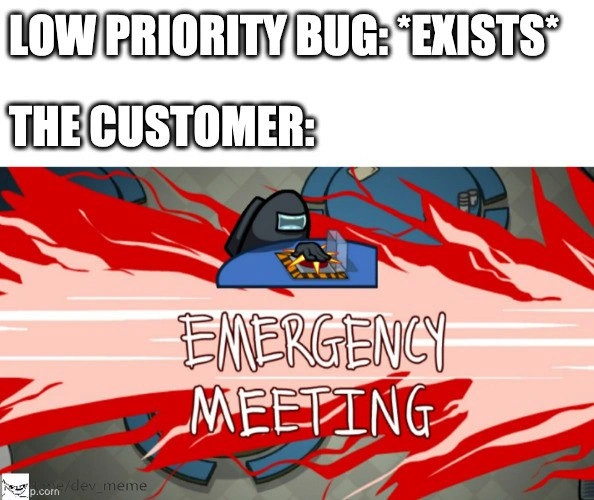
Now, according to the meme text, we have a low priority bug: exists. The wording “exists” with asterisks is internet slang implying that the mere existence of this minor bug is enough to set off the next event. And what is that next event? The text right after says “THE CUSTOMER:” and then we see the image of an EMERGENCY MEETING button being slammed. In other words, as soon as a customer knows about this little bug, they react as if it’s a hair-on-fire crisis.
Who is “the customer” here? It could be an external client who uses the software or an internal stakeholder (like a manager or executive sponsor) responsible for the product. Basically, it’s someone who is not on the engineering team but has a vested interest in the software working perfectly. Stakeholders/clients often have high expectations for quality; even small bugs can upset them because it might affect their business or just their confidence in the product. So the meme is illustrating a case of customer escalation: a customer finds a minor issue and immediately escalates it (raises it with urgency) up the chain, triggering a big meeting with all concerned. This is a form of overreaction, but from the customer’s perspective it might feel justified — they found a flaw and they want it addressed now.
The bottom panel image is a direct reference to the video game Among Us. In Among Us, players are cartoonish astronauts (crewmates) doing tasks on a spaceship, but some players are secretly “impostors” trying to sabotage or eliminate others. If a crewmate witnesses something suspicious or finds evidence of an impostor (like a dead body), they can report it or hit the Emergency Meeting button. When someone presses that button, the game abruptly cuts to a meeting scene: a loud buzzer sounds, red flashing graphics appear, and all players stop what they’re doing to discuss the emergency. It’s meant for urgent situations in the game. The meme uses an image of a crewmate slamming that button with the big “EMERGENCY MEETING” text to exaggerate how the customer reacts. Essentially, the customer is behaving like an Among Us player who saw something alarming and is immediately calling everyone together. The visual of red comic-book style streaks and giant text “Emergency Meeting” really emphasizes panic and urgency. It’s as if the customer is saying, “Drop EVERYTHING, we need to talk about this bug right now!”
For a junior developer or someone new to the industry, this highlights a common experience in tech: stakeholder expectations can be very different from the development team’s expectations. You might think, “It’s just a tiny bug, we’ll fix it later,” but the client might think, “This bug is affecting me, do the developers even care? I need to make sure it’s addressed immediately.” That mismatch can lead to pressure on the development team. You could find yourself pulled into a sudden meeting with project managers, customer support, maybe even the CEO, all because of a little issue you discovered or a user reported. It’s both frustrating and a little funny in hindsight. The humor of the meme comes from exaggeration but with a grain of truth: developers often joke that some customers make a mountain out of a molehill when it comes to bugs. The tags like BugsInSoftware and StakeholderPressure are referencing exactly this tension — a small software bug causing outsized pressure from stakeholders.
Let’s give a concrete example to make it clear: say you’re working on a website and there’s a small bug that causes a minor typo in the footer text. It doesn’t break anything, and maybe hardly any users even notice. You mark it as “low priority” in your tracking system (meaning you’ll get to it eventually, but it’s not urgent). Now suppose one day a major client or your boss happens to notice that typo. They might worry it looks unprofessional. Instead of just logging it and waiting, they might send an urgent email or call saying, “Why is this typo here? We need to fix this immediately!” Next thing you know, there’s a meeting invite with multiple people to discuss this typo. You, as the developer, might be thinking, “I already knew about this and it’s such a quick fix, why are we having a whole meeting?” but to the stakeholder, rallying everyone ASAP feels necessary to ensure the issue is taken seriously. This is essentially escalation of a minor issue (one of the context tags) in action.
The meme’s comedy lies in using the Among Us emergency meeting metaphor to depict that scenario. In Among Us, calling an emergency meeting too often or without a serious reason can annoy other players — similarly, developers get a bit exasperated when every tiny bug turns into a big meeting. It’s a form of meeting humor in the tech world: we tease about how sometimes companies respond to issues with excessive meetings. So if you’re new to development, don’t be surprised if you see this happen: a small bug might indeed trigger a big reaction if the right (or wrong?) person finds it. Part of growing as a developer is learning how to communicate about bugs to non-technical stakeholders, helping set the tone so that not every minor bug feels like a system meltdown. And part of the coping mechanism is sharing memes like this with your teammates and laughing, because it’s something a lot of us have experienced and survived!
Level 3: Priority Inversion Paradox
At a senior engineer’s glance, this meme nails a classic bugs vs. stakeholders scenario. It highlights a kind of priority inversion in project management: a low priority bug (a minor, non-critical defect the dev team has triaged to fix later) suddenly receives high priority attention because a customer discovered it. In software terms, priority inversion usually refers to low-level thread scheduling issues, but here it’s metaphorical — the normal priority order gets flipped on its head. The developer marked this bug as a trivial P4 (very low urgency), yet the moment a client notices, it’s treated like a P0 showstopper. The humor comes from that stark contrast in perspective: what engineers see as a tiny blip, external stakeholders blow up into a five-alarm fire. It’s a perfect intersection of Bugs, panicky Stakeholder Expectations, and dreaded Meetings culture, all wrapped in one relatable image.
Why is this funny to experienced devs? Because it’s too real. We’ve all witnessed a minor glitch trigger stakeholder pressure way out of proportion. Imagine a small UI misalignment or a misspelled label that barely affects usage — internally it’s tagged as “cosmetic, fix in next release.” But if a major client spots it (especially during a demo or executive review), suddenly you get an email chain with upper management CC’d, and an Emergency Meeting invite pops up on your calendar. The meme exaggerates that feeling by using the bold Among Us meeting graphic, but honestly, it’s not far from reality. In real life, the moment an important customer exclaims “There’s a bug!”, it can set off a chain reaction. Managers scramble, product owners call a meeting, and the development team gets pulled from their sprint work to put out a “fire” that, moments ago, was a low-priority backlog item. It’s comedic because the escalation of a minor issue is depicted as instant and over-the-top — exactly how it feels when business folks hit the metaphorical panic button.
This situation reflects some common industry anti-patterns. One is the “HiPPO effect” (Highest Paid Person’s Opinion) where if someone important cares about an issue, it inevitably becomes top priority, logic be damned. Here, the customer (or a client representative) is effectively the HiPPO: their alarm turns a molehill bug into a mountain. There’s also a bit of “squeaky wheel gets the grease” — any bug can become critical if the right person makes noise about it. Seasoned developers know that bug triage processes (sorting bugs by severity and impact) exist for a reason, but they also know those processes often get thrown out the window when a high-profile stakeholder is on the warpath. Best practices say to focus on high-impact issues first; reality says if a paying client is upset about a trivial glitch, you drop everything to placate them. That’s the unwritten rule being poked at here.
Another layer to this humor is the sheer Meeting Culture it lampoons. The image of the Among Us crewmate slamming the emergency button with red alarm blaring is a spot-on metaphor for corporate reactionism. We joke that some orgs’ first response to any issue is, “Let’s schedule a big meeting about it.” The devs seeing this meme chuckle because they’ve sat through those all-hands-on-deck calls where half the attendees don’t even know what’s broken, but everyone is exuding urgency. Ironically, more time gets spent in that meeting discussing the tiny bug than it would take a single engineer to quietly fix it! This Kafkaesque outcome — a full-blown stakeholder emergency meeting over a one-line code fix — is what makes the meme absurd yet relatable. It captures the stakeholder overreaction in a visual nutshell.
From an organizational standpoint, there’s an implicit critique here. If minor bugs routinely trigger major escalations, it hints at misaligned stakeholder expectations and possibly a breakdown in communication. Perhaps the customer reporting the bug doesn’t understand the term “low priority” and interprets it as “the team isn’t going to fix this (and doesn’t care).” That misunderstanding can fuel panic. A seasoned project manager might sigh at this meme because they spend their days managing exactly these perceptions: calming the client, explaining that “low priority” doesn’t mean “won’t fix”, and negotiating reasonable timelines. But often, by the time a client is slamming the button, that nuance is lost and it’s pure reaction mode. There’s also the factor of reputation and stakes — maybe this trivial bug appeared in a high-stakes context (like during a sales demo or on the company homepage during a big launch). In such cases, even a tiny defect feels huge to stakeholders responsible for the outcome. So in a way, the customer’s overreaction isn’t completely insane: they’re safeguarding their interests (albeit dramatically). The humor is that developers see the internal metrics (like “only 0.1% of users will ever stumble on this bug”) whereas the customer sees the one instance and assumes the sky is falling.
The choice of the Among Us emergency meeting image is brilliant for the tech crowd. Among Us was a massively popular game in 2020, and its “Emergency Meeting” moment is iconic for being loud, sudden, and often chaotic — just like these stakeholder escalation meetings. In the game, players slam the button when they suspect an impostor; everyone drops what they were doing to discuss the emergency. Calling one without a good reason is frowned upon (and often gets the button-presser labeled sus or voted out for wasting everyone’s time). See the parallel? In a dev team, calling an all-hands meeting over a trivial issue will have engineers rolling their eyes much like Among Us crewmates saying, “Was that really necessary?”. The meme leverages this pop culture reference to amplify the absurdity: a dark-blue crewmate pounding that button with comic red streaks is exactly how a panicked client looks to a developer. It’s a mix of frustration and dark humor — we laugh because we’ve been there, muttering “Calm down, it’s just a minor bug,” even as we join the call and prepare our status update on the “critical” issue.
In short, this meme resonates on multiple levels: it satirizes how minor bugs in software can lead to disproportionate stakeholder pressure, it playfully uses a gaming reference (the Among Us “Emergency Meeting”) to visualize the panic, and it pokes at the corporate tendency to respond to any problem with another meeting. Seasoned devs chuckle (or groan) because they know this priority inversion paradox well — where the low-priority bug existing is never as simple as it sounds once “The Customer” gets involved. It’s funny because it’s true, and perhaps a bit cathartic: laughing at these situations is easier than crying over the spilled milk of our sprint plans getting derailed by a single, overblown defect.
// Pseudocode of how priorities sometimes *really* work in the real world
if (bug.priority === "LOW" && bug.reporter === "ImportantCustomer") {
bug.priority = "CRITICAL"; // Instantly escalate priority
scheduleEmergencyMeeting(bug); // Sound the alarm!
}
// When a VIP finds even a trivial bug, it magically becomes high priority
Description
A two-part meme that contrasts a developer's perspective with a customer's reaction. The top section has white text on a plain background, stating, 'LOW PRIORITY BUG: *EXISTS*'. Below this, another line reads, 'THE CUSTOMER:'. The bottom image is a screenshot from the popular video game 'Among Us.' It shows a player character in a black spacesuit pressing a large, red emergency button. The entire screen is filled with a dramatic red alert graphic, and the words 'EMERGENCY MEETING' are displayed in a frantic, hand-drawn style. This meme hilariously captures the disconnect between a development team's internal bug triage and a client's perception of severity. A minor issue, deemed non-critical by engineers, is often treated as a catastrophic failure by a customer, leading to immediate escalations and demands for attention, perfectly symbolized by the game's 'Emergency Meeting' mechanic
Comments
7Comment deleted
The customer's definition of a P4 bug is one that requires them to hit the 'Emergency Meeting' button with slightly less force than a P1. Both still require interrupting the entire team's sprint
Enterprise triage in a nutshell: a 2-pixel logo drift summons a 30-person “war room,” while the silent data-corruption ticket politely ages out of Jira
That edge case you marked "won't fix" in 2019 just became the CEO's personal demo failure, and suddenly everyone remembers how to use JIRA's priority field
Ah yes, the classic Schrödinger's bug: simultaneously 'low priority' in JIRA and 'business-critical' in the customer's Slack channel. The bug exists in a superposition of severity states until observed by someone with purchasing authority, at which point the wave function collapses directly into your calendar as a 4 PM Friday emergency meeting. Bonus points if it's been sitting in the backlog for six months with a 'nice-to-have' label, only to become existential the moment their VP notices it. The real technical debt here isn't the code - it's the organizational alignment on what 'priority' actually means
Real incident scoring algorithm: severity = (execs CC'd) × CapsLock; Datadog is just visualization
Severity measures impact; priority measures who’s cc’d - Sev3 until the customer emails the CEO, then PagerDuty pages your calendar and it’s an Emergency Meeting over a tooltip typo
Devs triage as P5; customers escalate to Sev0 faster than a zero-day in the wild