Management Math vs. Developer Reality
Why is this Management PMs meme funny?
Level 1: One Cook, Two Meals
Imagine your mom tells you: “Bake a cake and cook dinner, and you have one hour to finish both, since each one takes an hour by itself.” 🍲🎂 Sounds silly, right? You can’t actually be stirring a pot and measuring flour at the exact same moment with one pair of hands. If you try to jump back and forth, you’ll probably burn something or make a big mess, and it will definitely take more than an hour to get both a dinner and a dessert done. In everyday life, we know you either need more time or an extra person to help.
The boss in the meme is making that same kind of impossible request at work. He thinks one person can do two big jobs in the time it normally takes to do one job. Even a kid knows that if you have to clean your room and do your homework, and each one needs an hour, you can’t magically finish both in one hour by doing them at the same time. You’d either need two of you (one to handle each task) or you’re going to need about two hours. The meme is funny because the employee’s reaction — “Wait…” — is basically them saying, “Hold on, that doesn’t make sense. I’m not a superhero who can be in two places at once!” It highlights something obvious that the boss is ignoring, and we laugh because we all recognize how unrealistic the boss’s expectation is.
Level 2: Multi-Tasking Myth
For a newer developer or someone early in their career, this meme is a clear lesson about how time estimation and multitasking really work. The setup is straightforward: your boss assigns you Project A and Project B. Each one is estimated to take about 3 days of work if you focus on it alone. The boss’s “logic” says: great, do them both at the same time and you’ll still be done in 3 days! On the surface that sounds efficient, but it’s actually a major multitasking misconception.
Here’s what’s wrong with that idea in plain terms:
- You still have to do all the work for both tasks. If each project needs ~3 days (let’s say roughly 24 hours) of focused effort, doing them concurrently doesn’t magically reduce it to 3 days total. You’d still have to put in about 48 hours of work to complete both. Whether you do one after the other or juggle them in parallel, you can’t escape that fundamental sum of work.
- Humans can’t truly do two things at once. Unlike a computer with multiple processors, you as a developer have essentially one “core” — your brain (and one pair of hands) — working on the code. You can only actively write or think through one piece of code at any given moment. What the boss suggests is a form of concurrency (alternating between Task A and Task B), but it’s not true parallelism (working on A and B at the exact same time). Concurrency isn’t parallel when you’re a single person; it just means you're slicing your time between tasks.
- Switching tasks has a cost. Every time you stop working on Project A and switch to Project B, you incur what’s called context switching overhead. You have to pause your train of thought on A, remember where you left off on B, possibly reopen different files or tabs, and get your mind back into that project. That transition time is basically lost productivity. It’s like if you tried reading two books by swapping between them constantly; you’d spend extra time each switch re-reading a bit to recall the storyline. In programming, this overhead might mean re-running a build, re-loading the mental state of the code, or just the fatigue of refocusing. Frequent task switching makes you slower and more error-prone.
- The deadline becomes impossible. A deadline is the due date for a task. If both projects are due in 3 days but each one realistically needs 3 full days of work, that due date can’t be met for both. It becomes an unrealistic deadline. You’d have to either work double-length days (e.g. 12-16 hour days, which is exhausting and risky) or miss the deadline for one of the projects. This is why developers often push back on plans like this — not because they don’t want to work hard, but because they know even working hard has its limits on a clock.
The meme’s chat-style format (Boss says X, Me says Y) highlights the disconnect between management’s expectations and engineering reality. The boss sees two tasks and a three-day window and thinks it fits neatly, kind of like scheduling two meetings at different times on the same day. They might even draw it on a project timeline or use a planning tool to put both tasks in the same 3-day stretch. (A Gantt chart is one such tool that shows tasks over time. If someone isn’t careful, they could mistakenly put two tasks on the same timeframe for one person in a Gantt chart — a big planning no-no.) The developer’s reaction “Me: Wait” in the meme is the moment of realizing “Hold on, that doesn’t add up. I can’t magically double my output just by multitasking.”
The takeaway for a junior dev is: don’t fall for the multi-tasking myth. Doing two big tasks simultaneously will still take roughly twice as long, usually even a bit more due to the overhead of switching. Managers (or teachers, or anyone assigning work) sometimes make this mistake by assuming work can be parallelized without limits. The humor in the meme comes from how obvious it is to the developer that the plan won’t work — it’s basically pointing out that two plus two doesn’t equal two in the world of work. The boss’s expectation is completely out of sync with how real work gets done, and the meme makes that clear in a simple, comical dialogue.
Level 3: Parallel Universe Planning
In the real world of software projects, senior engineers recognize this situation immediately. It’s a textbook case of misaligned expectations between management and engineering. The boss is doing naive arithmetic — let’s call it boss math — by essentially saying: “3 days + 3 days = 3 days, if you do them at the same time.” Seasoned developers know that this isn’t how anything works in reality. The meme captures that moment of head-scratching disbelief (the developer’s incredulous “Wait…”) when a manager proposes what amounts to a fantasy timeline.
Why is this funny (or painfully relatable) to experienced devs? Because we’ve all been there. A project manager or boss figures that if each project individually takes, say, a week, then doing two at once still just costs a week — as if by multitasking magic the calendar doesn’t budge. It's the same flavor of wishful thinking behind adding more people to a late project and expecting it to go faster. (Recall Brook’s Law from The Mythical Man-Month: “adding manpower to a late software project makes it later.”) In this case, they’re not adding manpower at all — they’re just double-loading the same poor developer! The humor comes from how blatantly this plan violates basic project reality, yet how earnestly some managers present it with a straight face.
Let's break down the fallacies in the boss’s logic:
- Ignoring human limitations: The plan assumes the developer can operate like two people or a dual-core processor. In reality, one person’s brain can’t fully work on two streams of thought simultaneously without severe efficiency loss.
- Assuming context switching is free: It imagines you can jump between Task A and Task B with zero context-switch overhead. In truth, every swap means lost focus. The “where was I?” time when resuming a task is very real, whether it’s picking up a codebase after lunch or after toggling to another assignment for a few hours.
- Treating work as simple math: It treats complex development like basic addition, as if two 3-day tasks = one 3-day block of work. Software tasks aren't liquid that you can just pour together; they’re more like solving two puzzles. Doing them side by side doesn’t merge them into one puzzle — you still have two separate puzzles to finish.
- Overlooking risks and delays: It blissfully forgets that even a single “3-day” estimate is usually optimistic. Bugs, integration issues, or unclear requirements can extend one task. If you’re juggling two tasks when such issues arise, progress on both grinds down. Under deadline pressure, these schedule slips compound quickly.
The predictable outcome of this parallel estimation fallacy is that neither project actually finishes in 3 days. Instead, you get two half-done pieces, or one task cannibalizes the time of the other while the second languishes. Then the boss is puzzled why nothing was fully delivered "on time." Cue the engineer’s exhausted sigh. This disconnect creates developer frustration: programmers end up working overtime or cutting corners to try to meet these unrealistic deadlines dreamt up by spreadsheet logic rather than actual effort. It’s humorous in the meme, but in practice it leads to burnout and morale problems on the team.
You can almost visualize the planning behind this. Picture a timeline with two task bars perfectly overlapping, both assigned to the same individual, as if that person can be in two places at once. It’s a classic gantt chart fail. Seasoned devs laugh (or maybe groan) because it highlights a persistent industry issue: management planning that treats people like infinitely parallelizable resources. In short, this “boss logic” lives in a parallel universe where concurrency has no cost and one worker can produce two workers’ output in the time of one. Back in reality, we know better — and that contrast is exactly what makes the meme ring so true (and perhaps a tad painful).
Level 4: Single-Threaded Human CPU
From a computing theory perspective, expecting one developer to finish two independent 3-day tasks in parallel within 3 days defies fundamental resource constraints. A single developer is like a single-core CPU: it can only execute one thread of instructions at a time. If you assign two CPU-bound threads (tasks) to a single core simultaneously, the core doesn't magically complete them both in the time it takes to do one. Instead, it must time-slice between them — rapidly switching context back and forth. Every context switch has overhead: the CPU (or here, the person) spends extra cycles saving and loading state, regaining momentum, and dealing with the mental "cache misses" as they recall where they left off in each task.
In formal terms, this scenario highlights a parallel estimation fallacy. The manager implicitly assumes linear scalability of work: that doubling the tasks while holding the single resource constant yields no increase in total time. However, Amdahl's Law from parallel computing tells us that the maximum speed-up from parallelization is limited by the portion of the work that must be done sequentially. Here, all of the work is sequential from the perspective of one person — only one task can be actively worked on at any given moment. So the theoretical speed-up is ~1× at best (meaning it still takes at least the sum of both tasks' times, not the time of just one). In reality, the speed-up is < 1× — meaning it could take even longer than doing the tasks one after the other, due to the task switching overhead.
We can express the naive boss logic versus reality succinctly:
# Boss's naive math:
expected_total_days = 3 # two tasks, each "3 days", magically done concurrently
# Realistic math:
task1_days = 3
task2_days = 3
context_switch_penalty = 0.5 # extra days lost to ramp-up/brain-switch each time
real_total_days = task1_days + task2_days + context_switch_penalty # > 6 days
The code above humorously shows that in reality real_total_days ends up even exceeding the sequential sum (6 days) once you factor in the constant mental thrash from alternating tasks. It's like two processes contending for one CPU core: concurrent in concept but strictly sequential in execution, plus overhead from swapping. The resource contention is absolute — both tasks are competing for the same single developer's time slice. Without an additional "core" (another developer or a cloned copy of yourself), there's no true parallelism, just concurrency with performance penalties. The boss’s arithmetic 3 days + 3 days = 3 days ignores these fundamental limitations, akin to dividing by zero in a real system and expecting no error. It's simply not how throughput works in any real system governed by finite resources and non-zero switching costs.
Description
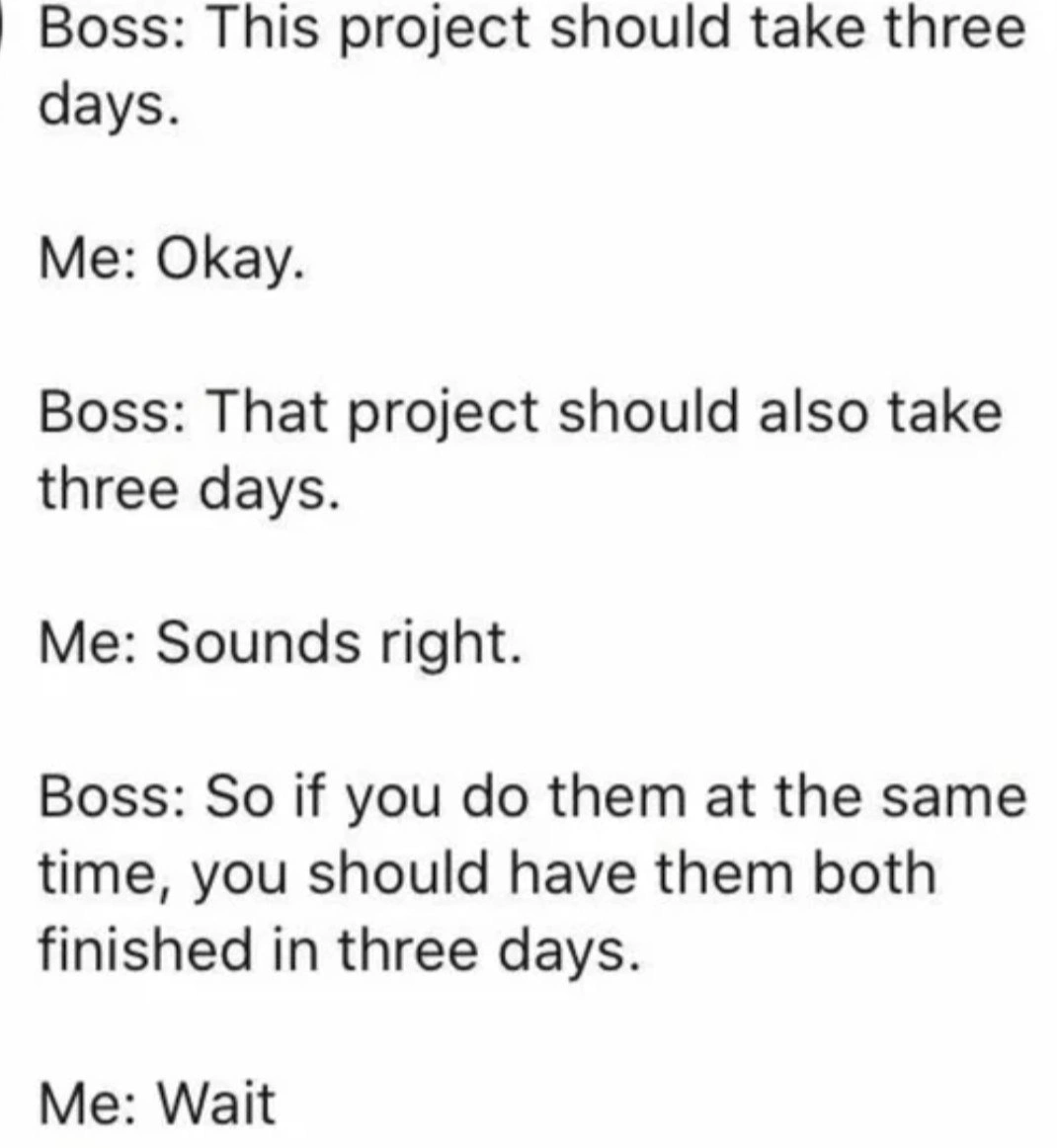
A text-only meme on a plain white background that depicts a short conversation. The dialogue is between 'Boss' and 'Me'. The boss first states, 'This project should take three days,' to which 'Me' agrees. The boss then adds, 'That project should also take three days,' and 'Me' agrees again. The logical fallacy comes in the final exchange where the boss says, 'So if you do them at the same time, you should have them both finished in three days.' The meme ends with the developer's simple, dawning realization and objection: 'Me: Wait'. This meme satirizes a common and frustrating project management anti-pattern where development work is treated as perfectly parallelizable. It highlights the disconnect between managerial planning and the reality of software development, where tasks require focus and context switching has a significant cost. Experienced developers find this relatable as it captures the absurdity of assuming one person can handle two distinct, full-effort tasks simultaneously without any impact on the timeline
Comments
7Comment deleted
This is the project management equivalent of assuming you can achieve 2x throughput by setting thread count to 2 on a single-core CPU. My brain's context switching has a higher latency than a cold start on a serverless function
“Apparently my brain is expected to have infinite cores, zero cache misses, and free context switches - Amdahl’s Law just logged an HR ticket for abuse.”
Someone who thinks developers can run concurrent threads clearly never had to explain why their "quick context switch" just invalidated three hours of mental state and left seventeen Chrome tabs orphaned
Ah yes, the classic management assumption that developers are perfectly parallelizable processes with zero context-switching overhead. If only we could fork() ourselves and have both instances share the same brain cache without invalidation costs. This is Brooks' Law in reverse: adding more projects to one developer somehow makes them finish faster. Next they'll suggest we implement lock-free concurrent brain algorithms to eliminate the 'thinking' bottleneck
Boss math: two 3-day projects in parallel equals three - Amdahl’s Law says my replica count is one and the mutex on “attention” has 100% contention
Running two 3-day projects in parallel on a single human core just turns Amdahl's Law into a context-switch interrupt storm
Boss just proved Amdahl's law in reverse: 100% parallelizable dev time yields 1x speedup