Skip to content
DevMeme
5813 of 7435
Corporate Control vs. the 'Uncontrollable' C Language
Languages Post #6370, on Nov 10, 2024 in TG

Corporate Control vs. the 'Uncontrollable' C Language

Why is this Languages meme funny?

Level 1: Stay in the Sandbox

Imagine your teacher at school gives you a list of “safe toys” you’re allowed to play with. All the toys on that list are made by big, famous companies – they’re shiny, new, and designed so you can’t easily hurt yourself. Maybe there’s a cool robot from Google-Toys, a fancy building set from Apple-Toys, and a neat puzzle from Amazon-Toys. These companies made the toys in a way that if you try to do something wrong, the toy just won’t let you; you’re kept safe. Now, you have an old toy – let’s say a super fast bicycle that doesn’t have any training wheels or safety gear. That bike isn’t made by any big company, and no one really “owns” it – it’s like a custom bike passed down from your parents’ generation. It can go really fast, and you can do all sorts of tricks, but if you’re not very careful, you could scrape your knee or worse. The teacher doesn’t include this bike on the safe list.

You might think the teacher is just worried you’ll get hurt (because, yeah, that bike can be dangerous). But this meme jokes that maybe the “real” reason the bike isn’t allowed is because the teacher (or the school) can’t control that toy – it’s not from one of their trusted big brands. The safe toys all come from companies the teacher knows and can talk to, but the bike is this wild, independent thing. So the joke is like: “They say it’s about keeping us safe, but maybe they just don’t like that one toy because it’s outside their control.”

In simple terms, the meme is comparing programming languages to toys. Languages like Java, Go, or Rust are the safe, company-made toys – they help keep you from making big mistakes (so your programs don’t crash or get hacked easily) and they’re maintained by big organizations. C is like that no-rules bike – it lets you do whatever you want, which is fun and powerful, but you can also get hurt if you’re not careful. And since no single company runs C, it’s like the teacher can’t call up the company to complain or suggest changes; it’s free but a bit unruly. The humor comes from that feeling of a kid told to “stay in the sandbox where it’s safe,” while eyeing the open playground outside. It’s funny because it’s a mix of truth (some toys are safer, some languages are safer) and a bit of rebellious imagination – thinking the grown-ups have a secret agenda just because they don’t want you riding your wild old bike. In the end, it’s poking fun at the idea of safety rules by hinting there might be another reason behind them, even if in reality it really is mostly about safety.

Level 2: Big Tech’s Safe Picks

Let’s break down the meme’s content in simpler terms. Recently, the NSA (National Security Agency – a U.S. government body focused on security) put out guidance encouraging developers to use “memory-safe” programming languages. Memory safety means a language is designed to prevent certain kinds of bugs that can make programs crash or become vulnerable to hackers. In a memory-safe language, you’re much less likely to accidentally read or overwrite the wrong part of memory (imagine an errant write going into a neighbor’s apartment – a safe language puts up strong walls to stop that). This matters because a huge portion of security vulnerabilities (think of viruses or hacks you hear about in the news) come from programmers accidentally creating these memory mistakes in languages like C or C++. So the NSA’s advice was basically: “if you can, write new code in languages that stop these bugs by design.”

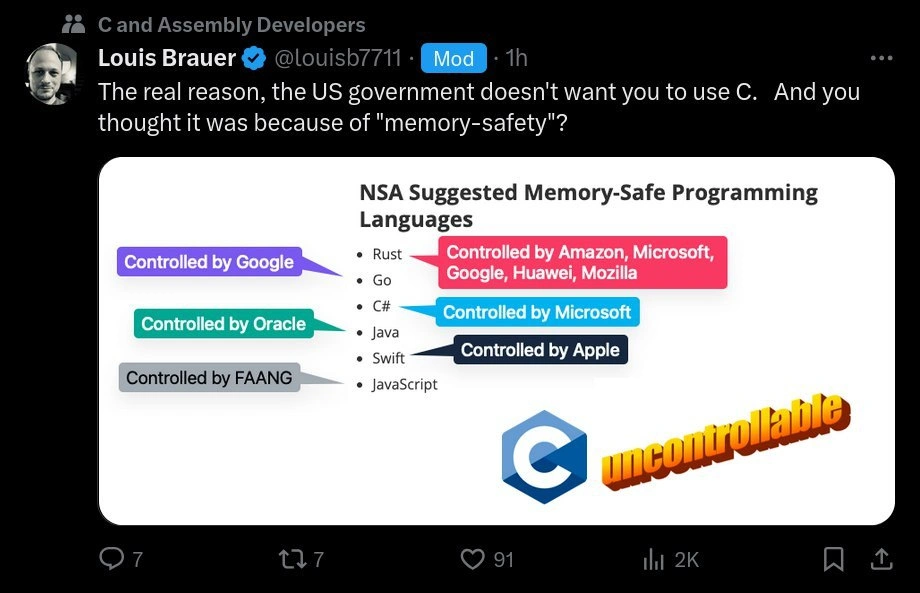
The meme lists the languages the NSA suggested, and next to each language it notes who effectively runs or steers that language. Here’s a rundown of that list in text form:

Language “Controlled by” (major steward)
Rust A foundation with heavy input from Amazon, Google, Microsoft, Huawei, Mozilla (big companies invest in Rust)
Go Google (created it and leads its development)
C# Microsoft (invented for .NET, still mainly theirs)
Java Oracle (owns Java after acquiring Sun Microsystems)
Swift Apple ( designed by Apple for iOS/macOS ecosystem)
JavaScript Technically governed by a committee (ECMA), but in practice FAANG companies (Facebook, Amazon, Apple, Netflix, Google) control its engines and evolution (through browsers and frameworks)
C No single company – It’s standardized by an international committee (ISO), and implemented by many (GNU, Microsoft, etc.), so nobody like a Google or Apple solely controls C.

In the meme image, each of those first six languages is tagged with a colorful label like “Controlled by Google” or “Controlled by Microsoft,” emphasizing that behind each language there’s a dominant big tech influence. FAANG is an acronym you might know – it stands for Facebook (now Meta), Amazon, Apple, Netflix, Google – basically the biggest of Big Tech. The meme cheekily groups JavaScript under FAANG’s control because all those companies have a stake in how JavaScript runs (whether it’s the V8 engine in Chrome by Google, or Apple’s Safari engine, or Facebook and Netflix heavily using JS for web apps).

Now, the last item on the list is C, represented by its blue letter logo, with the word “uncontrollable” slapped next to it in big orange 3D text. What’s that about? Well, unlike the others, C isn’t owned or controlled by any one company. It’s one of the oldest mainstream programming languages (born in the early 1970s at Bell Labs), and over the years it’s become an international standard. That means changes to C happen via a committee of experts from many organizations, and multiple compilers (programs that translate C code to machine code) exist. No single corporation can decide tomorrow to change how C works or push out an update that every C developer must accept. In a sense, C is “free” and somewhat anarchic – anyone can implement it, and its evolution is deliberate and slow, with lots of community input. That’s what the meme labels as “uncontrollable.” It’s highlighting that C doesn’t have a corporate master calling the shots.

However, it’s also hinting at the flip side: C is not memory-safe. C will let you do almost anything with memory if you ask – even if it’s a really bad idea. You can manually allocate memory (malloc), access arbitrary memory locations via pointers, and if you make a mistake (like not allocating enough space or forgetting to stop at the end of an array), C won’t stop you. The result could be a program crash or a serious security flaw. SecureCodingPractices in C require a lot of discipline and careful checks, because the language itself won’t protect you from foot-guns like buffer overflow. In contrast, languages like Java, C#, Go, Swift, JavaScript automatically manage memory for you or at least check that you stay in bounds – they won’t let you, say, write past the end of an array (if you try, they throw an error or panic out). Rust is a special case: it aims to give low-level control like C and prevent those errors at compile time with its famous borrow checker. But as great as Rust is, it’s newer and the meme points out it’s under the influence of multiple big companies who are part of its funding and governance.

So the humor here for a newer developer: the meme suggests a tongue-in-cheek reason why the government favors these safer languages. Ostensibly, it’s to get rid of nasty security bugs (memory_safety is the official reason). But the meme maker jokes, “And you thought it was because of memory safety?” implying a sarcastic “no no, that’s just what they tell you.” Instead, they present the idea that maybe it’s really because those languages are controlled by large corporations that perhaps governments work closely with or can influence. Meanwhile, C stands out as this rogue element – powerful but not under any one party’s thumb (neither Big Tech nor government). This plays into a bit of a language wars narrative: some developers feel strongly about using open, older languages like C for freedom and control, versus adopting newer languages that come bundled with corporate-driven ecosystems and tools.

In reality, the NSA isn’t banning C; they’re just recommending new projects consider safer alternatives when possible. But the image humorously exaggerates it like a prohibition or a secret agenda. If you’re a junior dev, think of it this way: all the languages on that list except C are more modern, safety-oriented, and have big companies tending to them (fixing bugs, adding features, providing support). C is like an old-school, do-it-yourself tool – super effective but requires you to be very careful. The meme jabs at the notion that Big Tech and by extension the government might prefer tools they have a say in. It’s half-joking, half-pointing out that our industry’s popular languages aren’t just abstract inventions – they often come from companies with their own interests. So when someone says “use a safe language,” a skeptic might reply, “sure… or you just want me to use something you control.” It’s a mix of legitimate tech concern (safety) and a bit of playful paranoia about big_tech_influence.

Level 3: Memory-Safety Monopoly

This meme hits experienced developers right in the trade-offs. It highlights the irony that the NSA’s guidance on “memory-safe languages” reads like a roll call of Big Tech’s favorite offspring. Officially, the NSA (and other cybersecurity experts) have urged engineers to move away from C/C++ in new projects, citing endless memory-related security bugs. If you’ve been on call for a production incident or spent a week chasing a segmentation fault, you know memory unsafety is a real problem. Buffer overflows, heap corruption, stack smashing – these are not just theoretical, they’ve caused everything from the Heartbleed vulnerability in OpenSSL to countless Windows viruses. So when the US government says “Hey folks, maybe stop using C for things like new secure software; use Rust or Java or Go instead,” it sounds like sensible advice for better SecureCodingPractices.

But then you look at which languages get the seal of approval. Rust – a language praised for modern safety features – is heavily backed by companies like Amazon, Google, Microsoft, and Mozilla (even Huawei has contributed). Go – invented at Google, with Google still steering its direction (just check who controls golang.org). C# – birthed by Microsoft, living in the .NET world. Java – stewarded (and trademarked) by Oracle; the Java Community Process exists, but Oracle holds a lot of cards (remember the Google vs Oracle lawsuit over Android’s Java use?). Swift – created by Apple, and while open-source, Apple dictates its evolution (it’s the lingua franca of iOS development, after all). And JavaScript – the odd one, being standardised by ECMA, but effectively controlled by FAANG in practice, since companies like Google (Chrome’s V8 engine), Apple (Safari’s WebKit), and others dictate where JS and the web go. It’s a who’s who of industry giants: the meme’s colored arrows bluntly label each language with its corporate overlord. Seasoned devs recognize that each of these languages, wonderful though they are, ties you into ecosystems that big corporations influence.

That’s where the humor turns into a sardonic grin. We’re basically seeing the NSA’s “recommended safe languages list” reinterpreted as “preferred technologies of Big Tech”. The kicker: C, the granddaddy of modern programming, is portrayed as the one language to rule them all that nobody can rule. The big blue C icon sits apart with the word “uncontrollable” in loud 3D letters, like a rebel graffiti tag on a corporate office wall. Every old-timer who has spent nights debugging C pointers or wrestling with malloc and free can’t help but smirk: Yeah, C is dangerous – it doesn’t even have training wheels – but at least no single company is pulling its strings. It’s the wild west of programming languages, for better or worse.

Why is this funny to industry folks? Because it frames a legitimate security initiative as if it were a Saturday morning cartoon villain plot: “We’ll force everyone to use languages we control! Mwahaha!” 🙃 Developers love a good conspiracy joke, especially one rooted in a kernel of truth. There’s ongoing debate (often heated LanguageWars) about big companies creating programming languages and how that shapes developer behavior. Some remember how JavaScript became ubiquitous thanks to browsers from big companies – now it’s standardized, but if Google tomorrow decided to push a new JS feature via Chrome’s auto-update, the web would adapt or break. Similarly, Google’s influence on Go or Microsoft’s on C# means those companies’ priorities can affect the whole community (ever had to update your .NET runtime because Microsoft pushed a new version?). This can feel like a vendor lock-in not at the product level, but at the language level. The meme leverages that feeling: the NSA isn’t just recommending any safe languages, they’re effectively steering developers toward Big Tech’s embrace. It tickles that tiny rebellious part of a programmer’s brain that whispers, “They want us to use their tools so they’re in control.”

It also resonates because many developers have a love-hate relationship with C. We know C is like a chainsaw: incredibly powerful, widely used in system kernels, embedded devices, high-performance libraries – but also fully capable of cutting your leg off if you’re careless. As the joke often goes, C gives you plenty of rope to hang yourself (and C++ gives you even more rope plus a fancy chair to kick away). Here, that proverb might continue: “…but at least it’s your rope, not a Google-issued safety harness.” 😏 There’s a rugged independence in writing C code – you’re closer to the metal, nothing between you and the CPU but your own code. For some tasks, that’s critical. And no single corporation can suddenly decide that printf or malloc should behave differently for their own profit or policy – the C standard changes at a glacial pace via an international committee, not by edict of a CEO.

Consider the context: memory_safety has been a hot topic in IndustryTrends_Hype, especially with Rust rising as a potential “C replacement” in systems programming. When the NSA’s guidance came out (pointing to memory-safe languages as a security boon), it fueled the debate: should we rewrite critical infrastructure in Rust? Are our beloved low-level languages obsolete for new projects? Many devs are on board with safer code, but others bristle at the hype – they’ve heard the “this will solve all bugs” promise before. This meme plays to that skeptical audience, joking that there might be ulterior motives. It’s poking at the idea of big_tech_influence: if all code is in languages controlled by a few giants, is that a form of centralized control over the tech world? It’s a tongue-in-cheek nod to both government_recommendations and corporate dominance.

Finally, there’s an implicit nod to history and pragmatism. Government agencies have tried to guide coding practices before. Old-timers recall the Department of Defense’s ADA language mandate in the 1980s – a memory-safe, strongly-typed language the DoD pushed for all defense software. ADA was actually pretty good (and no single company owned it – it was a government-sponsored project), but it never killed C/C++ entirely. The industry tends to resist one-size-fits-all edicts. Fast-forward to today: instead of creating a new “safe language,” the NSA just pointed to industry favorites. The meme humorously suggests this wasn’t mere coincidence. It’s the classic cynical veteran sentiment: “Of course they say it’s about security... but follow the money and power, kid.” Developers who’ve been around the block chuckle because, well, we’ve seen cozy relationships between big tech and governments in other areas – why not programming languages too? Even if it’s far-fetched as an actual conspiracy, it’s a hilarious framing of the situation. The truth is likely mundane: those languages are recommended because they’re modern, safer, and widely supported. But the way the meme juxtaposes “controlled by [Tech Giant]” for each creates a perfect setup for dark humor. It’s language comparison meets political satire. We’re essentially laughing at the idea that C (with all its flaws) might be disfavored not purely because of its segfaults and security holes, but because it’s a free-roaming beast that no single company (or agency) can ride. In the daily trench warfare of coding, that’s a potent mix of flattery and mockery – flattery that our old friend C is too wild to control, and mockery of the alphabet soup of agencies and FAANG companies that think they can herd developers like cats into using only “approved” tools.

Level 4: The Trusting Trust Paradox

At the deepest level, this meme touches on a classic computer security conundrum: who do you trust in your toolchain? In 1984, Ken Thompson’s famous paper “Reflections on Trusting Trust” described how a C compiler could be modified to invisibly inject backdoors—proof that if a single entity controls a compiler or language, they wield immense power over every program built with it. Modern memory-safe languages (like Rust or Java) rely on sophisticated runtimes and compilers to enforce safety guarantees. These systems are marvels of design – borrow checkers, automatic memory management, bounds-checking – all working to prevent buffer overflows and dangling pointers. But they also introduce a trust dependency: developers must trust that the language’s stewards (often Big Tech vendors or foundations heavily influenced by them) implement these safety features correctly and without malicious influence.

From a programming language theory perspective, memory safety is a formal property: a language is memory-safe if well-formed programs cannot perform out-of-bounds memory accesses or use freed memory. Languages like Rust achieve this at compile time via strict rules (the borrow checker enforces aliasing and lifetime disciplines rooted in affine type theory), while others like Java or Go rely on runtime checks and garbage collection (trading some performance and control for safety). There’s deep computer science here – research on type systems and formal verification aims to prove safety properties mathematically. For instance, Rust’s design draws from decades of academic work on affine types and region-based memory management, attempting to guarantee at compile-time what C can only catch (if at all) at runtime or not at all. The downside? Such guarantees rely on the correctness of the compiler and runtime.

This is where the trust paradox comes in. Highly optimized C code, while dangerous if misused, compiles down to relatively transparent machine instructions. Seasoned developers can read the assembly, reason about the stack and heap, and even formally verify critical C code with tools. C has multiple independent compilers (GCC, Clang/LLVM, MSVC), each open to scrutiny by different groups. There’s no single master switch or update pipeline that could introduce a universal change overnight without the community noticing. In contrast, a language like Go or Swift is largely developed under the watchful eye of one corporate entity – new versions, safety features, and yes, potential vulnerabilities or backdoors, come through that gatekeeper. The meme’s jab that Rust is “controlled by Amazon, Microsoft, Google, Huawei, Mozilla” and that C is “uncontrollable” hints at this monoculture risk. If one entity (or a tight-knit group of industry players) controls the spec and the primary compiler of a language, a subtle change (malicious or accidental) can propagate widely before it’s caught. Memory-safe languages dramatically reduce an entire class of errors (and security vulnerabilities), but they concentrate trust in the language’s implementation. The humor here taps into a deeply technical debate: is it better to live with the chaos of C, where you manage memory (and risk) yourself but have ultimate autonomy, or to cede control to a managed environment where “safe” behavior is enforced by a potentially opinionated compiler? It’s almost a philosophical difference: formal safety guarantees versus freedom to shoot yourself in the foot (and, as the meme implies, freedom from oversight).

This tension isn’t just theoretical – it echoes real-world concerns. The NSA’s push for memory safety is grounded in hard data: something like 70% of critical security bugs are due to memory mismanagement in languages like C/C++. Historically, that’s how worms, viruses, and nation-state exploits worm their way into systems (a buffer overflow here, a use-after-free there). One might cynically note the paradox that intelligence agencies both exploit these bugs offensively and advise against them defensively. The meme winks at a hypothetical “backdoor conspiracy”: if everyone uses languages overseen by vendors that might cozy up to governments, could the toolchains themselves be an attack vector? While there’s no concrete evidence of widespread compiler backdoors in these languages, the mere idea is a longstanding paranoid flavor in cybersecurity circles. In short, the “uncontrollable” C in this image isn’t just about corporate independence – it symbolizes a trust distribution. You don’t have to trust a single corporation to use C; you mostly trust yourself (and decades of openly vetted compiler code). At this level, the meme raises a profound point disguised as a joke: programming languages carry implicit trust contracts, and consolidating that trust in a few corporate hands might be its own kind of vulnerability.

Description

A screenshot of a tweet from user Louis Brauer in the 'C and Assembly Developers' community. The tweet presents a conspiracy-style joke, saying, 'The real reason, the US government doesn't want you to use C. And you thought it was because of "memory-safety"?'. Below the text is an infographic titled 'NSA Suggested Memory-Safe Programming Languages'. The graphic lists several languages and attributes their control to major tech corporations: Rust (Amazon, Microsoft, Google, etc.), Go (Google), C# (Microsoft), Java (Oracle), Swift (Apple), and JavaScript (FAANG). In stark contrast, the bottom of the infographic shows the C programming language logo next to the word 'uncontrollable' in a bold, 3D font. The humor is a satirical commentary on the NSA's recent guidance advising developers to move to memory-safe languages. Instead of accepting the official reason of enhancing security, the meme posits a humorous conspiracy that the true motive is to push developers towards ecosystems controlled by large corporations. It champions C as a bastion of independence, a language governed by an international standards committee rather than a single corporate entity, making it 'uncontrollable' in this context. This resonates deeply with senior developers who value open standards and may be skeptical of the influence large tech companies wield over modern development ecosystems
Comments

18
Anonymous ★ Top Pick The NSA promotes memory-safe languages because they're 'controlled.' Meanwhile, C is so uncontrollable that half its behavior is 'undefined' by its own standards committee, which is a level of chaotic freedom even government agencies can't handle
  1. Anonymous ★ Top Pick

    The NSA promotes memory-safe languages because they're 'controlled.' Meanwhile, C is so uncontrollable that half its behavior is 'undefined' by its own standards committee, which is a level of chaotic freedom even government agencies can't handle

  2. Anonymous

    Sure, Rust has the borrow checker and Java has Oracle; C’s only regulator is undefined behavior - good luck subpoenaing that

  3. Anonymous

    After 20 years of debugging segfaults at 3am, you realize the NSA's push for memory-safe languages isn't about national security - it's about preventing developers from achieving true enlightenment through manual memory management and the spiritual journey of tracking down use-after-free bugs in production

  4. Anonymous

    Ah yes, the NSA's real concern with C isn't the buffer overflows or use-after-free vulnerabilities - it's that they can't call up Dennis Ritchie's estate to request a backdoor. Meanwhile, memory-safe languages come with built-in corporate surveillance as a feature, not a bug. Who needs memory safety when you have plausible deniability through segfaults?

  5. Anonymous

    Memory safety: swapping wild pointers for corporate leash holders who backtrace your every allocation

  6. Anonymous

    Funny how "memory-safe" reads like "procurement-safe"; C isn't unsafe, it's just the only language where the vendor is you

  7. Anonymous

    Procurement wants a vendor to hold accountable; C offers a standards committee and a core dump - hard to subpoena undefined behavior

  8. @lilfluffyears 1y

    Is Java controlled?

  9. @mrskbbs 1y

    https://www.youtube.com/watch?v=dDRDova2uro

  10. @qwnick 1y

    who control c++?

    1. @RealFoundr 1y

      c

  11. @dev_key 1y

    jokes aside...

  12. @GLXBX 1y

    C forever

  13. @Diotost 1y

    Will they return to Ada?

    1. @Johnny_bit 1y

      US Dept of Defence likes this.

  14. @mohamed_023 1y

    HolyC is controlled only by god

    1. @SamsonovAnton 1y

      Only partially, as Brian Kernighan has not ascended yet.

  15. @TheRamenDutchman 1y

    Wait how is Rust controlled by Amazon, Microsoft, Google and fucking Huawei?

Use J and K for navigation