The performance paradox: faster code, slower projects
Why is this Performance meme funny?
Level 1: Too Much of a Good Thing
Imagine you learn a super cool trick to do your homework extra neatly and perfectly. Sounds great, right? But then you spend so much time making every single answer look just perfect that you don’t finish your homework before bedtime. In other words, you got carried away with the new trick and missed the big goal. That’s what this meme is joking about: sometimes learning how to make something really good (like super-fast code) can make you so obsessed with polishing every little part that you forget to actually finish the whole task on time. It's like spending hours decorating each cupcake with very fancy designs and then realizing the party is over before you even served them. The funny lesson here is simple: doing something well is good, but doing it too much can slow you down when you need to get things done.
Level 2: Rubber Ducks & Deadlines
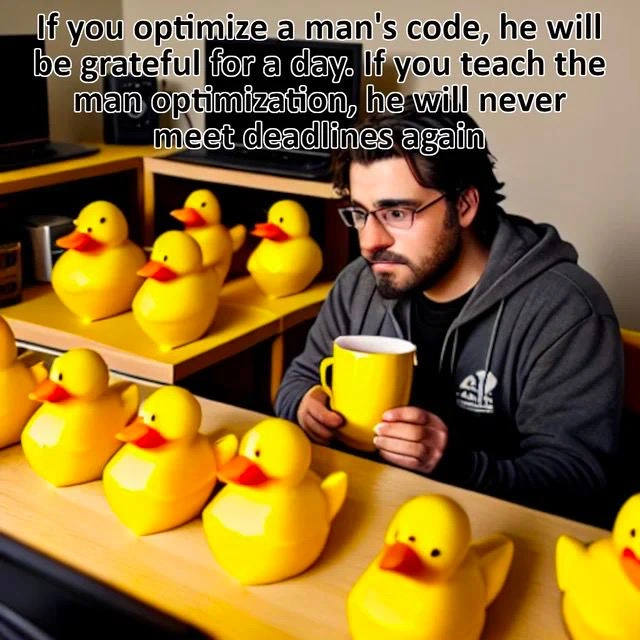
Let's break this meme down in plain terms. The image shows a programmer at his desk with an army of rubber ducks lined up in front of him and more on the shelf behind. He's holding a yellow coffee mug and looks deep in thought. That detail with the ducks is actually referencing something in programming culture: rubber duck debugging. This is a simple but famous troubleshooting technique where a developer explains their code, line by line, to an inanimate object (often a little rubber duck) as if the duck is a student or coworker. The idea is that by teaching or verbalizing the code out loud, the programmer might spot mistakes or find a solution on their own. It works because explaining something step-by-step forces you to slow down and examine it carefully. Usually, one duck is enough for this trick — the meme exaggerates it with many huge ducks to make it funny and to show just how deep into debugging or thinking this developer is.
Now, the text on the meme is a play on an old saying: "Give a man a fish, and you feed him for a day. Teach a man to fish, and you feed him for a lifetime." In the context of programming, they've replaced fishing with code optimization. Code optimization (also known as performance optimization) means making code run more efficiently – for example, run faster or use less memory. So the caption reads: "If you optimize a man's code, he will be grateful for a day. If you teach the man optimization, he will never meet deadlines again." Let's unpack that. The first part is saying if you do the work for someone (make their code better/faster for them), they'll be happy that day. The second part says if you teach them how to do it themselves, they'll get so absorbed in doing this optimization everywhere that they won't finish their work on time anymore.
Why would that happen? Well, once a programmer learns how to squeeze more speed out of code, it can become a bit of an obsession. Imagine a newbie developer who just discovered how to make a program run twice as fast by using a clever trick. That excitement can lead them to try improving everything they touch. It's like a kid who learns a new magic trick and then wants to use it on every single thing – even when it's not needed. In coding, there's a known warning about "premature optimization," which means trying to optimize code too early or without good reason. It’s considered a bad habit because you might spend a lot of time on small improvements that don't actually help the project much. For example, a programmer might spend hours making one function run in 0.1 seconds instead of 0.15 seconds, even though that function is rarely used. Meanwhile, a more important feature or bug fix gets delayed during that time.
Deadlines are the due dates or final dates by which projects or tasks must be completed. In software development (or school projects, or any work with a schedule), if you keep polishing and polishing your work, you risk missing the deadline. So there's always a balance: make the code good, but also finish it in time. The joke in this meme is that by teaching someone how to optimize code (a seemingly good skill), you might actually distract them so much with constant tweaking that the project’s schedule falls apart. The phrase "never meet deadlines again" is hyperbole (an exaggeration) to emphasize that they'll be perpetually late because they're stuck in optimization mode.
The combination of the serious-looking developer with his coffee and all those silly giant ducks makes the situation humorous. It suggests he's super focused, possibly overthinking or over-debugging every little detail. Coffee is the fuel of choice for many programmers, especially when working long hours, so that mug fits the stereotype. The ducks all lined up and "listening" make it look like he's holding a class on optimization techniques for the ducks. Meanwhile, the caption sets us up with a wise proverb style but then delivers a punchline: instead of a lifetime benefit, the poor guy ends up never finishing on time.
For someone just starting out in development, the takeaway is: yes, making code faster or more efficient is cool and important sometimes, but you have to know when to stop. If you try to optimize everything without thinking, you could waste a lot of time. It's often better to write code clearly and make sure it works first, and only then improve the parts that are actually slow or critical. And if you find yourself talking to a whole row of rubber ducks, you might be overdoing it (usually one duck is plenty!). The meme uses those bright ducks and a twist on a common saying to poke fun at how easily programmers can get carried away with something that's supposed to help, turning it into a hindrance for their productivity if taken too far.
Level 3: Optimizing into Oblivion
Experienced developers chuckle at this meme because it nails a well-known pitfall in software projects. We've all seen it (or lived it): a programmer learns the wonders of code performance tuning and suddenly every line of code becomes a target for improvement. That one innocent lesson in optimization turns into an all-consuming premature optimization spree. Instead of focusing on building new features or finishing the task at hand, the developer is benchmarking different sorting algorithms, tweaking recursion into iteration, and replacing perfectly fine code with clever one-liners—all in the name of speed.
The humor comes from the absurd but familiar scenario: give a developer a small performance fix and they're happy briefly, but teach them the techniques to optimize, and they'll sink days or weeks chasing microseconds. It's a parody of the proverb "Give a man a fish... teach a man to fish...," flipped on its head for programmers. Here, the "lifetime supply of fish" becomes a lifetime habit of tinkering under the hood. The meme's caption says:
"If you optimize a man's code, he will be grateful for a day. If you teach the man optimization, he will never meet deadlines again."
This playful twist encapsulates the optimization vs deadline tradeoff every seasoned engineer knows too well. Once the dev has tasted the thrill of making code run faster, everything else (like, say, delivering the project on time) starts to feel secondary.
Look at the developer in the image: he's clutching a big yellow mug, surrounded by an almost comical number of rubber ducks. This is a nod to rubber duck debugging, a troubleshooting method where you explain your code out loud to a rubber duck to find bugs or logic errors. In practice, most developers keep one duck by their desk as a sounding board. But this guy has an entire battalion of ducks! It's exaggerated for effect, suggesting he's so deep into analysis and fine-tuning that he needs a whole committee of ducks to bounce ideas off. It's as if each duck is being taught an optimization lesson too. The scene screams "intense focus" – he’s in performance-tweaking mode, possibly explaining every micro-improvement to his inanimate yellow assistants. Meanwhile, you can almost hear his project manager in the distance, biting their nails as the deadline looms.
From a senior perspective, this image is painfully relatable. It's common to see a well-intentioned developer get obsessed with optimization and lose sight of the bigger picture. Sure, their code might run 10% faster now, but the feature freeze was last week and the team is left scrambling. The internal monologue goes something like: "Just one more tweak... I can make this function run in 0.005 seconds instead of 0.01!" – all while the QA team is waiting and stakeholders are asking for the new feature. It's a classic case of mismatched priorities. Deadline pressure is mounting, but the developer is in the zone, chasing performance perfection.
There's also an implicit commentary on developer productivity. On paper, teaching someone optimization should make them more effective—who wouldn't want a team that writes high-performance code, right? Yet in reality, there's a thin line between useful optimization and time-wasting nitpicking. High-performance code is great, but not if it means missing every project deadline. Seasoned engineers have learned (often the hard way) that it's crucial to balance optimization with actual delivery. They might chuckle at this meme because it reminds them of times a project was delayed by someone (maybe even themselves) refactoring code obsessively for speed, or rewriting a working module in C "because it might be faster," while the launch date slipped further away.
The meme highlights that tension with a hearty dose of irony. By teaching the "man" optimization, you unleash his inner perfectionist. The result: endless cycles of profiling and refactoring, and a timeline that's shot to pieces. It's funny because it's true—many of us have had a moment where we realized we've spent half a day making a function run 5% faster when no user would have noticed the difference, and meanwhile the real work slid behind. The combination of the wise-sounding proverb format and the ridiculous image of a developer literally surrounded by rubber ducks makes the lesson clear: Focus too much on low-level optimizations, and your schedule will quack under the pressure. The seasoned dev reading this is likely nodding and laughing, remembering how they now often caution newbies: "Make it work, make it right, then make it fast — and please, not all at once!"
Level 4: The Root of All Evil
In software engineering lore, premature optimization is the root of all evil – a famous admonition by Donald Knuth reminding us that focusing on micro-level performance too early can backfire. Once a developer is taught the dark arts of code optimization, they may dive into the depths of algorithmic fine-tuning at the expense of everything else. This is humorous precisely because it's grounded in truth: the moment one learns how to shave off microseconds in code, there's a temptation to optimize everything, whether it matters or not.
From a theoretical perspective, teaching someone optimization unleashes a Pandora’s box. They start scrutinizing every loop and memory allocation as if chasing the last nanosecond. Yet algorithmic complexity theory tells us that big improvements come from better algorithms, not minor tweaks. Improving an algorithm from O(n^2) to O(n log n) yields massive gains, whereas hand-optimizing a single loop (say, using bit shifts instead of multiplication, or unrolling loops manually) typically only affects constant factors. It's the classic scenario: an unoptimized quicksort (average O(n log n)) will still outrun a meticulously optimized bubble sort (O(n^2)) on large inputs, no matter how much assembly magic you apply to the bubble sort.
There's also Amdahl's Law from parallel computing, which applies generally to optimization: it states that the maximum speed-up of a system is limited by the portion that cannot be improved. In plain terms, if only 10% of your code is actually slow (the true bottleneck) and you turbo-charge that part to be instant, the overall program can at best be ~10% faster. Optimize the wrong things, and you'll see negligible overall benefit. But an over-enthusiastic optimizer might not realize they're burning weeks polishing code that isn't even on the critical path. The result? The code might run 5% faster, but the project timeline runs 50% slower.
Modern computing systems add another twist: CPUs, compilers, and runtimes are incredibly good at optimization on their own. Just-in-time (JIT) compilers, out-of-order execution in CPUs, and advanced compiler optimizations often already handle low-level improvements. Sometimes, a naive-looking high-level code will be auto-tuned under the hood. If a freshly taught optimizer isn't careful, their manual micro-optimizations might conflict with these systems. For example, overly clever bit-math tricks can confuse the CPU's branch predictor or prevent auto-vectorization, ironically making the code slower on modern hardware. There's a rich irony here: the newly enlightened programmer, armed with textbook tricks, might actually undermine performance by second-guessing the compiler.
So at this deep technical level, the meme captures a real performance paradox. Knowing how to make code blazingly fast in theory can lead to an obsession with doing so everywhere. It's a bit like a physicist with a new formula who tries to apply it to every problem in the universe, even when it's not applicable. The academic wisdom is clear: optimize only after profiling and only where it truly matters. But as the meme jokes, once you open that optimization floodgate for someone, it's hard to close it. They now see endless possibilities to tweak and improve, like a mathematician chasing an ever-smaller epsilon. Thus, the surest way to derail a schedule is indeed to invoke this optimization obsession – an almost inevitable outcome given human nature and the laws of computing. It’s as if efficiency pursuits will consume all available time (see also: Parkinson's Law, where work expands to fill the time available). In summary, at the theoretical level, the meme humorously alludes to how the pursuit of perfect performance can conflict with fundamental limits and project management laws, making it nearly axiomatic that deadlines will be blown.
Description
The image shows a male developer with glasses and a grey hoodie, holding a yellow mug and staring intently at his desk, which is covered in numerous yellow rubber ducks. This visual setup strongly alludes to the 'rubber duck debugging' technique. An overlaid text presents a parody of a well-known proverb: 'If you optimize a man's code, he will be grateful for a day. If you teach the man optimization, he will never meet deadlines again'. The technical humor satirizes the concept of premature optimization. It highlights the common scenario where a developer, once introduced to performance optimization, becomes obsessed with perfecting code efficiency, often losing sight of practical project goals and deadlines. This creates a conflict between engineering perfectionism and the business necessity of shipping features, a relatable tension for experienced developers
Comments
7Comment deleted
The three stages of developer growth: 1. Making it work. 2. Making it fast. 3. Realizing you spent three weeks optimizing a cron job that runs once a month and the product manager doesn't care
Each duck marks a micro-optimization that saved 0.1% CPU; fifty ducks later we’re still I/O-bound and the release board is quacking about Amdahl’s Law
After 20 years in tech, I've learned the real optimization is knowing when your O(n²) solution that ships today beats the O(log n) solution still being debated in next quarter's architecture review meeting
Ah yes, the classic senior engineer dilemma: do you spend 15 minutes fixing their O(n²) loop, or spend 2 hours teaching them Big O notation and watch them spend the next sprint refactoring the entire codebase to squeeze out microseconds while the product backlog grows exponentially? It's the engineering equivalent of Pandora's box - once they discover profiling tools and understand cache locality, suddenly every feature estimate needs to account for 'architectural improvements' and 'performance considerations.' The rubber ducks have seen this story play out countless times
Teach a dev optimization amid rubber ducks, and watch Big O turn their sprint into an eternal asymptote
One rubber duck fixes bugs; a raft of them forms Raft and blocks the release until we shave another 3µs off p99
Give a dev a micro‑optimization and you save 5 ms; teach them cache lines and branch prediction and they’ll spend two sprints aligning structs to 64 bytes while the roadmap accrues compound interest