One does not simply merge into production...
Why is this Testing meme funny?
Level 1: What Could Go Wrong?
Imagine a kid baking a cake for the first time. He’s super excited because it’s a shiny, yummy cake. The oven dings, and the cake looks brown on the outside, so he thinks, “It’s probably done. I want to show it off now!” His friend sees him about to take it out and serve it and says, “Maybe we should check if it’s fully baked – like poke it with a toothpick or taste a little piece first?” That’s the sensible voice saying, “Let’s test it before we give it to everyone.” But the kid is impatient and replies, “Nah, it looks great. I’m sure it’s fine!” He skips the test, puts the cake on the table, and cuts big slices for all their friends. And oh no… the inside of the cake is gooey raw batter! 😖 The outside fooled him, and now everyone has sticky dough instead of cake. Some might even get a tummy ache because raw batter isn’t exactly good for you.
This is funny in a face-palming way because the kid could have easily avoided the mess by just taking a moment to check the cake. But temptation – the cake smelling so good and the excitement to eat it – made him ignore the warning. We’ve all been that kid at some point, so eager to enjoy something new that we skip the safety step. In the meme’s story, the developer is like that kid, the friend yelling “test it first!” is the cautious buddy, and the untested code deployed for everyone is the half-baked cake. The humor comes from recognizing that feeling of reckless excitement and its predictable flop. It’s basically saying: skipping the “let’s make sure it’s safe/ready” step can turn a sweet idea into a sticky disaster – a lesson even a child can understand.
Level 2: Cast It Into Test
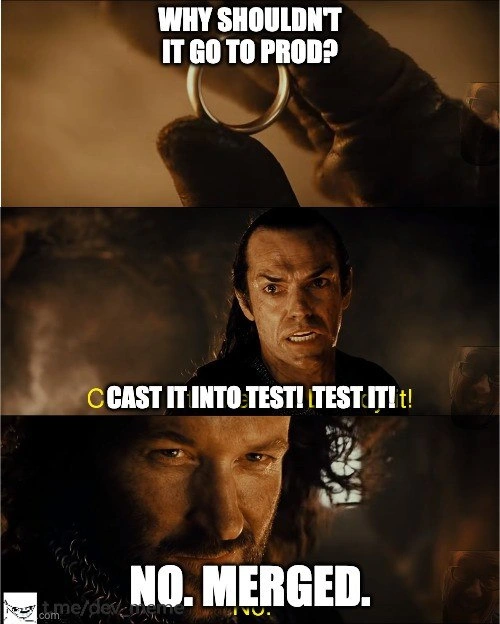
At its core, this meme is comparing deploying untested code to production with a famous moment from The Lord of the Rings. Let’s break it down in simple terms. In software development, Production (prod) is the live environment where real users interact with your application – it’s like the real world for your code. A test environment, often called staging or QA, is a safe playground that mimics production where you’re supposed to try out new code to make sure everything works correctly before it goes live. In the meme, when the character shouts “Cast it into test!”, he’s essentially yelling, “Put that code in a test environment! Test it!” This is the sensible advice that any experienced developer or QA engineer would give: don’t deploy directly to prod without testing.
Now, why the dramatic imagery? The meme maker used scenes from the Lord of the Rings (LotR) movies. In the actual movie, a council is debating how to deal with an all-powerful but dangerous Ring. The wise choice (destroy the Ring in Mount Doom) is analogous to doing the right thing in software: thoroughly testing code or discarding a risky change. The tempting bad choice (keep the Ring for oneself) is like a developer saying, “Eh, I’ll just deploy this untested code, it’ll be fine.” The top text in the meme, “WHY SHOULDN’T IT GO TO PROD?”, is written in bold caps to mimic a character (akin to Boromir from LotR) eagerly suggesting to use the Ring’s power. Translated to our world, it’s a developer or manager insisting, “Let’s push this new code live now.” It’s the classic overconfidence or pressure speaking.
In the second panel, another character (Elrond in the movie, here representing the team’s voice of reason) basically says: “No! Don’t do it! Test it first!” — “Cast it into test!” instead of the original movie line “Cast it into the fire!”. He’s urging them to throw that code into a testing phase (the fire of Mount Doom symbolically) so any bugs can be discovered and fixed. That’s standard best practice in development: you validate changes in a controlled environment. When he says “Test it!” twice, it humorously emphasizes how obvious and important this step is. It’s as if he’s shouting, “For goodness’ sake, test it, you fools!” (In fact, Gandalf in LotR says “Fly, you fools!” in another scene – here the vibe is similar.)
Finally, the bottom panel shows a character who replies, “No. Merged.” In the movie, this was the moment a human king refuses to destroy the Ring by simply saying “No,” and walks away with it. In the tech parody, the character has foolishly merged the code into the main branch (usually merging to main or master branch), which often triggers a deployment to production. “Merged” is a term from version control (like Git) meaning you’ve integrated your changes into the central codebase. It usually signals the code is on its way to production if you’re practicing continuous deployment. By saying “No. Merged.”, this person is ignoring the advice and going ahead with the release. It’s the ultimate ** last-minute deploy** decision that everyone else feared.
So the meme is a dialogue every developer team can imagine:
- Impatient Developer: “Why can’t we just deploy this new feature right now?”
- Wise Team Lead/QA: “We haven’t tested it properly! Put it in the test environment first!”
- Impatient (or Overconfident) Dev: “Nope, I merged it already.” 😱
The reason this is funny in a dark way is because everyone in software knows deploying untested code is a terrible idea, yet it still happens often. Maybe there’s a tight deadline, or managers are pushing, or someone is overly sure that nothing will go wrong. This causes release anxiety for the team – people get nervous because once the code is live in production, any bug can cause real user complaints, break features, or even crash the system. We call these Production issues when things break on prod. They can be anything from a minor glitch to a major outage. And guess what often causes them? Code that wasn’t tested enough.
Let’s clarify some of the terms and why they matter:
Untested code: Code that hasn’t been verified by automated tests or by a QA team. It’s like a car that nobody test-drove — maybe it’ll run, maybe the wheels fall off on the highway. Without tests, you just don’t know what could go wrong. Developers write unit tests (small tests for individual pieces of code) and integration tests (tests that check how different parts work together) to catch bugs before the code gets to users. Skipping this step is asking for trouble.
Production environment (Prod): This is the “real” application environment with actual customers or users. For example, if you have a web app, the production is the live website. If it’s an app, production is the version people have on their phones. In production, data is real and stakes are high: a mistake can lose money or user trust. That’s why changes to production are usually done carefully, often with a deployment pipeline that includes building the code, running tests, and maybe a manual approval before going live.
Test environment (Staging): A separate, safe environment that mimics production. Think of it as a dress rehearsal stage. We deploy new code to staging first, where testers and developers can play with it to see if anything breaks or if it behaves unexpectedly. If the code crashes or corrupts data in staging, it’s not a big deal because it’s not “real” user data; we find the bug and fix it, and users never see the problem. This environment is critical for catching issues early. When the meme says “Cast it into test!”, it literally means put the code in staging (or run the test suite) to ensure it’s not evil 😈 (i.e., full of bugs) before letting it near real users.
Merged: Using a version control system like Git, developers often work on separate branches (say a feature branch for a new feature) and then merge their changes into the main branch (often called
mainor previouslymaster). Merging is the moment those changes become part of the official codebase. Many teams have it set so that merging intomainwill automatically kick off a deployment to production (continuous deployment). That’s why “Merged” in the meme is effectively saying “Deployed to prod”. It’s the point of no return (well, you can rollback, but it’s a headache). A merge done without testing is like lighting a fuse on a bomb—you hope it’s a dud, but it could blow up in your face.
For a junior developer or someone new to this, the meme is a cautionary tale wrapped in humor. DeploymentHumor like this might make you chuckle, but it also carries advice: always test your code changes. If you ask any experienced dev about pushing untested code to production, they’ll likely cringe and share a war story. Maybe they brought down an entire website at 2 AM because of a silly bug that a simple test would have caught. Or they hurried a patch without running it on staging and ended up causing even worse issues — the classic “fix one thing, break two others” situation. These stories are so common that they turn into CodingHumor memes, as a way for developers to laugh off the pain and remind each other of best practices.
The Lord of the Rings reference just makes the message more epic and nerdy (which developers love). The Ring in LOTR is a metaphor here: in the story, the Ring corrupts those who hold it, encouraging them to do foolish things. Untested code in a developer’s hand has a similar seductive danger: it whispers “It’s fine, just deploy me, think of the glory!” even though it might be full of hidden bugs (corruption) that will cause chaos. The dramatic “No. Merged.” at the end is funny because it’s so blunt — imagine someone in a meeting just saying “Nope, I did it anyway” after being told not to. It’s infuriating in real life, but as a meme it’s amusing because we can picture the face-palm reactions.
In short, this meme is highlighting TestingHumor and ReleasePressure in one package. For a newcomer: always remember the lesson here. When someone says “Why shouldn’t it go to prod?”, there are many reasons: it hasn’t been tested, it could break things, and it’s better to be safe than sorry. “Cast it into test!” is sage advice: test your work in a non-prod environment or at least run your test suite. And if you ever hear yourself saying “No. Merged.” without testing... well, be prepared to deal with the possible fallout. As the saying often goes in development circles (playing on another LOTR meme): “One does not simply deploy untested code to production.” 🔥💻
Level 3: One Merge to Doom All
The meme evokes a deployment disaster waiting to happen, wrapped in an epic Lord of the Rings reference. In the top panel, a developer clutches a glowing commit (the “One Ring” of untested code) and boldly asks, “Why shouldn’t it go to prod?” This is the battle-scarred scenario every senior engineer recognizes: the irresistible allure of pushing code directly to Production despite that nagging voice of reason. In the second panel, the voice of a wise architect (an Elrond-like figure in this drama) is effectively yelling, “Cast it into test! Test it!” – a desperate plea to throw that code into a testing environment (Mount Doom for code) and verify it before it can wreak havoc. The final panel delivers the punchline: a stubborn character flatly declaring, “No. Merged.” instead of destroying the ring. It’s the digital equivalent of Isildur keeping the Ring – a shortsighted decision sealing one’s doom.
This humor strikes a chord because it caricatures a real-world deployment anti-pattern. We’ve all seen the scenario: a last-minute feature lands on Friday evening, there’s release pressure to deploy, and someone says, “It works on my machine, let’s ship it.” Everyone in the room feels the dread, much like the Council of Elrond watching man’s folly. Skipping tests and pushing unvalidated changes to production is the software equivalent of putting on Sauron’s Ring – terribly tempting but bound to end in chaos. The meme frames this as a dramatic fantasy moment, which is hilarious because deploying untested code actually can have dire consequences (just not as cinematic as orcs overrunning Middle-earth). The wise counsel “Cast it into test!” is what seasoned developers yell inside their heads whenever a gung-ho teammate or manager suggests an overnight launch with zero QA. And yet, time and again, the dark spell of “just deploy it now” wins out, resulting in 3 AM outages and pager alerts summoning the development fellowship to clean up a disaster in Mordor—I mean, production.
Why is this scenario so relatable? Because it satirizes the eternal tug-of-war between fast releases and safe releases. In theory, modern teams set up guardrails: CI/CD pipelines with automated test suites that fail a build if tests don’t pass, code review processes, staging deployments, etc. These are supposed to be the elven ropes that keep us from falling into the volcano. But under the influence of the “One Ring” (tight deadlines, overconfidence, or managerial pressure), those safeguards get bypassed. It’s common in some crunch-time deployments to see something like:
# Building and deploying the code without running any tests (yikes!)
$ mvn clean install -DskipTests && kubectl rollout restart deployment/prod-backend
# ^^^^^^^^^^^^
# Using the "skipTests" flag here is basically wielding a cursed ring of power
In the snippet above, -DskipTests is the temptation made explicit: a flag to skip running the test suite for a faster build. It’s a real-life command that has likely caused many a production issue. A veteran engineer looks at that and hears the same words as the meme: “Why shouldn’t it go to prod?” – because in the short term, skipping tests seems to save time and get that shiny new feature out. But, just like the Ring’s corrupting influence, the hidden bugs in untested code inevitably surface once deployed, binding the team in a period of darkness (a.k.a. emergency bug-fixing).
The emotional core for senior developers is a mix of dark humor and PTSD. We’ve been in war rooms after an outage caused by that one merge that should never have gone live. This meme nails the absurdity: deploying untested code is so perilous it’s as if a character in Middle-earth chose personal power over the fate of the world. It’s DeploymentHumor with a sting of truth. The phrase “No. Merged.” encapsulates the fatal mistake — akin to “No, I will not throw the ring away; I’ll use it.” And we all know how that ends: Sauron’s evil (or in our world, endless production issues) comes roaring back.
From an organizational perspective, this pattern persists because of poorly aligned incentives and human nature. Release anxiety should encourage more testing, but often the anxiety of missing a deadline or being scooped by a competitor is greater. Management might reward getting features out ASAP, so engineers feel pressured to cut corners. There’s also a bit of hubris: a developer might truly believe their code is perfect since it passed basic smoke tests locally (“Works on my machine!” syndrome). Plus, sometimes companies lack a robust staging environment or proper QA staff – so they rationalize deploying to prod as “the real test.” It’s a classic trade-off: speed vs. safety. Skipping straight to production is faster… right until something blows up. After that, all the time saved is paid back tenfold in firefighting, customer apologies, and sleepless nights. As the cynical saying goes, “We don’t have time to do it right, but we’ll always find time to do it over.”
The LOTR analogy adds a layer of geeky hilarity. The Ring “wants to be found” – just like untested code wants to find its way to unsuspecting users. An engineer under the Ring’s influence might say, “Our code has no known bugs, so let’s deploy now and test in production.” That phrase “test in production” is practically invoking dark magic in the developer world. It’s something you do in chaos engineering experiments, not for ordinary feature releases. Yet we’ve all either done it or been one bad decision away from doing it. It’s funny because it’s dangerously true. The meme’s final panel, “No. Merged.”, is delivered with the gravitas of a hero succumbing to evil – and every seasoned dev cackles (or groans) because they recall a real deploy where somebody essentially said those exact words, and everyone’s fate was sealed for a rough weekend.
In summary, this meme resonates on multiple levels of developer experience. It highlights the absurd confidence of thinking “nothing will go wrong”, the ignored wisdom of seasoned engineers advocating testing, and the inevitable reckoning when reality strikes back. It wraps a common IT folly – deploying untested code – in the grand drama of a beloved fantasy saga. And unfortunately, in the real world, there are no elves or wizards to save us when we’ve merged something we should have tested; we only have ourselves, our rollback plans, and hopefully a recent backup. One does not simply push untested code to production… except, as this meme dryly notes, we too often do. And that’s why experienced devs smirk and cringe in equal measure at this joke: we’ve all carried the Ring at one time or another, and it never ends well.
Description
This is a three-panel meme that uses a dramatic scene from the movie 'The Lord of the Rings: The Fellowship of the Ring' to illustrate a common software development conflict. The first panel shows a close-up of the One Ring being held, with the superimposed text asking, 'WHY SHOULDN'T IT GO TO PROD?'. This represents a developer eager to deploy their new code. The second panel features the character Elrond looking stern and urgent, commanding, 'CAST IT INTO TEST! TEST IT!', humorously altering his original line 'Cast it into the fire!'. This role embodies a tech lead, senior developer, or QA engineer insisting on proper procedure. The final panel shows the character Isildur with a defiant expression, simply stating, 'NO. MERGED.'. This represents the original developer ignoring the advice and merging the code directly, mirroring Isildur's failure to destroy the Ring. The meme effectively satirizes the tension between the temptation to ship code quickly and the critical need for testing. It’s a relatable scenario for any developer who has witnessed someone bypass the software development lifecycle (SDLC) and push untested changes, often with disastrous consequences
Comments
7Comment deleted
Some code is so precious you can't just cast it into test. You have to walk it all the way to production and merge it, ignoring the advice of the entire council of Elrond
Untested code is the One Ring of the CI pipeline: it promises velocity in sprint planning, invisibility during review, and a 3 AM trek to Mount PagerDuty for whoever sends it into Mordor - sorry, production
After 15 years in the industry, you realize the real precious isn't the code that passes all tests - it's the code that somehow works in production despite never being tested, living rent-free in your head during every incident review while you explain why 'it worked on my machine' isn't a valid deployment strategy
The One Ring of deployment strategies: forged in the fires of Mount Prod, it promises ultimate velocity but corrupts all who wield it. Senior engineers know that 'testing in production' isn't a deployment strategy - it's a cry for help. Yet like Isildur before us, we've all had that 3 PM Friday moment where merging directly to main seemed like the path of least resistance. The ring whispers 'the tests are probably fine' and 'it's just a small change,' but we know how this story ends: not with the destruction of the ring in the fires of proper CI/CD, but with a 2 AM PagerDuty alert and a very awkward post-mortem
“I tested it” without a merge is Schrödinger’s release - simultaneously done and undeployable until the approval gate collapses
"I tested it" is Schrödinger's QA: true until the merge train observes it in prod
Elrond pushes for tests; Gandalf merges master - because nothing says 'reliable microservices' like a 3AM Balrog in prod