Bug Outlived By Product Failure
Why is this Bugs meme funny?
Level 1: Problem Ate Problem
This meme is like worrying that your toy car has a broken wheel, then finding out the whole toy is being thrown away. You did not fix the wheel, but you also do not have to worry about it anymore. The funny feeling is relief mixed with guilt, because the small problem vanished only because a much bigger problem happened first.
Level 2: Bigger Failure Wins
A bug is a defect in software: the program does something wrong, crashes, loses data, shows incorrect information, or fails a user in some other way. A critical bug is serious enough to threaten an important workflow, customer trust, security, or revenue.
Normally, developers fix bugs by reproducing the problem, finding the cause, changing the code, adding tests, and releasing the fix. That process can take time, especially if the bug only happens under specific conditions or sits inside old, complicated code.
The meme's caption says the product fails before the developer can fix the big bug. That means the larger product, feature, or business situation collapses first. Maybe users stop using it. Maybe the feature is canceled. Maybe management changes direction. Maybe the company decides the product is not worth maintaining. Once that happens, the bug no longer matters in the same way because the thing containing the bug is gone.
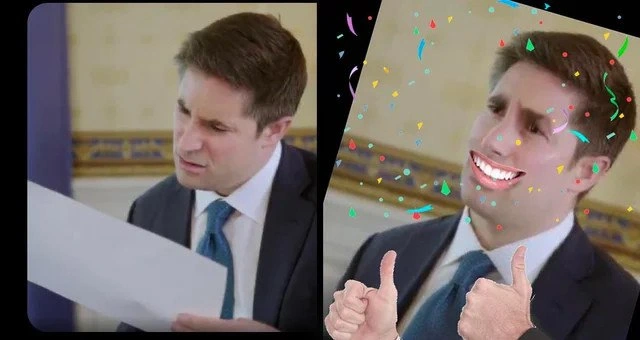
This is funny because it reverses normal priorities. Usually a big bug is the emergency. Here, the emergency is overtaken by an even bigger failure. The developer goes from worried in the left image to happy in the right image because the problem was removed from their responsibility without actually being solved.
The humor is dark because this is not a good engineering outcome. A product failing is bad. An important bug going unfixed is also bad. But people still understand the relief of one painful task disappearing from the backlog. It is the workplace version of being saved from a hard exam because the school building closed.
Level 3: Decommissioned Defect
The image has no visible caption inside it, which is part of why the metadata line does so much work:
When the product fails before you have a chance to fix the "big bug"
The left panel shows a suited man looking down at a document with a concerned, skeptical expression. That is the moment a developer reads the bug report, incident note, or reproduction steps and realizes the defect is not cosmetic. The right panel edits the same man into celebration mode: enormous smile, thumbs up, confetti falling. The face says what the ethics training politely will not: the bug did not get fixed, but it also stopped mattering.
The joke lives in the guilty relief of a CriticalBug being neutralized by a larger failure. In a healthy engineering culture, serious bugs get triaged, prioritized, fixed, tested, and released. In a messier reality, priorities compete with product-market fit, runway, leadership changes, feature churn, sales commitments, and the product's basic ability to justify its own existence. If the feature is canceled, the product is sunset, or the startup runs out of customers, the bug's blast radius collapses to zero. Not because anyone performed heroic debugging. Because the battlefield got paved over.
This is why the reaction edit is funny and bleak. The right panel's confetti is not pride in craftsmanship. It is risk removal by extinction. The cleanest fix for a broken user journey is apparently removing the users, which is the kind of solution architecture only a quarterly planning meeting could love.
Real teams see versions of this all the time:
- A nasty checkout bug disappears because the whole payment experiment is abandoned.
- A scaling problem never arrives because adoption stalls.
- A security concern gets deprioritized because the integration is shut down.
- A mobile crash becomes irrelevant when the app version is forcibly retired.
- A backend migration bug is "solved" when leadership cancels the migration and calls it focus.
The deeper satire is about incentives. Engineers are taught to care about correctness, reliability, and long-term maintainability. Organizations often reward visible delivery, revenue movement, and avoiding uncomfortable conversations. So a developer may feel professionally obligated to fix the "big bug" while also feeling human relief when business failure quietly removes the task from the queue. That is not noble, but it is recognizable.
This meme fits StartupLife especially well because startups can turn existential whiplash into backlog management. Yesterday the bug was a blocker for launch. Today the launch no longer exists. Tomorrow someone will ask whether the abandoned code can be reused in the new pivot. That distant rumbling sound is the bug, surviving in a different repository under a more optimistic name.
Description
The image is a two-panel reaction meme with no visible text. On the left, a suited man studies a document with a confused or concerned expression; on the right, the same image is edited with a huge smiling mouth, thumbs up, and falling confetti. The sibling metadata caption says "When the product fails before you have a chance to fix the \"big bug\"." The developer joke is the guilty relief of a serious defect becoming irrelevant because the product, feature, or startup collapses before the bug can reach its expected blast radius.
Comments
1Comment deleted
The cleanest bug fix is a decommissioned user journey.