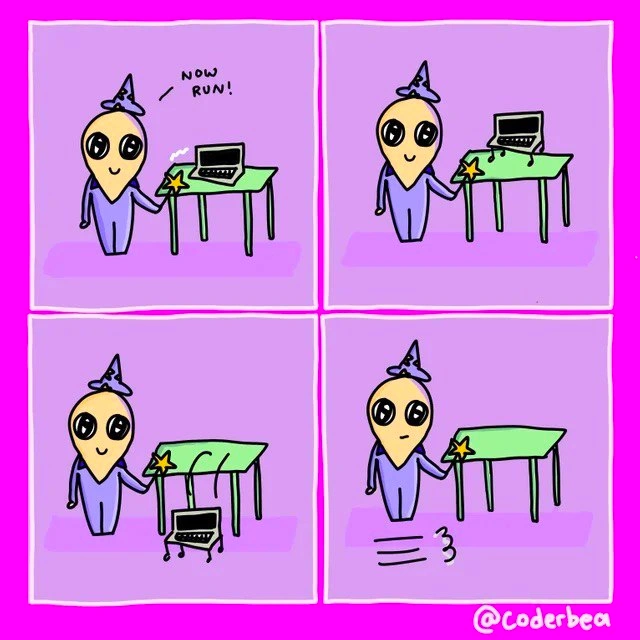
When the 'run' command is taken too literally
Why is this Bugs meme funny?
Level 1: Laptop with Legs
Imagine you tell your toy robot, “Go ahead and run!” You expect it to start its program or maybe roll across the floor. But instead, the robot suddenly grows legs and sprints out the door! You’d be left standing there, wand (or remote) in hand, eyes wide, wondering what just happened. That’s exactly the silly feeling this cartoon shows. The wizard (like a kid playing with a magical gadget) said “Run” meaning “start working”, but the laptop thought, “Okay, time to literally run!” and zoomed away. It’s funny because it’s a huge misunderstanding. We don’t expect a computer to act like a person or a pet that runs away, right? When the laptop jumps off the table and dashes off, the poor wizard is surprised – he didn’t mean run away, he just meant do your job! This is like if you told your friend to “run off and do your homework”, and they took it so literally that they actually ran out of the room and disappeared. The humor comes from that mix-up between what was said and what was meant. Even a kid can laugh at the idea of a running computer because it’s so goofy and unexpected. The core feeling is something we all know: sometimes, things (or people) don’t do what we expect, and it can be both baffling and comical. In the end, the wizard and his empty table make us giggle, because we’ve all had moments where we give a simple instruction and get a wildly unexpected result – though hopefully not our laptop growing legs and escaping!
Level 2: The Running Laptop
Let’s break down the joke in simpler terms. In programming, to “run” code means to execute the program – basically, start it up and let the computer follow the instructions you wrote. We use the word “run” so often (e.g. “Run your script” or clicking the Run button in an IDE) that it becomes second nature. This meme takes that word literally. Instead of the code running (executing) inside the computer, the laptop itself runs away! The cartoon shows a cute little laptop growing legs and sprinting off. That’s obviously not something that happens in real life – it’s a visual pun. The programmer is drawn as a tiny alien wizard with a wand, which is a fun way to depict a developer. Sometimes coding does feel like wizardry for beginners: you write some mysterious symbols and poof, things happen on the screen. Here, the wizard says “Now run!” like he’s casting a spell to make the program go. But to his surprise, the whole computer misunderstands the command.
Why is this funny to developers? Because it captures a feeling we all recognize. Often, especially when you’re new, you’ll try to run your program and something unexpected happens. Maybe nothing visible happens at all, or an error flashes and the program closes immediately. It’s as if the code refused to cooperate. In the meme, the code “refusing to cooperate” is shown as the laptop literally jumping off the table and escaping. It’s a way to express “my program didn’t do what I wanted” in a joking, exaggerated manner. We call these problems bugs – errors or mistakes in the code that cause it to behave in weird ways. Every programmer, from a newbie writing their first Python script to an expert with decades of experience, has encountered bugs. Some are simple (like a missing semicolon causing a syntax error, so the code won’t run at all). Others are strange and hard to figure out – those can make you feel really frustrated or confused. This meme falls into the DeveloperHumor category because it takes that common frustration and makes it silly. The tags like RelatableDevExperience and DebuggingFrustration are there because, once you’ve tried coding, you know the exact scenario being joked about: you confidently hit “Run”, and then stare at your screen thinking, “Wait, what just happened? Where did my program go?”
The term Developer Experience (DX) mentioned in the categories is about how it feels to develop software. A good DX means your tools and code run smoothly, and you feel productive. A bad DX is when you’re stuck, things keep going wrong, and you’re frustrated. This cartoon shows a bad DX moment in a funny way – the developer did everything right (they wrote the code and told it to run), but the outcome was totally absurd. For a junior developer, it’s a lighthearted reminder that sometimes computers take things very literally. Unlike humans, who understand context and intention (usually), a computer will do exactly what your instructions tell it to do, not what you meant. Here of course, no one actually programmed the laptop to sprout legs – it’s just a joke. But it symbolizes those times when the program’s behavior feels utterly out of line with your intentions. The laptop_running_away and literal_run_command tags describe exactly that: the joke is about a literal interpretation of the “run” command, resulting in a laptop that actually runs. It’s an unusual bug scenario that makes us laugh because of how ridiculous it is. And the little alien wizard? That’s just the artist’s creative way (shout-out to coderbea for the cute artwork!) to represent a programmer – someone who might wish they had real magic to fix their bugs, but ends up just as stunned as our wizard when things go wrong.
Level 3: Code on the Run
In this whimsical meme, a robed alien wizard (our developer avatar) taps a magic wand on a laptop and confidently commands, “NOW RUN!”. This incantation is something every programmer recognizes – we hit Run expecting our code to execute. But here the code takes off literally: the laptop sprouts little legs and runs away off the table. It’s a brilliant play on the double meaning of “run” in a coding context. Developers often anthropomorphize their tools (who hasn’t yelled “please just work!” at a build?), and this cartoon cranks that up to 11 by giving the computer a mind of its own. The humor taps into a shared DeveloperExperience_DX moment: that absurd, exasperating feeling when your program does anything but what you intended. It’s a form of DeveloperHumor that’s instantly relatable – a mix of “Ha, my code actually did that once!” and “Yep, this is my life now.”
On a deeper level, the meme highlights how literal computers are, while flipping the script for comedic effect. In reality, code doesn’t grow legs, but it can “run away” in more subtle ways. Seasoned devs have seen processes spin out of control – think runaway memory leaks or a thread that goes rogue and maxes out the CPU. We jokingly call those unusual bugs “runaway processes”. Here that concept is visualized to the extreme: the program didn’t just misbehave, it bolted off-screen! Every senior developer chuckles (perhaps a bit darkly) at the times a simple run command led to chaos, like an app crashing instantly or a script that mysteriously exits without a trace. The empty table in the final panel perfectly captures that debugging frustration: one moment your code is there, the next it’s gone, leaving you staring at nothing, wondering “Where on earth did my program go?”. It’s the Bugs in our software that make us feel like the machine has a mind of its own. The wizard’s shocked expression is basically our face when a bug is so bizarre that it feels like the laptop just up and escaped.
There’s also a nod to the almost magical thinking developers sometimes resort to. The wizard motif playfully suggests that writing code can feel like casting spells or performing rituals. (Have you ever rubbed your lucky token or executed a build exactly the same way as last time, hoping for success? 🪄) The truth is, coding is very logical – computers do exactly what you program them to do, for better or worse. But when a bug thwarts our intentions, it’s like the code interpreted our instructions in the most perverse way. This meme exaggerates that idea: the dev said “run” meaning “execute the program,” but the code interpreted it as “run away.” It’s a classic misunderstanding trope applied to programming. The senior perspective here recognizes a bit of comic truth: there are days it genuinely feels like our code is actively trying to escape us. We laugh because if we didn’t, we might cry – but hey, at least our real laptops don’t literally grow legs (not yet, anyway).
# Pseudocode of the computer's literal interpretation (just for laughs):
command = "run"
if command.lower() == "run":
spawn_legs(laptop) # Uh-oh, gave the laptop actual legs...
laptop.run_away(direction="off_table") # ...and off it goes!
else:
execute_program(command) # What we *actually* wanted to happen
This short snippet imagines the comically impossible “bug” at play: the if check treats the run command as a cue to physically flee. Of course, in reality, our bugs are more about faulty logic than rebellious hardware. But any veteran engineer can relate to code behaving as if it had a will of its own. It’s this shared “WTF just happened?” experience that makes the meme so funny. By combining a coder’s literal instruction with a fantastical outcome, the joke lands well with those of us who wrestle with machines daily. We’ve all exclaimed something like, “It compiled, why won’t it run?!”, only to watch the program instantly close or freeze – a digital vanishing act. This cartoon distills that feeling into one absurd visual punchline. And as experienced devs, we nod, laugh, and maybe double-check that our code hasn’t actually leapt off the server rack.
Description
A four-panel comic strip with a purple background, drawn by @coderbea. In the first panel, a friendly alien character dressed as a wizard points a star-tipped wand at a laptop on a table and exclaims, 'NOW RUN!'. In the second panel, the wizard looks on with a pleased smile. The third panel shows the laptop sprouting legs and physically running off the table, with musical notes trailing behind it. In the final, fourth panel, the wizard stands alone by the empty table, looking bewildered and slightly disappointed. This comic is a visual pun on the term 'run' in programming, contrasting the technical meaning (to execute a program) with its literal, physical meaning. It humorously captures the feeling of code behaving in unexpected ways, as if by magic, a sentiment that resonates with developers at all levels who've seen their instructions lead to surprising outcomes
Comments
7Comment deleted
This is a classic feature, not a bug. The acceptance criteria never specified *how* it should run. The ticket is now closed
Told the new microservice to “run” and it immediately scheduled itself on every node in the cluster - nothing like watching your quarterly budget sprout legs and sprint across five availability zones
After 20 years in this industry, I've learned that '= 3' is the universe's way of telling you that your unit test passed but your integration test, production environment, and sanity are about to fail spectacularly
Every developer's workspace follows the second law of thermodynamics: entropy always increases. You start with a pristine desk setup, proper monitor height, ergonomic keyboard placement - then run your first build. Three hours later, you're on the couch with the laptop balanced on a pillow, the desk serving as an expensive plant stand. The 'NOW RUN!' moment is when you realize your carefully architected workspace has the same stability as a microservices deployment at 2 AM - theoretically sound, practically migrating to wherever gravity and comfort intersect
In imperative pipelines, shouting “run” is undefined behavior - the runner forks, execs, then exit()s with legs
Asked the app to run; it saw kubectl current-context=prod and triggered the only safe circuit breaker: it ran away
Classic side-effect hell: 'npm run start' and suddenly your rack is doing sprints