Brute-Forcing a Memory Leak, Taylor Swift Style
Why is this Bugs meme funny?
Level 1: The Leaky Bucket Trick
Imagine you have a bucket with a hole in it that’s slowly leaking water. Instead of patching the hole, you decide to pour in extra water continuously or use a bigger bucket so it takes longer to leak empty. For a little while, it looks like everything’s fine – the bucket stays full for the weekend – but the hole is still there, and water is still dripping out. Eventually, even the bigger bucket will run dry if you don’t fix the hole. This is exactly what the joke in the meme is about, but with a computer program. The program has a “hole” (it keeps losing track of memory, kind of like water leaking out). The quick fix was to just give the program more water (more memory/RAM) so it doesn’t “run dry” as quickly. The meme is funny because we all know that’s not really fixing anything – it’s just a sneaky way to hide the problem for a short time. It’s like cleaning your messy room by shoving everything into a closet: for the weekend the room looks clean, but open that closet door later and the mess tumbles out. In simple terms, the meme is joking that you can make bad, leaky code behave nicely for a little while by giving it extra help (more memory), but after a short time, the original problem will spill out again. The humor comes from recognizing this silly “fight the symptoms, not the cause” solution that, deep down, everyone knows can’t last – but hey, it works for the weekend!
Level 2: Quick Fixes vs Real Fixes
Let’s break down what’s happening in this meme in simpler terms. It’s poking fun at a programming problem called a memory leak. A memory leak is basically when a program keeps grabbing more memory from the computer and never gives it back, even though it’s done using it. Imagine an app that opens a new file or creates a new object every time you click a button but doesn’t close the file or discard the object when it’s finished – over time it’s hoarding tons of stuff in memory. Eventually, the program has taken so much RAM (Random Access Memory, the working memory of the computer) that there’s no space left, and things start to go wrong: the program slows down a lot or crashes. It’s a pretty common bug in software, especially in big, complex programs or in languages where the programmer manually manages memory (like C++). Even in languages like Java or Python that manage memory for you, you can leak memory by accidentally keeping references to things you don’t need anymore. The result is the same: memory usage just keeps growing.
Now, a proper way to handle a memory leak is to find and fix the bug in code. That usually means figuring out where the program is allocating memory without later freeing it. For example, if the program is reading user data and storing it in a list, maybe the bug is that it never clears that list after using the data. Fixing it might mean adding code to remove or null out old data once done. However, finding the exact spot of a leak can be tricky – developers often use tools like profilers or debuggers to trace what’s happening. It’s like detective work, looking for clues in logs or memory snapshots. It can take a lot of time and expertise to track down. This is where the idea of a quick fix or workaround comes in.
The meme’s top caption “adds more RAM to solve memory leak issue” describes a classic workaround: instead of fixing the code, you just give the program more memory to chew on. It’s literally saying, “Our app is leaking memory? Fine, let’s just put in more memory so it won’t run out so fast.” This is like if you have a bucket with a small hole leaking water, and your solution is to use a bigger bucket or keep pouring water in continuously – you’re not fixing the leak, you’re just delaying the moment it runs dry. In computing, adding more RAM is often as easy as upgrading your server or tweaking a setting in your cloud hosting to allocate more memory to the application. It’s something you can do quickly, especially if you’re in a pinch. The meme jokes that this tactic “makes the bad code good for a weekend.” In other words, the program will behave as if it’s fine (no crashes, decent performance) for a short time because the extra memory masks the problem. But it’s only for the weekend – come Monday (after some time passes), the leak will have gobbled up that new RAM too, and the problem will be back. It’s very much a temporary Band-Aid.
Let’s clarify some terms and tags here:
- MemoryLeaks: as mentioned, that’s when memory isn’t freed properly. It’s a big source of PerformanceIssues because as memory usage grows, everything can slow down (imagine your computer trying to juggle too many tasks at once with limited space). It can also outright crash programs.
- TechnicalDebt: this is a metaphor in software where doing something the quick-and-dirty way (instead of the right way) is like taking on debt. You didn’t “pay” the cost of doing it properly now, but you’ll pay more later. In this meme, not fixing the leak is a form of technical debt. The “interest” on that debt might be an outage at an inconvenient time or hours spent later urgently debugging what you postponed.
- CodeQuality: when we say “bad code,” we’re talking about code quality. Good code handles resources gracefully – for instance, it frees memory it no longer needs. Bad code, in this context, neglects that. The meme acknowledges the code is bad, but jokes we can make it appear good temporarily.
- QuickFixes and Workarounds: these terms describe solutions that might not be ideal or permanent, but solve the immediate symptom. Adding RAM is exactly a quick fix. It doesn’t require touching the code, so it’s risk-free in terms of not introducing new bugs. But it also doesn’t remove the original bug. Developers sometimes do this when they’re short on time or when a proper fix is too risky to deploy immediately. It’s basically buying time.
- BugsInSoftware: a memory leak is a type of bug. The meme falls under developer humor because only developers (and those who’ve dealt with such bugs) really face this scenario and can laugh at the absurdity. It’s a joke about our own practices.
- DebuggingPain: anyone who’s tried to debug a memory leak knows it can be painful. You might have to comb through thousands of lines of code or run special monitoring for hours to catch the leak in action. The frustration of that is what sometimes drives people to say “forget it, just throw more RAM at the problem.” The pain is real, and the meme reflects a bit of that exasperation.
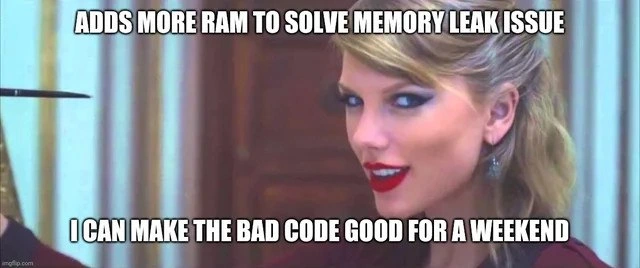
In the meme image, although it’s not strictly technical, we see a smug-looking face (the meme uses a clip of a famous singer smirking) with text in the typical bold white Impact font at the top and bottom – that’s the classic meme format. The top text states the action: adding more RAM to solve a memory leak. The bottom text is the punchline: making bad code good for a weekend. The character’s confident smirk kind of represents the developer thinking they’ve cleverly averted disaster, if only temporarily. There’s an ironic swagger here – like “Yeah, I didn’t fix the code, but the app’s not gonna crash on my watch this weekend. I’m a hero… kinda.” For a junior developer or someone new to these concepts, it’s a peek into how programmers sometimes cope with problems. It might be surprising – you’d think we always fix the bug right away. But in reality, we sometimes have to prioritize keeping the system running over perfection. That’s why this joke resonates: it’s making fun of that compromise.
Think of it like this: suppose you have a car that’s leaking oil. The true fix is to take the car to a mechanic and seal up the leak (maybe replace a gasket). But that’s time-consuming and maybe you need the car for a big trip tomorrow. As a workaround, you keep adding more oil before it gets too low. The car runs fine for now because you’re topping up what’s leaking out. You’ve solved the immediate problem (preventing the engine from running out of oil), but clearly the car still has an issue and will continue to leak until properly repaired. In software, adding more RAM to deal with a memory leak is the same idea – maintenance by constantly refilling rather than repairing. It’s not sustainable, but it might get you through the weekend trip.
Another concept here is hardware scaling vs. fixing code. Sometimes, when an application is slow or struggling, you have two options: optimize the code (make the software more efficient) or just give it more resources (CPU, memory, etc.). Beginners might assume always you should fix the code, but in real scenarios, adding resources is often the first go-to because it’s straightforward. This meme exemplifies that: we should fix the memory management issue, but instead we opted to scale up the hardware. The tagline “good for a weekend” hints that everyone knows this is only a temporary victory. It’s a bit like sweeping dirt under the rug – the room looks clean for now, but the dirt is still there.
In summary, at this level, you should understand that the meme is about a temporary workaround for a software bug. It’s highlighting a common situation in programming: using an easy fix (more RAM, i.e., more computer memory) to hide a harder problem (a memory leak in the code). The humor comes from the acknowledgment that this fix won’t last long – just like a weekend fling, it’s not a long-term relationship. The meme is funny to developers because it’s painfully relatable: we’ve all seen bad code given a “pass” for a short time thanks to some hack or extra resources, only to eventually face the music later. It teaches, in a lighthearted way, that throwing hardware at a software problem is a short-term patch, not a real solution. And if you’re a junior dev, the take-home lesson is: try not to rely on such fixes except in emergencies, because technical debt will come back around. Better to learn how to fix the leak – but if you ever do find yourself adding RAM to buy time, know that you’re in the company of many seasoned programmers who’ve done the same while chuckling to themselves, “this isn’t making the code any better, but it’ll do until Monday.”
Level 3: Band-Aids and Technical Debt
For seasoned developers, this meme hits a nerve because it satirizes a common anti-pattern in software engineering: instead of fixing the root cause of a problem, we apply a quick band-aid solution and hope it holds. The top caption, “ADDS MORE RAM TO SOLVE MEMORY LEAK ISSUE”, describes a scenario many of us veteran coders have witnessed (or shamefully implemented) in real life. The bottom caption, “I CAN MAKE THE BAD CODE GOOD FOR A WEEKEND”, is a witty twist on a pop culture lyric, and it perfectly captures the mindset of a desperate quick fix. Essentially, the developer is saying, “Our code is bad (it leaks memory), but by upgrading our hardware I can make it look good – though only for a short time.” The humor has a bit of a dark edge: we know this isn’t a real solution, and that’s why it’s funny. It’s the laugh of “we’ve all been there, and we know how this ends.”
Why is this combination of elements so humorous to developers? Because it’s a truth wrapped in exaggeration. Companies and teams often face pressure to keep systems running, especially when a critical issue pops up at a bad time. Imagine it’s Friday evening and a production service is mysteriously slowing down every few hours. Logs are pointing towards some memory issues – classic signs of a memory leak (like rising RAM usage in your monitoring graphs). A proper fix means diving into code, hunting the leak, writing a patch, testing it… and honestly, that could take days. But users are complaining now. So someone quips, “What if we just double the server’s RAM for now?” Bingo – the service stops crashing because now it takes twice as long for the leak to eat all the memory. You’ve masked the symptom. Everyone goes home for the weekend, with plans to “really fix it on Monday.” This meme is basically narrating that scenario with a cheeky grin. The bad code is still bad come Monday, but for the weekend it’s running smoothly, thanks to the extra RAM. It’s a programmer’s equivalent of using duct-tape to stop a leak in a dam and saying “that’ll hold it for now.” We laugh because it’s too real and a bit absurd – like putting a bucket under a leaky ceiling instead of repairing the roof.
The grand, medieval-looking image with a confident smirk on the character’s face adds to the irony. It’s actually a screenshot of a very glamorous pop star (in a fancy setting) repurposed for our nerdy joke. The original lyric “I can make the bad guys good for a weekend” from a hit song gets morphed into “I can make the bad code good for a weekend.” This clever caption remix connects a developer’s quick fix to a mainstream reference. Even if you don’t catch the song allusion, the phrase itself is clear enough: we’re temporarily making something bad appear good. That contrast – epic imagery and lyrical drama applied to a grubby coding workaround – is classic developer humor. It’s funny because we’re treating a trivial tech hack with the same gravity as a grand proclamation. It’s like announcing “Behold, I have fixed the unfixable!” when all you did was throw more hardware at it.
On a more serious note, the meme touches on the concept of technical debt. Technical debt is the idea that if you take a shortcut in code (like not fixing a bug properly), you’re incurring a “debt” that must be paid later with interest (i.e. it’ll cause bigger problems down the line, or be harder to fix later). Here, not fixing the memory leak is a classic accumulation of technical debt. Yes, adding RAM avoided a crash today, but the underlying bug is still ticking like a time-bomb. Over the weekend, everything might look fine (debt successfully deferred), but perhaps a week later the app will start crashing again as usage grows or the leak continues. The interest on this debt could be downtime, firefighting sessions, or even user data loss if the process dies unexpectedly. Seasoned devs have a kind of weary humor about this – we know we’re just kicking the can down the road. The meme’s punchline implicitly says, “We’ll have a good time (the app will appear stable) for the weekend, but come Monday, reality hits back.” Developers grin at that because it’s a scenario that plays out in countless post-mortems and war stories.
Real-world scenarios that this meme brings to mind:
- The Weekend Miracle: A critical service was leaking memory and kept crashing every 6 hours. The on-call engineer at 2 AM Saturday decides to quadruple the container’s memory limit. Boom – now it takes maybe 24+ hours to crash, buying enough time to survive the high-traffic weekend. Come Monday, the team scrambles to find the leak. For those two days, though, everyone pretended the “fix” was legit.
- Hardware Overkill: A database process was consuming more and more RAM due to a bug. Rather than rewrite a chunk of the caching logic (risky and time-consuming), the team just moved the database to a beefier server with double the RAM. Problem solved… until even that server filled up a month later. By then, the habit of relying on hardware had set in, and someone proposed another upgrade. (At some point, this stops being cost-effective – a classic case of ignoring the root cause for too long.)
- Scheduled Restarts: This is a common “invisible” band-aid. Instead of adding RAM, some teams set their leaky application to automatically restart every night during off-peak hours. That way, it never runs long enough to exhaust memory. It’s the same spirit as the meme’s joke: don’t fix the leak, just periodically reset the bucket. You’d be surprised how many production systems quietly do this. It’s a bit of a dirty secret in operations – a workaround born of expedience.
The systemic issue behind all this is a mix of laziness, time pressure, and the tempting availability of cheap hardware. It’s often said in tech that “hardware is cheaper than developer time.” In many organizations, it’s easier to justify buying more server resources (or upping a cloud instance size) than to allocate a developer’s hours to chasing down a elusive bug that “only causes a problem after several hours”. The incentive structures sometimes favor quick uptime over long-term robustness. Managers want the site up now, and if adding RAM does that, it’s hard to argue against in the moment. The long-term consequences (like an ever-growing AWS bill, or a massive crash later) are someone else’s problem, or so we hope. This meme captures that cynical calculation in one sentence. “Make the bad code good for a weekend” really means let’s hide the bad code’s effects temporarily. Every senior engineer knows that come Monday (or whenever the buffer runs out) you’ll pay the piper. The shared laughter is a way of coping with the fact that, yep, we’ve all had to be that engineer applying a duct-tape fix, even though we knew we were planting a time bomb.
We also recognize in this meme an implicit commentary on code quality and pride (or lack thereof). Writing code that leaks memory is often seen as a code quality issue – it indicates something wasn’t designed or tested carefully in the memory lifecycle. A team that genuinely values code quality would feel compelled to track down the leak and fix it properly. But the meme winks at the reality that often, due to pressure, that ideal is compromised. The bottom text almost reads like an engineer boasting in a tongue-in-cheek way: “Don’t worry, I’ve got a trick up my sleeve. It’s not ‘good’ code, but I can make it good (enough) for now.” That boast has an undercurrent of irony – nobody truly believes adding RAM makes the code good; it just makes the symptoms go away for a bit. In fact, sometimes developers will joke in retrospectives, “Well, the code wasn’t great, but at least memory is cheap!” This meme is exactly that joke distilled into an image.
Let’s talk about the performance aspect too. A memory leak typically manifests as a performance problem: as memory usage grows, the application may slow down or struggle. By adding more memory, you temporarily improve performance simply by giving the app more breathing room. It might stop thrashing (constantly hitting slow disk swap or garbage-collecting frantically) once it has ample headroom again. So the code seems faster or healthier after the RAM upgrade. But it’s a bit of an illusion – the inefficiency is still there, quietly eating resources. This is why experienced devs find the meme funny: it’s essentially saying “I optimized performance by just adding resources, lol.” It’s an eye-roll moment because it’s the least sophisticated “optimization” one can do. It’s like solving a traffic jam by opening more lanes temporarily, without ever teaching the bad drivers to improve. A senior developer reading this might chuckle and think, “Yeah, done that… also regretted it later.”
Crucially, everyone in on this joke understands that the problem will return. That’s where the shared trauma comes in. We’ve seen memory leaks bring down services in spectacular fashion. Maybe it was at 3 AM on a Sunday when the “RAM buffer” finally got exhausted and pagers started going off. The meme’s promise of “good for a weekend” drips with the implication “...and then all hell breaks loose”. It’s funny because it’s true – you get that calm before the storm. Developers often cope with severe bug situations using humor, and this meme is a prime example of laughing at our own folly. It pokes fun at the tendency to push problems off: technical debt piling up like a credit card we don’t want to look at. Eventually, the debt comes due.
To sum up the senior perspective: this meme hilariously encapsulates a quick fix vs. real fix dilemma. It resonates because it’s a hyperbolic yet accurate snapshot of engineering trade-offs and a bit of engineering cynicism. We all strive to write clean, efficient code with no leaks (that’s good CodeQuality), but in the real world, sometimes you’re that harried developer saying “Screw it, just up the AWS instance size and we’ll deal with the leak later.” It’s both cathartic and cringe-worthy to admit. That mix of relief and dread – making bad code behave briefly, knowing it’s temporary – is what gives the meme its punch. It’s the laugh so you don’t cry kind of humor. And on Monday, when the graphs start creeping up again, you’ll remember that band-aids don’t heal wounds, they just cover them for a while.
For a clearer comparison of the strategies implied, consider this table of the “Add RAM” workaround vs true fix:
| Quick Fix: Add More RAM | Proper Fix: Fix the Memory Leak |
|---|---|
| Increase hardware resources (e.g., upgrade server from 8GB to 16GB RAM). | Dive into code to find where memory isn’t released. |
| Almost immediate results – system stops crashing for now. | Takes time to implement and test – no instant gratification. |
| Costs money (buying more memory or paying higher cloud fees). | Costs developer time (which is often more expensive in the short run). |
| Treats the symptom (high memory usage) by raising the ceiling. | Treats the cause (the bug) by eliminating the unnecessary memory usage. |
| Risk: hides the issue, which can resurface worse than before. | Risk: touching complex code might introduce new bugs, but yields long-term stability. |
| Adds to technical debt (you’ll eventually have to pay up – fix it or keep paying for more RAM). | Reduces technical debt (removes a latent bug and potential future failure point). |
| Example mindset: “It’s 5 PM Friday, just beef up the server and call it a day.” | Example mindset: “Let’s schedule time to profile memory and plug this leak properly.” |
Most senior engineers reading this meme immediately grasp this trade-off table mentally. The meme, in one line, summarizes the left column – the path of least resistance – taken a bit too often in crunch times. And we all aspire to be the hero who does what’s in the right column… but hey, no one’s perfect and weekends are short. Hence the collective chuckle.
Level 4: Feeding the Memory Beast
Under the hood, this meme highlights a fundamental memory management issue: a program with a memory leak gradually consumes more and more RAM until it exhausts the system. In technical terms, a memory leak occurs when a program allocates memory (for example, via a call like malloc() in C or by creating new objects in Java) and then forgets to release it when it's no longer needed. That forgotten memory remains occupied, unavailable for reuse, effectively shrinking the pool of free memory over time. The program doesn’t immediately crash – instead, its memory usage just keeps climbing. Eventually, one of two things happens: the process hits an upper memory limit and throws an OutOfMemory error, or the operating system’s OOM killer (Out-Of-Memory killer) steps in and terminates the greedy process to save the rest of the system. In other words, the software keeps gobbling memory like a beast that never gets full, until the system has nothing left to give.
Adding more RAM to a machine in this scenario is like feeding that memory-hungry beast extra food. Technically, increasing physical memory raises the threshold at which the program runs out of room. If you double the available memory, you roughly double the time it takes for the leak to fill it. We could express a simplified idea of this as:
$$ T_{\text{to_crash}} \approx \frac{\text{Total RAM}}{\text{Leak Rate}}, $$
where Leak Rate is how fast the program is consuming memory (e.g. MB per hour). This equation isn’t exact science (leak rates can vary and other factors like garbage collection can intervene), but it captures the essence: more memory = more time before the inevitable crash. The leak’s underlying cause isn’t fixed at all; the growing memory usage is just masked by a larger capacity. It’s reminiscent of the adage in performance engineering that software will expand to fill all available resources. In fact, this mirrors Wirth’s Law in action: software gets slower (or more bloated) faster than hardware gets faster. Here, the hardware (RAM) got beefed up, and the software immediately takes advantage by leaking more, until it too runs out. In short, adding RAM postpones the reckoning but the eventual out-of-memory doom is mathematically certain if the leak continues unchecked.
To appreciate how insidious a memory leak is, consider a tiny code example in C:
// Simulating a memory leak in C: allocating memory and never freeing it.
for (int i = 0; i < 1000000; ++i) {
char *chunk = malloc(1024); // allocate 1 KB chunk
if (!chunk) {
break; // stop if allocation failed (ran out of memory)
}
// ... use the chunk for something ...
// Oops: forgot to free(chunk)! This 1 KB stays allocated forever.
}
Above, every iteration allocates 1KB and never releases it. After a million iterations, that’s ~1GB of memory leaked. On a system with only 1GB of RAM, this program would likely exhaust memory and crash or trigger the OS to kill it. On a system with 2GB RAM, the same leak runs longer — it can grab that extra gigabyte before hitting the wall. The performance impact of such a leak grows over time: as free memory gets low, the OS might start swapping to disk (massively slowing things down), or a garbage collector (in managed languages) might thrash trying to reclaim memory, causing noticeable slowness. Essentially, the program gets slower and less stable as the leak progresses. Adding more RAM in the middle of this is like extending the size of a leaky tank — it delays the overflow, but doesn’t stop the leak.
On an operating system level, memory is managed in pages and heaps. When a process leaks memory, it’s like it’s hoarding those memory pages and never giving them back. Modern OSes don’t automatically reclaim memory from a process unless the process frees it or exits. So a leaky program can sit there bloating, page by page. If the system has a lot of RAM, the OS will dutifully keep handing pages over until it can’t. At that breaking point, Linux’s OOM killer might say “Enough!” and sacrifice the offending process to reclaim memory (imagine the OS as an angry monarch beheading the greediest noble to save the realm). Other environments, like the Java Virtual Machine, will throw a OutOfMemoryError and halt the program when the heap limit is exhausted. Either way, it’s game over for the process once it runs out of RAM, no matter how gloriously large that RAM is.
From a theoretical standpoint, detecting and preventing memory leaks can be a hard problem. It’s essentially a resource management bug, and finding it often requires tracing through program logic or using specialized tools. There’s no automatic “theorem” that can catch all leaks, because determining if a program frees all memory it allocates is akin to certain undecidable problems in computer science (it can be reduced to the Halting Problem in the general case). That’s why we rely on practical tools like profilers and analyzers (e.g. Valgrind, AddressSanitizer) to catch leaks at runtime or test time. These tools instrument the code to track allocations and frees, and they report any memory still allocated when the program ends or when it should have been freed. They’re effectively looking for evidence that memory was orphaned (allocated but lost with no pointer referencing it, or still referenced by objects that won’t be used again). In garbage-collected languages, leak diagnosis might involve heap dump analysis to see what objects are filling up memory and why they aren’t being collected. For instance, a common memory leak in JavaScript or Java is leaving an object in a global array or never removing old event listeners — the garbage collector thinks those objects are still in use (because they’re referenced), so it won’t free them. The result is logically the same leak phenomenon: memory usage grows without bound.
So when the meme jokes about “ADDS MORE RAM TO SOLVE MEMORY LEAK ISSUE”, it’s pointing to a very brute-force strategy at the system level. In the hierarchy of solutions, this one operates entirely outside the code: throw more hardware resources at the problem instead of changing a single line of the leaking code. It’s a textbook example of a band-aid solution. The bad code (the leak) is still in there, dripping away; we’ve just enlarged the bucket so it takes longer to overflow. A veteran engineer knows that while hardware vertical scaling (bigger memory, faster CPU) can improve capacity or buy time, it doesn’t address the root cause of a bug. Eventually, the leak will consume the new RAM as well, revealing that the “fix” was temporary. In fact, in some cases, giving a leaky program more memory can even encourage lax monitoring — everyone relaxes for a while because the crashes stopped, and the leak gets ignored longer, accruing technical debt interest in the background. When it resurfaces, it might do so even more spectacularly (now it might take down a 16 GB server instead of a 8 GB one, doubling the drama).
At this deep technical level, the humor of the meme comes from recognizing a fundamental anti-pattern: using brute force hardware to contend with a software flaw. It’s the kind of thing that makes performance engineers and purist developers smirk or sigh, because it violates the ideal of elegant, efficient code. We’d prefer to see the leak fixed by proper allocation and deallocation discipline (maybe using smart pointers in C++ for automatic memory management, or employing memory profilers in Java to find and remove unintentional object retention). But reality often intervenes, and many of us have indeed “fed the memory beast” in crunch times. The meme’s punchline “I can make the bad code good for a weekend” is a tongue-in-cheek way of saying: more RAM will make the program behave (i.e. not crash) ... but only temporarily. It’s like a weary engineer’s dark joke — acknowledging that, yes, this stunt can save your hide for a short span, though you’re definitely not slaying the monster lurking in the code. In summary, on a theoretical and system level, the meme is funny because it exposes the inevitability behind a quick fix: you can boost resources to postpone a failure, but you haven’t changed the big-O nature of the bug (unbounded memory growth). The laws of computing won’t be defied — sooner or later, the leak wins, and the weekend ends.
Description
This meme features a still image of Taylor Swift from her 'Blank Space' music video, where she has a sly, knowing expression. The meme is divided into two text captions. The top text reads: 'ADDS MORE RAM TO SOLVE MEMORY LEAK ISSUE'. The bottom text is a parody of a lyric from the song, reading: 'I CAN MAKE THE BAD CODE GOOD FOR A WEEKEND'. The humor comes from the juxtaposition of a common, yet poor, technical solution with the song's theme of temporary, doomed relationships. Instead of properly debugging and fixing a memory leak (a type of bug where a program incorrectly manages memory allocations), the developer simply adds more RAM. This doesn't solve the underlying problem but merely delays the inevitable crash, making the 'bad code' appear functional for a short time. For senior engineers, this is a painfully relatable example of accruing technical debt and treating the symptom rather than the cause, often due to deadline pressure or inexperience
Comments
20Comment deleted
Our memory leak isn't a bug, it's a feature. We call it 'unbounded caching.' The solution is simple: just vertically scale the server until the cloud provider's stock price goes up
We rebranded the memory leak as “elastic state,” threw 256 GB at each pod, and now the only thing leaking is Finance’s confidence
After 20 years in tech, I've learned there are two types of memory leak fixes: the one where you spend three days with a profiler finding that rogue event listener, and the one where you quietly bump the EC2 instance to r6i.32xlarge and update your LinkedIn before the next quarter's AWS bill arrives
Ah yes, the classic 'download more RAM' solution to memory leaks - because why spend hours with Valgrind, AddressSanitizer, or heap profilers tracking down that rogue pointer when you can just vertically scale your way out of accountability? Sure, your application's RSS keeps climbing like it's training for Everest, and yes, the OOM killer is getting increasingly familiar with your process name, but with 128GB of RAM, you've bought yourself a solid 72 hours before the CFO starts asking why the cloud bill looks like a phone number. It's not technical debt, it's 'deferred optimization' - and that 3am PagerDuty alert is definitely a future-you problem
If your heap delta per minute is positive, adding RAM just converts debugging into a budgeting problem - finance becomes your garbage collector until Monday
Adding RAM to a memory leak: converting heap pressure into AWS revenue until Kubernetes stamps it OOMKilled on Monday morning
Vertical scaling: the architect's prayer for dodging refactor tickets until post-weekend blame game
That’s the way! Comment deleted
This is where the fun begins Comment deleted
А при чем тут эта женщина? И кто она? Comment deleted
What? Comment deleted
А при чем тут эта женщина? И кто она? Comment deleted
Это Тэйлор Свифт, у нее есть песня Blank Space и там типо похожие слова Comment deleted
Спасибо Comment deleted
Its Teylor Swift (probably wrong, but can’t bother to google) She have a song Blank Space with similar lyrics Comment deleted
Translate... Comment deleted
A pri chem tut eta zhenschina? I kto ona? Comment deleted
T Translation Comment deleted
Probably a pm of some company Comment deleted
Hm, almost:D Comment deleted