Skipping endless meetings so developers can finally code and hit the looming deadline
Why is this Meetings meme funny?
Level 1: Stop Talking, Start Doing
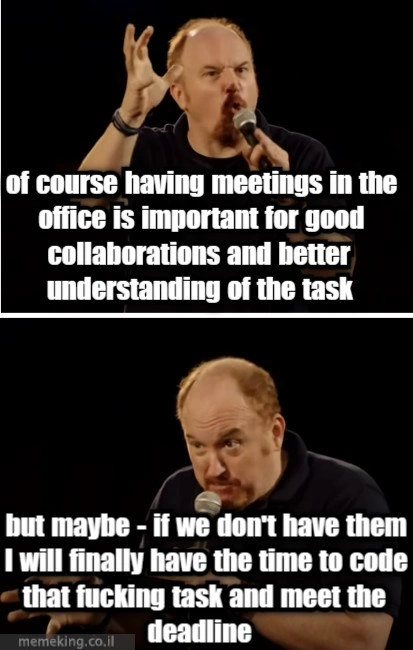
Imagine you have a big school project due tomorrow, but instead of letting you work on it, your teacher keeps calling you over and over to talk about the project. Every hour, the teacher says, “Let’s discuss how you’re going to do your homework so you really understand it.” Talking about it might help a little, but if it happens too often, you end up with no time to actually do your homework. You get really upset and think, “If we didn’t have all these talks, I could have finished my project by now!” That’s exactly the feeling this picture is joking about. The first part shows someone saying, “Meetings (lots of talking with everyone) are very important to help us work together and understand what to do.” The second part shows him getting angry and saying, “But if we stop having so many meetings, maybe I’ll finally have time to do my work and finish it before it’s due!” It’s funny because it’s true – sometimes people spend so much time talking about the work that they barely have time to actually do the work. The joke is basically: less talking, more doing would make everyone a lot happier when there’s a big deadline coming up.
Level 2: The Context-Switch Tax
In plain terms, this meme highlights how too many meetings can wreck a developer’s day when a deadline is fast approaching. Let’s break down the scenario. A developer has an important task due soon – that’s the looming deadline (the date by which their code must be finished). Management keeps insisting on having meetings in the office, supposedly to help everyone communicate and understand the work better (they often call this “improving collaboration” or “alignment”). But the developer is getting frustrated because every hour spent in a meeting is an hour not spent coding the actual feature they’re responsible for. They’re essentially saying: “If we cancel some of these meetings, I’d finally have time to write the code and get it done before we run out of time!”
This speaks to a common rookie surprise in the tech industry: as a new developer, you might expect your day to be 8 hours of pure coding, but then you discover a big chunk of it is consumed by meetings – daily stand-ups, planning sessions, sprint retrospectives, design discussions, you name it. Some meetings are helpful for clarifying tasks or solving problems as a team. However, MeetingOverload is when there are so many meetings that you barely get a solid chunk of time to program. New engineers often feel DeveloperFrustration when they realize half their day vanished in conference rooms (or on Zoom calls), and their Productivity plummets. This meme is a punchy expression of that frustration. The top panel parrots what management usually says (“Meetings are important for teamwork and understanding the task”), and the bottom panel is the developer’s inner voice screaming (“Actually, if we skip these meetings, I might have a chance to finish my work on time!” – with an expletive for emphasis).
Let’s explain a couple of key terms and concepts here:
Deadline: This is the due date or time by which a task or project must be completed. In the meme, the deadline is “looming,” meaning it’s coming up soon. Deadlines create pressure on developers to finish their coding on schedule. When a deadline is looming, every minute counts, and interruptions become especially frustrating.
Meeting: In a workplace, a meeting is when a group of people gathers (in person or virtually) to discuss things. For developers, common meetings include project planning, status updates, and problem-solving discussions. Meetings can be useful, but they take time away from doing actual coding work.
Collaboration vs. Focus: Collaboration means working together and communicating (e.g., sharing ideas in a meeting). Focus (or “focus time”) means working with full concentration on a task without interruptions. Developers need long periods of focus to write and debug code effectively. The meme highlights a conflict between collaboration and focus: too much collaboration time (meetings) can destroy the focus time needed to write code.
Context Switching: This is a term borrowed from computer operating systems, but it’s also used to describe human work. For a developer, context switching means changing from one task to another – for instance, switching your mind from coding to attending a meeting, then back to coding. Each switch has a “tax” or cost in productivity. When you stop coding to join a meeting, you lose some momentum. After the meeting, you have to mentally reload what you were working on. That takes extra time. If you have lots of meetings, you keep switching contexts, and it can feel like you never get anything done. In the meme, the developer is basically complaining about the context-switching chaos caused by excessive meetings as the deadline approaches.
Meeting Fatigue: This is the tiredness and drained feeling people get after sitting through too many meetings. It’s both mental and physical. For developers, meeting fatigue can be particularly frustrating because after all those discussions, you might be too exhausted to code efficiently. The meme’s second panel (with the guy looking frustrated and done with talking) perfectly captures the “I am so done with these meetings” vibe of meeting fatigue.
The two panels of the meme use a common comedic format. The first panel sets up the premise in a very neutral or positive way – here, it’s the official company line: “Meetings are important for collaboration and understanding the task.” The second panel then delivers the twist or punchline – the candid truth from the developer’s perspective: “Maybe if we don’t have these meetings, I’ll have time to actually code this task and meet the deadline!” The humor comes from this contrast: the polite, perhaps overly optimistic management-speak versus the crude, honest frustration of the developer who just wants to do their job. The use of the f-word (“that fucking task”) in the meme’s text really drives home how fed up the developer is – it’s a strong comedic exaggeration of what a developer wishes they could say out loud in that situation (though likely wouldn’t in a real office meeting).
For a junior developer (or anyone new to office life), this meme is a relatable eye-opener. It highlights a typical DeveloperPainPoints: you can’t write code if you’re stuck in meetings all day. It also gently suggests a solution/hint that many learn over time: protecting your focus time is important. Many teams actually recognize this issue – that’s why some companies have rules like “No Meeting Thursdays” or set aside specific hours in the day as “meeting-free” so engineers can concentrate. This meme humorously validates the feeling a lot of us have early in our careers: “I’d be so much more productive if everyone would just let me code!” It’s basically office humor about ProductivityLoss due to too much talking and not enough doing. And trust me, even your team lead or senior dev who smiles at this meme has been that frustrated coder at some point, silently begging to skip the next meeting and just get back to building the software.
Level 3: Meeting-Driven Development
Of course meetings are important – that’s the corporate mantra. Every seasoned developer knows the satire here: those endless "collaboration" sessions meant to clarify the task often become the task. This meme nails a classic DeveloperPainPoints scenario: management insists on back-to-back meetings for “good communication” right up until the deadline, while engineers sit there thinking, “If I wasn’t in this meeting, I could actually finish the damn code!” The humor cuts deep because it’s MeetingHumor rooted in truth – we’ve all experienced MeetingOverload that tanks our DeveloperProductivity.
Let’s unpack why this is too real. In theory, meetings should enhance teamwork and ensure everyone understands the project. In practice, excessive meetings create CommunicationOverhead that sabotages productivity. It’s an ironic trade-off: time spent talking about work directly reduces time available to do work. The result? DeadlinePressure intensifies, and the team’s stress spikes because the “looming deadline” didn’t budge for those hour-long status calls. It’s a textbook example of an organizational anti-pattern – call it Meeting-Driven Development (MDD). In MDD, progress gets measured by the number of Zoom invites and conference-room huddles, rather than working code or closed JIRA tickets. The meme’s second panel drops the polite pretense and voices what every dev is thinking: maybe fewer meetings would actually let us deliver on time. No surprise, the caption escalates to profanity – that DeveloperFrustration is 100% genuine. You can practically hear the dev’s internal scream: “Let me code, already!”
Why is this so relatable for senior engineers? Because experienced devs have survived exactly this scenario, often repeatedly. We’ve seen managers schedule a “quick sync” to ask “Why aren’t we coding faster?” – an absurd self-own that steals another precious hour of coding. It’s a vicious cycle: the more behind schedule a project gets, the more meetings management calls to triage – which makes it even later. This is reminiscent of Brook’s Law from The Mythical Man-Month: “adding manpower to a late software project makes it later.” Why? Because communication scales non-linearly – every new person (or meeting) adds overhead. Here, adding more meeting time to a delayed project just multiplies the delay. The meme highlights this absurdity with comedic punch: the very act of obsessing over collaboration can become ProductivityLoss. It’s workplace satire many of us have lived: everyone nodding about “better understanding of the task” in a boardroom, while the actual task sits untouched on GitHub.
There’s also a collaboration_vs_focus tug-of-war here. Developers need long stretches of uninterrupted focus – often called “flow state” – to solve complex problems. Each meeting is like hitting the break pedal on that flow. That frustrated face in panel 2? That’s a developer whose flow state just got nuked for the third time today. Regaining deep focus isn’t instant; studies (and painful experience) show that after an interruption, a programmer might need 15-30 minutes to get back in the zone. Now imagine a day sliced into one-hour meeting chunks – you’re constantly rebooting your brain, re-reading the code, trying to recall where you left off. The context switching penalty is brutal. Seasoned devs joke that a one-hour meeting can easily cost two or more hours of lost development time in context-switch churn and MeetingFatigue.
Let’s not forget the “in the office” twist in the first panel’s text. Around 2022, many managers were extolling the virtues of in-person meetings for “good collaboration” (sometimes as part of the return-to-office push). The meme riffs on that: management insists that gathering everyone physically will improve understanding, but the disheveled developer is thinking, “Actually, if I weren’t dragged to the office for this chat, I could be coding.” It’s a jab at the belief that more face time automatically equals productivity. A cynical veteran will tell you: collaboration is crucial, but over-collaboration is counterproductive. There’s even a nod to the famous concept of Maker’s Schedule vs Manager’s Schedule. Managers operate on hourly increments (meetings, calls, check-ins – it’s how they coordinate). Developers, the “makers,” need half-day or full-day blocks to design, code, and debug. If you force a maker into a manager’s cadence of constant context shifts, you wreck their day. The meme’s exasperation is basically a rallying cry for the maker’s schedule: give us focus time or watch the deadline slip.
In real engineering life, we cope with this by carving out “No Meeting” blocks, or as one colleague calls it, “core coding hours.” Some teams institute No-Meeting Wednesdays or block mornings for development only, pushing meetings to late afternoon. It’s an attempt to beat the communication overhead monster. Why? Because experienced devs know that uninterrupted coding time is sacred – and that meeting fatigue is real. After 4+ hours of discussions, your brain is mush; good luck debugging that race condition at 5 PM when you’ve been in slide presentation hell since lunch. The meme’s humor is edgy because it’s a bit painfully true: sometimes the best way to “collaborate” and “understand the task” is simply to shut up, let the engineer work, and maybe just read the darn project spec or PR updates asynchronously. As the saying goes, This meeting could have been an email. Or better yet, a Jira comment.
The two-panel format itself contributes to the joke. In panel 1, the speaker (comedian Louis C.K. in this image template) is shown making a reasonable, corporate-friendly statement. In panel 2, he’s visibly agitated, delivering the punchline – essentially “No offense, but I have actual work to do!” This contrast is a common meme structure to highlight hypocrisy or conflicting realities: the polite official stance vs. the frustrated truth. Here the official stance is “Meetings are key to collaboration,” and the truth is “Meetings are derailing my ability to deliver.” Every veteran dev in the room smirks at this because we’ve either thought it, muttered it under our breath, or outright blurted it out at some point under DeadlinePressure. It’s DeveloperHumor with a dark edge: we’re laughing, but only to keep from crying about how real it is.
Bottom line? The meme resonates because it captures a DeveloperFrustration so common it’s practically a rite of passage. It’s mocking the synergy addiction of some workplaces. When the clock is ticking and a critical feature needs coding, nothing is more satisfying (or necessary) than slamming that meeting room door and getting back to your keyboard. As any jaded engineer will tell you with a smirk: Zero lines of code are written in a meeting. You can have the best collaboration in the world, but if you never give developers time to code, that looming deadline will loom a lot larger. This meme victoriously screams what every dev has wanted to say at least once: “Less meeting, more coding, please!”
Description
Two - panel meme on a black background shows a blurred man gesturing energetically. Panel-1 text, in bold white capital letters, reads: "of course having meetings in the office is important for good collaborations and better understanding of the task". Panel-2 shows the same speaker looking frustrated, with text: "but maybe - if we don't have them I will finally have the time to code that fucking task and meet the deadline". The image humorously contrasts management’s emphasis on in-office meetings with engineers’ need for uninterrupted focus time to actually deliver code before deadlines, highlighting the classic tension between collaboration ceremonies and developer productivity
Comments
9Comment deleted
After profiling the sprint, we realized the real performance bottleneck wasn’t the database - it was the manager’s recurring meeting holding a global write lock on everyone’s calendar
The only synchronization primitive that consistently causes deadlock in production is the calendar invite - and unlike mutexes, there's no timeout mechanism that actually works when stakeholders are involved
Every senior engineer knows the painful irony: we schedule meetings to discuss why the project is behind schedule, thereby ensuring the project stays behind schedule. It's like running `git commit` before `git add` and wondering why nothing changed - except the meeting is the commit, the actual work is still unstaged, and your sprint velocity just took another hit. The real kicker? That 'quick sync' just cost you two hours of flow state you'll never get back, and now you're debugging at 11 PM because that's the only time Slack is quiet enough to think
Office meetings: the ultimate context switch that nukes flow state worse than a full GC cycle
Our calendar is a distributed lock manager; every “alignment” meeting acquires a global mutex on engineering - throughput drops to zero, but hey, we’re perfectly consistent
Every alignment meeting increases utilization to 100% and throughput to 0% - Little’s Law meets my calendar
okay, sounds reasonable now, lets set up a meetings to discuss it further Comment deleted
Manager: I can only cut on your sleep or salary Comment deleted
http://programming-motherfucker.com https://macode.ru Comment deleted