Skip to content
DevMeme
3159 of 7435
The Developer's Dilemma: To Delete or to Comment Legacy Code
LegacySystems Post #3479, on Jul 30, 2021 in TG

The Developer's Dilemma: To Delete or to Comment Legacy Code

Why is this LegacySystems meme funny?

Level 1: Wobbly Block Tower

Imagine you have a tall, wobbly tower of blocks that you built a long time ago. Now you notice there’s one block in the tower that looks out of place – maybe it’s not really supporting anything, and it might even be making the tower unstable. You have two choices: take the block out completely, or leave it in but tape it so it doesn’t move.

  • If you take the block out (like deleting code), maybe the tower will become cleaner and stand just fine. But you’re scared that removing it might actually make the tower collapse, because who knows, maybe that block was somehow important for balance in a way you don’t see.
  • If you tape the block in place (like commenting out code), it means the block stays in the tower but isn’t actually doing anything anymore – it’s just stuck there. The tower looks messy with a random taped block, but at least by not fully removing it, you feel a little safer that you didn’t disturb the delicate balance too much.

Now you’re standing there with sweaty hands, trying to decide what to do, because neither option feels perfect. Taking it out might break the tower, but leaving it taped there keeps the tower messy. This is exactly how a programmer feels in the meme: the tower is an old software system that’s shaky, and the block is a piece of old code. They can either remove the old code (risking that something might break) or just disable it and leave it in place (keeping things safe but cluttered). The picture is funny because it shows how even a big strong superhero-looking person can sweat and panic over such a simple-looking choice – just like you might sweat over which block to pull from a shaky Jenga tower. It’s a silly way to show the fear of making a fragile thing fall apart, something even a kid with a block tower can understand. The humor comes from realizing that sometimes grown-up engineers feel as nervous as someone playing a tricky game of blocks, and that makes the situation both relatable and funny.

Level 2: Legacy Code 101

Let’s break this down in simpler terms. Legacy code refers to old code that has been in use for a long time – usually written by other people (who might not even be around anymore). It’s the kind of code running in critical systems that everyone is afraid to touch because it’s brittle (fragile) and complicated. Often this code was written quickly to solve immediate problems, accumulating what we call technical debt. Technical debt is like shortcuts or “ quick fixes” in coding – they save time in the short run but make the code harder to maintain later, just like taking on financial debt gives you quick cash but a burden of repayment with interest. Over years, a legacy codebase can become a tangled mess (hence the term spaghetti code, implying everything is jumbled like a bowl of spaghetti noodles). When code is spaghetti, pulling on one piece (changing one part) can shake or break something unexpectedly in another part, because of hidden dependencies.

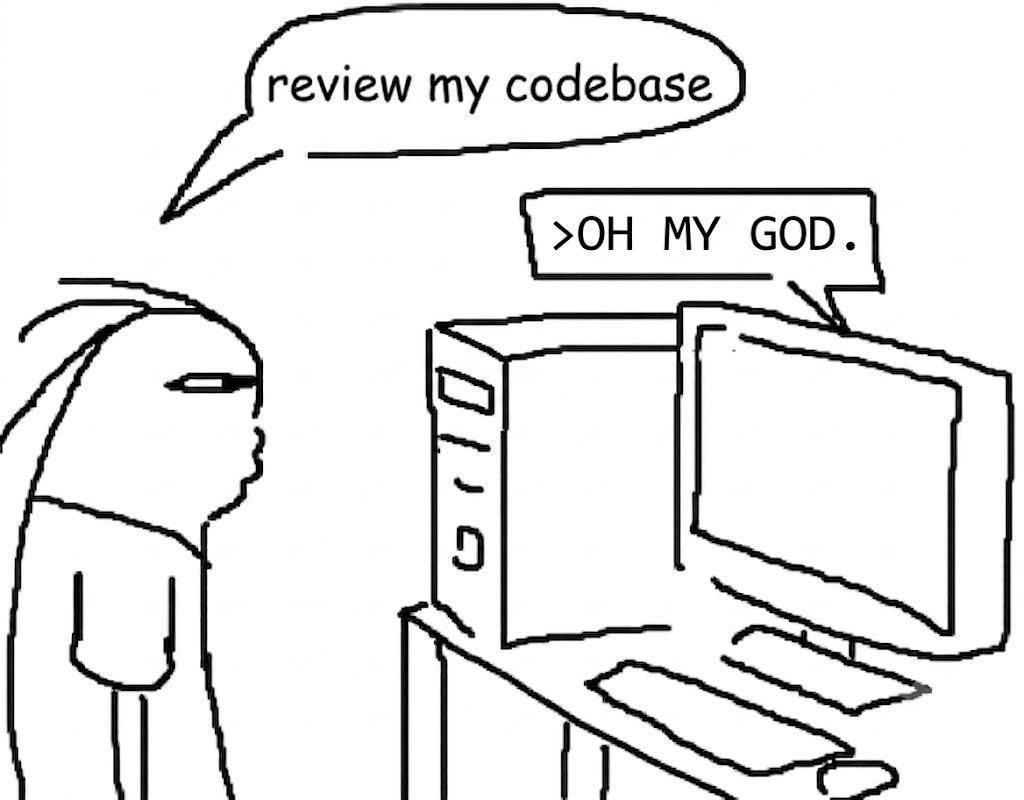
Now, what does the meme show? It uses the popular two buttons meme format: a cartoon character has to choose between two red buttons. Each button is labeled with an option, and neither option is ideal, which is why the character is sweating and distressed in the second panel. In this case, the two choices are: “Comment legacy code” or “Delete legacy code.” This represents a situation every developer in a legacy project recognizes: you encounter some old code that might not be needed anymore. You have two main options:

  • Comment the code out: In programming, to comment out code means to put special symbols (like // in C++/Java/JavaScript, or # in Python) in front of the lines so that the computer ignores those lines when running the program. The code stays in the file as a reference, but it doesn’t actually execute. It’s like telling the program “skip this part.” Developers do this if they think the code might be unnecessary or causing a bug, but they aren’t 100% sure it’s safe to remove. By commenting it out, they can easily bring it back if needed by removing the comment markers.
  • Delete the code: This is the bolder option – you remove the code entirely from the source. It’s gone from the file (though if you use a code repository like Git, it’s still in history). This cleans up the codebase (no clutter), but if that code was doing something important that you didn’t realize, you might cause a new bug or break the application’s functionality.

Why is this a dilemma? Because in a LegacySystems environment, people often don’t fully understand what every piece of old code does. Imagine coming across a weird 100-line function named computeAdjustmentLegacy() with no comments explaining it. It’s not being called anywhere obvious, and the app seems to work whether or not you run it. So is it safe to remove? In a well-documented, well-tested system, you’d run tests to see if anything fails without it. But legacy code often has poor documentation and few (if any) tests. So you have this uneasy feeling: “What if I delete it and something breaks that I’m not immediately seeing?” Perhaps another module or a rare workflow triggers computeAdjustmentLegacy() via reflection or a config file. Or maybe it was a workaround for a specific customer’s data years ago. You likely won’t know until it breaks. That’s why deleting is scary.

On the flip side, leaving the code in but commented out is also problematic. It makes the codebase larger and more confusing. Other developers (or future you) might later stumble on that commented code and waste time wondering, “Why is this here? Was it important? Is it meant to be removed or revived?” It’s refactoring pain: you want to clean up (refactor) the code, but you're not confident enough to just rip stuff out. Refactoring means restructuring or improving the code without changing what it does – but with legacy code, even figuring out what it does can be a challenge! So the meme’s buttons are essentially saying:

  • Do I “clean up” by excising this old code completely (delete it),
  • or do I play it safe and just mark it inactive (comment it out), keeping it around just in case?

The gloved hand hovering anxiously between the two buttons shows the developer’s indecision. It’s like having two bad options and you’re sweating, trying to choose the one that will cause the least trouble. The costumed character wiping sweat is a drawn representation of a developer under pressure. (In the original classic meme, that character is a superhero-like figure torn between two tough choices – here it’s used to represent a programmer’s internal drama).

This is a well-known legacy_code_dilemma in the programmer community. It's humorous because it exaggerates how such a simple action (commenting or deleting a line) can feel like a huge, stressful decision in an old system. In a newer, well-understood codebase, choosing to remove unused code shouldn’t be a big deal. But in a legacy codebase, it’s like doing surgery on a house-of-cards structure – one wrong move and the whole thing might crumble. The stakes (the fear of breaking production) make the developer sweat in the meme.

In summary for a junior perspective: The meme is joking about the fear of handling old, fragile code. If you comment it out, the code won’t run but still stays in the file (making the code messy). If you delete it, you clean things up but risk that you might unknowingly remove something important. The developer in the picture is panicking because they can’t decide which is the “right” choice – they both feel risky in a system that’s held together by unknown quirks. It’s a scenario that teaches why having good tests, documentation, and understanding of the code is important. Without those, even simple clean-up tasks become nerve-wracking decisions.

Level 3: Refactoring Russian Roulette

For seasoned developers, this meme captures the dark humor of maintaining LegacySystems weighed down by TechnicalDebt. The two red buttons labeled "Comment legacy code" and "Delete legacy code" represent a classic no-win scenario in refactoring old, fragile code. Hitting either button feels like spinning the cylinder in a game of Russian Roulette: maybe nothing bad happens… or maybe you just blew a hole in your production app. The sweating, panicked character in the bottom panel is every developer who’s ever touched a brittle legacy codebase. The humor (tinged with terror) comes from shared trauma: we’ve all encountered a mysterious piece of code that’s probably useless, possibly harmful, but potentially critical in some edge-case we don’t fully grasp.

Why is this so funny and painful? Because it’s too real. In a large legacy codebase – imagine thousands of lines of SpaghettiCode that has evolved over a decade – nothing is simple. If you delete legacy code outright, you risk breaking some dependency or subtle workflow that wasn’t documented. Perhaps that code was a workaround for a production bug in 2014; nobody updated the comment, but if you remove it, surprise! – midnight batch jobs start failing or an entire module goes down in production. On the other hand, if you comment out the code (i.e., disable it by turning it into a comment), you’re not executing it anymore, but you’re leaving a corpse in the codebase, a reminder of functionality past. Commented-out code tends to linger like a ghost: future developers will stumble on it and scratch their heads. It contributes to code rot – the codebase accumulates clutter and becomes even harder to understand. Yet, developers often comment out rather than delete because it feels “safer”: you can easily un-comment if things go wrong. It’s like taping over a broken switch instead of removing it from the circuit – a half-measure born out of fear.

This ties directly into TechDebt: every quick fix or hesitant decision (like leaving dead code in place) is a form of debt that makes the system harder to change later. The meme’s "eternal dilemma" highlights how technical debt forces bad choices. With high debt, you often lack tests or documentation, so you can’t confidently delete things. The code might be so brittle that even cleaning it up can introduce bugs. The result? Many devs choose to just comment it out – effectively fossilizing the questionable code in the repository strata. I’ve seen 10-year-old systems where huge sections are commented with notes like // TODO: remove if no one screams or // Legacy hack – do not delete. Those lines are warnings from Cautious Engineers Past who, faced with the same two buttons, decided to freeze the code in a non-executing state rather than risk an outage.

The two_buttons_meme_format exaggerates the agony: one gloved hand hovering indecisively, sweat dripping – it’s a perfect metaphor. Either choice could be wrong. Press the "Delete" button and pray you don’t get a 3 AM call about a crash. Press the "Comment" button and you’re essentially kicking the can down the road, leaving the mess for future you (or some other poor soul). Notice the character’s anguished face in the bottom panel – that’s basically a developer imagining their boss’s face when asked “why did you break the system?” versus “why is this code still here?”.

Humor aside, there’s insight here about software practices. In an ideal world, we’d have 100% unit test coverage, continuous integration running full regression suites, and up-to-date documentation. Then we’d just delete the legacy code with confidence because tests would catch any problem. But reality in legacy systems is far from ideal – tests might be missing or incomplete, the original authors have long since left the company, and the code’s purpose is obscure. It’s a minefield. So developers end up superstitious and ultra-conservative about removals. Version control systems (like Git) in theory should make deletion safe – “we can always bring it back from history if needed!” – but when you’re staring at a gnarly 5,000-line legacyModule.cpp with ancient business logic, do you truly trust that you know all its side effects? Often not. The meme nails this common Legacy Code Dilemma: the paralyzing choice between doing nothing permanent (just comment it out) or doing something potentially catastrophic (delete it). And as any battle-scarred senior dev knows, sometimes neither option feels good. The result is a stalemate, humorously portrayed by that sweaty hero who’d probably rather fight Thanos than refactor a brittle codebase without backup.

In short, the meme resonates because it satirizes a genuine Engineering Catch-22: you can’t improve the system without removing old crud, but removing it might break the system. So you hesitate, sweat, maybe flip a coin – then comment it out with a prayer. As one might joke in DeveloperHumor, “Legacy code isn’t code plus tests, it’s code plus fear.” The sweaty superhero’s distress is funny because it’s true – we’ve all been that hero/victim, finger hovering over the big red button in a code editor, living the RefactoringPain of legacy systems.

// Example of the dilemma in code (C++ style):
int result = modernCalculation(data);
// Old legacy workaround (was causing weird bug, or was it fixing one?):
// int result = legacyMagicFunction(data);  // commented out, just in case

Above: The developer introduced a new method modernCalculation and commented out the old legacyMagicFunction instead of deleting it. Why? In case they discover legacyMagicFunction was doing something important that modernCalculation misses. This way, they can quickly restore it by uncommenting if all hell breaks loose. It’s a safety net – albeit one that clutters the code. Such comment stubs often stick around far longer than intended, a testament to the fear of finality when dealing with unknown legacy behavior.

Level 4: The Halting Problem of Dead Code

At the most theoretical level, deciding whether it’s safe to delete a piece of legacy code can resemble an undecidable problem. In computer science theory, determining whether an arbitrary piece of code will ever execute (or is truly "dead") is related to the Halting Problem. The Halting Problem proves there's no general algorithm that can perfectly predict whether any given program will finish running or go on forever. Likewise, there’s no foolproof algorithm to decide if some snippet of code is truly unused in all possible scenarios. Why? Because in a complex system, that "dead" function might only be called on February 29th of a leap year during a full moon, or triggered by some configuration combination nobody remembers. Checking every path or input that could reach that code is computationally infeasible – it can explode into a search as hard as brute-forcing all program states (often an $NP$-complete or worse problem, and in general equivalent to solving halting for arbitrary code). This is why static analyzers and compilers can only do limited dead code elimination – they remove obviously unreachable code (like an if(false) block), but they can't guarantee some weird reflective call or side effect isn’t keeping that code relevant. In academic terms, legacy systems accrue so much complexity that the behaviour of the whole becomes intractable to predict formally. To truly know if deleting a legacy function won’t break anything, you’d almost need a formal proof of the system’s correctness or exhaustive testing of all inputs – practically a form of formal verification which is rarely done for business software. As a result, engineers face a computability barrier with legacy code: knowing something is safe to remove is as hard as solving a mini undecidable puzzle inside your codebase. And so, the sweaty dev in the meme isn't just being dramatic – in a very theoretical sense, they’re grappling with a problem that even Turing would sympathize with!

Description

A popular two-panel meme format known as 'Daily Struggle' or 'Two Buttons.' The top panel features a light blue control panel with two large red buttons. The left button is labeled 'Comment legacy code,' and the right is labeled 'Delete legacy code.' A finger is hesitantly pointing towards the 'Delete legacy code' button. The bottom panel shows a close-up of a muscular, red-shirted cartoon man, sweating profusely and wiping his forehead with a white-gloved hand, his face a mask of extreme anxiety and stress. This meme captures the universal and nerve-wracking decision a software engineer faces when encountering old, mysterious code. Commenting it out is the safe, reversible, but clutter-inducing option, effectively kicking the can down the road. Deleting it is the clean, professional choice, but it carries the terrifying risk of removing a critical, undocumented feature, potentially causing a major production outage. The humor lies in the visceral, relatable panic of this high-stakes decision
Comments

13
Anonymous ★ Top Pick The only thing scarier than deleting legacy code is finding out three weeks later it was the only thing keeping the CI/CD pipeline from achieving self-awareness
  1. Anonymous ★ Top Pick

    The only thing scarier than deleting legacy code is finding out three weeks later it was the only thing keeping the CI/CD pipeline from achieving self-awareness

  2. Anonymous

    Comment it and my name lives forever in git blame; delete it and I live forever on PagerDuty - looks like we’re A/B-testing existence behind a feature flag

  3. Anonymous

    After 15 years in the industry, you learn the third option: git blame, find out it's your code from 2019, then quietly create a ticket titled 'Technical Debt Investigation' and assign it to the backlog's event horizon

  4. Anonymous

    The real senior move? Press both buttons simultaneously - comment it out, commit with a detailed explanation of why it's being removed, then delete it in the next commit. That way, when the PM asks to restore that 'critical feature' six months later, you can smugly point to the git history while internally screaming about the three days you'll spend reintegrating code that was deprecated for good reason

  5. Anonymous

    Commenting legacy code: translating COBOL hieroglyphs. Deleting it: the bullet you chamber but never fire in prod

  6. Anonymous

    Comment it and you've invented a feature flag with no TTL; delete it and you’ll discover which 2009 cron job still calls it - via PagerDuty at 2am

  7. Anonymous

    Press Delete - Git is the comment; if prod explodes, congrats, you just discovered an undocumented business rule to memorialize with a test named after the incident

  8. @ZgGPuo8dZef58K6hxxGVj3Z2 4y

    😂😂😂😂😂

  9. dev_meme 4y

    And by doing it without compression (and without preview) looks like i made this screenshot last one in a chain 👀

  10. @sylfn 4y

    The chain continues

  11. @RiedleroD 4y

    second acc go brr

    1. @RiedleroD 4y

      nvm I'm dumb

  12. @NiKryukov 4y

    Bruh

Use J and K for navigation