Skip to content
DevMeme
6111 of 7435
The tone-deaf recruiter conversation loop
Career HR Post #6697, on Apr 25, 2025 in TG

The tone-deaf recruiter conversation loop

Why is this Career HR meme funny?

Level 1: Because You Begged

Imagine you’re happily playing at home with your favorite toy, and a friend from next door really wants you to come play at their house instead. You’re not bored at home at all, so at first you say, “No, I’m okay here.” But your friend keeps asking: “Please come over! Pleeease!” They even give you that big-eyed puppy dog look 🙏 that’s really hard to resist. They’re practically begging, saying “Pretty please, with sugar on top!”

After a while, you sigh and say, “Alright, fine, I’ll come play at your house.” So you put down your toy and go over because they begged you to. But as soon as you arrive, your friend asks you, “So, why did you leave your house to come play here?”

😕 You’d probably stand there thinking, “Um… because you asked me to, remember?!” It’s a silly question, right? They were begging you to come, and now they’re acting like it was your idea and they’re curious why you did it. It’s kind of funny because it doesn’t make sense. It’s like if a parent begged for a bite of your cookie, and when you finally gave it to them, they said, “So, why did you give me your cookie?” You’d laugh because the answer is obvious: because they kept asking!

In the meme, the HR person is like that friend. They keep saying “Pleaaaseee” to the developer, who finally agrees to interview for the job. Then the HR person asks, “Why are you leaving your current job?” which is just as silly as your friend asking why you came over. The reason is super simple – because they begged you to! That’s why this is funny. It’s showing a goofy, mixed-up situation where someone first begs for something and then asks why it happened, making everyone laugh at how backwards it is.

Level 2: Recruiter Persistence 101

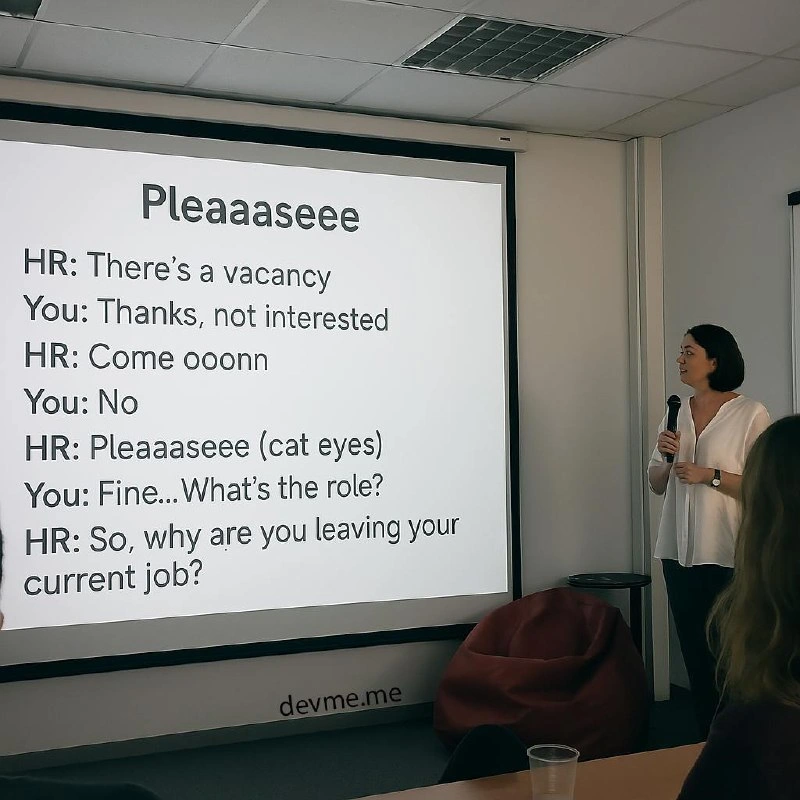
Let’s break down what’s happening in this meme in simpler terms. The scene is a conference room with a projector displaying a mock conversation between an HR person and a developer (labeled “You”). It’s highlighting a common experience in tech hiring. Here’s the play-by-play:

  • HR says, “There’s a vacancy.” This means a recruiter or someone from Human Resources is telling you there’s a job opening at their company. In tech, HR recruiters often reach out to developers even when those developers aren’t actively job-hunting. They’re basically saying, “Hey, we have a job available, are you interested?”

  • You respond, “Thanks, not interested.” You’re politely turning down the offer. Maybe you’re happy at your current job or just not looking for a change. This is candidate_resistance – a common initial reaction when you’re approached out of the blue about a job. A lot of developers, especially if they’re content in their role, will say “no thanks” when a recruiter first comes knocking.

  • HR pushes further: “Come ooonn.” Here, the recruiter isn’t giving up. The drawn-out “come on” implies they’re pleading or trying to convince you. This is classic recruiter persistence. Recruiters often have quotas to fill or are really eager to get good candidates, so they might try to persuade you a bit if you decline. Think of it like a friendly salesperson saying “Oh, but wait, there’s more!” They genuinely want you to just listen to the pitch for this job.

  • You still say, “No.” You’re holding your ground. At this point, you (the developer) remain uninterested. Maybe you really don’t want to move jobs, or you’ve had experiences with persistent recruiters before, so you’re cautious. It’s pretty common for tech folks to be skeptical when approached out of nowhere with a “great opportunity.” After all, if you’re not looking, switching jobs is a big deal.

  • HR goes all-in: “Pleaaaseee (cat eyes).” Now the recruiter is practically begging. The meme exaggerates it with “Pleaaaseee” and even notes “(cat eyes)” – referring to that wide-eyed, cute pleading look (imagine the cat from Shrek making the adorable big eyes). This is a humorous way to show the recruiter is really, really trying to convince you. It’s like when someone says, “Pretty please?” with a goofy, desperate face. Career recruiters sometimes do turn up the charm or persistency this much, especially if they believe you’re a perfect fit for the role or they have to fill the position urgently. It’s an InterviewHumor trope: the idea of an HR person practically on their knees saying “pleeeease” is obviously an exaggeration, but it captures how it can feel when they keep coming back trying to change your mind.

  • You finally give in: “Fine… What’s the role?” This line shows that the developer (you) has been worn down by the persistence. You basically sigh and say, “Okay, tell me about this job you’re so excited about.” In real life, this might happen after multiple messages or calls. Maybe the recruiter mentioned a great salary, a cool project, or some perk that piqued your interest. Or maybe you’re just curious what could be so great that they’re begging you. By saying “What’s the role?”, you’re agreeing to listen – you’ve moved from “not interested” to “okay, I’ll hear you out.”

Up to this point, the meme is painting a picture of a persistent recruiter who succeeded in getting a reluctant candidate to consider a job. This is actually pretty common in tech: many developers who weren’t job hunting end up interviewing somewhere because a recruiter convinced them to. It’s called being poached or headhunted – when a company actively pursues you even though you didn’t apply.

  • Then HR asks: “So, why are you leaving your current job?” Here’s the punchline of the meme. The moment you show interest, the recruiter (or often another HR person who is handling the formal interview) asks one of the most standard interview questions: “Why are you leaving your current job?” This is a pretty normal question in any job interview. They ask it to understand your motivation. Are you leaving for more money? For growth? Because you dislike your boss or the company? It’s an important question for HR to gauge if you’re a good fit or if you might speak negatively about your old job (which can be a red flag).

    But here’s why it’s funny: in this scenario, you weren’t planning on leaving your current job at all! You literally only considered this new role because the recruiter begged you to. So the question “Why are you leaving?” is completely out of place. The correct answer is, “Well, I wasn’t going to leave… you convinced me to!” The meme highlights the absurdity: the recruiter basically twisted your arm to get you interested, and now they’re acting like it was your idea all along and probing your reasons. It’s a huge irony in the hiring process.

For a newer developer or someone early in their career, here’s the context: once you agree to pursue a job opening, the process becomes like any normal job interview. Even if the company begged you to come, they’ll still ask you the typical interview questions. “Why are you leaving your current job?” is usually asked to see if you’re leaving on good terms and what you’re looking for in a new position. Interviewers love to ask this to understand your mindset. Normally, you’d answer with something like, “I’m looking for new challenges,” or “I want to grow my skills in a different environment,” or maybe “There’s no more room for growth at my current job.” Those are the kind of positive, professional answers people give.

However, in this meme’s story, you (the candidate) would have to come up with an answer on the spot that isn’t just “Because you asked me to leave my job!” It puts you in a weird spot. Even though the question is silly in context, you still have to play along in the interview. This is why experienced folks find it so comical – it’s a lose-lose situation for the poor developer. Either you tell the truth (“I wasn’t planning to leave until you persuaded me”), which doesn’t sound very driven, or you invent a reason for leaving a job that you actually had been totally fine at yesterday. Awkward, right?

So, to sum up this scenario in straightforward terms: a recruiter really wants an engineer to join their company. The engineer isn’t looking for a new job and says no. The recruiter pleads over and over until the engineer agrees to hear more. But the moment the formal interview process starts, the recruiter (or HR) treats the engineer like any other candidate and asks why they want to leave their current job – even though the only reason is that the recruiter pushed them to consider leaving. It’s a tongue-in-cheek commentary on how hiring works sometimes, especially in tech. The meme is tagged with things like HiringProcess and InterviewProcess because it’s pointing out a funny quirk in those processes. And anyone who’s been on the receiving end of a persistent recruiter invitation will likely read this and go, “Ha, yep, I can totally see this happening.”

Level 3: The Recruiter Paradox

This meme nails a situation that seasoned developers know all too well: the recruiter who relentlessly poaches you from a perfectly fine job, then switches to corporate autopilot the moment you say "yes." On the big screen we see a mock presentation:

HR: "There’s a vacancy..."
You: "Thanks, not interested."
HR: "Come oooonn..." (persistent recruiter_persistence)
You: "No."
HR: "Pleaaaseee" (complete with cat eyes desperation)
You: "Fine... What’s the role?"candidate_resistance defeated.
HR: "So, why are you leaving your current job?" 🤦‍♂️

It’s a classic CareerHumor scenario: HR begs an engineer to consider an opening, then immediately asks the InterviewProcess question “Why do you want to leave your current job?” as if it was all your idea! This absurd U-turn is the essence of the hiring_process irony that has every developer in the room facepalming. We’re looking at a poaching paradox – they entice you away and then demand you explain why you’re leaving.

Seasoned devs chuckle (or cringe) because we’ve lived this. It’s the Recruiter’s Script gone wrong: first they make you feel like a rockstar being wooed, then they put you through the same old HR checklist. It’s like a bait-and-switch for interviews. One moment the recruiter is offering you the world (with a pleading “Pleaaaseee” that no doubt triggers flashbacks of Puss in Boots doing puppy-dog eyes), and the next moment they’re staring at you across the interview table asking the very question that they effectively caused. The humor here is darker for experienced engineers – we recognize the corporate double-think. They want you so badly that they’ll practically beg to get you in the door, but once you’re in, they act as if you showed up out of some dissatisfaction with your old job. Talk about mixed signals!

Why is this so funny and frustrating? It highlights an anti-pattern in tech hiring: the left hand (recruiting) creates a scenario that the right hand (interviewing HR) pretends is normal. It’s a systemic disconnect in the HiringProcess. Recruiters often operate in full-on poaching mode – scouring LinkedIn, cold-emailing, even slipping into your DMs with promises of beanbags and big salaries. They’ll persist even when you’re perfectly happy where you are. (In the meme’s office scene, there’s literally a red beanbag by the screen – a subtle nod to the kind of startup perks recruiters love to hype.) A battle-hardened dev has seen this persistence first-hand: the friendly-but-insistent calls, the “Come on, just hear us out” appeals, the cat-eyes level cajoling. Eventually you think, “Fine, I’ll take the meeting if only to get them off my back.”

But then comes the switch. The moment you agree to talk, the process reverts to InterviewHumor 101. The recruiter (or another HR rep) launches into the standard script, treating you like any other candidate on the market. Hence the absurd question: “So, why exactly are you leaving your current job?” It’s delivered as if you strolled in looking for a change, not like you were dragged in by all that pleading. You can almost hear every dev in the room groan in unison. It’s the HiringProcess equivalent of writing a script that calls quitCurrentJob() and immediately after calls askReasonForQuit(). In code, it might look something like:

# HR's recruitment workflow in pseudocode
while candidate.is_happily_employed:
    recruiter.make_pleading_face(style="cat eyes")  # "Pleaaaseee"...
    if candidate.reply == "Fine...What's the role?":
        break

# Proceed to interview phase, as if this was all the candidate's idea
recruiter.ask(candidate, "So, why are you leaving your current job?")
# 🤦 The irony: HR begged them to leave, then asks why they're leaving.

It’s hilarious in the same way a bug in legacy code is: a logical oversight that anyone with context can spot. Here, the context (that the dev wasn’t job-hunting at all) gets lost in HR’s one-size-fits-all process. The result is pure InterviewHumor: a question that completely misses the point. The poor developer is thinking, “I’m not ‘leaving’ my job — you basically dragged me out of it!” But of course, in a real interview you have to bite your tongue and come up with some diplomatic answer about “seeking new challenges”, all while resisting the urge to roll your eyes.

From a senior engineer’s perspective, this meme also hints at the power imbalance and absurdity in corporate hiring. HR often has their checklist of questions (Why are you leaving? What are your weaknesses? Where do you see yourself in 5 years? etc.), and they’ll stick to it religiously, even if it doesn’t fit the situation. It’s like an algorithm that doesn’t check its inputs: if candidate_source != "actively_applied" is not handled, you get nonsense output. The recruiter was so fixated on filling that vacancy that they ignored the context of how and why the candidate came to the table. It’s a recruiter_persistence success followed by an employment_negotiation_irony failure.

In real life, many of us have dealt with this irony. You get that enthusiastic call from a recruiter when you weren’t even looking, and after a few rounds of “Come on, just meet the team, we really think you’re a fit”, you cave. Then you join the interview Zoom (or walk into their office) and someone from HR asks, “So, what made you start looking for a new job?” At that moment, you can only laugh inwardly. The truthful answer is, “I wasn’t looking — you came knocking!” But saying that outright might sound snarky, so you spin something about growth or new opportunities. It’s a ridiculous little dance we do in the tech industry. The meme captures that dance in one slide and leaves every experienced dev smirking.

Ultimately, the humor lands because it’s too real. It satirizes the disconnect between how desperately companies chase talent and how clumsily their processes handle that chase. The recruiter in the meme literally begs like a kid in a candy aisle (“Pleaaaseee!”), then instantly flips to the role of austere interviewer, essentially asking, “So, why are you disloyal to your current candy store?” The seasoned folks in the audience recognize this duality and likely swap war stories: “Yep, had a recruiter hound me for weeks and then ask me that exact question in the interview. Classic.” It’s funny, a bit depressing, and absolutely on point. This is the kind of HiringHumor that makes you nod in agreement while chuckling at the insanity of it all.

Description

The image captures a presentation slide at a tech meetup. A woman in a white blouse stands to the right, holding a microphone and presenting. The slide, projected onto a large screen, has a title "Pleaaaseee" and displays a satirical conversation between an HR recruiter and a developer. The text reads: "HR: There’s a vacancy. You: Thanks, not interested. HR: Come ooonn. You: No. HR: Pleaaaseee (cat eyes). You: Fine… What’s the role? HR: So, why are you leaving your current job?". A watermark "devme.me" is at the bottom of the screen. The joke satirizes the common experience of senior developers being relentlessly pursued by recruiters, only to be met with generic, scripted questions that ignore the fact that the developer wasn't actively looking for a job. It highlights a disconnect in the recruiting process where the initial outreach is aggressive, but the follow-up is impersonal and fails to acknowledge the context
Comments

7
Anonymous ★ Top Pick This is the recruiter equivalent of a function that takes a null argument, ignores the null check, and immediately throws a NullPointerException by asking `.whyAreYouLeaving()`
  1. Anonymous ★ Top Pick

    This is the recruiter equivalent of a function that takes a null argument, ignores the null check, and immediately throws a NullPointerException by asking `.whyAreYouLeaving()`

  2. Anonymous

    Recruiter pipeline: DDoS my inbox like a fire-and-forget message queue, coax me onto a Zoom, then open with “So why are you leaving your current job?” - buddy, if your hiring flow ignores back-pressure this hard, imagine prod

  3. Anonymous

    After 15 years of 'exciting opportunities with competitive salaries,' you've learned that HR's definition of 'urgent hiring need' mysteriously transforms into a 6-month interview process the moment you show interest - right after they've already extracted your entire employment history, salary expectations, and why you're not 100% fulfilled in your current role

  4. Anonymous

    The real tragedy here isn't the recruiter's persistence - it's that after finally wearing you down with 'cat eyes' and getting you to ask about the role, they immediately pivot to 'why are you leaving your current job?' as if you initiated this whole dance. It's the recruiting equivalent of a circular dependency: they need you to want to leave to justify the hire, but they also need you to not want to leave to prove you're not a flight risk. Classic O(n²) interview complexity where n is the number of contradictory signals they're trying to extract

  5. Anonymous

    Classic recruiter RPC: retries 'no' with exponential backoff, then runs an exit interview on a system that hasn’t initiated shutdown - protocol violation

  6. Anonymous

    Recruiter protocol: they want your commit message before they show you the diff

  7. Anonymous

    HR's pitch: Beg like a leaky abstraction, then probe your current job's tech debt - efficient context switch to exit interview

Use J and K for navigation