When you forget to rate limit the 'like' endpoint
Why is this Automation meme funny?
Level 1: Magic Internet Points
Imagine you and your friends are in a big classroom where everyone can give each other thumbs-ups if they like something you did, or thumbs-downs if they don’t. Now picture one kid shows a super simple magic trick – let’s say he just snaps his fingers – and then somehow gets 167,000 thumbs-ups from the class, and only about 1,100 thumbs-downs. 😮 That number is huge – it’s like the whole school, plus all their cousins, plus a small city, all giving a thumbs-up for something really tiny. It’s so over-the-top that you just know something weird is going on. Maybe the kid secretly hooked up a machine to spam the “like” button, or he convinced an army of robots to all clap for him. In any case, it’s clearly not a normal situation!
The joke here is about those “magic Internet points” that people get for posts online – kind of like getting stickers or gold stars from everyone on the web. In this picture, the code snippet (just a little piece of computer instruction) has an unbelievably high score of likes. It’s like if a student turned in one short sentence of homework and got thousands and thousands of reward stickers for it. Pretty funny, right? We all know one sentence of homework doesn’t usually earn a truckload of praise. So the humor is in the ridiculousness: it’s making fun of how on the Internet, sometimes people care too much about these like counts or can even cheat to make the number go up. Those thumbs-up and thumbs-down buttons are there to show if something is good or not, but seeing a number that big for something so small is like seeing someone brag that they scored a billion points in a video game by using a cheat code. It makes you chuckle because it’s so exaggerated.
In simple terms, the meme is saying: “Look how silly it is to have so many likes on a little bit of code!” It’s poking fun at the idea that these points (the likes and dislikes) are kind of make-believe. They’re fun to collect, but if you see a result that’s clearly unreal, you realize it’s just a game. Even the person who wrote about it joked that someone must have “abused the like button” with bots – meaning it’s as if robots were clicking “like” non-stop to pump the score up. So, it’s a goofy picture that makes developers laugh, because it reminds us not to take those internet points too seriously. After all, getting 167,000 people clapping for one line of code is as fantastical as a dragon in a school play – it catches your eye, but you know it’s not real!
Level 2: Karma Points 101
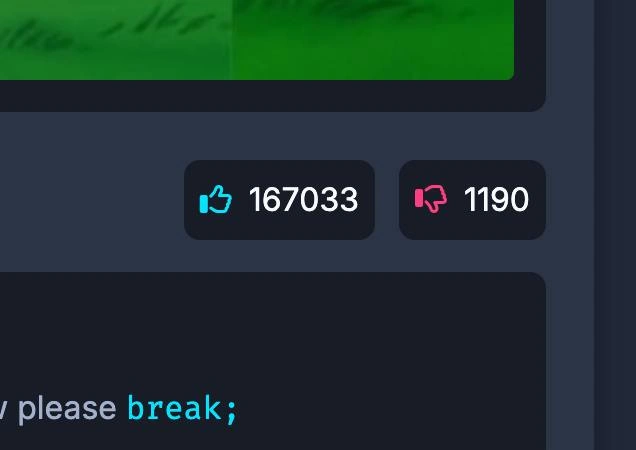
Let’s unpack the scene in a more straightforward way. What we have is a screenshot of a voting interface, common in many programmer communities (think Stack Overflow, Reddit’s programming boards, or other dev Q&A forums). There are two pill-shaped counters side by side. The cyan thumbs-up icon with the number 167033 next to it indicates the number of upvotes (likes) that a particular piece of content – here a code snippet – has received. The magenta thumbs-down icon with 1190 next to it shows the number of downvotes (dislikes). In plain terms, 167,033 people (or clicks) said “This code snippet is good or useful,” while 1,190 said “I don’t like this or it’s not helpful.” That is a huge difference! For roughly every 140 users who gave a thumbs-up, only 1 gave a thumbs-down, which is an insanely positive ratio.
In developer forums like Stack Overflow, users earn reputation or karma points when others upvote their contributions. It’s a form of online_reputation system: the more upvotes you get on your answers or posts, the higher your score. This score is often visible on your profile and can grant you privileges on the platform (for example, high-rep users can moderate content, edit posts, etc.). It’s also a bit of a status symbol – a high score means you’ve contributed a lot of helpful content (at least in theory). Karma points (a common term on Reddit) or rep points are essentially an internet scoreboard for how much the community appreciates your content. They don’t have tangible value (you can’t buy a coffee with Stack Overflow rep), but within the community, they’re a rough measure of trust and contribution. Think of it as getting gold stars in school for good behavior or correct answers – get enough stars and everyone knows you’re a good student. In the context of DeveloperExperience_DX, these points are supposed to enhance the experience by highlighting reliable contributors and making the community self-moderating.
Now, realistically, a number as high as 167k upvotes on a single piece of code is extremely unusual. Even the most famous answers on Stack Overflow — like the canonical “How to exit Vim” joke, or highly useful answers about common programming pitfalls — rarely reach such stratospheric vote counts. We’re talking maybe ten thousand, perhaps a bit more over a decade. 167,033 upvotes goes beyond “popular”; it’s bordering on implausible. That’s a clue that this image is a joke (or that something fishy happened). It’s likely a deliberate exaggeration to make a point, or possibly a real screenshot where someone manipulated the votes. The post’s text strongly hints at manipulation: phrases like “abuse that like button” and using bots to click those buttons “24/7” indicate the author suspects (or jokes) that this score was achieved by artificial means.
Let’s talk about bots in this context. A “bot” is just a script or program that performs automated tasks online, often mimicking a human user. For example, a bot could be programmed to log into a website and upvote a post repeatedly, or it could create thousands of fake accounts to each cast an upvote. Most well-run communities have safeguards against this kind of cheating (like rate limits, CAPTCHAs, or detection algorithms for unusual activity patterns). But if someone says “finally someone made a bold move to abuse the like button,” they’re implying that a person actually went ahead and found a way to inflate the score despite those protections. The second line, about running bots 24/7, doubles down on that idea: it humorously suggests setting up an army of automated scripts clicking the thumbs-up non-stop. If one bot can do it, why not many, around the clock? It’s a playful “what if” that underscores how meaningless these counters become if you can’t trust that real people are behind the votes.
For a newer developer or someone not familiar with these community systems, the meme is basically highlighting a quirk of Developer Communities: the obsession with and absurdity of internet points. We often joke about “meaningless internet points” because, outside of the platform, those upvote numbers don’t directly translate to real-world benefits. They won’t get your code to compile or make you a better coder by themselves. They’re there to encourage participation and thank people for help. But sometimes people start chasing the points for their own sake — that’s called karma farming. It can lead to strange behaviors: like answering common questions in superficial ways just to get upvotes, or gaming the system in unethical ways. Here, the snippet’s insane score looks like the result of someone literally gaming the system. It’s as if a prankster found a way to slam the “Like” button tens of thousands of times and hardly anyone (or no automated system) caught it.
The presence of the lone code line break; in the snippet adds to the humor. In many programming languages, break; is a simple statement that exits a loop or switch case. It’s not some earth-shattering algorithm – it’s actually one of the most basic, unglamorous pieces of code (often taught in beginner lessons on loops). Showing just break; getting this tidal wave of approval is absurd. It’s like posting a super simple tip (“turn your computer off and on again”) and receiving a standing ovation of 167k people. It’s relatable humor because every developer has seen newbie posts or very simple answers sometimes get more attention than they perhaps deserve, due to timing or human psychology. We can imagine a scenario: maybe someone posted a snippet with break; as part of a larger joke or meme, and it went viral in a community as an in-joke. The developer in-joke angle might be that break; “broke” the internet (or broke the voting system). The coloring (bright turquoise text on navy background) resembles many modern code editors’ syntax highlighting, which gives it an authentic feel. It looks exactly like a snippet you’d see on a forum or in documentation, lending a bit of realism to an otherwise unrealistic situation.
In essence, for a junior developer or someone new to these platforms, the meme is saying: “Look how silly it can get. This one little piece of code got an outrageously high score in likes, which probably means someone cheated or it’s a joke about how these scores can be exaggerated.” It’s teaching implicitly that upvotes/downvotes are just a popularity metric, not an absolute measure of code quality. And it’s also a lighthearted caution: don’t take these thumbs_up_icon/thumbs_down_icon tallies too seriously, because under the hood they might not always be as organic as they seem. Even if not actually cheated, even real high scores often come from a content going viral due to humor or timing rather than pure technical merit. The community finds this funny because we all recognize the grain of truth: online, sometimes the scoreboard has a life of its own, separate from the real value of what’s being scored.
Level 3: Reputation Overflow
At first glance, this screenshot is showing off an almost comically lopsided upvote_ratio – a code snippet with 167,033 thumbs-ups to just 1,190 thumbs-downs. In developer communities like Stack Overflow (and similar Q&A or snippet-sharing sites), seeing a ratio that skewed is like spotting a unicorn in production. Normally, even brilliant answers or useful code snippets might gather a few hundred upvotes over many years. But 167k upvotes? That’s astronomical. It hints that something unusual (or outright fishy) is going on under the hood. The code snippet itself appears to contain only a single discernible line, break;, glowing turquoise in a dark editor theme. That’s it – a lone break statement seemingly garnering more internet points than a decade’s worth of top-voted answers.
To seasoned developers, this is ripe for DeveloperHumor. We recognize the satire here: the snippet is “flexing” an absurd score, poking fun at our community’s obsession with karma_points and reputation. On platforms like Stack Overflow, each upvote on your answer boosts your online_reputation (a number that’s supposed to indicate trust or contribution level). Get enough upvotes, and you earn badges, privileges, and nerd cred. It’s a gamified system – part helpful, part ego-stroking. So when a trivial snippet (literally just a break; statement) flashes 167k likes, it’s highlighting how these systems can be gamed or rendered meaningless. It’s the equivalent of someone finding a cheat code to rack up points on the scoreboard without actually achieving something useful.
The disparity between the cyan thumbs_up_icon count and the magenta thumbs_down_icon count is the visual punchline. Typically, content that polarizes people will have a more balanced ratio, or at least the absolute numbers won’t be six figures. Here, the massive popularity (over a hundred sixty thousand upvotes!) combined with the relatively tiny number of downvotes implies either God-tier genius or, more plausibly, some tongue-in-cheek shenanigans. Given the meme’s caption about abusing the like button and running bots 24/7, we’re clearly leaning towards shenanigans.
Why is this funny to us devs? Because it satirizes our DevCommunities and their reward systems. We’ve all seen users who chase reputation like it’s the holy grail, or posts where an answer gets disproportionate attention due to timing or hype. The meme exaggerates this to an absurd extreme – a snippet “breaking” the upvote counter (appropriately, with a break; inside!). It ridicules the idea that these internet points have any real value. A Cynical Veteran developer might chuckle darkly here: “Sure, kid, go ahead and brag about your 167k karma. Let’s see if those points fix the 3 AM server outage.” In other words, high reputation on a site doesn’t always translate to real-world coding prowess, and obsessing over it can be a meaningless vanity exercise.
The commenter says, “Finally someone made a bold move and started to abuse that like button.” This implies that an individual possibly wrote a script or found a loophole to send a flood of upvotes to this post – basically a bot army clicking the thumbs-up relentlessly. It’s described as a bold move with a tone of mischievous admiration because it’s so blatant. The community has long been aware that these like systems could be gamed, but most folks don’t actually try to blatantly break them (either out of ethics or fear of getting caught by anti-abuse measures). Here someone did, and the result is this outrageous score. The follow-up quip, “Still waiting for someone to run a few bots clicking those meaningless buttons 24/7 :D”, doubles down on the joke: why not go all-in and have automated scripts 24/7 inflate karma points ad infinitum? It’s a tongue-in-cheek way of saying “these points are so silly that I half-hope someone fully blows up the system to prove it.”
From a slightly serious engineering perspective, there’s also an ironic truth: systems like these rely on rate-limiting and anti-bot verification to keep votes honest. If those safeguards fail (or someone finds a way around them), you truly could inflate scores artificially. This meme tickles that idea – it’s a mini “what if” scenario illustrating a dev community feedback loop gone haywire. It’s StackOverflow meets Black Mirror: the ratings have detached from reality. And if you look at the numbers, you might even do a double take – is that a real vote count or did an overflow bug print an extra digit? (167k is suspiciously high; one could joke that some junior dev accidentally hardcoded these values to test the UI and it slipped into a screenshot).
In sum, the humor operates on multiple levels for an experienced dev: it mocks the absurdity of online reputation, highlights how easily these metrics can lose credibility, and winks at all the times we’ve seen trivial posts oddly get tons of attention. It’s a reminder that in developer forums, just like in real life, the loudest applause isn’t always proportional to the quality of the performance – sometimes it’s just an act of trolling or gaming the system. And as veterans, we can’t help but smirk because we’ve seen it all before: the hype, the karma farming, the bots, the backlash. This meme distills that entire cycle into one image of a ridiculous thumbs-up count next to a humble little break; line.
// Hypothetical "bold move" script: abusing the like button via bots
for (let i = 0; i < 167033; i++) {
clickButton("thumbs_up"); // Bot clicking like 167k times (just kidding... or am I?)
}
Description
This is a close-up screenshot of a user interface, likely a social media or content platform, with a dark mode theme. It features two prominent buttons for user reactions: a cyan 'thumbs up' icon with a massive count of 167,033, and a magenta 'thumbs down' icon with a much smaller count of 1,190. Below these buttons, a fragment of code is partially visible. The caption provided for this image was: "Finally someone made a bold move and start to abuse that like button. Still waiting for someone to run a few bots clicking those meaningless buttons 24/7 :D". The technical humor comes from the implication that the absurdly high 'like' count is not organic but the result of a script or bot repeatedly hitting an API endpoint. This scenario is relatable to senior developers who have to design systems resilient to such abuse, often by implementing measures like rate limiting or CAPTCHAs. It serves as a commentary on the vanity of engagement metrics and the ease with which they can be manipulated
Comments
23Comment deleted
The frontend shows 167k likes, but the backend logs show one IP address, a cron job, and a comment saying '// TODO: Add rate limiting before this goes viral'
167 033 up, 1 190 down - turns out leaving “bypassRateLimit=true” enabled in prod is the quickest A/B test for your bot detector
After 167,033 iterations, even the loop itself started upvoting the break statement out of sheer exhaustion - proving that sometimes the real O(n) complexity is the emotional damage we accumulate along the way
When your Stack Overflow question about semicolons gets 167k upvotes, you know you've either solved the P=NP problem or asked 'Why does my JavaScript work without semicolons?' The ratio suggests this developer discovered the ancient secret: the community's collective trauma over missing semicolons transcends all programming languages, frameworks, and even that one time someone suggested Python's whitespace sensitivity was 'intuitive.'
That 167,033 upvotes is what happens when a non-idempotent Like API meets an auto-retrying client and React StrictMode double-invokes your onClick
167,033 👍, 1,190 👎 - PM calls it “validated.” The diff is one line: break; We didn’t fix the feature, we shipped a circuit breaker for our vanity metrics
167k upvotes prove 'v; break;' scales better than any microservices refactor
I'm too lazy to do that thing Comment deleted
принято Comment deleted
Please, refrain from usage of any language besides English in dev meme 🙏 Comment deleted
No problem Comment deleted
это где Comment deleted
Please, refrain from usage of any language besides English in dev meme 🙏 Comment deleted
Just dropped by devme.me & added another 100+ likes.😌😂 Comment deleted
Nice! Comment deleted
look at the counter now Comment deleted
I will say; people up to this point have had zero talent for spamming APIs. why do I have to be the bringer of chaos? Comment deleted
got 1M likes now 🔥 Comment deleted
ok but … that doesn't persist Comment deleted
Who said that it’s gonna be plain easy tho? 🌚 Comment deleted
Where is that? Comment deleted
I'm also curious where's that going on. Tag me too, please 🫶 Comment deleted
@Diotost @SoutHora what do you mean? It’s on main page of devme.me Comment deleted