The Two Conflicting Gods of Software Development
Why is this CodeQuality meme funny?
Level 1: Stuff It or Sort It
Imagine you’re cleaning your room. You have toys and clothes scattered everywhere. You’ve got two ways to deal with this (two moods):
Quick and easy way: You take everything and stuff it under your bed or throw it all in the closet. Boom, the room looks clean in just a few minutes! 🎉 You didn’t worry about sorting anything or finding the right place for each toy; you just wanted the room to look clean as fast as possible. This is like the left side of the meme: “just do the easiest thing.” You got a quick result (a “clean” room), but later when you need that one toy or your favorite shirt, you’ll have a hard time finding it in that hidden mess. And if someone opens the closet… uh-oh, chaos falls out! In coding, that’s what happens if you only do things the easy way – you might hide problems for later.
Slow but perfect way: You pick up each item and put it exactly where it’s supposed to go. Legos go in the Lego box, dirty clothes go in the hamper, books back on the shelf in order. You even label the shelves maybe. Your room ends up super neat and organized, like one of those fancy showroom pictures. This takes a lot longer, though. Maybe it takes you the whole afternoon to finish. This is like the right side of the meme: “optimize everything to the last bit.” In coding terms, you made sure every part of the code is as perfect and efficient as possible, even if it took more time. Later it will be easy to find any toy (or in code, easy to run on any computer, even a weak one like a simple gadget), but you missed out on doing other things while you were busy organizing.
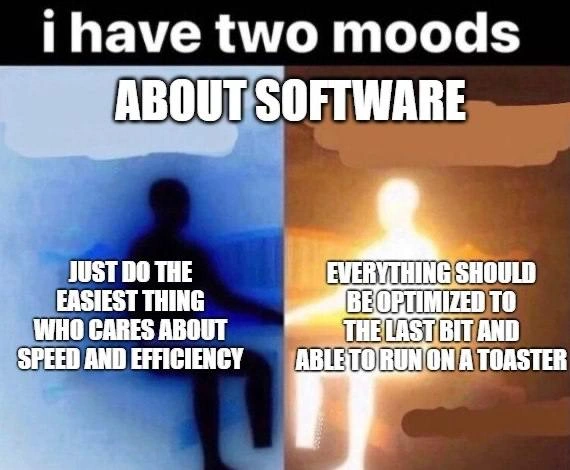
The meme is funny because developers (the people who write software) often feel like they have these two opposite moods when working. One mood is “Eh, just get it done, I don’t care if it’s messy” (like shoving stuff under your bed). The other mood is “I must make this absolutely perfect even if it takes forever” (like sorting and optimizing every little thing). Of course, in real life, the best approach is usually somewhere in the middle: you tidy up your room reasonably well (put most things where they belong, but you don’t need to color-code your socks!), just like a coder should write good clean code but not waste days making it ultra perfect when it’s not needed. The humor comes from recognizing that feeling when you suddenly switch from one extreme to the other. One day you might be lazy about a task, and the next day you’re overly meticulous about it. Seeing those two contrasting silhouettes (a slouchy blue figure and a glowing golden figure) with their bold statements is like seeing two sides of our own mind arguing. Even if you’re not a programmer, you can relate: sometimes you do things just well enough, and other times you go extra and overdo it. The meme just shows that in a fun, exaggerated way about software. It makes us laugh and maybe nod our heads, because yep – we’ve all been there, torn between “good enough for now” and “make it the best ever.”
Level 2: Tech Debt & Toasters
Let’s break down the terms and ideas for newer developers. First, technical debt (tech debt for short) is a metaphor in software: it’s like financial debt, but instead of money, you “borrow” time by taking shortcuts in code. For example, if you write code “the easy way” without thinking about efficiency or clarity, it’s quick now (you saved time, like taking a loan), but the code might cause problems later (you’ll “pay it back with interest” when you or someone else has to fix or improve that messy code). The left side of the meme – the blue, slouched figure saying “Just do the easiest thing, who cares about speed and efficiency” – is basically embracing technical debt. This mood values immediate convenience over future-proof design. It’s like saying, “I don’t care if this function is slow or the code is ugly; I just need it to work right now.” In development, that might mean writing a super simple solution that works for now but might not scale if there’s more data, or might be hard to maintain. This side isn’t thinking about PerformanceOptimization or CodeQuality at all. It’s the mood you might be in when you’re rushing to meet a school project deadline or a sprint goal: you prioritize finishing something that works over making it good. We’ve all written a quick for loop or a brute-force solution that isn’t elegant but got the job done. Maybe you repeat some code instead of refactoring it into a function because copying and pasting was faster (code duplication – a common result of the “just hack it” approach). The attitude is “if it ain’t broke (right now), don’t fix it.” The tech debt here is that later on, those quick fixes can make the codebase confusing or inefficient, and someone (maybe future you) will have to spend extra time to clean it up or optimize it properly. In simple terms, you saved time today by ignoring best practices, but you might spend more time tomorrow dealing with the consequences.
On the other side, we have the glowing figure proclaiming, “Everything should be optimized to the last bit and able to run on a toaster.” This is an exaggeration of a performance fanatic. What do we mean by “optimized to the last bit”? In computing, a bit is the smallest unit of data (a 0 or 1). So this phrase means making the software as efficient as absolutely possible, down to the tiniest details. An example would be using bitwise operations or very low-level code tricks to make a program faster or use less memory. For instance, imagine you want to count even numbers in a list. The easy way: use a loop in Python and just check each number with if num % 2 == 0. A micro-optimizing person might say: “I can do it faster by using bitwise AND: if num & 1 == 0 (which checks the last bit of the binary representation). That saves a few CPU cycles!” In a normal context, that’s overkill – the speed difference is tiny and the bitwise check is harder to read for someone unfamiliar with that trick. That’s what we call overengineering: adding complexity (like a clever bit trick) that isn’t truly necessary for the requirements at hand. The mention of a toaster is a joke: a toaster doesn’t literally run software (most just have simple circuits). Saying “it can run on a toaster” means your code is so efficient and lightweight that even a device with extremely low computing power (like a hypothetical “smart toaster” with a tiny processor) could run it. It’s an extreme benchmark for optimization, akin to saying “my code is so optimized, it could probably run on a potato battery” (another common joke meaning the code can run on ridiculously low power). This right-side mood is all about PerformanceTradeoffs taken to the extreme opposite of the left side: it sacrifices developer time and simplicity to make the program as lean and fast as possible. A developer in this mood will spend hours or days tweaking code to use less memory or run faster, even if the original version was already “fast enough.”
For a junior developer, it’s important to understand both code quality and performance, and how they trade off. Good CodeQuality often means code is easy to read, maintain, and extend. The left approach (just do the easiest thing) might give you okay code quality if “easiest” means simple and clear, but often it can mean messy shortcuts (like hardcoding values, lack of structure, no comments) which hurt code quality. The right approach (optimize everything) often harms code quality because extremely optimized code can become very complex and hard to understand. Think about it: if you try to optimize “to the last bit”, you might write some crazy complex logic or use a low-level language like C or Rust instead of a simpler language like Python. That code might run faster, but a new developer reading it might struggle to figure out how it works, or how to modify it. That’s a maintainability issue.
A classic beginner question is, “Should I write code that’s easy or code that’s fast?” The seasoned answer is usually, “First, write code that’s correct and clear. Then, optimize if you need to.” There’s a well-known saying: “Make it work, make it right, then make it fast.” The meme essentially shows a person skipping to either “make it work” (and never making it right or fast) or jumping straight to “make it fast” (possibly at the expense of simplicity). Both are exaggerated. In reality, if you always do the left thing, your software might become slow or expensive to run (e.g., using too much CPU/cloud time, which can literally cost money), or it might break when scaling up to more users or data. If you always do the right thing, you might never finish projects on time, or you could waste effort optimizing parts of your program that don’t impact users noticeably. For example, imagine you’re programming a simple game. The easy approach: use straightforward logic, maybe some built-in game engine physics, and you get a playable game quickly. It might not run on a 20-year-old computer, but it runs fine on any normal PC. The over-optimized approach: you decide to write the entire physics engine from scratch in assembly language to make sure it could, in theory, run on a computer from 1995 – but this took you months and the game itself didn’t get new features in that time. Most players wouldn’t see a difference, since their modern computers handle the unoptimized version well. See the difference? It’s all about context. The meme is funny to developers because it exaggerates these two states of mind that we toggle between. Sometimes we joke, “my code isn’t pretty but it works” when we’re in rush mode. Other times we joke, “I bet I can make this so efficient it’ll run on a toaster, haha,” when we catch ourselves obsessing over small optimizations. Knowing when to clean up code and when to optimize is something you learn with experience. The truth is usually in the middle: write clean code, but keep an eye on performance where it matters. And yes, it’s okay to laugh at yourself when you catch your brain switching into either the lazy mode or the over-engineer mode — it happens to the best of us!
Level 3: Cutting Corners vs Counting Cycles
Why do developers find this meme so spot-on? Because it captures an internal pendulum swing that most of us have experienced. On one end, there’s the “just ship it” attitude (the blue half): you’ve got a feature to deliver, or a bug to patch, and there’s no time (or will) for elegance. You hack together the simplest solution that appears to work. Maybe you copy-paste some code from Stack Overflow, maybe you hardcode a value that should be calculated, or you write a loop in the most straightforward (but not efficient) way. You know you might be incurring technical debt – essentially creating future maintenance problems – but today’s deadline or the pressure to show progress is weighing on you. This is the Cutting Corners side: you cut through the problem like a machete through jungle, not caring what undergrowth (mess) is left behind. Every senior developer has done this at least once, often with a nervous glance at the clock on a Friday afternoon. “It’s okay, we’ll refactor it later,” we tell ourselves, knowing full well that “later” might never come. The humor (and pain) here is that we collectively recognize how those quick fixes accumulate into monstrous technical debt that haunts us in future sprints. Entire codebases have turned into Jenga towers of fragile hacks because of this easiest thing first mentality. That’s why the left figure looks slouched and perhaps guilty – we know when we write something sloppy just to get by, and we do it anyway when circumstances push us.
Now swing to the opposite extreme – the golden, radiant right half, the Counting Cycles side. This is the mood where a developer goes full throttle on optimization, often beyond what’s sane or necessary. It’s the mindset that says no to any compromise on performance or resource usage. We’re talking about the colleague who insists on rewriting a Python script in C because the Python version used 50 MB more memory – even if it still ran in under a second. This is where PerformanceOptimization overshadows all other concerns like readability, development time, or sometimes even actual need. In team meetings, this is the engineer arguing that “if we refactor this module in Rust and use SIMD instructions, we can reduce latency by 5 milliseconds”, while everyone else is like “Umm, our API response is already quite fast and users won’t notice 5ms.” It’s funny because many of us can recall being in overengineering rabbit holes, optimizing something to perfection that didn’t need to be perfect. Perhaps you spent an entire day micro-optimizing a piece of code inside a loop – using bit shifts instead of multiplication, pre-allocating arrays, unrolling loops – only to find you improved the runtime by, say, 2%. Meanwhile, you could have achieved a 50% improvement by choosing a better algorithm or simply caching a result. Performance trade-offs often follow the 80/20 rule: 80% of the runtime comes from 20% of the code. The guru on the right, however, is treating 100% of the code as if it’s performance-critical – an overkill strategy that leads to a lot of wasted effort. The phrase “able to run on a toaster” is a tongue-in-cheek way of saying “we must optimize until the software is so lightweight and efficient that even a kitchen appliance’s tiny computer could handle it.” It brings to mind humorous feats like hackers getting Doom (a 90’s video game) to run on absurd devices (calculators, fridges, even toasters with screens). It’s gloriously geeky and pointless – much like extreme optimization can be in typical projects.
The meme strikes a chord because real software development oscillates between these two poles, and finding the balance is hard. In a fast-paced startup, you might live on the left side: crank features out fast, cut corners, and say “we’ll optimize later, if users complain.” Here, CodeQuality often takes a backseat. Startups accumulate piles of messy code (tech debt) for speed – it’s almost a survival tactic. In contrast, in domains like embedded systems, game engines, or high-performance computing, you sometimes must inhabit the right side: every byte and CPU cycle is precious. I’ve seen senior engineers working on embedded firmware who literally examine compiler assembly output to ensure the code can run in a few kilobytes of memory. They do talk about code running on toasters without irony, because maybe they’re coding for a smart toaster or an IoT sensor with similar constraints! But here’s the kicker: even those folks know you can’t optimize everything. They profile, find the critical sections, and optimize those ruthlessly, while keeping less critical code simple for sanity’s sake.
So the laughter here is a bit knowing: we laugh because we recognize these extremes in ourselves. One day, you wake up determined to be a clean-code champion, writing straightforward, well-structured code and not worrying about minor inefficiencies (“who cares about speed, as long as it’s easy to maintain!”). The next day, you might drink a strong coffee, read an article about how Facebook saves 100 million CPU cycles by tweaking C++ allocations, and suddenly you’re combing through your code looking to shave off microseconds (“let’s make this so slick it could run on a potato-powered Arduino!”). It’s borderline comic-inducing how we can go from “just commit it already” to “I will refactor this four times to save 0.001 MB of memory”. The meme distills that schizoid developer mindset into a simple visual: a slacker silhouette vs. a golden zealot. And every experienced dev has a story from both sides. We’ve all had crunch times where shipping something that works was the priority (and later we prayed it wouldn’t fall over in production 😅). And we’ve had moments where we got nerd-sniped by an optimization problem that nobody else cared about, but it mattered to us. This is classic developer humor because it’s an exaggerated reflection of real dilemmas in coding: the eternal PerformanceTradeoffs between doing it fast (to develop) and making it fast (to run). The fact that the meme labels it as “two moods” implies it’s often the same person swinging between lazy TechnicalDebt acceptance and obsessive PerformanceOptimization. That duality is hilarious and painfully true. No wonder every senior engineer smirks at this – we’ve lived both extremes, sometimes in the same week!
Level 4: Bitwise Enlightenment
At the deepest level, this meme touches on the core of software performance vs. simplicity—a tension known to any seasoned programmer. The glowing figure on the right (our performance guru) embodies a near-spiritual obsession with efficiency, akin to achieving enlightenment by mastering each bit and CPU cycle. This is the developer who will micro-optimize inner loops in assembly, manually manage memory, and count CPU instructions as if each were gold. They think about how code interacts with the machine at the lowest levels (hence “to the last bit”). Ever heard of code being “close to the metal”? That’s this mindset: minimizing abstraction so the program runs blazingly fast on even the tiniest hardware. It’s the kind of thinking that produces a sorting algorithm implemented with hand-tuned bitwise operations, or game developers who squeeze a whole graphics engine into 64 KB for a demo scene. It’s how you’d code if you literally needed it to run on a toaster’s microcontroller. A toaster might have a tiny 8-bit CPU and a few kilobytes of RAM – about as powerful as a 1980s home computer – so running modern software on it would require extreme optimization. The joke “able to run on a toaster” is a hyperbole for code so efficient it could run on anything, no matter how underpowered. This is performance overengineering pushed to the max.
On the other extreme, the blue shadowy figure on the left represents the ultimate quick-and-dirty approach. This developer’s mantra is “make it work, who cares how”. From a computer science perspective, this is like ignoring algorithmic efficiency entirely. Need to sort a million items? Sure, just slap in a bubble sort of $O(n^2)$ complexity because it was easiest to write, and hope no one notices the slowness. The left-side mood skips any form of analysis or optimization. It’s all about shortest path to functionality: use the highest-level abstractions, maybe an inefficient library call, maybe brute force the problem—whatever is simplest to implement. The code might end up doing tons of redundant work or using way more memory than necessary, but it works today. This approach thumbs its nose at Big-O notation and hardware limitations. If the code runs in 5 seconds instead of 0.5? Meh, it’s good enough if it saves the developer an hour of thinking. In theoretical terms, this is like prioritizing developer time over computational time to an extreme degree.
The humor emerges from the absurd gap between these two philosophies, taken to their logical limits. At one end, we have a borderline academic pursuit of perfect efficiency—think of deep topics like optimizing cache locality (to avoid cache misses and exploit CPU caching hierarchy), minimizing branch mispredictions, or even ensuring code is vectorized to utilize SIMD instructions. These are legitimate concerns in systems programming, high-frequency trading, or embedded systems (indeed, in places where running on a proverbial toaster isn’t far from reality!). There’s an underlying nod here to Donald Knuth’s famous adage: “Premature optimization is the root of all evil.” The right side character doesn’t just prematurely optimize; they want to finalize optimize everything, upfront, down to the last byte of memory and last CPU cycle. It’s optimization as a way of life. Meanwhile, the left side is essentially saying, “Don’t optimize at all—ever.” From a pure CS theory standpoint, both extremes miss the sweet spot. Modern best practice is to first write a correct, clear solution, analyze its performance, then optimize the hot spots (the parts that actually matter). There’s even another principle at play: Amdahl’s Law, which reminds us that optimizing one tiny part of a program has diminishing returns if other parts dominate the runtime. The enlightened performance tuner might hand-refine a function that’s only 5% of the execution time, yielding almost no real-world improvement – a classic case of misdirected effort. Conversely, the quick-and-dirty coder might let an $O(n^2)$ algorithm slide in a performance-critical area, causing the whole system to crawl with large inputs. In essence, this meme humorously exaggerates a real computational trade-off: algorithmic efficiency vs. development efficiency. It’s like the two personas are debating a fundamental computer science question: Is it better to spend more human time to make the code faster for the machine, or vice versa? The answer in practice is a balancing act – but this meme portrays the entertaining scenario where a developer’s mindset quantum-flips between the two extreme answers, zero balance whatsoever.
Description
A two-panel meme format illustrating the conflicting mindsets of a software developer. The top text for the entire image says, 'i have two moods ABOUT SOFTWARE.' The left panel has a cool, blueish tint and shows a dark, shadowy silhouette of a person sitting. The text over this panel reads, 'JUST DO THE EASIEST THING WHO CARES ABOUT SPEED AND EFFICIENCY.' This represents the pragmatic, deadline-driven approach of shipping code quickly, often at the cost of quality or performance. The right panel is its opposite, glowing with a warm, golden light, showing a luminous, transcendent figure. The text here reads, 'EVERYTHING SHOULD BE OPTIMIZED TO THE LAST BIT AND ABLE TO RUN ON A TOASTER.' This captures the idealist, perfectionist drive for ultimate performance and efficiency, even when it's unnecessary. The meme humorously highlights the constant internal battle between getting things done ('good enough') and engineering them perfectly (premature optimization)

Comments
10Comment deleted
My two moods are either 'this can be a 300MB Docker container, who cares' or 'I will now spend 6 hours rewriting this shell script in Rust to save 20 milliseconds.'
Git log shows me at 09:00 merging a 5-line bubble sort because “we just need it live,” and at 15:00 replacing it with a cache-oblivious SIMD radix sort so the same feature can run on the CTO’s smart toaster - zero product requirements changed, just my mood swing
The real third mood is spending 6 hours automating a task that takes 5 minutes, then convincing yourself it was worth it because 'it might scale someday' - right before you rewrite everything in Rust for that sweet 2ms performance gain nobody will ever notice
The eternal struggle: Monday you're writing O(n²) nested loops because 'it works and we ship Friday,' but by Wednesday you're rewriting the entire module in Rust because 'JavaScript's garbage collector adds 3ms latency.' Both developers are right, both are wrong, and both have definitely argued about this exact thing in a 2 AM code review where someone suggested running the service on a Raspberry Pi Zero
My brain has two build profiles: ship the glue Python and meet the SLA, or rewrite the hot path in Rust until it fits in L1 cache; the switch flips the moment finance emails last month’s cloud bill
Left mood: ship the MVP. Right mood: rewrite in assembly so it runs on a 1985 toaster oven
My two moods: “SLOs are green, ship it” and “the CFO saw the AWS invoice - rewrite the hot path until it runs on a toaster.”
accurate Comment deleted
sometime work = good sometime need to find a optimization for every line of code Comment deleted
You can have both with import solution but y’all ain’t ready for that conversation Comment deleted