Skip to content
DevMeme
3961 of 7435
Engineer vanishes after delivery, leaving bewildered team demanding the documentation
Documentation Post #4311, on Apr 14, 2022 in TG

Engineer vanishes after delivery, leaving bewildered team demanding the documentation

Why is this Documentation meme funny?

Level 1: No Instructions Included

Imagine your friend built a really cool LEGO robot, said “I’m done!”, and then went home without leaving you any instructions. Now you and your other friends have this awesome robot toy but no idea how it was made or how to fix it if it stops working. You’d probably try to figure it out by poking around or taking pieces off, but it would be pretty confusing. This meme is funny because that’s how developers feel when someone finishes a big project and disappears without explaining anything. It’s like being left with a neat gadget but no instruction manual. Everyone is standing around asking, “Wait, how do we use this or repair it?” but the person who built it has vanished. The picture shows that person literally fading away like a magician in a puff of smoke. The joke captures the silly and frustrating feeling of being stuck with something cool that you don’t know how to handle because the builder didn’t stick around to help or leave any notes.

Level 2: Where’s the README?

A README is usually the first file you look for in a code project. It often contains instructions, setup steps, and an overview of how everything works. In this meme, the team member is asking for documentation as soon as the engineer says the project is "done." Documentation here means any written guide or notes that explain how the code works or how to use it. It could be a README file in the repository, a wiki page, comments in the code, or a separate manual. When someone finishes a project but doesn’t write these things down, other developers are left in the dark. Getting a new developer up to speed is called onboarding, and it's much harder to do without any documentation or guides.

If you’ve ever joined a new team or an open-source project as a junior developer, you know how important a good explanation is for learning the ropes. Imagine opening a codebase and finding no helpful comments, no README, and no guide at all. You’d probably feel lost and start asking lots of questions. That’s exactly what’s happening in this meme: the coworker leaning in with "Hey, where is the documentation?" really means “We need some instructions or explanation for what you just built!” It highlights a communication gap. The original engineer did the coding part but skipped the explaining part. Good documentation is like a map or an instruction manual for a project. It makes the developer experience (DX) much better, especially for newcomers or anyone who didn’t write the code themselves. Developer Experience is like user experience, but for developers working on a codebase — it’s about making the process of understanding and changing software smooth and pleasant. When documentation is missing, the developer experience suffers: everything takes longer and people get frustrated. The term documentation gap describes the situation when there’s a big difference between what people need to know and what has actually been documented. This gap is super common in real projects, which is why so many developer memes joke about it. It’s a relatable scenario for almost every programmer: at some point you’ve probably tried to fix or update something and thought, “I wish there was some documentation for this!” The meme exaggerates it in a funny way by showing the engineer literally disappearing after delivering the code. It captures that feeling when someone finishes their work and isn’t around to answer questions or provide a guide, leaving everyone else a bit puzzled.

Level 3: Commit and Run

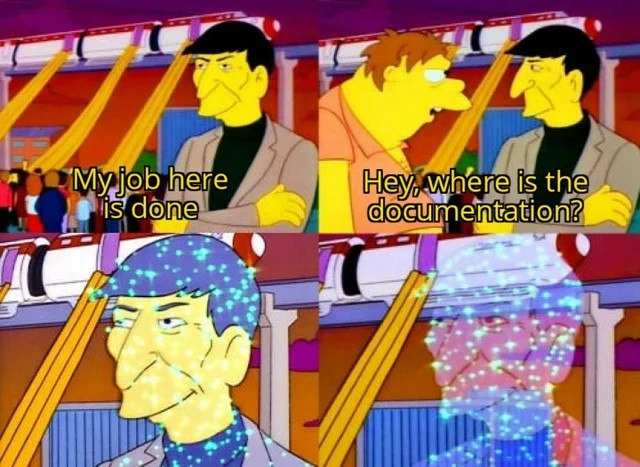
Picture a complex software project represented by a big factory machine in the Simpsons-style scene. The engineer in the first panel stands confidently with folded arms, saying "My job here is done." This tongue-in-cheek caption highlights a mindset some developers have: they think once the code is written and delivered, their work is complete. The coworker in panel 2 immediately asks, "Hey, where is the documentation?" — basically calling out that something important is missing. The humor of this combination comes from a notorious pattern in our industry: the commit-and-run approach. In other words, a developer pushes their code (makes a commit), declares victory, and vanishes before providing any documentation. The result is a glaring documentation gap that the remaining team now has to deal with.

Panels 3 and 4 show the engineer literally disappearing in a cloud of blue, starry particles (a nod to a classic Simpsons gag where a character magically fades away). This visual exaggeration is funny because it captures how it feels when a teammate finishes their part and promptly disappears (sometimes literally leaving the company or project). One moment they’re there saying “it’s done,” and the next they’re unavailable — as if they teleported out of the office. The team left behind is represented by the bewildered coworker who’s basically every developer who has ever asked, “Wait, how does this thing work?” only to find the author gone. We laugh at the absurdity (a human vanishing like a wizard), but it's relatable developer experience because in real life the "vanish" is metaphorical: the person might move to another team, go on vacation, or just mentally move on, and effectively they’re not around to help.

From a senior engineer’s perspective, this meme hits on issues of knowledge transfer and the dreaded single-person bus factor. The bus factor is a concept that measures risk: it's the number of team members that can disappear (say, get hit by a bus or, more pleasantly, take another job) before a project is in serious trouble. Here the bus factor was 1 — all crucial knowledge was in that one engineer’s head. When they disappear, all that knowledge disappears too. No documentation means the code is a black box to everyone else. This is a huge communication gap: the original developer didn’t communicate the design, assumptions, or usage of their code to the team or future maintainers. In well-run projects, writing things like README files, code comments, or design docs is considered part of "done." Without those, even a perfectly written piece of software can become a maintenance nightmare because others have to spend days or weeks reverse-engineering what it does. The meme is funny to seasoned devs because it’s an exaggerated reminder of an anti-pattern we’ve all seen – code delivered with comprehensive documentation none at all, turning what should be a victory into a future headache.

This meme also pokes at software team culture. Often, fast-paced projects or heroic solo efforts glorify getting features out the door quickly. Documentation and communication are sometimes treated as optional or “someone else’s problem.” But skipping docs creates a debt that must be paid later (usually by the poor souls maintaining the code). There's an old joke acronym RTFM, which stands for "Read The Fine Manual," implying that people should check the documentation. The irony in this scenario is that if you said "RTFM" to the team, there is no manual to read! Seasoned developers chuckle (and cringe) at this because they’ve lived through the aftermath of undocumented systems. In fact, writing documentation is a key part of good Developer Experience (DX) — it ensures that future developers (or your future self) can understand and use the software without hunting down the original author. This Simpsons-inspired “vanishing engineer” meme resonates because it humorously encapsulates a real truth: when developers treat documentation as an afterthought, they might as well be disappearing into thin air, leaving everyone else to pick up the pieces.

Description

Four - panel Simpsons-style meme with blurred faces: Panel 1 shows a confident engineer in a turtleneck and blazer, arms folded, standing beside a factory machine. Yellow caption: "My job here is done." Panel 2 has a coworker leaning in and asking, yellow caption: "Hey, where is the documentation?" Panels 3 and 4 show the engineer shimmering into a blue, star-particle silhouette and then completely disappearing while the background remains. The visual joke illustrates developers who finish coding and immediately exit without writing any docs, highlighting the perennial maintenance headache and communication gap that hurts onboarding, knowledge transfer, and overall developer experience

Comments

18
Anonymous ★ Top Pick The moment someone asks for docs, our principal engineer auto-scales to zero - apparently the only serverless component in the system is his continued presence
  1. Anonymous ★ Top Pick

    The moment someone asks for docs, our principal engineer auto-scales to zero - apparently the only serverless component in the system is his continued presence

  2. Anonymous

    After 20 years in tech, I've learned that 'self-documenting code' is just what we tell ourselves at 2am before pushing to prod, right before we mysteriously become unreachable during the knowledge transfer meeting

  3. Anonymous

    The documentation does exist - it's in the same place as the departed dev's tribal knowledge: an inaccessible plane of existence

  4. Anonymous

    This perfectly encapsulates the senior engineer's ultimate power move: shipping production-ready code with zero documentation, then immediately taking that two-week vacation they've been postponing. The real magic trick isn't the disappearing act - it's watching the next developer try to reverse-engineer your 'self-documenting' code that uses variable names like 'data2' and 'processStuff'. Bonus points if you left a TODO comment saying 'will document this later' from three years ago

  5. Anonymous

    Spock's prime directive: Merge PR, beam out - docs are eventual consistency

  6. Anonymous

    Say “Where are the ADRs and runbooks?” and the principal engineer immediately demonstrates our system’s strongest property: eventual consistency - of headcount

  7. Anonymous

    Our Definition of Done never included ADRs or runbooks; ask 'where's the docs?' and you invoke the only serverless function we ever shipped - the author disappearing - leaving onboarding to grep Slack and do archaeology in git blame

  8. @tarasssssssssssssss 4y

    Lol that's me

  9. @VladislavSmolyanoy 4y

    Lol that’s me

  10. @kulikov0 4y

    Lol that's me

  11. @sylfn 4y

    Лол тхат-с ме Lol that's me

  12. @affirvega 4y

    Lol das ist ich (is this correct?) Lol that's me

    1. @sylfn 4y

      ni san shi go...

      1. @sylfn 4y

        // 1, 2, 3, 4, 5 in japanese, romanized

        1. @affirvega 4y

          where is ichi?

          1. @sylfn 4y

            ich

    2. @RiedleroD 4y

      ist -> bin

      1. @sc0rsch 4y

        Schmarn

Use J and K for navigation