Skip to content
DevMeme
2573 of 7435
The Project Management Curve: Ship It by Lowering the Bar
ProjectManagement Post #2849, on Mar 22, 2021 in TG

The Project Management Curve: Ship It by Lowering the Bar

Why is this ProjectManagement meme funny?

Level 1: Moving the Finish Line

Think about a school race where you’re supposed to run 10 laps around the track by lunchtime. You start off running fast and get a bunch of laps done quickly. But then you get tired and slow down a lot. Lunchtime is getting closer and you’ve only finished, say, 7 laps. Originally, the rule was that the race is complete when someone runs all 10 laps. But seeing you struggle, the teacher suddenly says, “Actually, you know what? This race will be just 7 laps instead of 10. Congratulations, you’re done!” The teacher literally moved the finish line closer so that you could finish in time. You didn’t run the full 10 laps that were first asked, but by changing the rule to 7 laps, now it looks like you completed the race. Everyone claps and says “Yay, you did it!” even though you didn’t do what was first planned. It’s a bit silly, right? They lowered the goal so it matches what you managed to do. But it means you get to stop running and still get the trophy for finishing. This meme is joking about the same kind of thing, but in a software project: when they can’t meet the original goals, the bosses just change the goals to match what’s done, and then they proudly deliver the product as if everything went according to plan. It’s funny in the cartoon for the same reason the race story is a little funny – instead of working longer or harder to reach the original finish line, the finish line comes to you so that everyone can pretend the race is won.

Level 2: Lowering the Bar

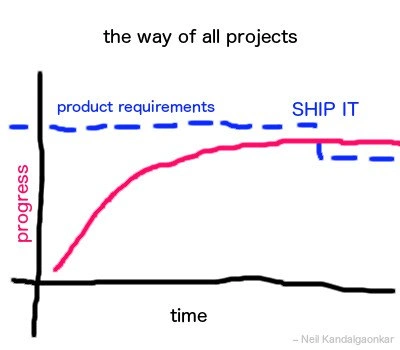
Imagine you’re a junior developer on a project that has a big list of features to build (those are the product requirements – basically everything the app or product is supposed to do when it’s finished). The team makes a lot of progress at first – you knock out the easy features quickly and things look on track. That’s the steep climb of the pink line on the graph: early on, work gets done fast. But as time goes on, progress slows down. Maybe the remaining features are really hard, or you keep finding bugs, or decisions from Stakeholders_Clients change things. Whatever the reason, the work completed starts flattening out – the pink line stops climbing and levels off. This means the team isn’t getting much closer to the full list of requirements anymore, even though the deadline is getting closer.

Now, the blue dashed line on the graph represents the product requirements – essentially the finish line or the goalpost that says “project complete – all planned features built.” Initially, that line is above where our progress ends up; there’s a gap between what’s done and what was supposed to be done. Normally, that’s a big problem: you can’t ship (release) the product if it doesn’t meet the requirements, right? But in this familiar scenario, management finds a sneaky solution: they lower the bar. In plain terms, they reduce the scope of the project at the last minute. This means they decide that some of those features on the original list aren’t actually needed right now. They might say “Okay, those extra reports or that fancy UI element will be phase 2, we’ll do them later.” By cutting out the hardest or least critical remaining tasks, they drop the required feature list down to exactly what the team has finished (that’s the blue line dropping to meet the pink line in the graph). Suddenly, ta-da! The project is “done” because now the requirements vs reality match. The product meets the new shrunken requirements.

When they shout "SHIP IT", it’s the signal to release the software to users or the client, basically saying “We’re done, let’s deliver it!” The phrase “ship it” is common TechHumor slang in development – it means push the product out the door, even if it’s held together with duct tape. Here it’s used jokingly because management is eager to ship something by the deadline. There’s a lot of DeadlinePressure from bosses or clients waiting, so instead of delaying the release, they choose to deliver a smaller product on time. To a junior dev, this might be surprising – wasn’t the goal to build everything we planned? It was, but in real projects, RequirementsVsReality often clash. Priorities shift, and finishing all the features on schedule can be so tough that folks in charge opt for a compromise. This meme shows that compromise in a funny way: rather than admitting the project is late or incomplete, they change what “complete” means. It’s like a teacher secretly shrinking the assignment so that the students who ran out of time still get a passing grade. It’s a bit cheeky, but it stakeholder_pressure happens a lot in projects running up against a deadline. The end result is a product that’s perhaps not as fully featured as originally intended, but hey – it’s delivered “on time.” Everyone breathes a sigh of relief, at least until the clients notice the missing pieces later!

For a newcomer, the lesson here is: in ProjectManagement, the project’s scope (what needs to be done), timeline (due date), and resources (people, budget) are always in tension. When time runs short and you can’t magically increase progress (you can’t instantly code twice as fast), something’s got to give. Often it’s the scope that gets trimmed. We call this cutting scope or descoping. The humor of the meme comes from recognizing this somewhat flawed fix. It’s a common DeveloperReality that sometimes, when you can’t do everything you planned, you redefine the plan to fit what’s done. As a junior dev, don’t be shocked if you see a project’s goals suddenly change late in the game – it usually means the project was too ambitious for the timeframe, and the higher-ups are doing damage control so they can still call it a success. It’s both funny and a little frustrating, but it’s part of learning how software projects often play out in the real world.

Level 3: Redefinition of Done

This hand-drawn chart perfectly satirizes a ProjectManagement nightmare that senior developers know all too well. The pink curve labeled progress shoots up early on, then slowly asymptotes (flattens out) long before reaching the original product requirements (that blue dashed line hovering above). In real life, that dashed line represents the full feature list or quality bar we promised to stakeholders. But as the deadline barrels toward us and progress plateaus, someone in Management_PMs invariably performs a management magic trick: they lower the bar. In the graph, the "product requirements" line literally drops down to meet the stalled progress curve near the end. Cue the triumphant shout of "SHIP IT" – declaring the project done not because we hit the original goals, but because the goals were quietly redefined to match what we accomplished. It’s a hilarious and painfully familiar case of RequirementsVsReality.

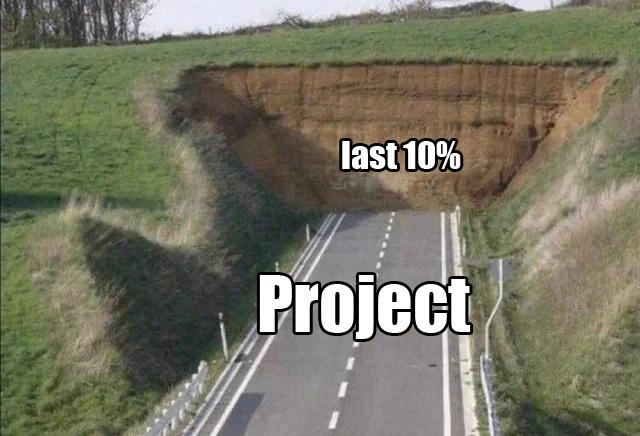
Why is this so funny to experienced devs? Because we've survived this DeadlinePressure and StakeholderPressure scenario countless times. Initially, the team might be crushing tasks – that steep early rise of the pink line – knocking out core features with optimistic speed. But then comes the notorious 90-90 rule: “The first 90% of the code accounts for the first 90% of the development time... the last 10% of the code accounts for the other 90%.” In other words, the closer you get to "complete," the slower progress becomes. Bugs, edge cases, integration woes, and MisalignedExpectations start to drag the pace. The pink progress curve approaches the goal like an asymptotic_progress_curve, getting ever closer but never quite hitting 100%. It’s like Zeno’s paradox of software: each day you close half the remaining gap, yet some gap remains. Meanwhile, the Stakeholders_Clients impatiently watch the clock (or the burn-down chart) as time runs out.

At this point, the project is behind the original scope – those must-have features and promises aren’t fully met. So what do many managers do? They quietly invoke the "scope reduction" strategy, a kind of reverse scope creep. Instead of adding features (scope creep), they remove or downgrade requirements until what’s been built now counts as the finished product. It’s basically moving the goalposts to where the ball already is. If our progress can’t rise to meet the requirements, they drop the requirements down to the progress. From a cynical perspective, it’s like declaring victory by lowering the flag until it touches your outstretched hand, rather than raising your hand to reach the flag. The meme captures this visually with that blue dashed line plummeting to intersect the pink line at the last moment. ProjectDeadlines often force this maneuver – something has to give, and rather than slip the date and anger clients, scope gets snipped. This lets the boss proudly announce “We met the deadline and delivered the project!” even if it’s only, say, 80% of the originally planned features. Everyone in the war room high-fives, while the dev team exchanges knowing smirks because they realize the definition of "done" was just massively rewritten.

if progress < product_requirements:
    product_requirements = progress  # Lower the bar to current progress
print("SHIP IT!")  # Now progress == requirements, time to ship

In code terms, the above pseudo-code is the cheeky algorithm management uses: if you can’t meet the requirements, just change the requirements to whatever you’ve got done and ship it. This little snippet is the ship_it_mindset condensed into a few lines. It might raise a dark laugh from developers, because it’s a hack solution we’ve seen in real projects. Instead of admitting “we’re not going to hit the target on time,” the target is adjusted to hit us. It’s management sleight-of-hand – truly a management_magic_trick to pull a “successful delivery” out of a hat. Of course, the fallout comes later: those dropped features become “Phase 2” or “we’ll patch it in version 1.1,” and technical debt or disappointed users are the price. But at least on paper (and in the sprint demo), the project is “done” by the deadline. Ship happens, as they say.

The humor has an edge of DeveloperReality and cynicism: it’s TechHumor from real experience. Every engineer who’s been through a death-march schedule or a product launch with MisalignedExpectations will chuckle (or groan) at this graph. It encapsulates the unwritten project plan B that everyone suspects: “If we can’t finish it in time, maybe it didn’t all need to be done.” It’s funny because it’s true – and it hurts a little. The RequirementsVsReality gap gets solved not by more progress but by cleverly redefining success. In the end, the meme’s title says it all: "the way of all projects." It’s an exaggeration, sure, but not by much. Seasoned devs have come to expect that initial product requirements are often just a polite suggestion, and the real definition of done is whatever we manage to deliver when the clock hits zero. 😅

Description

A hand-drawn style graph titled 'the way of all projects' that humorously illustrates a common software development lifecycle reality. The chart plots 'progress' (y-axis) against 'time' (x-axis). A dashed blue line representing 'product requirements' remains high and mostly constant. A solid pink line, representing actual progress, starts low, climbs steadily, and then plateaus, getting agonizingly close to the requirements line but never reaching it. The punchline occurs when, instead of progress meeting the requirements, the 'product requirements' line suddenly drops to meet the level of the progress line. At this intersection, the text 'SHIP IT' appears. The chart, credited to Neil Kandalgaonkar, is a cynical but accurate commentary on how projects are often completed: not by finishing all planned work, but by redefining 'done' and cutting scope to meet deadlines. It's a universal experience for senior developers who have seen initial grand visions compromised for a pragmatic release
Comments

9
Anonymous ★ Top Pick This isn't scope creep; it's scope drop. The feature isn't 'missing'; it's just been moved to the 'post-MVP nirvana' epic that we'll totally get to after the heat death of the universe
  1. Anonymous ★ Top Pick

    This isn't scope creep; it's scope drop. The feature isn't 'missing'; it's just been moved to the 'post-MVP nirvana' epic that we'll totally get to after the heat death of the universe

  2. Anonymous

    We’ve officially adopted Asymptote-Driven Development: once velocity plateaus, just slide the spec under the curve and announce GA

  3. Anonymous

    After 20 years in tech, I've learned that the only constant is the asymptotic relationship between actual progress and requirements - they approach each other infinitely but only touch in the parallel universe where estimates are accurate and stakeholders don't change their minds mid-sprint

  4. Anonymous

    Ah yes, the classic sigmoid curve of despair - where requirements drift upward like cloud costs, actual progress asymptotically approaches 'good enough,' and that black flatline represents the documentation we swore we'd write. The 'SHIP IT' marker arrives precisely when management's patience expires, not when the code is ready. We've all lived this graph: the first 90% takes 90% of the time, and the last 10% takes the other 90%. The real engineering challenge isn't building the system - it's explaining to stakeholders why their ever-expanding requirements can't magically compress into a fixed timeline while maintaining our sanity and the laws of physics

  5. Anonymous

    The intersection of logistic progress and a quarter-end acceptance-threshold decay is GA - “Generally Announced,” not “Generally Available.”

  6. Anonymous

    When progress asymptotes, the only stable control loop is changing the setpoint - rename requirements to MVP, hit SHIP IT, and declare convergence

  7. Anonymous

    Hofstadter's Law visualized: projects always take longer than expected, even when accounting for Hofstadter's Law - until that final 'SHIP IT' quantum leap

  8. Deleted Account 5y

    Hahahahahahahah true

  9. @SuperiorProgramming 5y

    Most projects

Use J and K for navigation