Two Buttons: Maintain Fortran From 1969 or Vibe Code From 2025
Why is this LegacySystems meme funny?
Level 1: Pick Your Poison
Imagine you’re a mechanic who has to fix one of two cars, and both options are tough. One car is from 1969 – a really old, classic car. It’s been running for a long time, but it’s so old that finding the right parts for it or even a manual in English is a huge challenge. The other car is from 2025 – a brand new, futuristic electric car with all the latest high-tech features. That sounds cool, but it’s so new that nobody really knows how to fix it yet if it breaks, and there might not even be a repair guide because the model just came out. Now, you have to choose one of these cars and make it work perfectly. You can see why you’d start sweating! The old car might surprise you with hidden problems simply because it’s decades old. The new car might surprise you with problems because it’s experimental and untested. Either way, you’re in for a lot of hard work and uncertainty. That’s exactly what this meme is joking about: a person (the developer) has to choose between an old, mysterious problem and a new, unpredictable problem. It’s funny because whichever one he picks, he knows he’s got a difficult job ahead – and anyone who’s ever faced a lose-lose choice can relate to that feeling.
Level 2: Legacy vs Modern Code
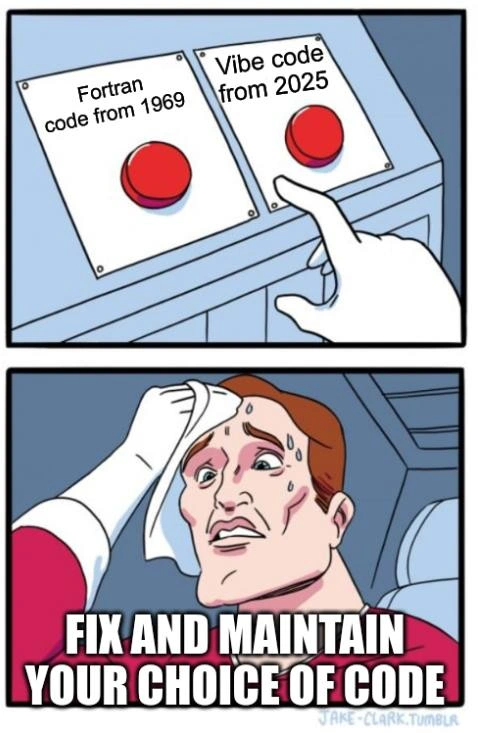
In this meme, we see a classic "two buttons" comic scenario. A drawn superhero character (looking stressed and sweaty) is standing in front of two red buttons, trying to decide which one to press. The left button is labeled "Fortran code from 1969" and the right button is labeled "Vibe code from 2025". In the second panel (the bottom image), the superhero is wiping sweat from his forehead, clearly anxious, and there's a caption that says "FIX AND MAINTAIN YOUR CHOICE OF CODE". This means whichever button he hits, he will have to deal with fixing and maintaining that codebase. The humor comes from the fact that both choices are awful in their own way, so he’s sweating because he can't win either way.
Let's break down what those labels mean. Fortran is one of the oldest high-level programming languages (the name stands for "Formula Translation"). It was first developed in the 1950s and was very widely used in the 1960s for things like scientific calculations and engineering. So if you have "Fortran code from 1969," you're talking about a very old program. To call this legacy code is an understatement – it's code from over half a century ago that's somehow still around and needs to be maintained. Working with such code is tough for a few reasons. The style and syntax are outdated; for example, old Fortran programs often rely on GOTO statements that jump around in the code, which tends to produce spaghetti code (code that's all tangled and hard to follow, like a bowl of spaghetti). Also, not many developers today know Fortran, or if they do, it's in its more modern form. Code from the 60s might have weird quirks (like using all-caps, fixed column formats, or very minimal comments). So if you're a developer assigned to fix a program written in 1969, you have to become a bit of a code archaeologist – deciphering ancient logic, maybe reading old documentation (if it even exists), and being extremely careful not to break anything that’s been quietly working for decades. It's like trying to repair a vintage car: the parts are rare, and only a few people alive even know how that car was built.
Now, "Vibe code from 2025" represents the opposite end of the spectrum – something very new and trendy (to be clear, "Vibe" is a made-up name here, standing in for whatever is the hottest new framework or language in 2025). This is the kind of code that gets written when developers chase the latest bleeding-edge technology. "Bleeding-edge" means it's so new it might not even be stable; it's beyond just leading-edge – you might "bleed" a bit dealing with the problems. So, what challenges come with maintaining a brand-new, hype-driven codebase? For one, the technology might still be changing. Imagine trying to fix code on a platform that updates every week – you might fix one thing, then a new version of the framework comes out and breaks something else. Documentation for new tech is often incomplete or rapidly outdated, because the authors are still figuring things out themselves. There may be very few experts or online resources to help you, because not many people have used this new tech in depth yet. In short, maintaining ultra-new code can feel like being a pioneer – you're exploring bugs and issues no one has documented. If we use a simple analogy, it's like being the first person to use a new gadget: when it works, great, but if it breaks, you're on your own because even the manual might not cover it yet.
A key concept that connects both these choices is technical debt. This is a term developers use to describe the cumulative consequences of quick-and-dirty solutions in code. Think of it like financial debt: you "borrow" time by not doing something properly now, but you incur a "debt" that must be paid back later when the issues inevitably surface. In a legacy system (like code from 1969), technical debt could be all the old quick fixes and outdated code that were added over years instead of doing a thorough overhaul. The system kind of works, but it’s brittle and full of old problems that never got fully solved – now someone has to deal with those. In a brand-new system ("Vibe 2025"), technical debt might come from the rush to use new tech and build features quickly without fully understanding the best practices (because those might not even exist yet!). The code could be poorly structured or lacking tests because the team was moving fast, planning to "clean it up later". Well, now it's later, and the next developer (the one in the meme) has to pay that debt by sorting out the mess or finishing what was left undone.
The caption "FIX AND MAINTAIN YOUR CHOICE OF CODE" highlights the aspect of maintenance. In software, writing code is one thing, but maintaining code is often the bigger, long-term job. Maintenance means you have to keep the software running correctly, adapt it to new requirements, and fix any bugs that come up over time. A maintenance nightmare is when this job becomes extremely difficult – maybe because the code is intricate, poorly documented, or just very complex due to age or design. Both options in the meme are classic recipes for a maintenance nightmare. If you pick the Fortran 1969 button, you're looking at understanding and modifying something from the computing Stone Age – definitely daunting. If you pick the Vibe 2025 button, you're signing up to handle a cutting-edge project where anything and everything might go wrong because it's so new – also daunting, but in a different way. These kinds of tasks are notorious developer pain points – meaning, they are well-known things that cause developers frustration and stress. Many devs joke about "inheriting someone else's code" as being scary; here, it's either inheriting code from long before you were born, or inheriting code so new that no one fully knows how it works yet!
So why is this funny? For someone outside coding, it might just look like a weird cartoon about a guy who can't choose a button. But for developers, there's a lot of truth behind it. It's poking fun at the fact that in real life you sometimes have to deal with very old tech or very new tech, and neither is simple. A junior developer might not have experienced this yet, but imagine your boss telling you either: "Hey, we have this program from the 1960s that needs a small fix" or "Hey, we just decided to use this brand new framework that just came out, can you make our app work with it?" — either scenario is the kind that makes even a pro feel a bit nervous. The meme uses exaggeration (1969 vs 2025 is a huge time gap!) to make it obvious. The sweating superhero is basically any developer thinking, "Oh man, no matter what I choose, I'm in for a rough time." It’s humorous because it’s a shared experience in tech: no one wants either extreme, but often you find yourself stuck with them anyway. In summary, the meme says: Choosing between maintaining ancient code or ultra-new code? Either way, good luck! And every programmer who’s been around a while chuckles (or groans) in agreement.
Level 3: Between GOTO and YOLO
This meme sets up a classic legacy systems dilemma that can make even battle-hardened engineers break into a cold sweat. The two red buttons represent an impossible choice between extremes: on one side, a codebase older than the moon landing (literally written in Fortran in 1969), and on the other, a codebase so cutting-edge it’s presumably from 2025 and built on whatever the latest hype is (labeled as Vibe code). The poor superhero with the sweating brow is basically every developer feeling cornered by technical debt of either the ancient or the bleeding-edge variety. It's a “pick your poison” scenario for code maintenance, because either path is likely to lead straight into a maintenance nightmare.
For experienced devs, the humor cuts deep: the left button (Fortran 1969) essentially says, “Here, maintain this half-century-old program that's been patched since the Nixon administration.” That code likely has spaghetti code logic with GOTO statements leaping around. Making sense of it is like reading hieroglyphs – the original authors are probably long retired (or no longer with us), and any design documents are lost in some archive (if they ever existed). You touch one line and risk unraveling quirks that have kept the system running since the '70s. It's the ultimate legacy technical debt – debt so old it's practically drawing a pension.
In fact, here's a taste of that old-school code style:
IF (ERROR .NE. 0) GOTO 999 ! If an error, jump to label 999
... (imagine dozens of lines here) ...
999 CONTINUE ! Label 999: execution resumes here
Notice the manual line label (999) and the GOTO – it's basically a choose-your-own-adventure jump in the code.
Now the right button (the 2025 Vibe code) looks shiny, but it's a trap in its own way. It's shorthand for “maintain this ultra-new, trend-driven system”. Maybe it's built with a flashy framework or language that just came out. Sure, it won't have 50 years of crust, but being bleeding-edge means it's unstable and unpredictable. The documentation is probably a half-finished wiki or a couple of blog posts. Dependencies might all be version 0.x — in other words, experimental. Keeping this running is like trying to ride a wild, unbroken horse. You're dealing with constantly changing libraries, and you're the poor soul who has to figure out why the thing that worked last week suddenly broke after an update. In short, you're facing brand-new technical debt: today’s shiny code can become tomorrow’s headache in record time.
For contrast, here's what a snippet of modern "Vibe"-style code might look like:
import vibe from 'vibe-framework'; // Hypothetical new library import
const result = await vibe.calculate(params?.value ?? 0);
// Modern JS: using async/await and optional chaining (?.) with a fallback (??).
// Looks slick, but if 'vibe' is experimental, debugging this could be an adventure.
This code is using cutting-edge JavaScript features and a made-up vibe library – it appears cleaner than the Fortran example, but if something goes wrong inside that vibe.calculate() call, good luck, because you’re probably the first person to ever debug it.
To sum up why both choices are scary, here's a quick comparison:
| Option A: Fortran (1969) | Option B: Vibe Code (2025) |
|---|---|
Language & Era: Fortran (late 60s era). Old-school syntax, heavy use of GOTO and fixed-format code. |
Language & Era: "Vibe" (futuristic 2025 framework). Modern syntax (think async/await, fancy ?. operators), extremely cutting-edge. |
| Stability: Rock-solid only because it's been untouched for years. Runs on some legacy mainframe that nobody dares reboot. | Stability: Shaky – everything is new. Runs on a bleeding-edge cloud setup with weekly updates. Expect surprise breakages after upgrades. |
| Documentation: Maybe a 1970s printed manual or a comment in the code (if you're lucky). Likely outdated or lost entirely. | Documentation: A sparse README and a lot of "TBD" sections. The framework is evolving, so docs can’t keep up with changes. |
| Expertise Available: Only a few veteran engineers know this stuff... and they're either retired or expensive consultants. | Expertise Available: Almost no one fully knows it yet. You’re essentially becoming the world expert as you figure it out (trial by fire!). |
| Technical Debt: Decades of band-aid fixes and outdated hacks layered over each other. The code is a Jenga tower of quick fixes. | Technical Debt: Newly born debt – rushed, unrefined code written to ship fast. Many TODOs and "temporary" solutions that will haunt future maintainers. |
| Risk of Change: Extremely high. One small tweak can have butterfly effects in a fragile old system. You break it, you bought it. | Risk of Change: High as well. Updating one library can cascade into breaking half the app. It's a house-of-cards that might collapse with a minor push. |
| Feeling for Maintainer: Like defusing a bomb from the past without the manual. Stressful and delicate work. | Feeling for Maintainer: Like beta-testing a prototype in real-time. Nerve-wracking – you're always unsure what might fail next. |
For a veteran developer, this scenario is the ultimate maintainability trade-off. Each choice demands skills that most people don't have on hand. Go with the legacy code, and you're basically a software archaeologist digging through relics (ancient logic, maybe even comments in Latin!). Go with the cutting-edge code, and you're a pioneer in the wild west, charting unknown territory where the map is still being drawn. In one case you're unearthing spaghetti-coded fossils, in the other you're wrestling with fresh-off-the-press complexity. No wonder our caped button-presser is sweating bullets.
Consider the real world: large banks, airlines, and government agencies still run programs written in the '60s and '70s (Fortran, COBOL, you name it). It's not a myth – there are systems older than most developers that handle critical tasks (like processing payments or scheduling flights). When a senior engineer gets tasked with modifying such a system, it's daunting: there are zero unit tests, the code's style is prehistoric, and every fix feels like defusing a decades-old bomb. These are classic developer pain points of maintaining legacy code. On the flip side, tech companies often chase the newest tools. Maybe a startup rewrote an app using whatever was hot last year (say a cutting-edge JavaScript framework or a new language like Rust) to be “innovative.” A year later, the original hot-shot developers have moved on, and now you're the poor soul maintaining what is essentially a prototype that somehow went to production. There's no Stack Overflow help for your oddly-named errors, and you're discovering bugs because you're literally on the frontier of that tech. Different era, same headache.
And as any experienced dev will tell you, neither of these beasts is tamed easily. Rewriting the Fortran code in a modern language sounds nice, until you realize nobody fully knows all the tiny assumptions baked into that old program. You could spend a year rewriting it and still not match its behavior exactly (cue some manager yelling, “Why are the quarterly totals off by 0.01%?!” because of a subtle logic detail lost in translation). On the other hand, trying to stabilize the new hype code can feel like nailing jelly to a wall. You add tests and update packages, but every month there's a new version or a change in the framework that breaks something. The team that built it was moving fast (maybe too fast) and probably didn't stick around to polish or document it. In both cases, you end up slogging through tons of extra work just to make the code behave. This is why people say technical debt eventually comes due — and guess who’s stuck paying it off? You, with a lot of late-night debugging sessions.
So the meme's two-button predicament perfectly captures the programmer's Catch-22. The sweating superhero wiping his forehead is a stand-in for any developer faced with this no-win choice. The caption "FIX AND MAINTAIN YOUR CHOICE OF CODE" basically means whichever button you press, you're volunteering for a tough time. Seasoned engineers smirk (and maybe groan) because it's true – they've lived it. Whether it's reviving a fossilized codebase or wrangling an unruly new one, the experience is equally nerve-wracking and thankless. It's funny in a dark way because every dev knows sometimes there are no easy options; you just cross your fingers and hope whichever code you picked doesn’t blow up in your face (or at least not at 3 AM on your watch!).
Description
The classic 'Daily Struggle' two-button meme (by Jake Clark) showing a sweating man faced with two equally terrible options: 'Fortran code from 1969' and 'Vibe code from 2025.' The bottom panel shows him sweating profusely with the caption 'FIX AND MAINTAIN YOUR CHOICE OF CODE.' The joke is that both options are nightmarish to maintain - ancient Fortran that predates modern practices and AI-generated 'vibe code' that nobody understands. It implies that AI-generated code may end up being the new legacy nightmare, just as impenetrable as 56-year-old Fortran
Comments
12Comment deleted
The year is 2081. A junior dev stares at two codebases: one written in Fortran before the moon landing, and one vibe-coded by ChatGPT before coffee. Both have zero documentation and the original authors are unreachable - one is dead, the other was never alive
The Fortran code is a logic puzzle with no documentation, but the 'vibe code' is a philosophical debate with a new, breaking framework release every week. Pick your poison: archaeology or anthropology
Either way you’ll be grepping through fifty years of commit history - one in punch cards, the other in auto-generated YAML
The real horror isn't choosing between FORTRAN from '69 and whatever 'vibe code' is in 2025 - it's realizing that your 'modern' microservices architecture will be someone's FORTRAN in 2070, complete with a Kubernetes cluster nobody remembers how to upgrade
The real senior engineer move? Realizing both buttons lead to the same outcome: you'll be the only person left who understands either codebase, making you simultaneously invaluable and trapped. At least the Fortran code has survived 56 years of production - your 2025 'vibe' framework will be deprecated before the sprint retrospective
Fortran from '69: Still parsing after 50 years. Vibe code 2025: Unmaintainable after 50 lines
Pick your poison: column-aligned Fortran with COMMON blocks and decades of uptime, or 2025 vibe-driven microservices where the spec is a prompt, npm audit writes a novel, and CI passes on a coin flip
Pick your poison: column‑sensitive FORTRAN with GOTOs or a vibe‑coded microservice whose dependencies are younger than your sprint - either way, the pager knows your name
Fortran 💯 Comment deleted
I would rather honor my grandfather's work, thanks Comment deleted
In 1969 it was FORTRAN not Fortran, therefore Grandpa was a time traveler and his code is vibe coded nonetheless. Comment deleted
For some cruel twist of destiny, my company makes me maintain both Comment deleted