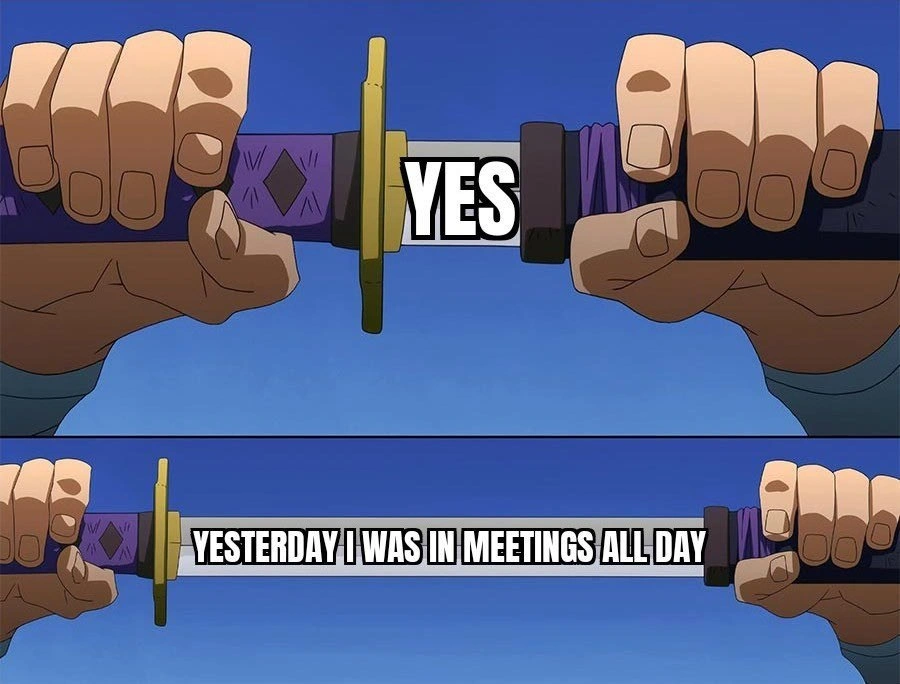
When the code review asks if you shipped anything yesterday
Why is this Meetings meme funny?
Level 1: Too Busy to Work
Imagine your teacher asks if you finished your homework, and you reply, “Yes… yesterday I was on a school field trip all day.” The first word “Yes” makes it sound like you did your homework, but then the rest of the sentence shows you really didn’t do it – you were busy with something else all day. It’s funny because you technically answered the question, but in a sneaky way: you did do something yesterday, just not the thing your teacher expected. The joke is that you were so busy the whole day that you had no time to do the actual homework, and saying “Yes” only to reveal the truth afterward makes everyone laugh.
Level 2: Zero-LOC Day
In simpler terms, this meme jokes about a day where a programmer didn’t write any code because they were stuck in meetings the whole time. The scenario is: during a code review or a team check-in, someone asks the developer, “Did you ship anything yesterday?” In software development, shipping something means delivering work – usually writing code and pushing it out for use. A code review is when teammates examine the code you wrote before it’s merged (to catch bugs or improve the quality). So essentially, the developer is being asked if they completed any coding work yesterday.
The developer’s response in the meme is funny because of how it’s delivered. First, they simply say “Yes.” This makes it sound like they did get something done. But then comes the twist: “Yesterday I was in meetings all day.” In other words, the only thing they “shipped” yesterday was their own presence in a bunch of meetings. They’re implying, “Yes, I was doing stuff – just not coding.” It’s a tongue-in-cheek way to say that they ended up writing 0 lines of code yesterday (often called a zero-LOC day).
What kind of meetings take up a full day for a developer? It could be several things:
- A short daily stand-up in the morning (where each team member quickly shares what they did yesterday and what they’ll do today).
- A longer sprint planning meeting to map out tasks for the next sprint (a sprint is a 1–2 week work cycle in Agile teams).
- Perhaps a design review or architecture discussion about how to build a new feature.
- A stakeholder meeting or client call to discuss requirements or progress on a project.
- And maybe an hour-long all-hands (a meeting where the whole company or department gets together for announcements and updates).
Each of those meetings alone might not seem like a lot, but if you have them back-to-back throughout the day, they can easily fill up all your working hours. For example, imagine you have a 15-minute stand-up at 9:00 AM, a two-hour planning meeting at 10:00, a design discussion right after lunch at 1:00 PM, a customer check-in at 3:00, and then an all-hands at 4:30. Even though there are small breaks between them, those breaks aren’t long enough to dive into coding anything substantial. You’re constantly either preparing for the next meeting or coming out of the last one. By the time you settle down to focus on writing code, another calendar alert pops up and pulls you away.
Writing code usually requires a focused block of time. Developers often talk about needing to get “in the zone” or achieving a state of flow. If you’re trying to solve a tricky programming problem, you have to load all the details of that problem into your head. Frequent interruptions – like a meeting every hour – make it really hard to maintain that mental context. It’s like trying to read a book, but someone interrupts you every few pages to talk about something else; you keep losing your place. So if a programmer’s day is chopped up by constant meetings, it’s very likely they won’t get a chance to write any meaningful code that day.
This contrast is sometimes explained as the difference between a manager’s schedule and a maker’s schedule. A manager’s day is usually full of many small meetings, since their job is to coordinate, communicate, and make decisions in quick bursts. In contrast, a maker (like a programmer) works best with longer uninterrupted periods to create something. In this meme, the developer had to follow a manager-style day (lots of meetings), which left no uninterrupted maker-time for coding. That’s why by the end of the day they had nothing deployed or committed – just a lot of discussion.
So when the code reviewer or team lead asks, “What did you deliver yesterday?”, the answer “I was in meetings all day” is basically the developer saying, “I worked yesterday, but all my work was meetings, so I have no code to show for it.” It’s both an explanation and a bit of humor. This situation is actually pretty common at companies, especially for senior engineers or team leads. If you’re a new developer, it might surprise you that some days you don’t code at all. But as projects get bigger and teams get more specialized, a lot of work is about communication – planning what to build, discussing how to build it, making sure everyone agrees. On those days, you might fall into bed thinking, “I was busy all day, but what did I actually do?”
The meme makes light of that exact feeling. It’s funny (in a slightly sad way) because the developer technically answered the question with “Yes” – they were doing something all day – but from a coding standpoint they accomplished nothing. It highlights that awkward moment when you realize an entire workday passed and you didn’t write a single line of code. Every programmer experiences that from time to time, and while it can be frustrating, at least we can joke about it when it happens.
Level 3: Double-Edged Schedule
This meme unsheathes a painful truth about developer life: sometimes all your time is spent talking about work instead of doing the work. In the first panel, the engineer’s reply “YES” glints like a sliver of steel as they start to draw their katana. It’s a confident one-word answer to “Did you ship anything yesterday?”. But in the second panel, the sword is fully drawn, revealing the extended caption: “YESTERDAY I WAS IN MEETINGS ALL DAY.” The dramatic anime-style reveal is the punchline. It symbolizes how the whole truth comes out: Yes, I was busy – but I wrote zero code.
Seasoned developers recognize this scenario instantly. The humor cuts deep because it’s painfully common in tech. A code reviewer or manager expects tangible output – new commits, features deployed, some actual code shipping. Instead, the developer’s entire day was devoured by meeting after meeting. It’s the quintessential maker_schedule_vs_manager_schedule clash. Developers (the “makers”) need long uninterrupted stretches to write code, but managers slice the day into hour-by-hour meeting blocks. If you spend your day on a manager’s timetable, you get no real coding done. The result? A zero lines-of-code (LOC) day – the dreaded zero_loc_day every engineer fears.
During a meeting-heavy sprint, this situation becomes almost inevitable. Think of all the Agile “ceremonies” in a modern software team: the daily stand-up, sprint planning on Monday, backlog grooming on Wednesday, a sprint review and retrospective at the end of the two weeks, not to mention ad-hoc design discussions, stakeholder check-ins, and the obligatory all-hands meeting. It’s like being nibbled to death by duck-sized meetings. Each individual meeting might only be 30 minutes or an hour, but they’re usually scattered throughout the day. This fragmentation kills any chance to enter a flow state for coding. By the time you’ve re-opened your IDE and regathered your thoughts, a calendar notification pops up – next meeting in 5 minutes. It’s death by a thousand syncs. By 5 PM, your Git diff looks the same as it did in the morning – no new code, just a lot of meeting notes and maybe a doodle or two in the margins of your notepad.
The technical term for this thrashing is context switching. In operating systems, frequent context switches between processes incur overhead – the CPU wastes time saving and loading state instead of executing instructions. In a developer’s world, switching between coding and meetings exacts a similar toll. Your brain has to drop the code’s state, hop into a Zoom call, then try to reload all that context afterwards. It’s inefficient and exhausting. By day’s end, you’ve got serious MeetingFatigue and nothing to show in the codebase. If you’ve ever tried to build a complex feature in 15-minute scraps between back-to-back meetings, you know it’s like trying to sharpen a sword in 10-second bursts – you lose the heat each time. As a result, some days the only thing you “ship” is a series of nods on video calls and a pile of JIRA tickets marked “discussed.”
What makes the meme especially sharp is the irony behind that question in the title: “Did you ship anything yesterday?” Often the very people asking for status or pushing for productivity are the ones packing the schedule with meetings. It highlights a classic communication gap in many companies’ corporate culture. Management wants high DeveloperProductivity – lots of new features and visible progress – yet management also demands constant status updates, alignment sessions, and “quick chats” that ensure productivity grinds to a halt. It’s a well-known paradox:
"We need this done ASAP, but first let’s have 7 meetings about it."
Engineers share memes like this as a form of collective commiseration. It’s a classic bit of DeveloperHumor about office life (specifically MeetingHumor) fueled by shared DeveloperFrustration: exaggerating the scenario just enough to laugh at it, even as everyone reading it feels that sting of truth. The image of brandishing a blade labeled with the boring reality (meetings, meetings, meetings) is funny because it’s so over-the-top, yet so accurate. A battle-hardened coder might chuckle and cringe, remembering weeks where Scrum rituals and “quick syncs” left them working late into the night to get actual coding done. It’s darkly comedic – a coping mechanism for burnout. As the joke goes, some days, the only thing you commit is your calendar.
Over the years, developers and tech companies have tried to slay this multi-headed meeting monster. There’s the popular concept of “No Meeting Wednesdays” or blocking out “Focus Time” on the calendar – attempts to guarantee at least a day or an afternoon with zero meetings so coders can actually code. Some teams explicitly set aside maker time (do-not-disturb periods for deep work). Despite these efforts, the gravitational pull of meeting culture is strong. Stakeholders want updates, team leads want coordination, HR sneaks in a training session, and before you know it, your whole week is chopped up again. The fact that this meme is so relatable even in 2022 shows that a decade after that famous essay on maker vs manager schedules, we’re still fighting for that precious focus time.
In the end, the meme uses the dramatic flair of anime to deliver a cathartic truth. The sword represents the developer’s cutting response: a slick “Yes” that initially satisfies the question, followed by a devastating truth-slash revealing why nothing of substance got delivered. It’s a clever visual metaphor for the double-edged nature of the modern workday. On one side, meetings keep everyone aligned (in theory); on the other side, they slice up the day and bleed away any coding productivity. The final effect leaves you grinning and grimacing at the same time. After all, unsheathing a katana to admit you wrote no code is hilariously dramatic – but every developer who’s endured a meeting_heavy_sprint knows that exact feeling of wanting to scream, “Yes! I worked all day – just not on code!”
Description
Two-panel anime meme of a katana being unsheathed. Panel 1 shows both hands gripping a still-sheathed sword; only a sliver of steel is visible and the blade is over-laid with the single word “YES” in bold white capitals. Panel 2 shows the sword fully drawn; the entire blade now displays the longer caption “YESTERDAY I WAS IN MEETINGS ALL DAY.” The scene uses crisp cel-shaded colors, bright blue sky background, purple-wrapped hilt, and exaggerated hand proportions typical of modern shōnen animation. Technically, the joke mirrors the maker-vs-manager schedule clash: engineers asked for output brandish a terse affirmative, but once the whole story is ‘drawn,’ it’s clear continuous meetings left zero time for actual commits - an experience painfully familiar to senior devs juggling sprint ceremonies, stakeholder syncs, and quarterly OKR reviews
Comments
6Comment deleted
My git diff was empty, but Jira gained 42 comment threads - turns out throughput moved from CI pipeline to calendar pipeline
The best part about being a senior engineer is having the authority to decline meetings, but also the responsibility to attend all of them
When your standup answer evolves from 'blocked' to a detailed retrospective of every Zoom call that prevented you from actually writing code - because apparently 'in meetings' is the enterprise equivalent of 'compiling' as the universal productivity black hole explanation
Yesterday’s DORA looked great - mean time to meeting near zero, deploy frequency zero; turns out the calendar is our monolith
Asked for a binary yes/no, my maker-schedule type widened it to a string: 'Yes - terday I was in meetings all day.'
Yesterday: 8 hours of 'let's align' yielding zero PRs. Today: Unsheathed, merging at lightspeed