Skip to content
DevMeme
4482 of 7435
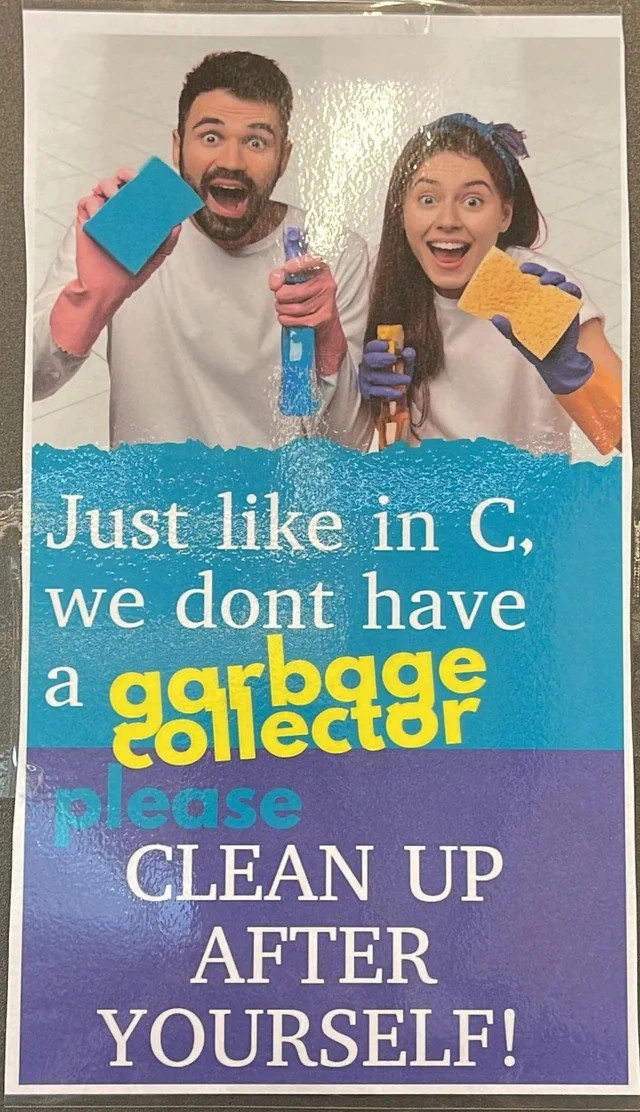
C Memory Management Analogy Reminds Devs to Clean the Office Kitchen
Languages Post #4919, on Oct 9, 2022 in TG

C Memory Management Analogy Reminds Devs to Clean the Office Kitchen

Why is this Languages meme funny?

Level 1: Clean It Yourself

Imagine you’re playing with a bunch of toys in your living room. You pull them all out to have fun. Now the room is messy with toys everywhere. In some houses, maybe a parent or a helper might come and automatically put away the toys after you’re done — that would be like a magic cleaning fairy, right? But in this case, there’s no magic fairy and no one else to clean up. Your parents say, “We don’t have a house-cleaning robot, so please clean up after yourself!” That means you need to pick up your toys and put them back on the shelf when you’re finished, otherwise the living room stays a mess.

This meme is joking about the same idea, but with computer stuff. In a certain computer language called C, when programmers make a mess in the computer’s memory (by using some space to do something), there’s no automatic helper to tidy it up. The programmer has to remember to clean it themselves. The funny poster says that just like that programming language with no helper, our office doesn’t have a helper to clean the kitchen. So if you make a mess (like a dirty dish or spilled coffee), you should clean it up yourself. It’s basically saying “be responsible for your own mess,” with a silly twist that mixes computer talk with everyday office rules. The reason it’s funny is that it uses a serious work rule (clean up your stuff) and compares it to a nerdy computer idea (no automatic garbage cleaner in C) — it’s an unexpected combo that makes tech folks smile and also reminds everyone of a simple courtesy: tidy up what you use!

Level 2: No Magical Janitor

Let’s break down the jargon and imagery so that even a less experienced programmer (or a non-programmer in a dev office) can appreciate why this sign is amusing. The meme is comparing manual memory management in the C programming language to the act of cleaning up your mess in a shared kitchen. In simpler terms, it’s saying: “In the C language, there’s no automatic cleanup of unused memory, just like in our office kitchen there’s no cleaning staff to wash dishes. So, in both cases, please clean up after yourself.”

First, what’s a garbage collector in programming? In many modern languages (like Java, Python, or JavaScript), you don’t have to explicitly tell the computer when you’re done using some piece of memory. You just stop using it, and behind the scenes, a special feature called a garbage collector notices that “this memory isn’t needed anymore” and frees it (makes it available for reuse). Think of it like an automatic garbage disposal: you toss an apple core in the sink and some machine magically grinds it up and clears it away for you. You don’t see it happen, but you trust that it’s taken care of. These languages have a runtime (the engine that runs the code) that periodically checks for “garbage” data (unused objects) and cleans them out. This makes life easier for programmers because they’re less likely to accidentally forget to clean something up. It’s a bit like having a janitor who comes in every night to empty the trash cans – you’re less likely to end up with a heap of trash because someone is maintaining things regularly.

Now, C is a different beast. C is a low-level programming language—LowLevelProgramming means it gives you a lot of control over the machine. You manage memory manually. When you need some memory to, say, store an array or a structure, you call a function named malloc (short for “allocate memory”). This is like grabbing a disposable cup from the cupboard. When you’re done with that memory, you’re supposed to call free to give it back. That’s like throwing away the cup when you’ve finished your drink. If you don’t call free, what happens? The memory remains allocated to your program even though you’re not using it anymore. That’s called a memory leak – over time, if your program keeps leaking memory, it’s as if you keep taking new cups but never discarding any; eventually, you run out of cups (memory) and can’t get more because all the ones you took are still “in use” (even though they’re just sitting idle). In an office analogy, imagine if everyone keeps taking new coffee mugs every day because nobody washes their mug – soon the cabinet is empty and the sink is overflowing with dirty mugs. Not good!

The poster text “Just like in C, we don’t have a garbage collector” is basically saying: we don’t have an automatic cleaning service. In a coding context, it means the programmer has to clean (free) memory. In the office context, it means each employee has to clean their own mess. The second line “please CLEAN UP AFTER YOURSELF!” drives that message home. It’s something you’d see in any shared space rules: whether it’s a dorm kitchen or an office break room, it translates to “don’t leave a mess for others to deal with.”

Let’s connect the dots with a quick comparison of scenarios:

Environment Automatic Garbage Collection? Who Cleans Up?
C Program Memory No – manual malloc/free calls Developer (you must call free())
Java/Python Memory Yes – runtime has a GC Language runtime (garbage collector does it)
Office Kitchen No – no auto-janitor for dishes You (the person who made the mess)

In the table above: if you’re coding in C, there’s no built-in helper to clean memory, so you as the programmer are responsible for every piece of memory you allocate. If you’re coding in Java or Python, there is a built-in helper (the GC) that usually handles it for you, so you typically don’t worry about calling free explicitly. And in the office kitchen, since there’s usually no dedicated cleaning crew for personal messes, each person is expected to tidy up their own stuff (wash their dishes, throw out trash).

Some key terms explained for clarity:

  • ManualMemoryManagement: This just means the programmer has to manage memory manually. In practice, that’s using functions like malloc (to get memory) and free (to release memory) in C. It’s manual because the system won’t do it for you automatically.
  • Garbage Collector: A system that automatically finds and frees memory you’re no longer using. It “collects garbage” data so you don’t have to. Not present in C, but present in many other languages.
  • MemoryLeak: When a program forgets to free memory it no longer needs. Over time, these leaks can accumulate and use up a lot of memory, which can slow down or crash programs. It’s like a leak in a water tank – drip, drip, and one day the tank is empty because all the water (memory) leaked out and can’t be reused.
  • Dangling Pointer (mentioned in the senior-level discussion): That’s when a pointer (like a reference or address in code) is left pointing to memory that has already been freed. It’s like having an address to a house that’s been demolished – if you try to go there, who knows what you’ll find (likely an error or crash in the program).

The RelatableDeveloperExperience here, especially for junior devs, often comes the first time you write a C program that crashes or behaves oddly because of a memory issue. Maybe you see something like “Segmentation Fault” (a common error when you misuse memory in C) or notice your program’s memory usage growing endlessly in Task Manager. Then a more experienced programmer or a tool like Valgrind (a memory debugging tool) points out, “Hey, you never freed X allocation,” and you have an aha! moment — I have to clean up manually! It’s a bit of a shock if you’ve only used languages that handle it for you. This meme is a lighthearted way to convey that lesson: manual_resource_cleanup is a must in C, just as washing your coffee mug is a must when there’s no dishwasher or cleaning staff.

Even if you’re not a programmer, you can appreciate the practical message: don’t be the person who leaves a mess. But if you are a programmer, especially one familiar with C, there’s an extra chuckle because the sign marries two worlds (coding and office life) with one clever phrase. It’s both an inside joke (”clean up your pointers”) and a normal office rule (”clean up your lunch container”) written in one go.

In summary, the analogy works on multiple levels:

  • Technical level: C has no garbage collector, so clean your memory mess.
  • Everyday level: Our office has no maid, so clean your kitchen mess. Combining them makes a mundane reminder entertaining for a techie audience. If you know, you know — and now you know! 😉

Level 3: Memory Leaks & Dirty Dishes

At this level, we’re basking in the DeveloperHumor that arises from painfully earned wisdom. The meme sets up a perfect analogy: manual memory management in code is likened to keeping a shared kitchen clean without a janitorial service. If you’ve ever chased a memory leak through a huge C codebase or walked into a break room full of unwashed coffee mugs, the parallel hits home immediately. It’s the same vibe: resource leak irony. Something that should have been cleaned up earlier was neglected, and now it’s everyone’s problem. The text “Just like in C, we don’t have a garbage collector” explicitly ties a nerdy programming concept to a mundane office reality. It’s a bit of gallows humor for systems programmers—folks who have seen what happens when you don’t clean up after yourself, whether in RAM or in real life.

Why is this combination so funny and relatable to developers? Because it’s calling out a shared frustration using a clever metaphor. In programming, especially in C, one of the classic mistakes is assuming someone (or something) else will deal with the mess. Newcomers fresh from GC-powered languages might blissfully allocate memory and never free it, thinking the garbage collector will swoop in like a fairy godmother. Seasoned C devs know that fairy doesn’t exist here—just like how office veterans know that the office_cleanliness_poster pleading “PLEASE clean up after yourself!” is born from bitter experience with messy colleagues. The sign’s tone is half-joking, half-exasperated: a smiley stock-photo couple in cleaning gloves, cheerfully reminding you of something that shouldn’t need reminding. It’s exactly the kind of passive-aggressive but humor-laced communication you find in workplaces full of engineers. We love analogies, and this one lands perfectly.

Consider the pointer_ownership_metaphor happening. In C, when you create (allocate) something, you implicitly own it and are responsible for its disposal. There’s an unwritten social contract in a dev team that if you allocate memory, you free it; just like in a shared kitchen, if you dirty a dish, you wash it. The meme highlights this contract’s absence of an enforcer: “we don’t have a garbage collector.” In other words, no automated cleanup crew is coming to save you. The humor has an edge of “You’d better know what you’re doing, or suffer the consequences.” Every senior engineer can recall (probably with a facepalm or a groan) an incident where a missing free() caused an outage or slow memory creep. It’s practically a rite of passage in low-level programming: the first time your app crashes after hours of running, and you discover it gobbled up all the system memory because you forgot to free a buffer in a loop. That sinking realization — “Oh no… I leaked memory on every iteration” — feels a lot like coming back to the office kitchen at 9 PM only to find the sink overflowing with someone’s day-old dishes. In both cases, you mutter please, clean up after yourself under your breath, perhaps with a few extra spicy adjectives for emphasis.

The meme is also riffing on how languages differ in philosophy. For instance, a Java or C# developer might not give a second thought to object cleanup; they’ve got a garbage collector acting like a diligent janitor picking up behind them (most of the time). But a C developer has to cultivate a mindset of constant vigilance – a bit like living in a house with no Roomba or housekeeping service. If you don’t sweep, dust, and take out the trash, nobody will, and soon you’ll be wading through debris. It’s a common pattern that junior devs coming from higher-level environments run into trouble when they first handle C or C++ code: they allocate memory and forget to free it, or free it incorrectly, causing weird bugs. The RelatableDeveloperExperience part is that every senior dev has been the junior at one point, cleaning up their own mess or, worse, cleaning up someone else’s. Just as often in an office, one sainted employee eventually gives in and cleans the microwave that everyone else left splattered with spaghetti sauce, in C programming a senior team member might end up writing a cleanup routine or patching a memory leak that wasn’t their doing because it’s got to be done. It’s equal parts camaraderie and frustration – we’ve all been there, and we secretly hope public shaming via a bright poster might prevent the issue in the future.

Another layer of humor: the poster format itself. This meme is styled like one of those kitchenette_rules flyers taped above the office sink. Typically they have cheery graphics (like our two enthusiastic cleaners here) with stern text like “Your mother doesn’t work here – wash your dishes!” In our case, the text starts sounding technical (“Just like in C, we don’t have a garbage collector...”) then pivots to the familiar kitchen plea (“please CLEAN UP AFTER YOURSELF!”). This subverts expectation in a delightful way. A non-programmer might scratch their head at “garbage collector” in that sentence, but devs immediately chuckle because we get the double meaning: garbage collector is both a programming concept and literally someone who takes out the garbage. The meme’s designer cleverly color-highlighted “garbage collector” in a contrasting font/color, emphasizing the pun. It’s almost winking at us: Get it? Garbage collector? Yes, we do, and it’s glorious.

From the MemoryManagement angle, the “clean up after yourself” admonition is basically doctrine. There’s a sardonic saying among C developers: “If you don’t manage memory, it will manage you,” meaning that careless allocations will come back to bite. Similarly, leaving a filthy kitchen means eventually you’ll face a science experiment in the sink or a stern all-hands email from HR. This meme encapsulates that shared knowledge with a dash of laugh-so-you-don’t-cry. That sense of “Ugh, I know, right?” is the hallmark of great developer humor. It takes something painful (like debugging a memory leak or scrubbing a disgusting fridge) and turns it into a communal joke. We find it funny precisely because it’s true. How many times have we uttered “Who the heck left this here?!” whether it’s an un-freed pointer or an unwashed plate? Too many times, my friend, too many times.

And it wouldn’t be a true senior-engineer perspective without acknowledging the irony that even with all our modern tools, these problems persist. We have sophisticated profilers and sanitizers for memory leaks, just like some offices have cameras or sign-out whiteboards in the kitchen (“manual_resource_cleanup tracking, if you will). Yet, memory still leaks and dishes still get left behind. Why? Because humans are fallible and sometimes lazy, and systems (whether codebases or office spaces) often lack enforced accountability. The meme quietly hints: neither the C runtime nor your office has a built-in nanny, so the responsibility falls to you. We laugh, but it’s a knowing laugh because we’ve either been the culprit or the cleanup crew in both scenarios. As any battle-scarred engineer will tell you, manual_memory_management in C builds character the same way doing your own chores does. This poster is basically saying “Be an adult – in code and in the kitchen.” And honestly, that’s a message even non-devs can get behind.

Level 4: The Janitorless Heap

In C (and other CFamilyLanguages like C++), dynamic memory lives on a heap that has no automatic janitor. When a program uses malloc() to grab a chunk of memory, the operating system hands over some RAM and trusts the programmer to eventually hand it back with free(). There’s no background process swooping in to clean up unused memory—no garbage collector in sight. This design grants extreme control (and speed) at the cost of manual memory management responsibilities. It’s as if the language says, “Here’s a storage room for your data; you keep the keys, you tidy it up.”

Without a garbage_collector_reference (like the ones in Java, Python, or C#), every malloc is a potential mess waiting to happen if not paired with a free. Forgetting to clean up—aka a memory leak—means that allocated bytes just sit in the heap indefinitely, like coffee mugs piling up in the sink. Over time, leaked memory can fragment the heap and exhaust available RAM, much like a cluttered kitchen counter eventually runs out of space. The operating system will reclaim all memory when the process terminates (similar to a landlord cleaning up after a tenant moves out), but during the program’s run, leaked allocations are untouchable ghosts consuming resources. This is why long-running processes (like servers) written in C that leak memory will slowly bloat, possibly crashing after days or weeks—just as an unattended kitchen develops a serious odor over time.

From a LowLevelProgramming perspective, manual cleanup is deeply rooted in C’s philosophy and history. C was designed in the 1970s to implement Unix; efficiency and simplicity of runtime were paramount. Back then, adding a garbage collector was impractical for systems programming: it demanded extra CPU cycles and unpredictable pauses—not ideal for an OS kernel or performance-critical utilities. Instead, C exposes raw pointers and leaves memory housekeeping to the developer. This works wonders for speed and flexibility, but if you misuse it… well, undefined behavior is your punishment (the kind of bizarre, nightmarish program misbehavior that has senior devs waking up in a cold sweat). A classic horror scenario is the dangling pointer—when you free memory but still keep a pointer referencing that freed space. Dereferencing that pointer (using it after free) is like trying to sip coffee from a mug you already tossed in the trash: best case, you get nothing; worst case, you get poison 🤢. In C, using a dangling pointer can lead to crashes or corrupted data because the memory might now be reused for something else, or not belong to your process at all. Here’s a snippet illustrating this peril:

char *p = malloc(128);         // allocate 128 bytes (like grabbing a new coffee mug)
strcpy(p, "Hello, world");     // use the memory (pour some coffee)
free(p);                       // free the memory (wash and put away the mug)
// Now p is a dangling pointer since the memory is freed.
printf("%c\n", *p);            // ERROR: using a freed memory (drinking from imaginary mug)

Above, after calling free(p), the pointer p is left pointing to an off-limits area. If you try to use it (*p), the program’s behavior is undefined—it might print gibberish, crash immediately, or seemingly work fine until it randomly explodes later. Seasoned C devs have all been burned by this at some point, learning the hard way that forgetting to nullify a pointer after free or reusing freed memory is a one-way ticket to Segfault City. Such RelatableDeveloperExperience is part of the initiation rites for low-level programmers: you don’t truly appreciate a garbage collector until you’ve spent an entire night debugging why your service crashes only under heavy load, only to find a stray free or missing free was the culprit.

Interestingly, other languages took a different path to avoid these pitfalls. Early on, Lisp (back in the 1960s) introduced automatic garbage collection so that programmers could focus on logic rather than manual bookkeeping. Modern high-level languages (Java, Python, C#, JavaScript) all have built-in GCs — effectively automatic garbage men who periodically roam the heap, collecting objects that are no longer in use. These garbage collectors use algorithms like Mark-and-Sweep or Generational collection: essentially, they identify which objects can’t be reached by any pointer/reference in the program and then reclaim those, freeing the memory without explicit calls to free. It’s like having a cleaning crew come in and tidy the kitchen every night so that no matter how many dishes you left in the sink, it’ll be empty by morning (though maybe with a mysterious note about clean up your mess next time if it’s a really disciplined crew). The trade-off, of course, is that garbage-collected languages relinquish some control. The cleaning crew decides when to clean (possibly halting your program briefly during a GC pause), and you have to trust they’ll eventually clean everything (most GC algorithms handle typical cases well, but you can still get leaks if you accidentally keep references to objects you no longer need, akin to hoarding junk in a closet where the cleaners never look).

The meme’s core joke leans on this manual_resource_cleanup reality of C. It’s poking fun at C’s lack of a safety net by drawing a parallel to a workplace with no janitor. In both cases, responsibility is pushed onto the individual. This has a deeper resonance for systems programmers: it echoes the golden rule of low-level coding — “You allocated it, so you’re in charge of freeing it.” Modern language design has tried to mitigate the risk of human error here. For example, C++ developers use RAII (Resource Acquisition Is Initialization) and smart pointers (std::unique_ptr, std::shared_ptr) to ensure resources get freed automatically when an object goes out of scope (kind of like using a self-cleaning coffee mug that evaporates leftover coffee when you’re done). And newer languages like Rust have an ownership system checked at compile-time to prevent both leaks and dangling pointers without a runtime garbage collector — basically issuing you one mug per coffee and forbidding you from dropping it until you explicitly hand it off, thereby guaranteeing no stray mugs and no need for nightly cleaners. Despite these innovations, good old C remains a realm where discipline and careful cleanup are the price of power. The meme wittily reminds us (in bold, colorful text no less) that neither our code nor our office kitchenette will clean itself up; neglect either, and you’ll eventually be dealing with a big stinking problem.

Description

A glossy poster shows two people in white shirts and rubber gloves brandishing cleaning supplies - sponges, spray bottles, and scrub brushes - against a tiled background. Centered beneath the photo, white and yellow text on a blue-purple gradient reads: “Just like in C, we dont have a garbage collector please CLEAN UP AFTER YOURSELF!” The design riffs on the fact that the C language relies on manual `malloc`/`free` calls rather than an automatic garbage collector, humorously mapping memory-leak prevention to tidying shared office space. The visual pun is immediately recognizable to experienced systems programmers who have spent decades chasing dangling pointers - and abandoned coffee mugs - through production environments

Comments

9
Anonymous ★ Top Pick If only the janitor thread actually called free(), our kitchen and heap would both stay leak-free
  1. Anonymous ★ Top Pick

    If only the janitor thread actually called free(), our kitchen and heap would both stay leak-free

  2. Anonymous

    After 20 years in the industry, I've learned that the only thing more reliable than a junior developer forgetting to call free() is a senior architect insisting their 'temporary' malloc() from 2019 is still technically part of the MVP scope

  3. Anonymous

    The eternal truth of C programming: you get blazing performance and complete control, but the compiler won't hold your hand - or clean up your memory leaks. While your colleagues in Java-land sip coffee while the GC does the dishes, you're manually tracking every malloc like a forensic accountant, knowing that one forgotten free() will haunt production at 3 AM. It's the programming equivalent of being trusted with the good china: powerful, elegant, and absolutely unforgiving if you leave a mess

  4. Anonymous

    This kitchen implements C semantics: malloc is O(1), free is manual; skip it long enough and Facilities runs a stop-the-world collector with pause times measured in fiscal quarters

  5. Anonymous

    In C, skip free() and watch your process balloon to OOM; skip the sponge, and the Slack pile-on achieves escape velocity

  6. Anonymous

    This kitchen uses C semantics - malloc(lunch), forget free(plate), and suddenly Facilities is triaging a long‑lived leak while the fruit flies implement a non‑deterministic GC

  7. @SamsonovAnton 3y

    Is this from "McDonalds for Mac users"?

    1. @slnt_opp 3y

      Wait, isn't Mac for Irish?

      1. @RiedleroD 3y

        Scottish, and the macintosh was named after the variant of apple. idk about McDonald's though.

Use J and K for navigation